Tree · Rosaceae
Cherry
Prunus avium
Offer it full sun, deep soil, and good airflow, and a cherry tree will thank you with fruit for decades to come.
Full sun
Every 7–14 days
USDA 4–8
20–36 ft · 6–11 m
Overview
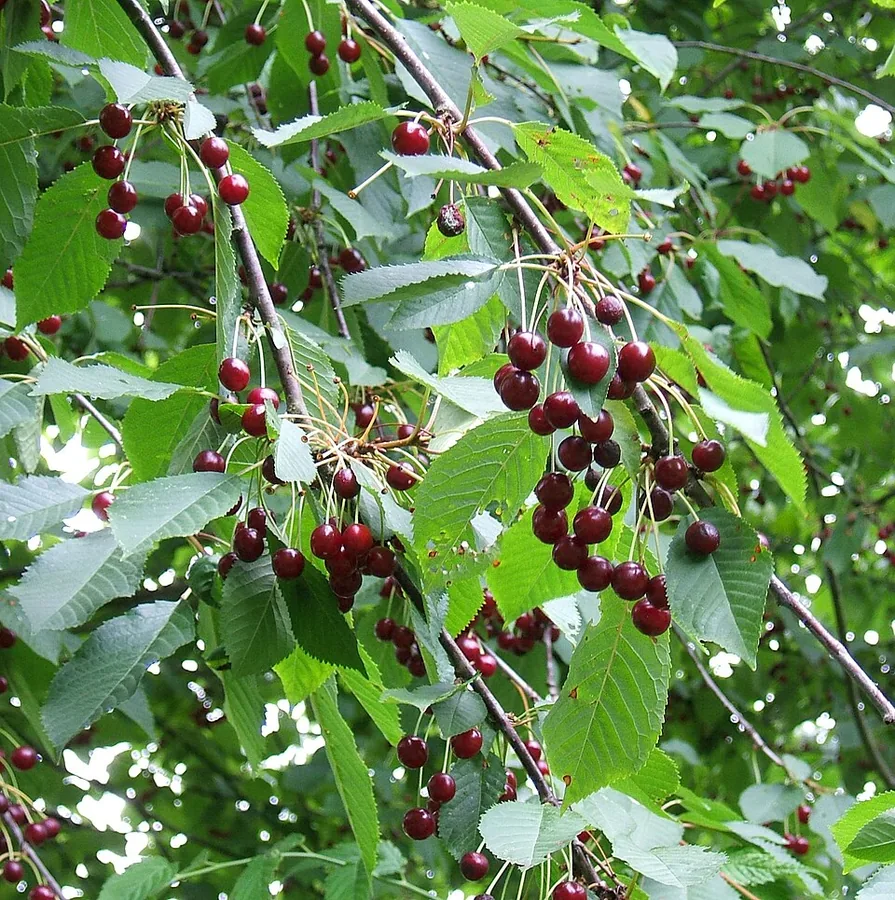
A cherry tree gives back twice in a single year, first with drifts of white bloom in early spring and then with bowls of fruit by midsummer, so you have plenty to look forward to. It sits in the rose family and arrives in two friendly kinds: the sweet cherry, Prunus avium, that you pluck and eat straight from the branch, and the sour cherry, Prunus cerasus, that bakes into a lovely pie. Both simply want sun, a bit of room, and soil that drains.
Keep in mind these are full-size trees rather than patio plants, and that is easy to plan around. A standard sweet cherry may climb to 20 to 36 feet (6 to 11 m), yet grafting onto a dwarfing rootstock keeps one small enough to net and pick with ease. Sour cherries hold a tidier shape and brush off the cold more readily, which is why they thrive a little further north.
Pollination is the one detail that worries new growers, and it is nothing to fear once you know it. Plenty of sweet cherries lean on a second, compatible tree to set fruit, while self-fertile types crop all on their own. Settle this before planting, because a solitary Bing with no partner will bloom beautifully yet give you next to nothing, and that is a disappointment well worth avoiding.
Care
The short version: give the tree full sun, deep and well-drained soil, and even water across the season, and you are most of the way there. Prune while it is dormant for an open, airy shape, pair a pollinizer with any sweet cherry that needs one, and slip netting over the branches before the birds discover the fruit.
Light
Cherries fruit best in full sun, with 6 or more hours a day being the sweet spot. A touch of shade will not stop them growing, but you give up fruit and welcome the damp that disease enjoys, so aim for the brightest spot you have.
Water
Give the tree deep, even drinks, above all while a young one is finding its feet and again as the fruit swells. Roughly 1 inch (2.5 cm) a week is the target, and you can taper off once it goes dormant. Uneven moisture and one heavy soaking close to harvest are what split the skins, so steady is the word.
Soil
Settle the tree into deep, fertile, well-drained loam. Cherries dislike wet feet, so skip low corners and heavy clay that holds water. A pH between 6.0 and 7.0 keeps the roots content and growing well.
Temperature
These are tough, forgiving trees, at home across a wide span from about -22°F to 86°F (-30°C to 30°C). Sour cherries take the cold even better, and the one real worry for a crop is a late frost catching the open bloom.
Humidity
Ordinary outdoor humidity in the 40% to 60% range suits them well, so there is no figure to fret over. Airflow matters far more, because still, damp air around the canopy is where brown rot and canker get their start.
Feeding
Feed in early spring before new growth wakes up, using a balanced fertilizer chosen with help from a soil test. Go gentle with the nitrogen, since a rush of soft growth invites disease and hands you leaves where you wanted fruit.
Pruning
Prune while the tree is dormant in late winter to shape an open frame that lets in light and air. Where bacterial canker is common, do your pruning in dry summer weather instead, and in either case always take out dead, diseased, or crossing wood.
Size & spacing
A cherry is a true tree, reaching 20 to 36 feet (6 to 11 m) tall and spreading 15 to 30 feet (4.5 to 9 m) wide, though dwarfing rootstocks keep it in bounds. Give a standard tree generous open space so air flows through the canopy and disease finds little foothold.
When to plant
Cherries move with the seasons, which makes them easy to plan for. Set a bare-root or potted tree in the ground in early spring while it is still dormant, enjoy the bloom as the days warm, and gather sweet cherries in early to midsummer with the sour kinds arriving just behind.
Northern hemisphere
Southern hemisphere
Typical months for a temperate climate: start earlier in warm zones, later where spring frosts linger.
- Plant: early spring while trees are still dormant
- Harvest: blooms in early spring; sweet cherries harvest in early to midsummer (June to July) and sour cherries shortly after, in the northern hemisphere
Hardiness
USDA hardiness zones: 4–8
Temperature: down to -34°C
Troubleshooting
Most cherry troubles settle on the fruit, whether from disease, insects, or birds, while canker goes for the wood. The encouraging part is that learning to spot the early signs lets you step in long before a crop is lost. Find the description that matches what you see below, then act while your effort still counts, and know that most setbacks here are recoverable.
Blossoms dying back and fruit going soft with fuzzy tan patches
What you are seeing is brown rot, and it is a common one, so take heart. The fungus scorches the flowers in spring, then settles into the ripening fruit and pushes up raised tan tufts of spores, moving quickest when the weather turns warm and wet. You can stay ahead of it by gathering and removing every shriveled, mummified fruit and opening the canopy with pruning so it dries fast once the rain passes.
Sunken weeping sores on branches with sticky sap
Bacterial canker presses into the branches and trunk, oozing gum and killing the wood beyond it, and it shows up most in cool, damp springs. No spray will undo it, so do not waste worry on finding one. Instead, cut back well past the canker into fresh, healthy wood, and save your pruning for dry summer days when the bacteria are quiet. A tree handled this way usually pushes on just fine.
Tiny maggots burrowing through cherries as they ripen
Finding a maggot is unsettling, but the cause is straightforward: the cherry fruit fly slips eggs into the swelling fruit, and the larvae feed quietly out of sight. The good news is that timing gives you the upper hand. Hang sticky traps as the cherries begin to color, and you will know exactly when to act before picking. Any fruit already tunneled is sadly past saving, so focus your energy on protecting the rest.
Ripe cherries disappearing to hungry birds
Birds adore a ripe cherry and can empty a tree before you reach for the basket, which catches almost every grower off guard at first. The simple fix is to drape netting over the canopy before the fruit colors, since that is the moment they arrive. Scare devices buy you a little time, though a determined flock soon learns to shrug them off, so netting is your steadiest friend here.
Cherries splitting open just before they are ready
Fruit cracking is nothing you did wrong; it simply happens when a ripe cherry takes up water faster than its skin can stretch, often after heavy rain or one generous, late watering. Those splits can let rot creep in, but you can head it off easily. Keep the soil moisture even all season, ease back as harvest nears, and pick promptly when a storm is on the way. A few cracked cherries are no reason to lose faith in the crop.
Toxicity
The ripe fruit is a treat to eat, yet the rest of the tree truly is dangerous, and it pays to respect that. Leaves, stems, bark, and the pits all hold cyanogenic glycosides that release cyanide, and wilted leaves from a snapped or pruned branch are the most dangerous part of all. Keep prunings and fallen leaves away from pets and grazing animals, and never let anyone swallow the pits.
Toxic to
Cats · Dogs · Horses · Rabbits · Livestock · Birds
Safe for
People
Cats Toxic
Because the leaves, stems, and pits hold cyanide-releasing compounds, a cat that chews on them faces a genuine hazard. Keep an eye out for drooling and a queasy stomach, and in a bad case dilated pupils, panting, and breathing that grows labored before shock takes hold.
Dogs Toxic
A dog that chews fallen branches or cracks open pits can swallow enough cyanide to make it sick. It often starts as simple stomach upset, but a bigger dose leads to heavy panting, bright red gums, and weakness. A pit that goes down whole can also become stuck and block the gut.
Horses Toxic
Among these animals horses are one of the most sensitive, and the greatest danger is wilted leaves from a limb that has broken or been trimmed. The poisoning moves quickly, bringing bright red gums, gasping breath, staggering, collapse, and at times sudden death with no warning.
Rabbits Toxic
Never offer a rabbit cherry foliage or bark. The cyanogenic glycosides can poison such a small grazer in short order, so keep all prunings and clippings well beyond their reach.
Livestock Toxic
Cattle, sheep, and goats face high risk, and the familiar cause of loss is wilted leaves after a storm or a round of pruning. A grazing animal can move from red gums and labored breathing to collapse in minutes, so fence stock well away from cherry trees and never throw trimmings into a pasture.
Birds Toxic
Birds swallow ripe cherries and drop the whole pit unharmed, yet the leaves, twigs, and crushed pits give off cyanide, so keep those parts away from caged and backyard birds alike.
People Ripe fruit safe
The ripe flesh is a well-loved, safe fruit to enjoy. Just avoid chewing or swallowing the pits, and keep children clear of the leaves and twigs, since those parts carry the cyanide-releasing compounds.
Keep pets and livestock away from prunings, fallen leaves, and pits; wilting leaves from broken or trimmed branches are especially dangerous to grazing animals. Do not let children swallow pits.
Helpline numbers

United States
ASPCA Animal Poison Control: (888) 426-4435 (fee applies)
Poison Control: (800) 222-1222



Canada
Poison Centres: 1-844-764-7669
Varieties
Cherries divide neatly into sweet kinds for fresh eating and sour kinds for the kitchen. Below are the ones you are most likely to come across, and whether each can fruit on its own is the detail to keep in mind as you choose.
Bing
A timeless, large dark-red sweet cherry that cannot fruit on its own, so it asks for a compatible pollinizer planted close by.
Rainier
A golden sweet cherry brushed with red that, like Bing, leans on a cross-pollination partner to bear a crop.
Stella
A self-fertile sweet cherry that fruits all by itself, making it the easy, reassuring choice when your yard has space for just one tree.
Montmorency
The favorite sour cherry, both self-fertile and cold-hardy, and the one most home bakers turn to for a pie.
Morello
A dark-fleshed, self-fertile sour cherry that copes with shade and cold more easily than its sweet cousins.
How to propagate
A cherry is not a tree you grow from a saved seed and expect the same fruit, so do not feel let down by that. To get a known variety you begin with a grafted tree, and the rootstock beneath it quietly decides how large that tree will become.
GraftingModerate
Nearly every named cherry is grafted or budded onto a chosen rootstock, since that is the dependable way to keep a cultivar true to its parent. The rootstock also decides how tall the tree grows, ranging from a full Mazzard standard down to a dwarfing clonal root that holds the branches within easy reach for picking. Once you understand this, choosing a tree feels far less daunting.
SeedModerate
Growing a cherry from a stratified pit is certainly possible, yet the seedling will not match its parent, so this path suits raising rootstock or breeding stock rather than a known variety. What you get is a wild or rootstock tree, not another Bing or Montmorency, which is good to know before you set your hopes on it.
Myths
The whole cherry tree is fine to eat.
In truth, only the ripe flesh is safe. The leaves, stems, blossoms, and pits carry cyanogenic compounds that release cyanide, which means those parts are toxic to people and animals alike. Savor the fruit and tuck the pit aside.
A cherry tree will never fruit unless you plant two.
It is true that many sweet cherries want a partner for cross-pollination, but self-fertile types fruit perfectly well alone. Sweet cultivars such as Stella, along with most sour cherries like Montmorency, will crop happily as a single tree.
Sour cherries are simply sweet cherries that got picked early.
Not so. They are a separate species, Prunus cerasus, rather than an underripe version of anything. Sour cherries are tart by nature, smaller, hardier, and self-fertile, and they ripen fully into that bright tang on purpose.