Tree · Rosaceae
Kwanzan Cherry
Prunus serrulata
Give it a spot in your yard for one unforgettable week of double pink bloom each spring, and it will reward the little care you offer.
Full sun
Every 5–10 days
USDA 5–9
25–36 ft · 7.6–11 m
Overview
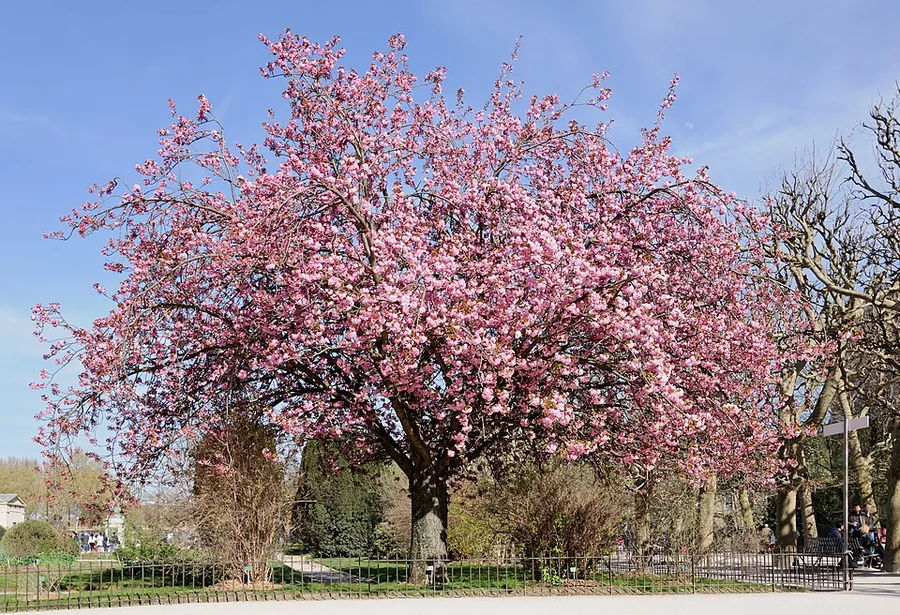
Kwanzan is the most generous bloomer among the Japanese flowering cherries, the tree that paints a whole street pink for a week in mid-spring. Every flower is a double pompom of 20 to 30 deep-pink petals, and they crowd the branches in thick clusters that open just before or as the leaves appear. A member of the rose family, it was bred for nothing but that glorious flush of flower, and you don't need a green thumb to enjoy it.
When this tree is happy, it is a joy. It grows at a comfortable, moderate pace into a vase-shaped form 25 to 36 feet (8 to 11 m) tall, then signs off the year with warm orange-bronze foliage. Because it is sterile and essentially fruitless, you get no messy fruit drop to sweep and no worry about a harvest, only the bloom and the leaves.
There is one gentle truth to accept up front: Kwanzan does not live a long life. Most trees begin to fade within 15 to 25 years, worn down by borers, cankers, and softer wood that storms can snap. Plant it as a bright, short chapter to treasure now, rather than a tree meant to shade your grandchildren, and it will feel like a gift well worth having.
Care
The short version: give it full sun, moist but well-drained loam, and reliable water while it's young. Prune lightly and only just after bloom, keep the trunk free of scrapes and wounds, and let go of the idea that it will be a long-lived shade tree.
Light
Give Kwanzan full sun and you'll get the fullest bloom and the richest fall color in return. It will accept a little partial shade, but flowering thins out, and damp, shaded leaves invite the very diseases this tree already leans toward.
Water
Keep the soil moist but well-drained, offering a drink every 5 to 10 days while the tree is young and its roots are still reaching out. An established Kwanzan copes with moderate drought, yet it will always be happier with steady moisture than a dry stretch.
Soil
Plant it in fertile, well-drained loam, and sandy, clay, or silt all work fine. A pH of 6.0 to 7.0 suits it nicely, but drainage is the thing that truly matters, since this tree fails on wet or coastal ground.
Temperature
Kwanzan is tough across a wide range, from around -20°F (-29°C) up to 95°F (35°C), which covers zones 5 through 9. It wants a genuine winter chill to bloom its best, and it takes summer heat in stride as long as the roots stay moist.
Humidity
Everyday outdoor humidity is all it needs, so there's no figure for you to fuss over. Air movement matters far more here, because still, damp air around the crown is what lets leaf spot and brown rot get a foothold.
Feeding
Feed it lightly in early spring before bloom with a balanced slow-release tree fertilizer. Keep the nitrogen modest, since soft, lush growth only draws borers and disease to a tree that is already vulnerable enough.
Pruning
Prune as little as you can manage, and only to remove dead, damaged, or crossing branches. Do the work just after flowering, make clean cuts without stubs, and skip pruning in wet weather, because Prunus wounds open the door to cankers and borers.
Repotting
This is a landscape tree rather than a container plant, so repotting simply doesn't apply once it's in the ground. If you're minding a nursery tree, watch for circling roots and water running straight through the pot, and get it planted before it sits rootbound.
Size & spacing
Expect a mature tree 25 to 36 feet (about 8 to 11 m) tall with a spread of 25 to 30 feet (about 8 to 9 m). Give it that full width of open ground so the vase-shaped crown can fill out and air can move freely through the canopy.
When to plant
You plant Kwanzan while it is dormant rather than starting it from seed, which keeps things simple. Set a balled-and-burlapped or container tree into the ground in early spring or fall, and it will thank you with its double pink bloom in mid-spring, before or just as the leaves unfurl.
Northern hemisphere
Southern hemisphere
Typical months for a temperate climate: start earlier in warm zones, later where spring frosts linger.
- Plant: Plant balled-and-burlapped or container trees in early spring or fall while dormant.
- Harvest: Showy double deep-pink pompom-like flowers (about 20-30 petals each) in mid-spring, typically before or as leaves emerge; essentially fruitless.
Hardiness
USDA hardiness zones: 5–9
Temperature: down to -29°C
Troubleshooting
With Kwanzan, most trouble shows in the bark and branches before it ever reaches the leaves, and that is part of why these trees are short-lived. The good news is that learning to read the early hints of borers, disease, and black knot lets you slow the decline. Find your symptom below, then step in while the tree still has plenty of vigor to draw on.
Branches going limp while sap seeps and sawdust gathers at the trunk
If you spot sawdust-like frass and gummy sap near the trunk, take heart, because catching it early is half the battle. This is the work of borers boring under the bark, and they often move in alongside cankers that settle into wounded or stressed wood. Cut away and burn the dead or badly infested limbs, and know that a well-watered, well-mulched tree with an unblemished trunk is your steadiest protection.
Fix:
- Remove and destroy heavily infested or dead wood
- Keep the tree vigorous with proper water and mulch to resist attack
- Avoid wounding the trunk with mowers or trimmers
Leaves eaten down to lace or silk tents in the branch forks
Two spring visitors leave their mark here, and neither one should worry you much. Shiny green Japanese beetles nibble the leaves down to a lacy skeleton, while eastern tent caterpillars weave silky nests into the branch forks. Tip the beetles into a pail of soapy water and snip out the caterpillar tents at dawn or dusk while the larvae are tucked inside, and remember that a healthy tree easily forgives a little chewing.
Fix:
- Hand-pick beetles or knock them into soapy water
- Prune out and destroy tent caterpillar nests in early morning or evening
- Tolerate minor feeding on established trees
Leaf spots that dry up and leave tiny holes across the foliage
When small round spots dry up and drop out, they leave that tell-tale shot-hole pattern, a sign of a fungal or bacterial leaf spot that likes damp, crowded air. Don't fret, just rake up and destroy the fallen leaves so nothing carries over, and thin the canopy gently to let it breathe. Keeping water off the foliage makes a real difference, since wet leaves are how the spores travel.
Fix:
- Rake and destroy fallen infected leaves
- Improve air circulation through proper spacing and pruning
- Avoid overhead watering that wets foliage
Rough dark lumps forming on twigs and small branches
Those rough, coal-black lumps swelling around the twigs are black knot, a fungus that slowly girdles branches and spoils the tree's shape. You can stay ahead of it: while the tree sleeps in winter, cut each knot out a few inches below the swelling and burn what you take off. Give your pruners a quick wipe between cuts too, or they'll carry the spores from branch to branch for you.
Fix:
- Prune out knots several inches below the gall during dormancy
- Destroy pruned material
- Disinfect pruning tools between cuts
Toxicity
This tree really is dangerous to animals, and it is worth being clear-eyed about that. The leaves, twigs, bark, and any rare seeds hold cyanogenic glycosides that release cyanide when chewed or wilted, and a wind-thrown branch left in a paddock can kill grazing horses or livestock within minutes. Since the tree sets little or no fruit, there is nothing here for people to eat either. Keep pets and stock well away from prunings and fallen limbs, and clear them promptly so no one is tempted.
Toxic to
Cats · Dogs · Horses · Rabbits · Livestock · Birds · People
Cats Toxic
A cat that nibbles the leaves, twigs, or bark can take in cyanide, so it helps to know the warning signs. Brick-red gums, wide pupils, panting, and labored breathing all call for an emergency vet trip right away.
Dogs Toxic
A dog gnawing on fallen twigs or wilted leaves faces that same cyanide danger. Because drooling, dilated pupils, quick breathing, and weakness can appear fast, don't wait, get to a vet.
Horses Toxic
Horses are especially vulnerable, and it is the wilted leaves that do the harm. Cyanide can trigger anxiety, staggering, gasping, convulsions, and collapse in minutes, sometimes before anyone even notices a branch came down in the paddock.
Rabbits Toxic
Those same cyanogenic compounds make the foliage unsafe for rabbits too. The kind thing is simply to keep them clear of any trimmings or fallen leaves rather than take the chance.
Livestock Toxic
Cattle, sheep, and goats are in real danger from wilted cherry leaves, which can release cyanide and kill within 15 to 20 minutes of grazing. Fence your stock well away from the tree, and clear any storm-broken branches before the animals find them.
Birds Toxic
Cyanide in the seeds, leaves, and bark is a threat to birds as well, so it is best to keep cage birds and poultry from pecking at any part of the tree.
People Caution
This tree makes little or no fruit, so there truly is nothing here for you to eat. The leaves, twigs, bark, and any rare seeds hold cyanide, so keep children from chewing on them and never steep the foliage into a tea.
Keep pets and especially horses and livestock away from fallen, pruned, or wilted branches and leaves, which are the most dangerous. Dispose of prunings promptly.
Helpline numbers

United States
ASPCA Animal Poison Control: (888) 426-4435 (fee applies)
Poison Control: (800) 222-1222



Canada
Poison Centres: 1-844-764-7669
Varieties
Kwanzan is only one of many flowering cherries, and the rest swap its dense double bloom for other shapes, scents, and longer lives. These are the ones you'll want to recognize by name.
'Yoshino' (Prunus × yedoensis)
This gently fragrant cherry, with single pale-pink-to-white blooms, is the one behind so much of the Washington DC display, and it grows more spreading and a bit longer-lived than Kwanzan.
'Shirofugen'
Its double flowers begin pink-tinged, soften to white, then blush pink once more, and it opens later in the season than most flowering cherries.
'Amanogawa'
Slim and columnar with semi-double fragrant pale-pink flowers, this one tucks neatly into tight spots where a wide, spreading cherry could never fit.
Weeping Higan cherry (Prunus subhirtella 'Pendula')
Its graceful weeping branches carry early single pink flowers, and happily it lives quite a bit longer than Kwanzan.
'Mount Fuji' / 'Shirotae'
This broad, flat-topped tree carries fragrant white semi-double flowers along low, sweeping limbs.
How to propagate
Kwanzan is not a tree you raise from seed, and that's perfectly fine. Because the cultivar is sterile, every plant is a clone made by skilled grafting, which puts it comfortably beyond casual backyard propagation.
GraftingDemanding
Late winter to early spring (bench grafting) or summer (budding) · 1-2 years to a saleable grafted tree
Since Kwanzan is sterile and double-flowered, it simply won't come true from seed, so growers graft or bud scion wood onto compatible cherry rootstock to hold the cultivar true. Bench grafting is done in late winter to early spring and budding in summer, and a tree ready to sell takes 1 to 2 years to grow on. It is skilled, patient work, and well beyond casual home propagation, so no shame in leaving it to the pros.
Stem cuttingsDemanding
Early summer from softwood · Several months to root, then 1-2 years to establish
You are welcome to try softwood cuttings in early summer under mist with a rooting hormone, though they root unevenly and plenty just don't take. Even a cutting that succeeds needs several months to root and another 1 to 2 years to settle in. Grafting stays the dependable route, so don't be discouraged if cuttings prove stubborn.
Myths
A Kwanzan cherry will eventually give you fruit to pick.
Kwanzan is a double-flowered ornamental raised for its show, not for the kitchen. It is essentially sterile and hardly ever sets fruit, so you plant it for the spring bloom and never for a harvest, and that is exactly as it should be.
The pits are the only part of a cherry tree that can hurt an animal.
The leaves, twigs, and bark carry the very same cyanogenic glycosides the seeds do. Wilted leaves are the classic trigger for sudden livestock and horse poisoning, which is why a branch snapped off in a storm deserves far more of your attention than any pit.