Ornamental · Asteraceae
Sunflower
Helianthus annuus
Plant it somewhere sunny and sheltered, and your sunflower will stand tall from summer right into fall.
Full sun
70–100 days
USDA 2–11
2–10 ft · 0.5–3 m
Overview
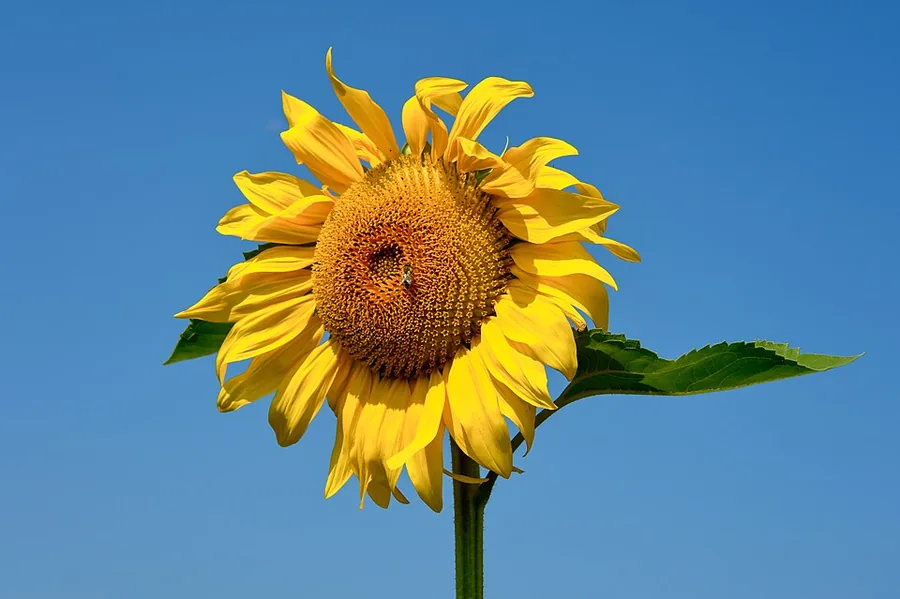
If any bloom says summer, it is the sunflower, and it is far kinder to beginners than its size suggests. This member of the daisy family turns up wild throughout much of North America, and from a single small seed it can shoot up to 10 feet (3 m) in one season. Find it a bright, open spot and let it take over from there.
There is a sunflower for almost any garden, whatever room you have. Some are towering single-stem giants grown for one enormous head and a generous crop of seed, while others keep low and bushy, opening dozens of little flowers week after week. Florists reach for the pollenless kinds that keep a vase tidy, and the smallest dwarf types rise no higher than a window box, so even a balcony has space for one.
Here is the reassuring part: sunflowers forgive plenty of small slip-ups. All they truly need is a place in the sun, warmth in the soil, and a bit of elbow room, and once the roots take hold they shrug off dry spells with ease. The one thing worth planning for is their height, since the tallest kinds appreciate a sheltered corner and a stake set before those big heads turn heavy.
Care
The short version: give your sunflower full sun and deep, well-drained soil of average fertility, keep the water steady while the seedlings settle in and again as the flowers form, then relax and ease off once the plants are established and shrugging off dry spells.
Light
Sunflowers truly need full sun, no way around it. Hand them the brightest, most wide-open spot in the garden and they answer with sturdy stems and generous heads. Set them in shade and you will get thin, leaning plants and only a scatter of flowers.
Water
While the seeds sprout and the seedlings find their footing, keep the soil evenly moist. After that, water deeply and on a regular schedule for roughly 20 days before and after flowering, the stretch when those heavy heads are counting on it. Once the plants are well rooted they turn remarkably drought tolerant and ask almost nothing of you.
Soil
Choose deep, loose, well-drained soil of ordinary fertility and your sunflower will be content. Its long taproot wants to plunge straight down, so loosen any packed layer before you sow. There is no need for rich ground, and plain garden soil suits it just fine.
Humidity
Out in the open air, humidity is simply not something you need to manage. What matters far more is good airflow, because leaves that stay crowded and damp are the ones downy mildew settles into.
Feeding
Sunflowers are light feeders. Once a few true leaves have opened, side-dress them a single time with a slow-release all-purpose fertilizer and leave it at that. Keep nitrogen modest, since too much drives leafy growth and disease while holding the flowers back.
Pruning
There is not much pruning to bother with. Deadhead the faded flowers to coax a branching sunflower into blooming longer, and snip away any damaged or diseased growth whenever you notice it.
Size & spacing
Depending on the type you pick, a sunflower may stand anywhere from 18 inches to 1.5 to 10 feet (0.5 to 3 m) tall and spread 1.5 to 3 feet (46 to 91 cm) across. Choose one that fits the room you have, and leave each plant enough space for air to pass freely between them.
When to plant
Sunflowers love warmth and have no patience for frost, so there is no rush. Wait until the last spring frost has passed and the soil has warmed to at least 60°F (16°C), then press the seeds straight into the ground. Flowers open from mid summer well into fall, and the seed heads are ready to gather in early fall, once their backs fade to yellow-brown and tip downward.
Northern hemisphere
Southern hemisphere
Typical months for a temperate climate: start earlier in warm zones, later where spring frosts linger.
- Sow: Usually unnecessary; sunflowers resent transplanting, so indoor starting is generally not recommended
- Plant: After the last spring frost, once soil has warmed to at least 60°F (16°C)
- Harvest: Blooms mid to late summer into fall; harvest seed heads in early fall when the back of the head turns from green to yellow-brown and nods downward
Hardiness
USDA hardiness zones: 2–11
Temperature: down to -46°C
Troubleshooting
Almost every hiccup with a sunflower shows up in one of three places: the leaves, the flower head, or those long stems. The good news is that spotting it early usually keeps it minor. Look through the problems below, find the one that matches, and step in while your effort still counts.
Webbing and nibbled seeds tucked inside the bloom
These are caterpillars, frequently sunflower moth larvae, that tunnel into the head to feed on buds, petals, and the seeds still forming. Split open a suspect bloom and the signs are clear: boring, webbing, and dark frass scattered through the seeds. Pluck out what you can, remove any head that is badly chewed, and if the damage keeps spreading, apply a labeled control as flowering begins.
Fix:
- Handpick caterpillars where practical
- Remove and destroy heavily infested heads
- Apply a labeled biological or insecticidal control at early flowering if needed
Yellow patches above the leaf with gray fuzz below
This one is downy mildew, a fungal problem that takes hold in cool, damp weather and shows as pale patches on top of the leaf with soft gray growth on the underside. Left alone it stunts and curls the newest growth as it moves through the plant. Pull and dispose of anything affected, widen the spacing so air can move, and try to keep water off the foliage.
Fix:
- Remove and destroy affected plants and debris
- Improve air circulation and avoid overhead watering
- Plant resistant cultivars where available
Ripening seeds vanishing before harvest day
Birds spot ripening sunflower seeds well ahead of any gardener and pick the heads clean as they fill. Drape a mesh bag or a length of row cover over each head as soon as the seeds begin to swell. Spinners, reflective tape, or an owl decoy will buy you a little time, and you can always cut the nearly ripe heads and let them finish drying somewhere indoors.
Fix:
- Cover maturing heads with mesh or row cover
- Use scare devices such as spinners, reflective tape, or owl decoys
- Cut and dry nearly mature heads indoors to finish ripening
Tall stems tipping or breaking after a storm
The giant single-stem sunflowers hold heads so weighty that they lodge, tipping or snapping once wind and rain arrive. Set a stake beside the tall cultivars early, well before the heads fill out and turn top-heavy. Watering deeply and evenly encourages a sturdier root system below, and a sheltered corner takes the sting out of the strongest gusts.
Fix:
- Stake tall and giant cultivars
- Provide deep, even watering to encourage strong rooting
- Site plants where they are sheltered from strong wind
Tiny clustered bugs and a sticky film along the stems
Those are aphids, tiny soft insects that crowd onto stems and the undersides of leaves, leaving a sticky honeydew film behind. A firm blast of water knocks most of them loose, and lady beetles and lacewings will happily mop up the rest. Save the insecticidal soap for the times a colony really gets away from you.
Fix:
- Dislodge aphids with a strong jet of water
- Encourage natural predators such as lady beetles and lacewings
- Apply insecticidal soap if populations are heavy
Toxicity
Here is one less thing to worry about: the sunflower is safe from root to petal. The ASPCA places it on its non-toxic list for cats, dogs, and horses, and the seeds have long been a favorite snack for people and wild birds alike. Should a curious pet nibble a leaf or a petal, there is nothing at all to fret over.
Safe for
People · Cats · Dogs · Horses · Rabbits · Livestock · Birds
Cats None
Cats are perfectly fine near sunflowers, and a little taste of a leaf or petal will do them no real harm.
Dogs None
There is nothing to worry about with dogs and sunflowers, and in small amounts the seeds make a wholesome treat.
Horses None
Horses can graze near sunflowers with no trouble, and the ASPCA counts the plant as non-toxic for them.
Rabbits Safe
A rabbit may nibble the leaves and flowers without any harm, so a stray stem in reach is nothing to worry about.
Livestock Safe
Cattle, goats, and sheep all get along fine with sunflowers, and the seed even turns up as an ingredient in animal feed.
Birds Safe
Birds adore sunflower seed and take no harm at all from it, with a ripe head acting like a built-in feeder.
People Safe
People enjoy the seeds as a snack, whether raw or roasted, and every part of the plant is safe to be around.
Varieties
There are thousands of sunflowers out there, but a handful of familiar types will suit most gardens, from sky-high giants to tidy cut flowers made for the vase. The few worth learning by name are gathered here.
Mammoth (Russian Giant)
The classic skyscraper of the group, this single-stem giant is grown for its enormous heads and a heavy yield of edible seed.
Autumn Beauty
A branching sunflower whose many smaller flowers arrive in warm autumn tones and keep coming over a long stretch.
ProCut and Sunrich series
Bred as pollenless single-stem plants, these give clean, long-lasting stems for cutting.
Teddy Bear
A compact dwarf with soft, fully double blooms that suits tight corners and settles happily into a pot.
How to propagate
Sunflowers grow from seed alone, and that single fact makes them one of the easiest plants to raise from the very beginning.
SeedEasy
Direct-sow after the last spring frost once soil has warmed to at least 60°F (16°C) · Germinates in about 7 to 10 days
Sow sunflower seeds right where they will grow, out in the open garden, once the last spring frost is behind you and the ground itself has hit at least 60°F (16°C). Set each seed 1 to 2 inches deep and it sends up a shoot in about 7 to 10 days. Sunflowers dislike having their roots disturbed, so there is no reason to fuss with indoor pots; just plant them in their final home from the start.
Myths
Fully grown sunflowers swivel their faces to chase the sun across the sky all day long.
Only the young, still-growing plants genuinely follow the light, swinging from east to west by day and easing back toward the east overnight. The moment a head opens into its mature bloom, that daily motion halts for good. An open field of mature sunflowers holds its gaze to the east instead of chasing the sun.