Ornamental · Asteraceae
Black-eyed Susan
Rudbeckia hirta
Tuck it into full sun once, and this cheerful golden daisy will keep sowing itself back for you every year.
Full sun
Every 7–10 days
USDA 3–8
2–4 ft · 0.6–1.2 m
Overview
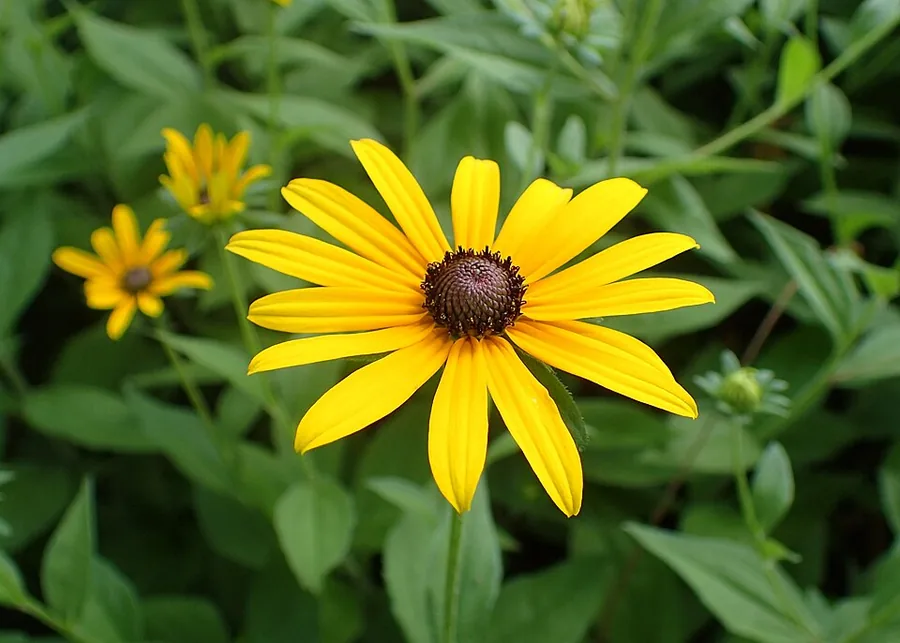
Black-eyed Susan is the bright gold daisy you have surely seen lighting up roadsides and meadows across much of North America. Each flower wears a ring of yellow petals around a dark brown center, the very eye that earns the plant its name. It belongs to the aster family and grows so fast and so willingly that it has become a beloved fixture in wildflower beds and cut-flower gardens alike.
For all the way it spreads, Rudbeckia hirta does not live long, and that is nothing to worry about. Most plants behave as an annual, a biennial, or a brief perennial that bows out after a season or two. The seed it drops each fall is what keeps the patch going, so a single planting tends to renew itself year after year with no extra effort asked of you.
Offer it sun and reasonable drainage and it will ask for next to nothing more. It takes heat and the occasional dry stretch in stride once its roots have settled, blooms from early summer well into fall, and goes on feeding birds with its seed heads through winter whenever you leave the faded flowers standing.
Care
The short version: give it full sun and average, well-drained soil, with a good deep drink every week or so until the plants find their footing. Feed it sparingly, deadhead through summer to keep fresh flowers coming, and let it self-seed so next year takes care of itself.
Light
Black-eyed Susan blooms its happiest in full sun, six or more hours a day. It will put up with a little afternoon shade, but the more sun you can give it, the more flowers you will enjoy and the stronger the stems will stand.
Water
Keep the soil evenly moist while the plants are settling in, offering a drink every 7 to 10 days whenever rain runs short. Once the roots reach deep, it shrugs off dry spells with ease. The only thing it truly cannot abide is soggy, poorly drained ground.
Soil
Almost any well-drained soil will please it, be it clay, loam, or sand, as long as the fertility stays modest. A pH anywhere from 6.0 to 7.5 covers the whole range it enjoys. Pass over the rich, heavy ground, since lean soil rewards you with better flowers.
Humidity
Plain outdoor air is all this plant could ask for, so there is no number to fuss over here. Good air movement matters far more than moisture, because crowded, still conditions are what tempt powdery mildew onto the leaves.
Feeding
This is a plant that fares best when kept a little hungry. Feed it lightly, if at all, through the growing season, since too much nitrogen trades flowers for leaves. Lean soil and a sparing hand bring you the finest bloom.
Pruning
Deadhead the faded flowers through summer and the plant keeps offering up new ones into fall. As blooming eases off, you can cut the stems back, or leave the seed heads standing to feed the birds and add a little winter interest.
Size & spacing
Plants grow 2 to 4 feet (60 to 120 cm) tall with a spread of 12 to 24 inches (30 to 60 cm). Give each one that much elbow room so air can move freely and mildew finds it harder to settle.
When to plant
Black-eyed Susan keeps time with the warm season. Sow seed indoors in late winter or settle it straight into the bed once the frost has passed, and your plants will flower from June through September, carrying on into fall as long as you keep up with deadheading.
Northern hemisphere
Southern hemisphere
Typical months for a temperate climate: start earlier in warm zones, later where spring frosts linger.
- Sow: About 6 to 8 weeks before last spring frost (around March 1 in the St. Louis area)
- Plant: After last spring frost, or direct sow at last frost date
- Harvest: June to September, extending into fall with deadheading
Hardiness
USDA hardiness zones: 3–8
Temperature: down to -40°C
Troubleshooting
This is a tough and forgiving plant, and most of its troubles turn up on the leaves or down low on the stems where they are easy to spot. Catch them early and a simple fix usually puts things right. Match what you see below, then step in before it has a chance to spread.
Stems suddenly wilting and folding over at the soil line
This one is southern blight, a soil fungus that arrives in warm, humid spells and can bring a plant down quickly. Check the base of the stem for white fungal threads and tiny tan pellets that confirm it. Sadly an infected plant cannot be saved, so lift it out with the soil around it, ease the drainage, and keep mulch pulled away from the stems going forward.
Fix:
- Remove and destroy infected plants and surrounding soil
- Improve drainage
- Avoid mulch piled against stems
Tender young leaves left full of ragged holes
Slugs and snails are usually behind this, drawn to the soft new growth and busiest when the weather turns damp. A silvery slime trail near the holes is the clue that gives them away. Step out after dark to pick them off by hand, tidy away the litter they shelter under, and circle your young seedlings with a simple barrier or trap to keep them safe.
Fix:
- Hand-pick slugs and snails
- Reduce excess moisture and mulch near crowns
- Use barriers or traps around young plants
A dusty white film creeping over the leaves
What you are seeing is powdery mildew, a fungus that tends to arrive late in the season when plants are packed close together and the air sits still. Take heart, because it looks far scarier than it is and seldom does lasting harm. Snip off the most coated leaves, open up a little breathing room between plants, and water at the base so the foliage stays dry.
Fix:
- Improve air circulation by spacing plants
- Remove and discard affected foliage
- Water at the base to keep leaves dry
Toxicity
Here is some reassuring news for homes with animals: black-eyed Susan is not toxic. It never appears on the ASPCA's poison list, and pets, livestock, and children can all be around it in safety. The one thing to keep an eye on is the bristly foliage, which can leave sensitive skin a little itchy, so it helps to reach for gloves when you cut it back.
Safe for
People · Cats · Dogs · Horses · Rabbits · Livestock · Birds
Cats Safe
You can relax around a curious cat, since black-eyed Susan never made the ASPCA toxic list and a stolen nibble does no harm. The worst that might happen is a little drool from the coarse, hairy leaves, and that passes in a moment.
Dogs Safe
A dog can sniff and chew at this plant without any worry on your part. The bristly leaves might scratch a tender mouth, yet there is no poison here to cause real trouble.
Horses Safe
Horses can graze right around Rudbeckia and come to no harm at all. It holds no toxin known to bother them, so there is nothing to fear.
Rabbits Safe
Rabbits are free to browse the foliage safely whenever they like. Often the rough texture is the only thing that turns most of them away.
Livestock Safe
Cattle, goats, and sheep can share a pasture with it and stay perfectly well. Nothing in the plant is poisonous to them, so you can rest easy.
Birds Safe
Birds love the seed heads come fall, and those seeds are a welcome treat rather than any kind of danger. Leave the spent flowers standing and you will be feeding finches right through the winter.
People Safe
This plant is gentle to handle, though the stiff, hairy stems and leaves can leave sensitive skin feeling a touch itchy. Slip on a pair of gloves before you cut it back and you will be just fine.
The bristly, hairy foliage and stems may cause mild skin irritation in sensitive individuals; wear gloves when handling.
Varieties
There are plenty of Rudbeckia selections to choose from, but a handful stand out for their size, their color, or their staying power. These are the ones it pays to know by name.
Prairie Sun
Named a 2003 All-America Selections winner, this one offers generous 5-inch blooms that fade from gold to soft lemon around a surprising light green cone in place of the usual dark eye.
Indian Summer
Its sturdy stems carry remarkable golden-yellow flowers that open a full 6 to 9 inches across.
Rudbeckia fulgida
Known as the orange coneflower, this is the steady perennial cousin that travels by rhizomes and comes through zones 3 to 9, while the short-lived R. hirta seldom lingers.
How to propagate
Black-eyed Susan is one of the most forgiving plants to multiply, whether you raise it from seed or split an established perennial clump.
SeedEasy
Start indoors about 6 to 8 weeks before last frost, or direct sow at the last spring frost date · Blooms the first year from early spring sowing
Seed is the gentle, forgiving way to begin. Sow it indoors 6 to 8 weeks before your last frost, or simply scatter it in the bed once the frost is behind you, and an early spring sowing will reward you with flowers that very same year. From then on the plants quietly carry on themselves, dropping seed each fall so fresh ones rise up year after year.
DivisionEasy
Spring or fall for perennial clumps · Re-establishes within one growing season
Division suits the perennial kinds such as R. fulgida, because the short-lived R. hirta rarely builds a clump worth dividing. Gently lift and split an established clump in spring or fall to keep it lively, and it will settle comfortably back in within a single growing season.
Myths
Black-eyed Susan is a true long-lived perennial that comes back reliably for years.
In truth Rudbeckia hirta lives as an annual, a biennial, or a short-lived perennial. What brings it back is self-seeding rather than a long-lived root, since the parent plants scatter seed and slip away while their seedlings rise to take their place. For one that returns from the very same crown season after season, reach for R. fulgida instead.
Black-eyed Susan is poisonous to dogs and cats.
You will not find Rudbeckia anywhere on the ASPCA toxic plant database, and it is treated as non-toxic to pets. The only small thing to keep in mind is the bristly foliage, which can leave sensitive skin a little irritated.