Ornamental · Asteraceae
Blazing Star
Liatris spicata
Tuck the corms in once and blazing star rewards you with tall purple spikes for the bees all summer long.
Full sun
USDA 3–8
2–4 ft · 0.6–1.2 m
Overview
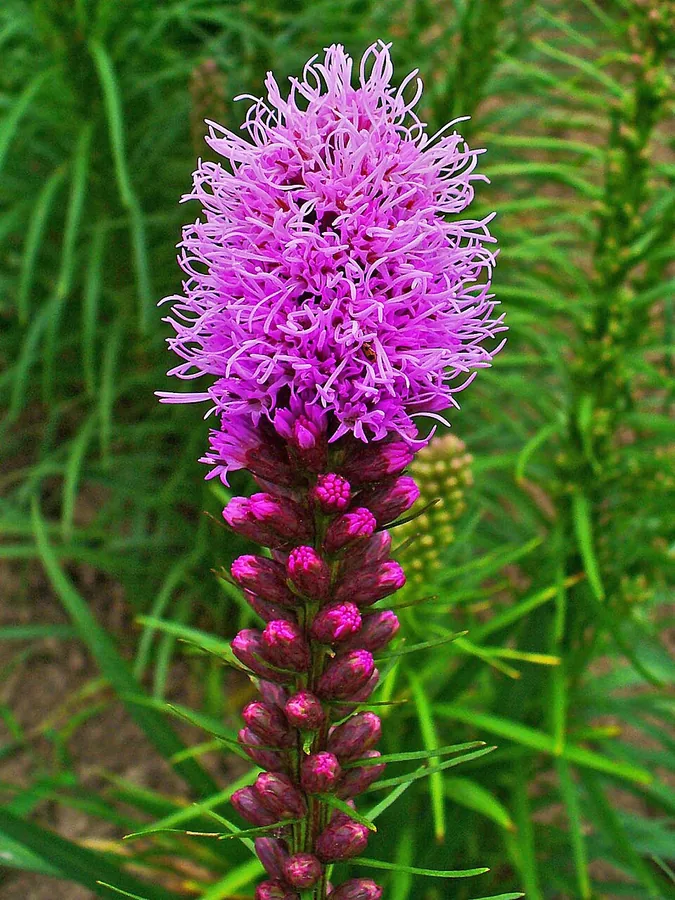
Blazing star is a forgiving North American prairie native, and it makes a wonderful first perennial. Instead of the wide, flat flowers most garden plants offer, it sends up tall, slim spikes crowded with dense purple buds that open into a soft, fuzzy column, and a group of them in bloom will draw butterflies and bees from all across your yard. It grows from a simple corm, returns faithfully each year on its own, and asks very little of you once it is settled in.
The best part shows up when it flowers. Where most spike flowers open from the bottom up, blazing star opens from the top down, so the tip fades while the base is still filling in, a small quirk that is fun to watch. Its grassy foliage and stiff stems lend a bed lovely vertical lines that few other perennials can give, whether you choose the full-height species or a shorter, easygoing pick like 'Kobold'.
This is a plant that helps you succeed. Give it full sun and ground that drains, and it will happily shrug off heat, drought, and even poor soil once its roots take hold, so a slow start is nothing to fear. The single thing it truly dislikes is wet feet through winter, which can rot the corm, but avoid that one soggy spot and you are well on your way.
Care
The short version: give it full sun and average, well-drained soil, water it faithfully through the first season and much less after that, and steer clear of any place that stays soggy all winter.
Light
Give your blazing star full sun and it will thank you. It does get by in partial shade, yet there the stems tend to stretch, weaken, and lean over, so the more sun you can offer, the sturdier and more upright it will stand.
Water
Keep it watered through that first growing season to help the roots settle in, and after that you can relax. Once established it is fairly drought tolerant and needs little from you, and it would far rather run a bit dry than sit wet, especially over winter.
Soil
It happily takes almost any well-drained soil, whether loam, sand, or clay, and even puts up with poor ground. A pH anywhere from 6.0 to 8.0 suits it just fine, so the one thing to watch is drainage rather than how rich the soil is.
Humidity
Plain outdoor air is all it asks, so there is no number to chase and nothing to fuss over. Good airflow matters far more here, since crowded, still conditions are what let powdery mildew and rust find a foothold.
Feeding
As a lean-soil prairie plant, it is not a heavy feeder, so go easy. A light feeding before growth begins in spring is plenty, and piling on fertilizer only encourages soft, floppy stems that struggle to hold their flowers up.
Pruning
Trim the spent flower stalks once they finish, but leave the foliage and hollow stems standing through winter to shelter native bees and feed the songbirds, then cut them back in early spring. Tall stems in rich, moist soil may appreciate a stake.
Size & spacing
Plants rise to 2 to 4 feet (60 to 120 cm) tall in a slim clump. Space them about 12 to 15 inches apart so air can move freely and each spike has room to stand tall.
When to plant
Blazing star is a tough, easygoing perennial for zones 3 to 8. Set your corms or young plants out in early spring, or plant container-grown stock again in early fall, and you can look forward to flower spikes in mid- to late summer.
Northern hemisphere
Southern hemisphere
Typical months for a temperate climate: start earlier in warm zones, later where spring frosts linger.
- Sow: Early spring; seed germinates in 20-45 days and benefits from 4-6 weeks cold moist stratification
- Plant: Plant corms or container plants in early spring; container-grown plants may also be set out in early fall, spaced 12-15 inches apart
- Harvest: Blooms mid- to late summer (July-August), with dense purple flower spikes opening from the top down
Hardiness
USDA hardiness zones: 3–8
Temperature: down to -40°C
Troubleshooting
Take heart, because blazing star has very few real troubles, and nearly all of them come back to one simple thing: ground that holds too much water. Keep a friendly eye on the stems and leaves as the season goes, and step in early before a small patch of fungus or a soggy corm gets ahead of you. Match what you notice below, then act while it still does some good.
A plant that suddenly wilts with a soft, rotting corm
This is the one to take seriously, though it is easy to prevent. Soggy, poorly drained ground opens the door to stem and corm rot, and soil that stays wet all winter is almost always behind it. A rotted plant can't be rescued, so lift it out along with the tainted soil around it. The lasting cure is simply good drainage: keep your blazing star away from any spot that holds water.
Fix:
- Improve drainage and avoid wet sites
- Remove and discard affected plants and surrounding infected soil
When tall flower stems lean or bow down
Don't worry, this one is easy to put right. Ground that is too rich or too damp coaxes out soft, floppy growth that simply can't carry a heavy spike, and a shady spot only adds to the problem. Move your plant into full sun and leaner soil, slip a stake under the tallest stems, or try a naturally compact cultivar like 'Kobold' that holds itself up beautifully.
Fix:
- Stake or provide support for tall stems
- Site in full sun and average, well-drained soil rather than rich, moist beds
- Choose compact cultivars such as 'Kobold'
A dusty white film spreading over the leaves
That pale coating is powdery mildew, a fungus that tends to arrive late in the season when plants sit close together and the air hangs still. You can gently turn things around by giving the clump more room, thinning it a little, and pulling off the most affected leaves so the fungus has less to travel to.
Fix:
- Improve air circulation by spacing and thinning plants
- Remove and dispose of badly affected foliage
Small orange to brown bumps under the leaves
Raised, rust-toned spots on the undersides of the leaves are the mark of rust fungi, and catching them early makes all the difference. Simply pick off and get rid of the spotted leaves before their spores travel, and open the planting up so fresh air can circulate and the foliage dries quickly after a rain.
Fix:
- Remove and destroy infected leaves
- Improve spacing and air circulation
Toxicity
Here is some lovely news for pet owners and parents: blazing star is safe all around. The ASPCA lists it as non-toxic to cats, dogs, and horses, and nothing in the leaves, stems, or corms will poison people or grazing animals. The most a big mouthful is likely to bring on is a passing bout of stomach upset.
Safe for
People · Cats · Dogs · Horses · Rabbits · Livestock · Birds
Cats None
You can breathe easy here, because the ASPCA lists blazing star as non-toxic to cats and a small nibble is nothing to fret over. If a cat overdoes it on any greenery it might be sick, but that comes from the rough leaves rather than any poison.
Dogs None
Dogs are just as safe with it, since there are no toxic compounds anywhere in the leaves, stems, or corms. The most a curious pup is likely to feel after a big mouthful is a little passing tummy upset.
Horses None
Rest assured your horses can graze right beside blazing star without any harm, because the plant holds nothing that is poisonous to them.
Rabbits None
Rabbits and other small pets are welcome to browse the foliage with no worries. It is a wildflower they would happily meet out in the meadow anyway.
Livestock None
Your cattle, goats, and sheep face no danger from blazing star in the pasture, as it carries no toxins that could trouble a grazing animal.
Birds None
Birds are perfectly fine around it, and better still, songbirds like goldfinches seek out the ripe seed heads all through fall and winter.
People None
No part of blazing star is poisonous to people, so you can relax around it. It is grown for its flowers and not the dinner plate, so there is no need to eat it, yet a stray touch or taste will not hurt anyone.
Varieties
Most of the named blazing stars have been chosen for a lovely color or a tidier, more manageable height. These are the ones you are most likely to come across.
Kobold
This compact, deep-purple pick stays short enough to stand on its own, making it a friendly, worry-free choice for the front of your border.
Floristan White
Gardeners reach for this white-flowered form mainly for cutting, because its clean spikes keep their good looks for a long while in a vase.
Floristan Violett
With stems sturdy enough to cut and carry indoors, this violet-flowered selection is a favorite whenever fresh flowers are wanted.
Alba
A pure white form topping out near 18 inches, it stays shorter than the species and tucks easily into a small bed.
How to propagate
You can grow more blazing star by splitting an established clump or by starting from seed, and one of the two will reward you with flowers a good deal sooner than the other.
DivisionEasy
Spring, just as leaves emerge · Establishes over one to two seasons; clumps can be divided every few years
Splitting an established clump is the most reliable way to grow your collection, and it is easier than it sounds. In spring, right as the leaves begin to poke through, lift the clump and gently pull or cut the corms and tuberous roots into pieces, making sure each keeps at least one eye. The fresh divisions come up true to the parent, though they take their time to settle, needing a season or two to fill out.
SeedModerate
Early spring indoors or direct sow, or fall sow outdoors · Seedlings typically bloom in their second or third year
Growing from seed simply asks for a little patience, and that is fine. Seed sprouts in 20 to 45 days, but only after a cold spell has woken it, so give it 4 to 6 weeks of cold, moist chilling first, or just sow outdoors in fall and let winter handle it for you. After that, a young seedling needs its second or third year before it rewards you with its first flower spike.
Myths
Blazing star will poison your dogs and cats.
You can set this fear aside, because the ASPCA counts blazing star among the plants that are not toxic to dogs and cats. Like any plant, a big mouthful might leave a pet with a mild upset stomach, but there is no poison here to worry about.
Liatris spikes open from the bottom upward like most spike flowers.
Blazing star happily breaks the rule that nearly every other spike flower follows. It opens from the top of the spike downward, so the very tip is already fading while the lowest buds are only just beginning to show their color.