Vegetable · Fabaceae
Field Pea
Pisum sativum subsp. arvense
Pair it with a grain to climb, and the field pea quietly builds your soil and feeds it nitrogen for free.
Full sun
Every 5–10 days
60–90 days
USDA 6–8
Overview
Think of field pea as the hardworking cousin of the garden pea, the very same species raised for its vines rather than its sweet pods. It belongs to the legume family and goes back to the old grain fields of Europe and the Near East. Gardeners and farmers lean on it as a cover crop and green manure, where its job is to feed the soil rather than the dinner table, though the young shoots and peas are still perfectly good to eat.
What it does below ground is the real gift. Like other legumes, it partners with soil bacteria to pull nitrogen straight from the air and fix it into the ground, leaving the bed richer than it started. Mow or till the crop under at full bloom, and your next planting gets to draw on that stored nitrogen.
Because the vines grow long, soft, and weak, a stand left on its own will flop over and mat down, but that's nothing to fret about. It just means field pea is nearly always sown with a small-grain nurse crop such as oats or rye for the tendrils to climb. Match the type to your winters, offer cool weather and steady water, and the plant takes care of the rest.
Care
The short version: give it full sun and cool weather, keep moisture steady since it dislikes heat and drought, plant it in well-drained soil of moderate fertility, and offer a small-grain nurse crop to climb. Inoculate the seed, skip the nitrogen, and let the plant make its own.
Light
Field pea loves full sun, though it forgives a touch of partial shade. Being a cool-season crop, it cares more about temperature than about sheer brightness, so it's happiest when the days are sunny but the weather stays cool.
Water
Keep the soil evenly moist, since this cool-season legume has only shallow drought tolerance. Heat is its real dislike, and once temperatures climb past 90°F (32°C) the flowers blast and seed yield falls off. Steady moisture through cool weather is what sees the crop through, so a regular drink is all it asks.
Soil
It settles in happily on well-drained clay or heavy loam of moderate fertility, and it does just fine on loamy sands too. Aim for a pH somewhere between 6.0 and 7.5. The one rule that truly counts is drainage, because soggy ground invites the root rots that trouble peas.
Temperature
This is a cold-tolerant cool-season crop, and the hardy winter types handle down to roughly 10°F (-12°C) with only minor injury, so chilly weather rarely worries them. The real caution sits at the warm end, where anything above 90°F (32°C) blasts the flowers and cuts seed set.
Humidity
Ordinary outdoor humidity suits it just fine, so there's no number to chase and no reason to fuss. Airflow and drainage matter far more, since damp, crowded growth is what brings on mildew and the leaf and stem blights.
Feeding
This is where field pea really earns its keep, because as a nitrogen-fixing legume it needs little to no nitrogen fertilizer. Coat the seed with Rhizobium at planting so the nodules can form, and add phosphorus or potassium only if a soil test comes back low.
Pruning
There's no pruning to worry about here. Instead, the whole crop is terminated at or before full bloom, whether mowed, tilled, rolled, or simply left to winterkill, since that's the moment it holds the most nitrogen for your soil.
Repotting
none
Size & spacing
12–47 in (30–120 cm) tall
When to plant
Field pea thrives in cool weather and has no patience for summer heat, so timing is mostly about matching it to your winters. In mild zones, sow Austrian winter pea from mid-August into September so it can overwinter, and in colder areas hold off and sow spring field peas the moment the ground can be worked. Either way the flowers open in spring, and that bloom is your friendly signal to terminate the crop for the most nitrogen.
Northern hemisphere
Southern hemisphere
Typical months for a temperate climate: start earlier in warm zones, later where spring frosts linger.
- Sow: Not started indoors; direct-sown in the field
- Plant: Sow Austrian winter pea from mid-August to mid-September to overwinter in mild zones (roughly USDA 6-8); sow spring field peas as early as the soil can be worked in colder areas
- Harvest: Pink-and-purple to white pea flowers in spring; terminate at or before full bloom for maximum nitrogen
Hardiness
USDA hardiness zones: 6–8
Temperature: down to -23°C
Troubleshooting
Almost every field pea hiccup comes down to three things: vines with nothing to climb, a winter too harsh for the type you sowed, or soil tired out by tight rotations. None of them are hard to recover from. Read the early signs below, match what you're seeing, and act while a little effort still goes a long way.
Floppy vines that sprawl and rot below
Take heart, because this one is easy to head off. The stems on a field pea grow long and tender, so a stand left to itself tends to lodge and mat down until the lower growth yellows and rots. The fix is simply company: sow your peas alongside a small-grain nurse crop like oats, rye, or barley that the tendrils can grab onto. Trim the pea seeding rate by roughly a quarter and the grain by about a third, and your planting will hold itself up nicely.
Fix:
- Grow the peas with a small-grain nurse crop such as oats, rye, wheat, barley, or triticale for the tendrils to climb
- Reduce the pea seeding rate by about one quarter and the grain by about one third in the mix
Winter pea browns out after a hard freeze
Don't be discouraged if this happens, because it is recoverable and often useful. This is winterkill, and it tends to strike Austrian winter pea grown colder than its comfort zone or sown too late to bulk up before the cold. The hardy types brush off around 10°F (-12°C) with only light injury, but a long stretch near 18°F (-8°C) without snow cover will finish them. In cold areas you can lean into it and let the dead vines work as a winter-killed mulch, or simply choose spring-sown field peas next time.
Fix:
- In cold zones treat winterkill as a feature and use it as a winter-killed mulch, or switch to spring-sown field peas
- Choose winter-hardy cultivars and plant early enough to reach 6 to 8 inches tall before soil freezes
Pale, patchy plants with bare roots
If the bed has gone years without peas, the helpful Rhizobium bacteria may simply be missing, so few nitrogen-fixing nodules form and the plants stay yellow-green and underpowered. The good news is you can confirm and fix it in one afternoon: gently dig up a few roots and look for pink, active nodules. If they aren't there, coat fresh inoculant on your seed right before sowing and plant again. It happens to plenty of growers, and it sorts out quickly.
Fix:
- Re-inoculate and re-seed with fresh, viable Rhizobium inoculant applied immediately before seeding
Yellowing, wilt, rot, spots, or white dust
A handful of diseases tend to gather on peas grown in tight rotations and wet ground, ranging from Sclerotinia and root rots to Ascochyta blight and powdery mildew, while pea aphids feed on the shoots and pass along viruses. Read the clues and you'll know what you're up against: browned, rotted roots mean root rot, dark stem and leaf lesions point to Ascochyta, and white fuzz signals mildew. You can stay well ahead of all of it by rotating away from peas for several years, planting on well-drained ground, and reaching for resistant cultivars and clean, treated seed.
Fix:
- Rotate out of peas for several years and avoid wet, poorly drained ground
- Use resistant or tolerant cultivars and clean, treated seed
- Scout for pea aphids and manage where thresholds are reached
Toxicity
You can breathe easy here, because field pea is the same species as the garden pea and carries no toxins. The shoots, pods, and peas are safe food for people and pets alike, and the vines make excellent forage. The only thing worth a gentle watch is heavy grazing of lush growth by cattle, sheep, and goats, which can bring on bloat rather than any kind of poisoning.
Safe for
People · Cats · Dogs · Horses · Rabbits · Livestock · Birds
Cats None
You can relax around cats, since peas pose no danger to them and a curious nibble on a shoot won't cause any harm. Most cats won't bother with the foliage at all.
Dogs None
Nothing in a field pea will hurt a dog. In fact, cooked peas show up as a wholesome ingredient in plenty of pet foods.
Horses Safe
Horses can graze the vines safely, and the crop is raised as forage for exactly that reason. Just ease them onto any rich new pasture gradually, the way you would with any lush green feed.
Rabbits Safe
The tender shoots and leaves are a fine treat for rabbits. Serve them alongside plenty of hay rather than as the entire meal.
Livestock Mild
Cattle, sheep, and goats do beautifully on pea forage, with one gentle caution: grazing heavy, lush growth can lead to bloat, which is a buildup of digestive gas and not poisoning. Bring animals onto the stand slowly and pair it with grass to keep their stomachs settled.
Birds Safe
Chickens and other backyard birds happily tuck into the peas and greens. Both wild and farmed birds welcome the seed as a tasty food.
People Safe
Since this is the same species as the garden pea, the young pods, peas, and shoots are all good to eat. Harvest them while tender for the sweetest flavor.
Immature pods, peas, and tender shoots are edible. Like other legumes, lush pea forage can cause bloat in ruminant livestock if grazed heavily, but it is not poisonous to pets or people.
Varieties
Field peas come in fall winter types and spring types, and choosing between them is mostly a matter of how cold your winters tend to get. Here are the ones you're most likely to come across.
Austrian Winter Pea
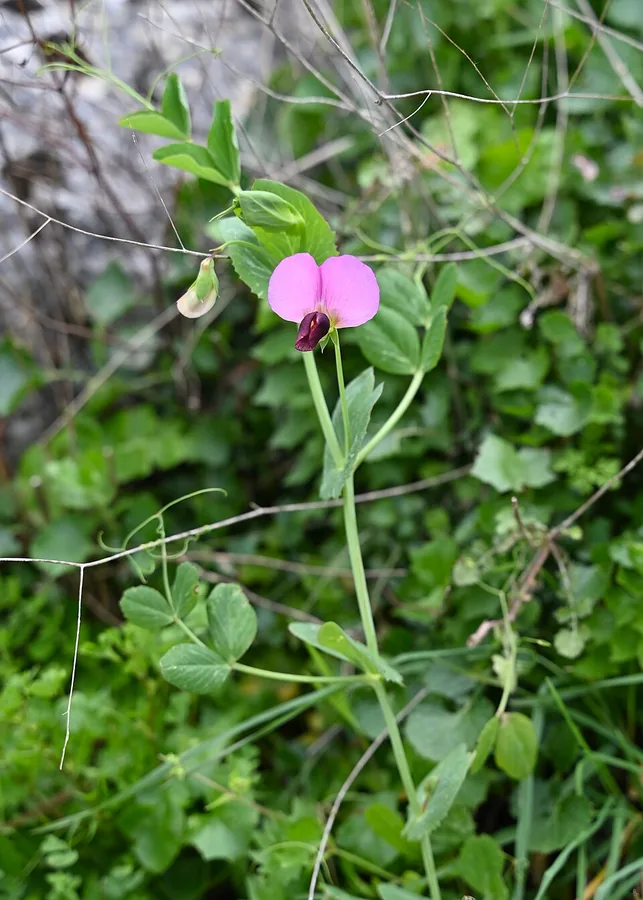
A cold-hardy fall type carrying bicolored purple and pink flowers and small, dark speckled seeds, sown in late summer so it can overwinter where the climate stays mild.
Whistler
A winter-type field pea grown for forage and cover, bred to handle cold-hardy fall planting.
40-10
A widely planted winter forage line that earns its place as a cover crop and green manure.
Spring forage field peas
Spring-sown types meant for colder regions, where a fall-sown winter pea would just winterkill.
Companions
Field pea grows best beside the small grains that hold its weak vines up, which is why nearly every cover-crop mix pairs the two.
Plant near
Oats: A small-grain nurse crop gives the weak pea vines something to climb on and adds biomass, reducing lodging.
Cereal rye: Provides upright support for the climbing tendrils and pairs well in fall-sown cover-crop mixes.
Barley: Serves as a nurse grain that supports the vines and balances the pea's nitrogen with a carbon-rich companion.
How to propagate
Field pea grows from seed and nothing else, sown straight into the ground rather than started in pots, which makes it a kind, low-stress plant to begin with. The real trick is gentle and simple: pair the seed with the right inoculant and a grain for it to lean on.
SeedEasy
Fall (mid-August to mid-September) for Austrian winter pea in mild zones; early spring for field peas in colder areas · Emerges in about 1-2 weeks; reaches usable size within several weeks to a couple of months
Growing field pea from seed is wonderfully simple, and you sow it right into the ground rather than starting it in pots. Where winters stay mild, sow Austrian winter pea from mid-August to mid-September; in colder spots, sow field peas as soon as the soil can be worked in spring. The one step worth remembering is to dust the seed with the right Rhizobium inoculant just before planting and sow it with a small-grain nurse crop for support. Seedlings come up in about 1 to 2 weeks and grow to usable size within several weeks to a couple of months, so you'll see progress before long.
Myths
Field pea and the edible garden pea are two separate plants.
Not so, because they share one species, Pisum sativum. Field pea is simply the forage subspecies arvense, chosen for its eager vining cover-crop growth instead of sweet shelling peas. Its tender shoots and peas are genuinely good to eat; the plant is just raised for building soil and feeding livestock.