Vegetable · Brassicaceae
Radish
Raphanus sativus
Hardly anything is kinder to a beginner: give a radish cool weather and steady water, and you will be pulling roots within weeks.
Full sun
Every 3–5 days
39–75°F · 4–24°C
22–60 days
Overview
The radish is the crop that pays back a little impatience with a quick, cheerful harvest. It belongs to the cabbage family and races from seed to plate faster than almost anything else in the garden, with the quick salad kinds ready in just three to five weeks. If you are new to growing and want an early success, this is the seed to reach for.
Do not picture only the little red globe. Radishes range from the round spring types you shave into a salad all the way to the long white daikon, which asks for a longer season and deep, loose soil, plus a few curiosities grown for their spicy seed pods instead of a root. The thread running through all of them is a fondness for cool weather, because heat is what turns a sweet, crisp radish tough and sharp.
Radishes ask for very little and forgive a lot, which is exactly why they suit a nervous first grower. Keep the soil evenly moist, give each seedling room by thinning, and lift the roots on time. Miss a step and you might get a cracked skin or a sharp flavor, but there is always another sowing a few weeks away, so no single slip is the end of anything.
Care
The short version: give radishes full sun and cool weather, keep the soil evenly moist with about an inch of water a week, go easy on nitrogen in loose ground, and pull the roots as soon as they reach size. Nothing here is hard to get right.
Light
Radishes are happiest in full sun, roughly 6 hours a day, though a bit of afternoon shade in warm spells is no problem at all. Give them too little light and the plant leans into leaves and skimps on the root you actually want.
Water
Aim to keep the soil evenly moist, about an inch of water a week, and a touch more in sandy ground or a hot stretch. That steady drink is what keeps the roots sweet and crisp and saves them from cracking or turning hot and woody.
Soil
Give radishes loose, well-drained sandy loam with the stones and hard clods cleared away, so the roots can plump up without a fight. They settle in nicely where the pH sits between 6.0 and 7.0.
Temperature
This is a cool-season vegetable at heart, most content between 39°F to 75°F (4°C to 24°C). Let the weather turn hot and the plants rush to flower while the roots go sharp and pithy, so lean on the cooler months.
Humidity
There is no humidity number to fret over here, since ordinary outdoor air suits them fine. What the roots truly care about is even moisture in the soil, not the dampness around the leaves.
Feeding
A little compost or well-rotted manure worked into the bed before you sow is usually all a radish needs. Keep a light hand with nitrogen, because a rich feed grows a jungle of leaves and leaves you with small, disappointing roots.
Pruning
There is nothing to prune, so let that worry go. The one job that matters is thinning: once the seedlings are up, thin them to about 2 inches apart, or 4 to 6 inches for daikon, giving every root the elbow room to swell.
Size & spacing
Depending on the type, plants stand about 6 to 35 inches (15 to 90 cm) tall, with the long daikon reaching the top of that range. Thin to around 2 inches apart, more for the big winter radishes, so the roots can fill out and fresh air can move between them.
When to plant
Radishes love the cool ends of the year and sulk in high summer, so timing is on your side more than you might think. Sow the quick types straight into the ground in early spring the moment the soil crumbles, then come back from late summer into fall, saving the long daikon and winter kinds for a fall harvest.
Northern hemisphere
Southern hemisphere
Typical months for a temperate climate: start earlier in warm zones, later where spring frosts linger.
- Plant: Direct sow in early spring (April-May) as soon as soil can be worked, and again in late summer to early fall (August-September); winter/daikon types are sown for fall harvest
- Harvest: Spring/salad types harvested 3-5 weeks after sowing; daikon and winter types harvested in fall
Hardiness
USDA hardiness zones: 2–11
Temperature: down to -46°C
Troubleshooting
Almost every radish hiccup shows up in the root, or in a burst of leaves that grew instead of one. The good news is that these signs are easy to read and easier to fix. Find your symptom below, then nudge your timing, watering, or feeding and try again.
Tunnels and soft rot inside the roots
Pale, legless grubs and brown tunnels running through a root are the mark of cabbage root maggots, and once they have been through, that root is past saving. Dig up and bin any that are affected. Then rotate away from brassicas, cover the bed as you sow, and steer clear of ground that was recently manured.
Fix:
- Remove and discard affected roots
- Practice crop rotation away from brassicas
Plenty of leaves but hardly any radish below
It feels backwards to get a full cap of greens and only a thread of root beneath, and the usual reason is too much nitrogen, often paired with a row that never got thinned. Heat, long days, and shade all tug the plant the same way. Ease off the rich feeding, thin the seedlings to proper spacing, and sow in cool weather where they get at least 6 hours of sun.
Fix:
- Thin seedlings to recommended spacing
- Stop applying high-nitrogen fertilizer
- Sow during cool spring or fall weather in full sun
A flower stalk rises before the root fills out
What you are seeing is bolting, set off by warm weather and lengthening days and sometimes hurried along by drought or crowding that stalls the plant. Once that central stem shoots up, the root goes woody and sharp on you. Pull whatever is worth saving now, then try again in the gentler cool of spring or fall.
Fix:
- Harvest promptly before quality declines
- Replant in cooler spring or fall conditions
Roots gone tough, pithy, or fiercely hot
A radish that sits in the ground too long turns tough and spongy and takes on a harsh, peppery heat, and dry, hot spells only hurry that along. Once the texture goes, there is no bringing it back. So pull your radishes at their peak and keep the soil evenly moist while they are growing.
Fix:
- Harvest at peak size
- Keep soil consistently moist during growth
Roots that crack and split down their length
Splitting usually traces back to uneven moisture, classically a big drink after the bed has dried right out, and to roots that lingered past their best. Water at a steady, even pace so the roots grow smoothly, and lift them at the right size before they get the chance to split.
Fix:
- Harvest at proper size
- Maintain even watering
Little shot-holes speckling the young leaves
Those neat round holes are the calling card of flea beetles, tiny dark specks that ping away the second you brush past. Young seedlings suffer the most, so lay a floating row cover over them to keep the beetles off, and move your brassicas to a fresh spot each year.
Fix:
- Use floating row covers over seedlings
- Monitor and manage early pressure
Toxicity
You can relax completely here: every part of a radish is safe. People eat the roots, leaves, flowers, and seed pods, and the plant does no harm to pets or livestock. The one small thing to know is that a freshly cut root can sting sensitive skin a little.
Safe for
People · Cats · Dogs · Horses · Rabbits · Livestock · Birds
Cats None
Cats are safe around radish. A small taste of leaf or root now and then may bring a little gas or a soft stool, but nothing that should worry you.
Dogs None
Dogs are fine with radish. A few plain pieces make an easy snack, though a big helping of the peppery root can leave a dog a bit gassy.
Horses Safe
Horses handle radish and its greens comfortably. As with any fresh treat, keep the amount modest so it stays a small part of the day.
Rabbits Safe
Rabbits love the leafy tops, and a little of the root is fine too. The greens really are the better part of the plant for them.
Livestock Safe
Cattle, goats, and sheep can graze both tops and roots without harm, and radish is sometimes sown on purpose to feed them.
Birds Safe
Backyard hens peck at the greens and roots quite happily, and the leaves give them a nice bit of green.
People Safe
Radish is a kitchen favorite, eaten raw or cooked, and the root, leaves, flowers, and seed pods are all good to eat. Handling a cut root can sting sensitive skin a little.
Leaves and roots contain isothiocyanates that may cause mild skin irritation in sensitive individuals when handling, and the raw root is pungent.
Varieties
There are hundreds of radishes out there, but only a handful turn up again and again on the seed racks. These are the friendly names worth knowing first.
Cherry Belle
The familiar round, bright red salad radish, and a reliable one that sizes up in about three to four weeks.
Easter Egg
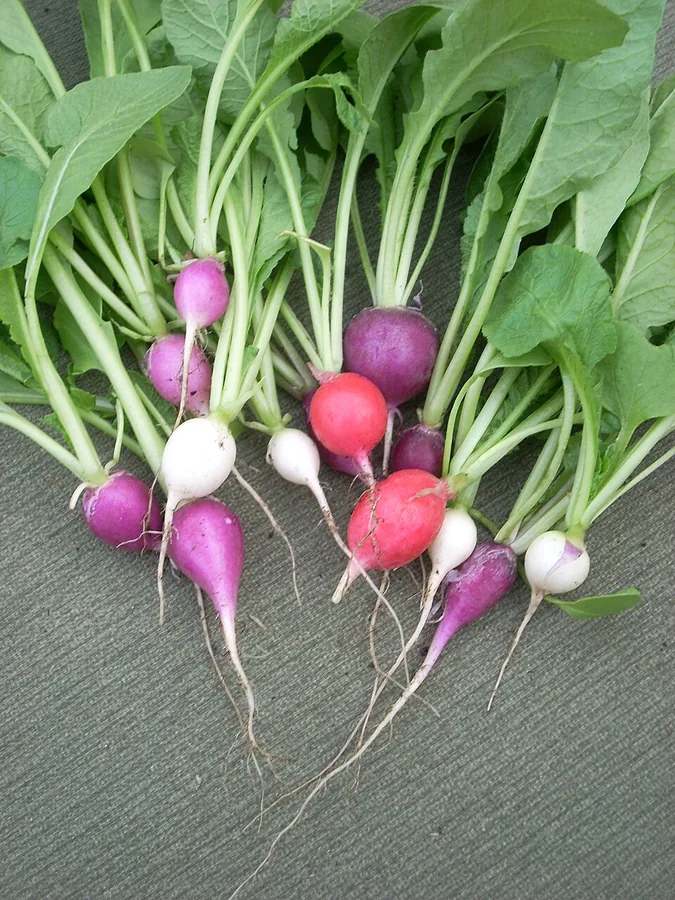
One packet and one sowing gives you roots in white, pink, red, and purple all at once.
Sparkler
A tidy round red radish finished with a crisp white tip at its base.
Daikon (var. longipinnatus)
The long white winter radish, which likes a longer season and deep, loose soil to stretch down into.
Rat's Tail (var. caudatus)
A charming oddity grown not for a root but for its edible, spicy seed pods.
Companions
Radishes earn their keep beside slower crops, holding space and marking rows before they're pulled and the neighbors fill in.
Plant near
Lettuce: Quick-maturing radishes interplant well with lettuce, using space before the lettuce fills in.
Carrots: Radishes are sown as a fast marker crop with slow-germinating carrots and are pulled before the carrots need the room.
Cucumbers: Radishes are commonly interplanted with cucumbers as an early quick crop in the same bed.
How to propagate
Radishes grow from seed and nothing else, tucked straight into the spot where they will grow up.
SeedEasy
Direct sow in early spring and again in late summer/fall · Germinates in about 3 to 7 days under cool, moist conditions
Radishes go in as seed right where they will grow, since they resent being moved. Set the seeds around 1/4 to 1 inch deep in early spring and again from late summer into fall, and in cool, damp soil they push up in only 3 to 7 days. Thin the young plants early so each one has the room to make a good root.
Myths
Big radish roots only come from rich, heavily fertilized soil.
Load the bed with nitrogen and what you get is a burst of leafy tops with barely a root beneath. Radishes do best in moderately fertile, well-prepared ground, not a heavily fed one.
You can leave radishes in the soil and harvest them whenever it suits you.
Leave them too long and the roots turn woody, pithy, and cracked while the flavor sharpens into a real bite. Lift them promptly once they reach size to catch them at their sweetest.