Tree · Rosaceae
Nectarine
Prunus persica var. nucipersica
A nectarine is simply a peach without the fuzz, and it repays full sun and one yearly prune with sweet, smooth-skinned fruit you will be proud of.
Full sun
Every 7–14 days
USDA 5–9
10–20 ft · 3–6 m
Overview
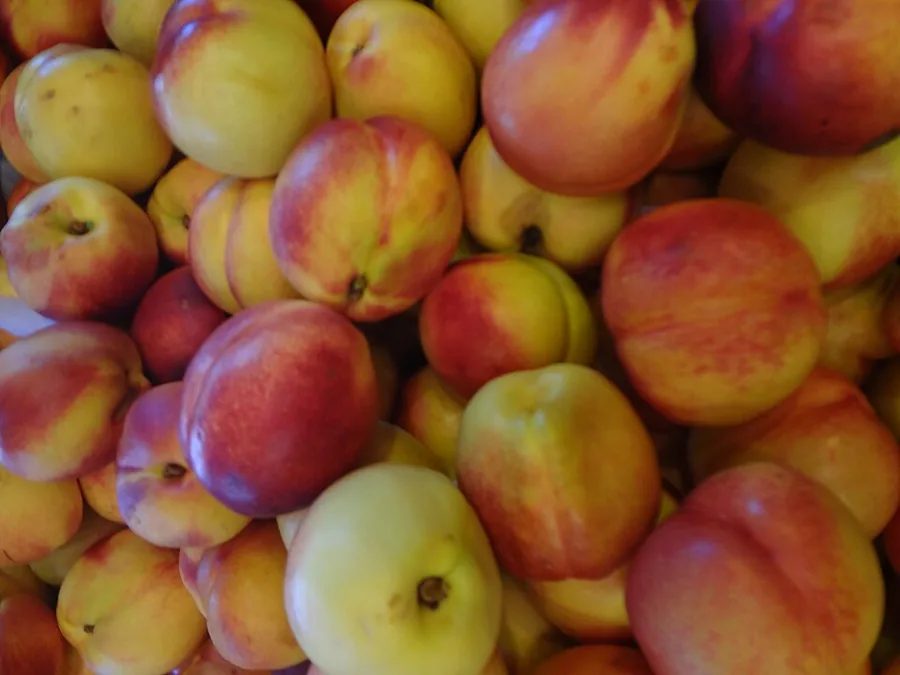
A nectarine is the very same tree as a peach, just one gene short of the fuzz, so if you can picture a peach you already know this one. It belongs to the rose family alongside cherries, plums, and apricots, and that smooth skin is really the only tell that sets it apart from its fuzzy twin. Grown with a little care it gives you firm, sweet fruit from a tree sized for a backyard rather than an orchard, and that is well within your reach.
It is fair to call this a demanding tree, and being honest about that helps you succeed. It wants full sun, deep well-drained soil, and a thoughtful prune each winter, and its smooth skin does scar and rot a touch more easily than a peach's. None of that is beyond a first-timer, and the reward is fruit you rarely taste at its best from a store, picked dead ripe from a branch you tended.
Most trees come already grafted onto a rootstock, so you plant a young whip and train it gently from the start, mistakes and all. It crops happily across zones 5 through 9, blooms early enough that a late frost can nip the flowers, and ripens its harvest through the warm heart of summer, right when you will most enjoy it.
Care
The short version: give it full sun, deep well-drained soil kept on the dry side once the tree has settled in, an open-center prune each late winter, and a dormant spray to stay ahead of leaf curl and brown rot, and you will do just fine.
Light
Give a nectarine full sun, as much as you can spare, since both fruit quality and sweetness lean right on it. A tree left in shade grows leggy and sets little fruit, and it holds damp leaves that invite disease, so a bright open spot is the kindest thing you can offer it.
Water
Water deeply while the tree is growing and sizing its fruit, then let the top half of the soil dry before the next good soaking. An established tree shrugs off a short dry spell without complaint, and keeping the water off the leaves quietly cuts down on fungal trouble.
Soil
Plant into deep, well-drained sandy loam, because nothing sets a nectarine back faster than soggy roots. Aim for a slightly acidic pH between 6.0 and 6.5, and if your ground tends to hold water, work on the drainage before planting and the tree will thank you.
Temperature
The tree is hardy across a wide swing, from about -9°F to 95°F (-23°C to 35°C), so it copes with more than you might expect. Its early bloom is the tender point, since a late frost can take a whole year's flowers before any fruit has a chance to form.
Humidity
Average humidity in the 40% to 70% range suits it just fine, so most gardens are already close. Damp, still air is the real trouble, because it invites brown rot and leaf curl, so open up the canopy and let a breeze move through.
Feeding
Feed from early spring into midsummer with a balanced complete fertilizer such as 10-10-10, then follow with calcium nitrate. Ease off by late summer so the fresh growth can harden up before winter arrives, and the tree will head into the cold in good shape.
Pruning
Train the young tree to an open-center, vase shape and give it a firm prune every late winter without second-guessing yourself. Each year you cut out water sprouts and thin the canopy so light and air reach the fruit, and this really is the one big job the tree asks of you.
Repotting
This is a field tree rather than a container plant, so there is no repotting to worry about in the usual sense. Just choose the planting spot thoughtfully up front, since a nectarine would rather not be moved once its roots have taken hold.
Size & spacing
Left to its own devices a nectarine reaches 10 to 20 feet (3 to 6 m) tall and about as wide. A yearly prune keeps it lower and much easier to pick from, but do give it the full 10 to 20 feet (3 to 6 m) of room so air can move freely through the canopy.
When to plant
Plant a bare-root nectarine while it is still dormant, in late winter or early spring, so the roots have time to settle before growth wakes up. The tree flowers early, which does leave the blossoms open to a late cold snap, and the fruit ripens from mid-June into September depending on the cultivar, so there is a long, rewarding season to look forward to.
Northern hemisphere
Southern hemisphere
Typical months for a temperate climate: start earlier in warm zones, later where spring frosts linger.
- Plant: late winter to early spring while dormant (bare-root)
- Harvest: blooms early spring; fruit ripens mid-June to mid-September by cultivar
Hardiness
USDA hardiness zones: 5–9
Temperature: down to -29°C
Troubleshooting
A nectarine's smooth skin shows the little troubles a fuzzy peach would hide, so problems usually land on the fruit and the new leaves first, which actually works in your favor. Learn the early signs and you can step in before a fungus or a borer sets the tree back. Match what you see below, act while it still counts, and know that most of this is recoverable.
Fuzzy gray-brown patches spreading over fruit still on the branch
Take heart, this common problem is brown rot, and it is manageable once you know it. The Monilinia fungi behind it spread quickly in warm, humid spells, and a nectarine catches it a little more readily than other stone fruit, so you are not doing anything wrong. Gather up every mummified fruit and snip out infected twigs, open the canopy with a prune so the wood dries, and a fungicide at bloom and again before harvest will keep you ahead of it.
Fix:
- Remove mummified fruit and infected twigs, prune for airflow, and apply fungicide at bloom and before harvest
Oozing gum and sawdust-like frass gathering at the trunk base
Gum and frass low on the trunk point to peachtree borers, the larvae of a clearwing moth that tunnel through the lower wood and can girdle a young tree, so it is worth catching early. The good news is that a healthy tree can wall off much of the damage on its own. Keep yours growing strong, dig out any larvae you come across, and time your trunk sprays to when the moths are flying and you will protect it well.
Fix:
- Keep trees vigorous, remove larvae, and time trunk sprays to moth flight
Fresh spring leaves puckered, thickened, and flushed red
What you are seeing is peach leaf curl, caused by the fungus Taphrina deformans that slips into the buds during cool, wet spring weather. Once leaves have distorted there is no rescuing them for that season, so try not to worry over the ones already curled. The one spray that truly helps is a dormant fungicide put on in late winter before the buds swell, and next year will look much better for it.
Fix:
- Apply a dormant fungicide spray in late winter before bud swell
Silvery scars and rough patches marking the fruit skin
Those marks come from western flower thrips feeding on the young fruit, and a nectarine's smooth skin simply shows their work more than a fuzzy peach would, so this is nothing to fret about. The scarring stays skin-deep and the fruit inside eats beautifully. Just keep an eye out for the pests at bloom and petal fall, and only step in with a treatment if their numbers climb past the threshold.
Fix:
- Monitor at bloom and petal fall and treat if thresholds are exceeded
Toxicity
The ripe flesh is safe and delicious, but the rest of the tree is not, and it is easy to manage once you know. The pits, leaves, twigs, and bark hold cyanogenic glycosides that release cyanide, and wilted leaves are especially risky for grazing animals. Keep prunings and fallen pits well away from pets and livestock, and never let anyone eat the pit, and you will have nothing to worry about.
Toxic to
Cats · Dogs · Horses · Rabbits · Livestock · Birds
Safe for
People
Cats Toxic
A curious cat that nibbles the leaves or stems may drool, be sick, or lose interest in food, and that alone is worth a gentle watch. The greater worry is the cyanide held in the pit and foliage, which can lead to dilated pupils, labored breathing, and a racing heart, so keep those parts out of reach.
Dogs Toxic
If a dog gets into the leaves or a fallen pit, look for vomiting, diarrhea, and heavy panting. A swallowed pit can lodge in the gut, and a large helping of plant material risks cyanide poisoning, so it is kindest to clear windfalls away before curious noses find them.
Horses Toxic
Horses face a serious risk, and wilted leaves that blow into the paddock are the danger to guard against most of all. Cyanide poisoning shows as brick-red gums, fast breathing, staggering weakness, and sudden collapse, so keep prunings well clear of where they graze.
Rabbits Toxic
The leaves, twigs, and pits carry cyanogenic compounds that a rabbit's small body cannot handle, so none of that should ever reach the hutch. A bite or two of ripe, pitted flesh is the one part it is reasonable to share.
Livestock Toxic
Cattle, goats, and sheep are most at risk from wilted prunings tossed over a fence, where the cyanide grows more concentrated. Poisoning comes on quickly, with breathing distress, trembling, and collapse, so it helps to burn or bag trimmings rather than pile them near the pasture.
Birds Caution
Keep birds away from the pits, leaves, and bark, since the cyanogenic glycosides are no safer for them than for other animals. A little ripe flesh is fine to offer, but the seed inside should always stay off the menu.
People Ripe flesh safe
The ripe flesh is a summer treat and perfectly safe to enjoy, so you can pick and eat with confidence. Just do not crack open or swallow the pit, because the kernel inside carries the same cyanide-releasing compounds as the leaves.
Keep pits and pruned leaves and stems away from pets and livestock; ripe flesh in moderation is not a concern.
Helpline numbers

United States
ASPCA Animal Poison Control: (888) 426-4435 (fee applies)
Poison Control: (800) 222-1222



Canada
Poison Centres: 1-844-764-7669
Varieties
Nectarines come in dozens of named types, but a handful of freestone cultivars turn up again and again because they taste wonderful and rarely let a grower down. These are the friendly names worth getting to know first.
Fantasia
A large freestone with firm yellow flesh and lovely color, and it sits among the very best-quality nectarines a home grower can raise.
Redgold
A large yellow-fleshed freestone loved as much for how sweetly it eats as for the easy way it settles into one region after another.
Independence
A red-skinned, yellow-fleshed freestone that fruits all on its own, so even a single tree will crop happily without a partner nearby.
How to propagate
There are two ways to start a nectarine, and only one hands you the fruit you are hoping for. Grafting copies a known cultivar faithfully, while a pit grows into a happy gamble, so pick the path that suits your patience.
GraftingDemanding
Named nectarines are budded or grafted onto peach or plum rootstock, and that is exactly how nurseries hold a cultivar true to type. It does take a steady hand and a bit of practice, so most growers happily buy a grafted tree rather than raise one, and there is no shame in that.
SeedModerate
A pit will sprout for you once it has had a good stretch of cold, moist stratification to break its dormancy. The one thing to expect is that the seedling will not match its parent, so you end up with a tree all its own rather than a copy of the fruit you began with, which can be a fun surprise.
Myths
A nectarine is a cross between a peach and a plum.
You can set that idea aside, because there is no hybrid here at all. A nectarine is just a smooth, fuzzless peach, the very same species Prunus persica, and the whole difference comes down to a single recessive gene that leaves the fuzz off.
Nectarines are a separate species from peaches.
They belong to one and the same species, and a nectarine is just a peach wearing smooth skin. That fuzzless form keeps reappearing from the same single-gene change, which is the friendly reason both trees ask for identical care and meet the very same pests.