Vegetable · Apiaceae
Celeriac
Apium graveolens var. rapaceum
Give it a long season, rich soil, and water that never quits, and celeriac will reward you with a knob no store can match.
Full sun
Every 2–4 days
50–77°F · 10–25°C
100–120 days
Overview
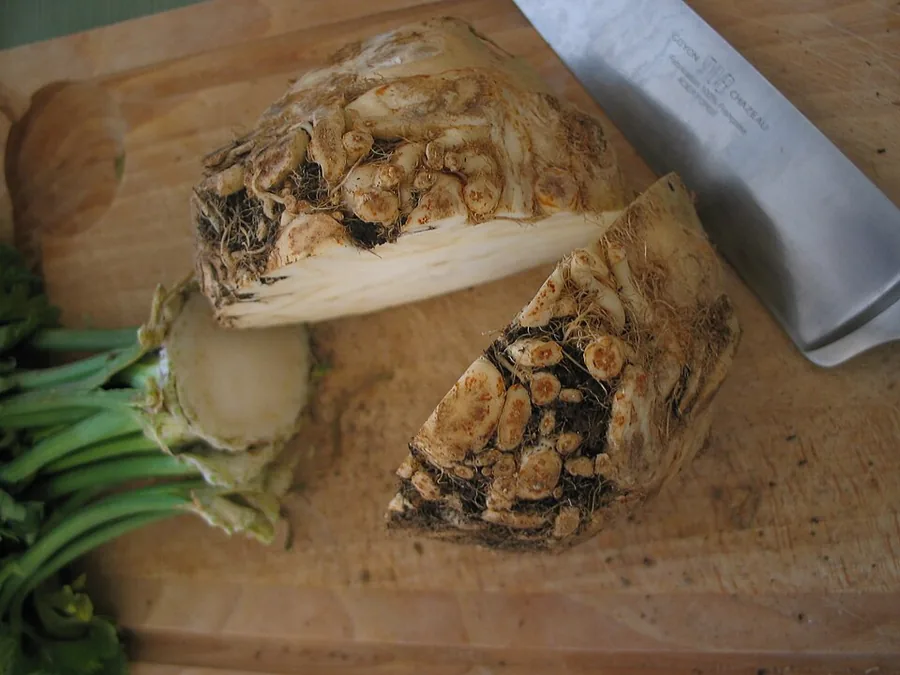
Celeriac is just celery raised for its root instead of its stalks, so if you have grown celery you already know its cousin. It sits in the carrot family and shares a species with everyday celery, but breeders have steered all its energy into a swollen, knobby base rather than crisp stems. Slip past the rough skin and you find dense, ivory flesh that tastes of celery with a warm, nutty, earthy note.
This is a crop for the patient gardener, and patience is really the only special skill it asks of you. It starts slow from a fussy seed and wants a long season of 100 to 120 days with steady moisture all the way through before the knob fills out. If you rush it or let it dry, you simply get smaller, fibrous roots, which is why celeriac has its demanding name, though none of that is hard, only a matter of keeping at it.
The reward is a vegetable that keeps for months and lends deep flavor to soups, mashes, and roasts. Get the simple basics right and a single plant hands you a knob the size of a fist or bigger, happy to store well past the first frosts.
Care
The short version: give it full sun and rich, deep soil, keep the ground evenly moist all season, offer a balanced feed once a month, and have the patience to let it run its full 100-plus-day course.
Light
Celeriac loves full sun to plump up a good knob, yet it will happily take a touch of afternoon shade where summers turn hot. Give it too little light and it simply grows slower across a season that is already long, so a bright spot pays off.
Water
This is the one factor that truly makes or breaks your crop, so don't be shy with the hose. Celeriac is a heavy drinker that wants the soil kept evenly moist all season, which often means a deep watering every 2 to 4 days. Let it dry out even for a short spell and the knobs come up small, hollow, or cracked.
Soil
Plant it in rich, deep loam full of organic matter that holds water without going soggy. A pH between 6.0 and 7.0 suits it nicely, and working in plenty of compost keeps both the moisture and the nourishment it craves right where the roots can reach.
Temperature
Celeriac is happiest in the mild band of 50°F to 77°F (10°C to 25°C). Cold snaps below about 50°F (10°C) on young plants can set off bolting, so warmth at transplant time matters every bit as much as warmth through the summer.
Humidity
Ordinary garden humidity, somewhere around 40% to 70%, is all this plant asks of you. What matters far more is not letting the foliage sit wet, since crowded, damp leaves invite the blights that like to trouble this crop.
Feeding
Celeriac is a heavy feeder that wants a balanced fertilizer with steady nitrogen, offered about once a month right through the growing season. Rich soil paired with regular feeding is what carries the plant through its long run to a full-sized knob, so keep it fed and it keeps growing.
Pruning
There is wonderfully little to do here, so relax. Pull off any lateral side shoots, and late in the season strip away the lowest, oldest outer leaves to open up the crown of the knob. Never cut the central foliage, because that is the part feeding the swelling root.
Repotting
Not applicable; grown in the ground or large beds, not as a container houseplant
Size & spacing
Plants grow 1.5 to 3 feet (46 to 91 cm) tall and 12 to 18 inches (30 to 46 cm) wide. Set them close, about 6 inches apart in the row, which trials have shown actually gives you the largest marketable roots, so don't be afraid to tuck them in.
When to plant
Celeriac needs the whole growing season, so a little planning with the calendar goes a long way. Start your seed indoors in late winter, move sturdy transplants outside only once the last frost has passed and the soil feels warm, then gather the knobs from late summer into fall before a hard freeze arrives.
Northern hemisphere
Southern hemisphere
Typical months for a temperate climate: start earlier in warm zones, later where spring frosts linger.
- Sow: 8-10 weeks before the last spring frost; seed is slow to germinate, surface-sow and keep warm and moist
- Plant: Transplant after the last frost once soil has warmed and seedlings are sturdy (late spring)
- Harvest: Harvest from late summer into fall once knobs reach 3-4 inches across, before a hard freeze
Hardiness
USDA hardiness zones: 4–9
Temperature: down to -34°C
Troubleshooting
Most celeriac troubles show up either in the size of the knob or the look of the leaves, and the cause is nearly always water, cold, or crowding, all of which you can manage. Read the early signs below and gently match them to what you see in your patch. Catching a hiccup early is what turns a fibrous dud into a fist-sized root, so trust your eyes.
A flower stalk rises early and the knob goes woody
Take heart, this one is preventable. When a tall seed stalk appears, it means bolting, and a cold spell has fooled the biennial into believing winter came and went. A bolted plant puts everything into that stalk, so the knob stays small and stringy and will not turn around; pull it gently and try again. The real fix is simply giving young transplants warmth and time so they never feel that chill.
Fix:
- Pull and discard bolted plants; the root will not improve
Knobs stay small, split open, or come up hollow
Nearly every time, the answer is simple thirst, because celeriac drinks steadily all season and even one dry stretch can stall the knob for good. A little shortage of boron can also brown and hollow the middle, and tight spacing or too short a season leaves roots underdone. Be generous and forgiving here: water deeply and often, feed well, and leave each plant about 6 inches of room to fill out.
Fix:
- Maintain even deep watering
- Ensure adequate fertility and balanced micronutrients
- Allow the full long season and proper spacing for bulking
Brown and gray spots creep across the leaves
Those spots usually point to a fungal leaf blight, often Cercospora or Septoria, which settles in when leaves stay damp and packed together. Don't worry, it is manageable: pick off the spotted leaves, thin the planting so air can move freely, and water at the soil line rather than over the top. Moving celeriac to a fresh spot each year keeps last season's spores from following along.
Fix:
- Remove affected foliage
- Improve spacing and air flow
- Water at the base rather than overhead
Leaves turn chewed, curled, or sticky to the touch
A sticky shine on the leaves usually means aphids and the honeydew they leave, while ragged holes point to celery worm, slugs, or earwigs nibbling the tops. Here is the reassuring part: none of this reaches the knob you are growing for, so pick off the caterpillars and slugs by hand and rinse the aphids away with a hose. A healthy, well-watered plant takes most of it in stride.
Fix:
- Hand-pick caterpillars and slugs
- Hose off or treat aphids as needed
Toxicity
Celeriac is a food crop and holds nothing that would poison pets, livestock, or people, so you can grow it with an easy mind. The root is safe for everyone, and the single mild catch lives in the leafy tops, whose natural furanocoumarins can leave sensitive skin sore after handling them in bright sun. Pull on gloves for that one little job and there is truly nothing to worry about.
Safe for
People · Cats · Dogs · Horses · Rabbits · Livestock · Birds
Cats None
Rest easy, there is nothing toxic in this plant for a cat. The worst a curious nibble might bring is a passing bit of tummy upset from greens it is not used to.
Dogs None
Dogs are safe with both the leaves and the root, so no need to fret. Plainly cooked celeriac even turns up in some home-prepared dog dinners.
Horses Safe
Horses can nibble or be offered celeriac with full peace of mind, as the plant holds nothing that would do them any harm.
Rabbits Safe
Rabbits are welcome to both the leafy tops and the root in modest helpings, given alongside their other usual greens.
Livestock Safe
Cattle, goats, and sheep do just fine with celeriac; it is a food crop, never a danger to the flock or herd.
Birds Safe
Backyard chickens and other birds are free to peck at the tops and trimmings without any worry.
People Safe
Cooked or raw, the root is a wholesome food. The only small thing to mind is the foliage, which holds furanocoumarins that can leave sensitive skin sore after handling the tops in bright sun, so slip on gloves and rinse your hands when you are done.
Like other Apiaceae (celery, parsnip), the foliage contains furanocoumarins (psoralens) that can cause mild phytophotodermatitis in sensitive people who handle the tops in bright sun. This is milder than parsnip and is a minor handling note, not a pet-poisoning risk.
Varieties
Celeriac varieties differ mostly in size, smoothness, and how cleanly the inside stays white, so any of them can serve you well. A handful of names keep coming up in gardens and trials, and they make a friendly starting point.
Balena
A strong, productive choice that grew the largest marketable roots in University of Maine trials, and it does best when you set the plants at a close 6-inch spacing.
Brilliant
A dependable mid-season grower whose smooth, rounded roots tend to shrug off the inner browning celeriac so often falls prey to.
Diamant
A smooth-skinned variety that shows little browning inside and holds up nicely in storage.
Giant Prague
The beloved old heirloom, cherished for big, globe-shaped roots that carry fewer of the side rootlets which make peeling such a chore.
How to propagate
Celeriac is grown one way, from seed, and that seed is honestly the trickiest part of the whole crop, though it is well within your reach.
SeedModerate
Start indoors 8-10 weeks before the last spring frost · Roughly 2-3 weeks to germinate and about 10 weeks to reach transplant size before setting out
Celeriac comes from seed, and that seed will gently test your patience, so go easy on yourself if it feels slow. The tiny seeds need light to sprout and take 2 to 3 weeks to wake up, so press them onto the surface, keep them warm and evenly moist, and begin a full 8 to 10 weeks before your last frost. Give them about 10 weeks to grow to transplant size, then harden the young plants off before they head outdoors.
Myths
Celeriac is a completely different plant from celery.
Not so, they are one and the same species, Apium graveolens, simply bred toward different parts. Celeriac is the root-grown variety rapaceum, and the leafy stalk celery you know is variety dulce, which makes them close family rather than strangers.
The knobby edible part is a true root.
It is easy to assume so, but that swollen knob is mostly an enlarged hypocotyl and stem base rather than a single taproot. The genuine fibrous roots are those stringy threads you see trailing from its underside.