
Introduction
Water hemlock is a native plant in the carrot family, and one root can kill an adult. USDA ARS calls it the most violently toxic plant that grows in North America. One field clue does more work than all the others. The side veins in the leaf run to the notches between the teeth, not out to the tooth points. Confirm that against the hollow stem and the chambered root before anyone acts on it.
The dose is the part people get wrong. CDC puts a fatal adult amount at about 1 inch (2 to 3 cm) of root, and the root carries more cicutoxin than any other part. Federal mortality files counted at least 58 US deaths from 1979 through 1988. Each one ate a poisonous plant they took for an edible one, and at least five of those cases were water hemlock. That count closed decades ago, so read it as a pattern and not as this year's tally.
The most toxic plant in North America is also easy to mistake for food you meant to pick. Cicutoxin acts on the central nervous system and brings on violent seizures, sometimes inside an hour of a bite. There is no antidote. Hospital care is supportive, so the clock matters more than anything you can do at the kitchen sink. If a person has eaten any part of the plant, call Poison Control at 1-800-222-1222 or 911 first, and call a veterinarian if it was an animal.
You do not have to wipe Cicuta maculata off your property. It sticks to wet ground, it feeds black swallowtail caterpillars and a long list of pollinators, and the risk to livestock climbs when a plow or a hoof turns the roots up where animals can reach them. You do have to know it on sight. Until you can, leave every wild carrot-family plant with big white flower clusters alone.
How to Identify Water Hemlock
The tractor gate at the top of the ditch was propped open and the white umbels behind it stood past my belt. I knelt in the wet grass and held one leaflet up to the light. Every side vein ran out from the middle and stopped in a notch between two teeth, not at a tooth point. I moved my heifers to the dry paddock that afternoon and the ditch stayed fenced off all summer.
How to identify water hemlock? Read the leaf veins first, before the flowers or the height. Five agencies name that same trait, and no other field mark comes close to that much agreement. Water hemlock leaves are alternate and cut two or three times into toothed leaflets, and the veins behave the same way on every one of them. Flip a leaflet over, hold it against the sky, and you have your answer in under a minute.
The stem backs that up. This plant puts up a hollow stem with cross partitions at the nodes, and the purple-striped stem near the base is what most people notice first. Height sorts nothing. Missouri Department of Conservation reports plants to 6 feet (1.8 m), while USDA ARS describes Cicuta douglasii in the West at 1.5 to 3 feet (0.5 to 1.0 m). A short plant in a ditch proves nothing either way.
Stem
- Structure: The stem is hollow and smooth, with cross-partitions at the nodes that become more numerous toward the base of the plant.
- Color: Missouri Department of Conservation describes stout upright stems spotted or mottled with purple near the base, sometimes under a white waxy coating.
- Contrast: University of Utah Health Poison Control notes that water hemlock shows little or no purple blotching compared with poison hemlock.
- Cutting caution: UF/IFAS describes the stem as fleshy and hollow with purple stripes, but cutting releases the plant's poisonous liquid, so this is not a casual test.
Leaves and leaf veins
- The decisive trait: Lateral veins from the leaflet midvein end in the notches between the teeth rather than at the tooth points themselves.
- Shape: Leaflets are narrowly lanceolate to oblong-lanceolate, roughly 0.5 to 4 inches (1 to 10 cm) long, with margins that are usually toothed.
- Arrangement: Leaves are alternate and two to three times pinnately compound, becoming smaller and less divided higher up the stem.
- Corroboration: Five separate Tier 1 sources name the vein-to-notch trait, which is what makes it the most reliable single check available in the field.
Flowers
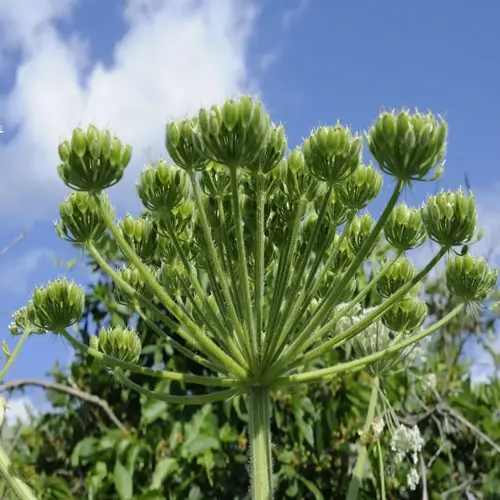
- Form: Minute white flowers with five petals sit in compound umbels that arise from the stem tips and from side branches.
- Size: Missouri Department of Conservation measures the umbels at 2 to 5 inches (5 to 13 cm) across, and NC State Extension reports them up to 6 inches (15 cm).
- Structure: NC State Extension counts 10 to 20 dome-shaped umbellets, each holding up to 15 flowers of about 1/8 inch (3 mm) across.
- Season: Bloom runs May through September in Missouri, while USDA ARS reports flowering in June or July at higher elevations in the West.
Root and rootstock
- Chambers: The thick rootstalk holds small chambers of brown or straw-colored poisonous liquid that is released the moment a stem or root is cut.
- Odor: Utah State University Extension and University of Utah Health Poison Control both describe a musky odor coming from the roots.
- Toxicity: CDC reports the root holds the highest cicutoxin concentration and that about 1 inch (2 to 3 cm) of it can be fatal in adults.
- Handling: Treat a cut root as the most hazardous part of the plant and keep a glove between it and your skin at all times.
Cut the root and you open the chambered rootstock. The thick rootstalk holds small chambers of brown or straw-colored liquid, and that liquid is the poison. It runs out of a cut stem base the same way. Keep a glove between it and your skin, and don't cut into a plant you haven't already read from the leaves.
I cut into a stem. It was hollow inside. That's when I knew it was water hemlock.
Lookalikes That Fool Foragers
Nearly every fatal mix-up starts with the same picture. The carrot family repeats one shape, a flat cluster of small white flowers over a tall hollow stem, and dozens of species wear it. Many water hemlock lookalikes are harmless, so people relax. One of them killed a Maine forager about 3 hours after he ate the root. Matching a single trait means nothing here. You want the trait that rules a plant out.
The water hemlock vs poison hemlock mix-up starts with a shared common name. University of Utah Health Poison Control makes the stem the deciding mark. Poison hemlock carries clear purple blotching, and water hemlock shows little or none of it, even though its own stem carries purple stripes or mottling near the base. So look at where the color sits and how far up the stalk it runs before you name the plant in front of you. Conium maculatum also grows taller, to 9 feet (2.7 m), and its leaves are fernlike and finely dissected rather than coarse and toothed.
Wild carrot is the easiest of the group to rule out. Queen Anne's lace has hairy stems, and water hemlock's stem is smooth, a difference you can see in good light without touching either plant. That umbel often carries a single dark purple floret at its center as well. You can drop elderberry on the stem alone, since it is pithy inside instead of hollow, and its leaves sit opposite each other on the twig. Near water, skip the botany and use the blunt rule. Avoid every aquatic plant with large clusters of white flowers.
The knife came out of the rootstock and a bead of straw-colored liquid welled up behind it, thin as sap, smelling like carrot. The cut face was not solid. It was partitioned into small chambers, each one holding brown or straw-colored fluid the way a honeycomb holds its cells. I pulled the nitrile-lined gloves from behind the truck seat before I touched that plant, and they live back there all year. I bagged the root and washed my hands anyway.
One matching trait is not an identification. Missouri Department of Conservation advises that anyone inexperienced with plant identification should treat every wild member of the carrot family as potentially fatally toxic.
How Cicutoxin Kills So Fast
How fast does water hemlock kill? A 23-year-old Maine forager died about 3 hours after eating the root. Cicutoxin is a highly poisonous unsaturated alcohol with a strong carrot-like odor, and it is not an alkaloid. The toxin packs into the tuberous root, where a portion of about 1 inch (2 to 3 cm) can kill an adult.
CDC lists the first water hemlock poisoning symptoms as nausea, stomach pain and epigastric distress. They start 15 to 90 minutes after a bite. Severe cases move past the gut fast, and then comes heavy salivation, sweating, bronchial secretion and hard breathing. In fatal cases, death usually comes from status epilepticus. That is seizure after seizure with no break.
15 to 90 minutes
CDC reports mild toxicity begins with nausea, abdominal pain and epigastric distress; early vomiting can be partly protective because undigested root may come back up.
Within 30 minutes
The younger brother, who took three bites of root, vomited and began to convulse, and was found unresponsive with dilated pupils and profuse salivation.
About 2 hours
The older brother, who took one bite and had no symptoms on arrival at hospital, began seizing and became delirious, then stabilized and recovered.
About 3 hours
The younger brother died after severe tonic-clonic seizures, periods of apnea and ventricular fibrillation, roughly three hours after eating the root.
Two bites separated those outcomes. The older brother felt fine when he reached the hospital. He began seizing 2 hours later, turned delirious, then stabilized and recovered. There is no safe small taste of this root. Vomiting early can carry some undigested root back up before it is absorbed, and that is chance rather than protection you can plan on.
The toxin cicutoxin, acting directly on the central nervous system, is a violent convulsant.
Cicutoxin acts on the central nervous system, and violent convulsant describes what that looks like on the ward. The harm comes as seizures, not as slow organ damage over days. Call Poison Control at 1-800-222-1222 or 911 the moment you think someone chewed part of a suspect carrot-family plant, and do not wait for a symptom to appear.
Emergency Response and First Aid
What do you do in the first minute? You call Poison Control at 1-800-222-1222, or 911 if the person is already convulsing, and you start moving toward an emergency department. That line answers 24 hours a day. There is no home version of water hemlock poisoning treatment, so skip the home remedies and any attempt to make the person vomit. Poison Control will tell you what to do while you move. This is the one plant emergency where the highest risk is standing still and hoping.
Should you wait and see whether symptoms show up? No. The older brother in the CDC's Maine case reached the hospital with no symptoms at all. He was given gastric lavage and activated charcoal, and he still began seizing and turned delirious 2 hours after eating the root. A calm patient in the first hour tells you nothing about the second one.
Call Poison Control at 1-800-222-1222 or emergency services before anything else. USDA ARS advises contacting a poison control center and obtaining emergency medical assistance as quickly as possible.
A man in the Maine case was asymptomatic on arrival at the hospital and still began seizing 2 hours after a single bite of root. Treat any suspected ingestion as an emergency from the first minute.
Seizure control and airway protection are hospital work, not roadside work. Seizures have to be brought under control to keep breathing and heart function steady, and that takes drugs and monitors you cannot carry.
Gastric lavage and activated charcoal were used in the Maine case. Doctors also watch for rhabdomyolysis with renal failure, metabolic acidosis, bradycardia and hypotension.
What can a hospital do? Stop the seizures, protect the airway, and watch closely for the damage the convulsions cause. There is no water hemlock antidote, so the whole plan is supportive care, which means treating each problem as it shows up. Take a piece of the plant with you in a bag if you can get it safely, because a confirmed ID tells the team more than a description of a white flower will.
No antidote exists for cicutoxin, and treatment is supportive from start to finish. Every minute spent deciding whether the exposure was serious is a minute not spent getting to a hospital.
Where and When It Grows
Where does water hemlock grow? In wet ground, and almost nowhere else. Wet meadows, streamside thickets, freshwater swamps, roadside ditches and river floodplains all suit it, and it holds through hardiness zones 5a to 9b. Walk one drainage ditch from the culvert to the fence corner and you can read the pattern in a single pass. You get thick stands in the standing water by the culvert, thinner plants on the dry bank in the middle, then a crowd again at the soggy fence corner where the runoff collects.
Two species take in most of the country between them. Cicuta maculata covers the East and the Midwest, where Missouri Department of Conservation reports stalks to 6 feet (1.8 m) and NC State Extension up to 8 feet (2.4 m). Cicuta douglasii holds the Intermountain West, and the Utah sources put it at 3 to 7 feet (0.9 to 2.1 m) along irrigation canals and moist pastures. Elevation caps that western range. In Utah the plant is seldom found above 8,500 feet (2,590 m).
When does water hemlock bloom? In Missouri the white umbels open any time from May through September, and at higher western elevations flowering waits until June or July. Those flower heads are your easiest way to pick the plant out of a green ditch bank. The rest of the year it looks like any other tangle of wet-ground growth. The water hemlock habitat you can map in July is the same ground you walk in March.
Peak danger comes long before the flowers do. The plant is poisonous at all stages of its development and it is most toxic in the spring, weeks before the first umbel opens. Leaves and stems do shed most of their toxicity as they mature. The green seed heads stay poisonous, and the root is the worst part of the plant in every season, so the low spring growth you barely notice deserves the most room.
USDA ARS reports that poisonings rise when roots are exposed by plowing, ditch cleaning or animals trampling streambeds, because the roots are more palatable than the tops.
Livestock, Pets and Safe Removal
The timing of water hemlock livestock poisoning splits into two windows, and both are short. USDA ARS reports that animals show signs 15 minutes to 6 hours after eating the plant, and death may follow 15 minutes to 2 hours after those signs start. Utah State University Extension counts from a different point. Where animals eat roots turned up by plowing or ditch cleaning, it puts death at 1 to 12 hours after the meal. Roots are more palatable to livestock than the tops, so water hemlock cattle losses often start with an exposed root.
"You sprayed it, so it's dead, right?" my neighbor said across the fence line. His two heifers were grazing maybe 20 feet (6 m) from a patch I had hit with herbicide four days before. Sprayed plants taste better to animals right after treatment, so a cow will walk past clean grass to reach one. We ran a hot wire across that corner and kept the heifers off for 3 weeks.
How to get rid of water hemlock comes down to two jobs, and the wetness of the ground decides which one you start with. On dry footing, spot-treat with a systemic herbicide such as glyphosate or 2,4-D in late spring or early summer. For plants standing in water or partly submerged, use an aquatic-labeled herbicide instead. Grubbing water hemlock suits a small patch, and it only counts if you lift the entire root, then burn what you pull.
- Gloves first: Wear gloves and cover your arms before touching the plant, because cut stems and roots release a brown or straw-colored poisonous liquid.
- Take the whole root: USDA ARS is explicit that if you grub water hemlock you must get all of the plant, including the roots, not just the top growth.
- Burn every part: USDA ARS advises gathering and burning every part of the plant rather than leaving cuttings lying in a pasture or ditch.
- Time the spray: UF/IFAS Duval County recommends spot-treating with a systemic herbicide in late spring or early summer, using aquatic-labeled products near water.
- Fence off treated plants: Keep animals away from sprayed water hemlock for 3 weeks, because USDA ARS reports palatability rises immediately after treatment.
- Watch after ditch work: Check for roots turned up by plowing, ditch cleaning or trampling, since USDA ARS reports poisonings spike when roots are exposed.
- Keep pets clear: NC State Extension flags water hemlock as a problem for cats, dogs and horses, so call a veterinarian at once if an animal chews any part.
Dogs, cats and horses are all at risk here. A dog digging in a wet ditch means a call to your veterinarian, not a wait and see. The amount is the part people get wrong.
A piece of root the size of a walnut can kill a cow-sized animal.
Common Myths
Water hemlock is the plant that killed Socrates, which is why people call it the classic historical poison.
Socrates was executed with poison hemlock, Conium maculatum, a different genus carrying a different toxin; water hemlock is a separate North American plant.
Water hemlock is safe as long as you leave the root alone, because only the tuber actually holds the poison.
NC State Extension lists every part as poisonous, including leaves, stems, flowers and seeds; the root simply holds the highest cicutoxin concentration.
Touching water hemlock cannot hurt you, so gloves are unnecessary when pulling it out of a wet ditch.
CDC notes cicutoxin may be absorbed through the skin, and cut roots leak a toxic liquid, so gloves and covered arms are the sensible rule.
A plant identification app can confirm whether a wild carrot-family plant is water hemlock or something safe to eat.
No app can carry that risk for you; Missouri Department of Conservation advises anyone inexperienced with plant identification to treat every wild member of the carrot family as potentially fatally toxic.
Conclusion
Water hemlock control runs on a calendar and not on one big push. Walk your wet ground in early spring and mark every stand you find, because CDC reports the plant is at its most toxic then, and that is the same stretch when hungry stock go looking for the first green growth. Spot-treat those marked plants in late spring or early summer, and use an aquatic-labeled product on anything standing in water. Then keep animals off the sprayed ground for 3 weeks. Sprayed plants turn more palatable before they die.
Water hemlock removal is optional most of the time. It stops being optional in two spots. One is a stand beside a play area. The other is a grazed pasture where plowing or ditch cleaning has turned the roots up, and those exposed roots are the ones animals reach. A piece of root the size of a walnut can kill a cow-sized animal. Grub out the whole plant with the roots attached, wear gloves while you do it, then gather every piece and burn it. Do not leave pulled plants lying in the field and do not put them on the compost heap.
Wet meadow safety comes down to knowing which stands you have and where people and animals walk. The plant hosts black swallowtail caterpillars and feeds bees, butterflies and moths, so a stand in a back ditch that nobody crosses earns its place. Put Poison Control 1-800-222-1222 in your phone now, while nothing is wrong. Manage this plant where your family and your stock are, and leave it alone where they are not. Let the leaf veins running to the notches settle what you are looking at.
Glossary
- Apiaceae
- The carrot family, a group of plants with umbrella-shaped flower clusters that includes carrots, parsley, poison hemlock and water hemlock.
- Chambered rootstock
- The thick underground base of water hemlock, divided inside into small hollow pockets that hold a brown or straw-colored poisonous liquid.
- Cicutoxin
- The poison in water hemlock, a chemical that acts directly on the central nervous system and causes violent convulsions.
- Compound umbel
- A flat or dome-shaped flower cluster where many small stalks spread from one point like the ribs of an umbrella, each ending in its own smaller cluster.
- Pinnately compound
- A leaf built from separate leaflets arranged in pairs along a central stalk, rather than one single leaf blade.
- Rhabdomyolysis
- Breakdown of muscle tissue that releases substances into the blood and can damage the kidneys; CDC lists it among water hemlock poisoning complications.
- Status epilepticus
- A seizure that does not stop on its own, or seizures that repeat without recovery in between; it is the usual cause of death in fatal water hemlock poisonings.
- Supportive care
- Hospital treatment that manages symptoms and keeps the body working, such as controlling seizures and protecting breathing, when no antidote exists.
External Sources
Frequently Asked Questions
Is water hemlock poisonous to humans?
Yes, and severely. CDC reports that eating about 1 inch (2 to 3 cm) of the root can be fatal in adults, and USDA ARS calls it the most violently toxic plant that grows in North America.
What is the difference between water hemlock and poison hemlock?
They are different plants in the same family. The quickest checks are:
- Water hemlock shows little or no purple blotching on the stem; poison hemlock shows it clearly.
- Poison hemlock has fernlike, finely dissected leaves and reaches 9 feet (2.7 m).
- Water hemlock leaflets are lance-shaped and toothed, with side veins running to the notches.
- Water hemlock is tied to wet ground; poison hemlock is not as strongly tied to it.
Can water hemlock poison you through the skin?
CDC states cicutoxin may be absorbed through the skin, although poisonings typically result from eating the plant. NC State Extension does not rate it as a contact-dermatitis plant. Wear gloves anyway, because cut roots leak toxic liquid.
What should you do if you touched water hemlock?
Keep the toxin away from your mouth and get advice. The steps are:
- Wash skin, tools and gloves that touched cut stems or roots.
- Keep hands away from your mouth, food and drink until you have washed.
- Call Poison Control at 1-800-222-1222 if you are unsure what you handled.
- Get emergency medical care immediately if any of the plant was swallowed.
Is there an antidote for water hemlock?
No. CDC states plainly that no antidotes exist and that treatment is supportive, which means controlling seizures, protecting the airway and managing complications in a hospital.
How long does it take for water hemlock poisoning to show symptoms?
CDC reports nausea, abdominal pain and epigastric distress within 15 to 90 minutes of swallowing in mild toxicity. In the 1992 Maine case, one man vomited and began convulsing within 30 minutes.
What part of water hemlock is the most poisonous?
The root. USDA ARS reports cicutoxin is found principally in the tubers, and CDC reports the root holds the highest concentration. NC State Extension still lists every part as poisonous.
Is water hemlock poisonous to dogs and cats?
Yes. NC State Extension flags water hemlock as a problem for cats, dogs and horses. USDA ARS reports the roots are more palatable to livestock than the tops, and exposed roots are what a digging dog can reach.
Is water hemlock still dangerous after it is cut or sprayed?
Yes. USDA ARS reports that palatability of stems and leaves rises immediately after herbicide spraying and advises keeping animals away from treated plants for 3 weeks.
Who famously died of hemlock poisoning?
Socrates. He was executed with poison hemlock, Conium maculatum, not water hemlock. The two are separate genera in the carrot family carrying different toxins.