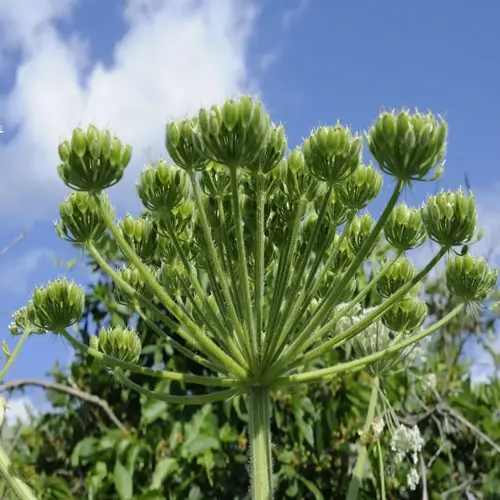

Socrates is the famous one. The plant that killed him was poison hemlock, Conium maculatum. Any retelling of Socrates hemlock poisoning that blames the water hemlock of North American ditches has grabbed the wrong plant. Both sit in the carrot family. They belong to separate genera and they kill by different chemistry.
Poison hemlock history is thin in most people's memory. There is a trial, a cup, and a plant called hemlock. The shared name does all the damage, because two different killers answer to it and only one of them was ever in that cup. Swap them and you teach someone to fear the wrong weed in the wrong place.
Family resemblance is the whole trap. Plenty of carrot-family plants throw up flat sprays of small white flowers on hollow stalks, so a quick glance hands you almost nothing to work with. You have to read the leaves and the ground under your boots. That is slow work, and the shared common name lets people skip it.
The botany is what settles it. Water hemlock gets called a close relative of the hemlock used to kill Socrates, and as family ties go that is true. It is also where the confusion breeds. Water hemlock carries a toxin called cicutoxin. It works straight on the central nervous system as a violent convulsant, and the plant Socrates drank did not hold a drop of it.
Put them side by side and they stop looking like twins. The Missouri Department of Conservation lists poison hemlock at up to 9 feet (2.7 m) tall, with fernlike leaves cut into fine segments, and it carries no strong tie to wet ground. Water hemlock stays married to soggy sites.
That habitat split is a useful way to keep the two apart in your head. Standing at a stream edge in front of a white flower head, water hemlock is the likelier of the two. If you are walking a dry field margin past something 9 feet tall, you are in the other story.
None of this is trivia you can skip. Identification advice written for one hemlock does not transfer to the other, since the height, the leaf shape and the ground they favor all differ. Learn the tall stem and the fine fernlike leaf of Conium maculatum and you still know nothing useful about the plant in the ditch behind the house.
Water hemlock causes most of the fatalities blamed on misidentification of poisonous plants in North America. Learn that plant on sight, and treat any hemlock advice you read as advice about one species, not two.
The historical detail people repeat least is the one worth keeping. Children have died from toy whistles cut from water hemlock stems, which is about as ordinary a way to meet a poisonous plant as there is. No cup, no trial, no famous last words. Just a hollow piece of stem and a kid in a wet meadow.
Read the wet ground as one clue when you are trying to name one of these plants. Poison hemlock leans away from wet sites rather than avoiding them, so let the leaves and the stem finish the job.
So the short answer stands. Every account of the Socrates hemlock poisoning points at one species, and it is not the plant in your local wet meadow. Water hemlock is a cousin with its own toxin and its own body count, and it is the one most likely to turn up where you live. Keep the two names apart and the rest of what you read about them will stop contradicting itself.
Read the full article: Water Hemlock: How to Identify and Stay Safe