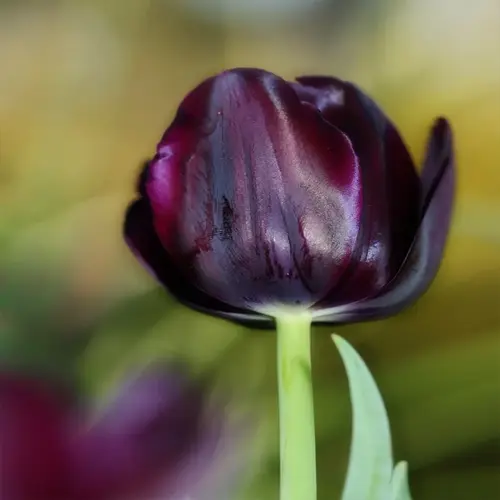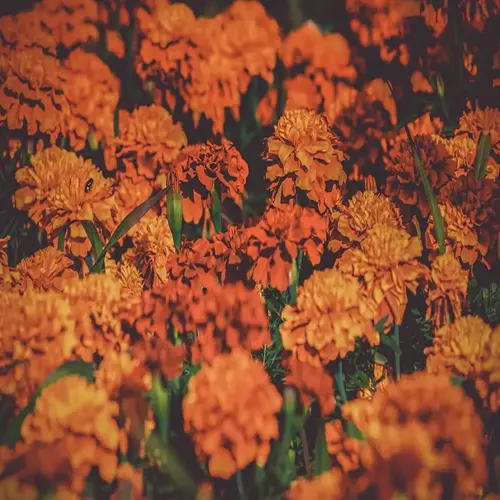

Introduction
Red flowers get their color from anthocyanin pigments. In about half of the red-flowered nightshades studied, orange carotenoids were layered in with them, and both routes land on the same shade. The choice that shapes your garden comes before any species name. Are you planting red for the view from the porch, or for the birds that work it? Those two answers send you to different plants.
Ng and Smith found red flowers in at least 65 angiosperm families. The color keeps getting built again on branches that are not related to each other. A later survey gathered 130 red-flowered species from 104 genera and 53 families, on every continent but Antarctica. The types of red flowers open to you run far past any list of 10, so counting them further does not help you pick.
The two pigment routes look the same to your eye, so a scarlet petal tells you nothing about the chemistry behind it. What red does tell you is who shows up. Red flowering plants are easy for birds to spot and much harder for bees. That matters more for your planting than red flower meaning, which is cultural convention about love and passion rather than anything the plant agreed to.
Start with the job you want done. For color you look at from a window, pick reds with a long bloom run and easy care. For hummingbirds, look past color to the shape of the bloom. Tubular flowers with deep, hidden nectar and no scent are the ones birds work hardest. Red is no guarantee, though. Ten species in that 130-species sample were pollinated by bees.
10 Red Flowers Worth Growing
You already expect a red rose and a red zinnia on a list like this, and both are here. Among 130 red-flowered species sampled worldwide, Chen and colleagues found 36.2% were hummingbird-pollinated against 7.7% bee-pollinated. That is the backdrop for the ten red flowers below, and flower shape is what tells you which ones sit in the bird camp.
The sun, soil and zone notes on these ten are general growing guidance rather than cited figures, so check each figure against your own conditions before you buy. Nursery specs drift between regions. The native red flowering plants further down carry sourced zones and bloom sizes, and you can hold those to the number.
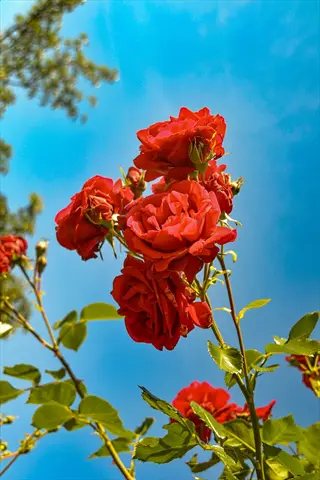
Red Rose
- Type: A woody shrub grown both as a garden plant and as the red cut flower most associated with the florist trade.
- Look: Petals range from bright scarlet through deep velvety crimson, and the darkest reds hold color best in cooler weather.
- Light: Roses want full sun for most of the day, since shaded plants flower less and hold moisture on the leaves.
- Bloom: Repeat-flowering types carry color from early summer until frost when spent blooms are removed on a regular schedule.
- Care: Water at soil level rather than overhead, and leave room around the canes so air moves between plants.
- Note: It carries the most familiar of the red flower conventions, and it appears on six of the seven biggest red flower lists.
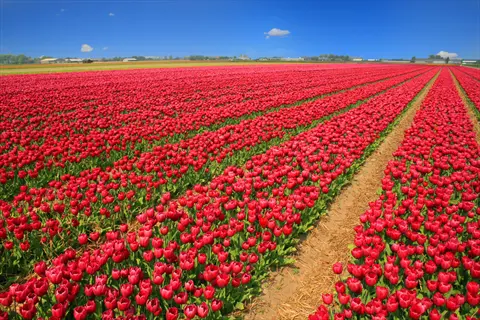
Red Tulip
- Type: A spring bulb planted in autumn, grown as a perennial in cold regions and treated as an annual in mild ones.
- Look: Cup-shaped flowers in solid scarlet or crimson sit on bare stems, so you read the color from across a garden.
- Light: Give tulips full sun and soil that drains fast, because bulbs sitting in wet ground rot before spring arrives.
- Bloom: Flowering runs for two to three weeks in spring, with early, mid and late types available to stretch the display.
- Care: Leave the foliage in place after flowering until it yellows, since the bulb is refilling itself during that period.
- Note: Red tulips are the classic mass-planting red, and the color arrives weeks before most red perennials have woken up.
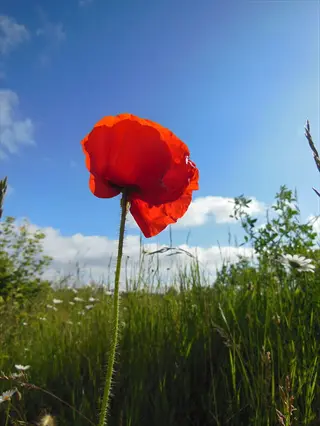
Corn Poppy
- Type: A hardy annual, sown directly where it is to flower, which self-sows once it settles into a bed.
- Look: Thin paper-like scarlet petals surround a dark center, and the flowers move in even a light breeze.
- Light: Full sun and poor, well-drained soil suit it better than rich ground, which produces leaves at the cost of flowers.
- Bloom: Each flower lasts only a few days, but a sown patch keeps producing new buds across several weeks of early summer.
- Care: Scatter seed on the surface in autumn or very early spring and avoid transplanting, since the roots resent disturbance.
- Note: The red poppy is the flower most often linked with wartime remembrance, so it carries weight the other reds do not.
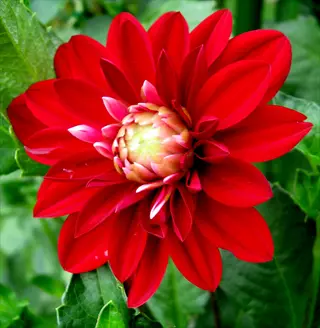
Red Dahlia
- Type: A tender tuber lifted and stored over winter in cold regions, and left in the ground where winters stay mild.
- Look: Red forms run from small ball shapes to dinner-plate flowers, with some cultivars pairing red petals with dark foliage.
- Light: Full sun and rich soil give the heaviest flowering, and taller cultivars need staking before the stems get heavy.
- Bloom: Flowering starts in midsummer and runs until the first frost, making dahlias the workhorse of late-season red color.
- Care: Cut spent flowers on a schedule, because a dahlia left to set seed slows down and stops producing new buds.
- Note: Red dahlias appear on four of the seven biggest published red flower lists, fewer than the rose or the geranium.
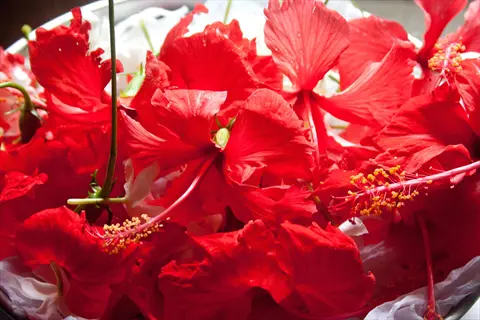
Red Hibiscus
- Type: A shrub grown outdoors in warm regions and kept in a container that moves indoors where winters turn cold.
- Look: Wide funnel-shaped flowers with a long central column, which is the shape the pollination literature ties to birds.
- Light: Full sun produces the most buds, though plants in very hot regions appreciate shade during the fiercest afternoon hours.
- Bloom: Individual flowers often last a single day, but a healthy plant opens fresh ones through warm weather.
- Care: Keep the soil moist and feed through the growing season, since flowering stops when a plant dries out.
- Note: Scarlet hibiscus, the native relative, carries deep red flowers 5 to 6 inches (13 to 15 cm) wide in zones 8 to 10.
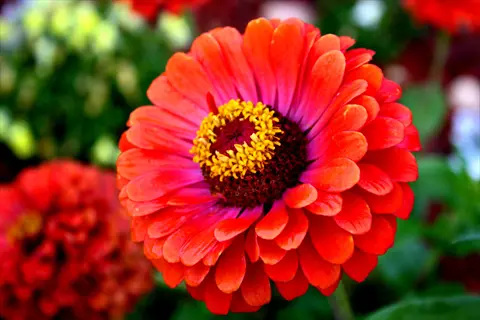
Red Zinnia
- Type: A fast annual grown from seed, flowering within weeks of sowing and thriving in the heat of high summer.
- Look: Flat daisy-shaped or fully double flowers in strong scarlet, held on upright stems that cut well for a vase.
- Light: Full sun and free air movement matter here, because crowded plants in still air pick up leaf spotting fast.
- Bloom: Cutting flowers makes the plant branch and produce more, so a picked zinnia patch flowers harder than an unpicked one.
- Care: Water the soil rather than the leaves, and thin seedlings early so each plant has room to build a frame.
- Note: Zinnias germinate fast and flower in the first summer, which makes a sensible first sowing if you are new to seed.
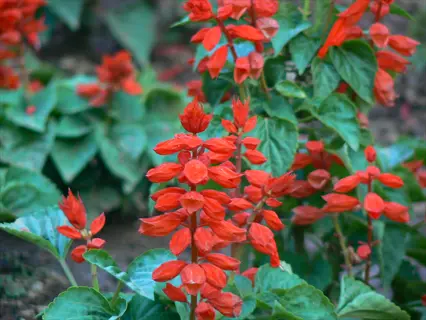
Scarlet Salvia
- Type: A bedding salvia grown as an annual in most regions, with narrow tubular flowers carried in upright spikes.
- Look: Dense spikes of tubular scarlet flowers rise above dark green leaves, holding color for weeks at a stretch.
- Light: Full sun to light shade suits it, and the plants keep flowering through heat that stops many other summer bedders.
- Bloom: Flowering runs from early summer until frost, with a light trim of finished spikes bringing on the next flush.
- Care: Give steady moisture in dry spells and avoid heavy feeding, which produces soft leafy growth at the cost of spikes.
- Note: Tubular red flowers like these match the bird-pollination pattern, so expect hummingbird traffic wherever the birds pass through.
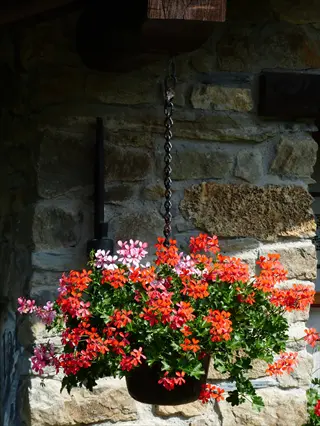
Red Geranium
- Type: A tender perennial grown as a container plant almost everywhere, and overwintered indoors in cold regions.
- Look: Rounded heads of small red flowers sit above scalloped leaves, giving a solid block of color rather than single blooms.
- Light: Six or more hours of direct sun keeps flowering heavy, while plants in shade stretch and produce fewer heads.
- Bloom: Flowering continues right through summer as long as finished heads are snapped off at the base of each stalk.
- Care: Let the top of the compost dry between waterings, since roots that never dry out are the usual cause of failure.
- Note: Geraniums appear on six of the seven major red flower roundups, which makes this one of the reds your eye looks for.
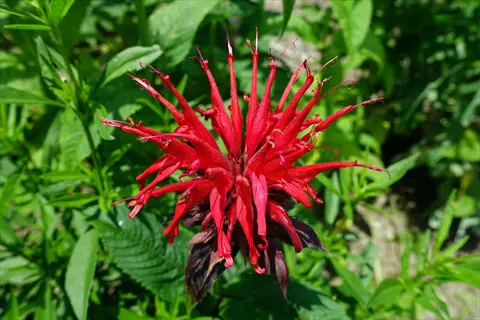
Bee Balm
- Type: A clump-forming perennial in the mint family, spreading at the root and easy to divide every few years.
- Look: Shaggy heads of narrow tubular red flowers sit on square stems, with aromatic leaves that release scent when brushed.
- Light: Full sun or light shade works, and good air movement around the clump keeps the foliage cleaner through humid weather.
- Bloom: Flowering runs through midsummer, and cutting the finished heads back encourages a lighter second showing later on.
- Care: Divide congested clumps in spring, because a crowded center flowers poorly and holds damp air around the leaves.
- Note: The narrow tubular flowers hold nectar deep inside, matching the structure that bird-pollinated flowers share.
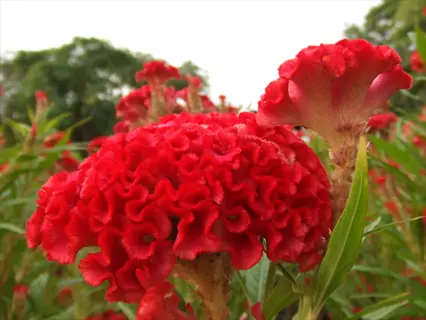
Celosia
- Type: A heat-loving annual grown from seed, sold both as the crested cockscomb form and as the feathery plume form.
- Look: Velvety crimson crests or upright plumes in intense red, holding color for weeks and drying well for arrangements.
- Light: Full sun and warm soil are essential, and seedlings sulk if you plant out before nights turn mild.
- Bloom: Flowering runs from midsummer into autumn, with the colored heads staying presentable long after other annuals fade.
- Care: Water at the base and keep the plants spaced, since crowded celosia in damp air develops leaf problems.
- Note: Celosia holds the deepest, most saturated red on this list, and it dries with almost no loss of color.
The coral honeysuckle on my mailbox post has worn the paint smooth where the stems wrap around it. I feel the bare wood every time I reach in for the mail. Red trumpets hang in loose clusters up the whole post, and a few open at a time from spring on. It climbs to 15 feet (4.6 m) and holds through zones 4 to 10. One morning I watched a hummingbird work the top clusters and pass over everything flat in the same bed.
Shape is the fastest filter you have. Narrow tubes with nectar set deep mark the bird flowers, which covers bee balm and the red salvia here. Flat open faces like the corn poppy and the red zinnia are easier to land on, so they stay open to a wider range of insects than a deep tube does. Grow both kinds in one bed and you keep something working it from midsummer to frost.
What Actually Makes Red
What makes flowers red? Two pigment families, and a plant can run either one or both at once. Anthocyanins are water-soluble pigments that sit in the sap inside each petal cell, and they cover pink, red, purple and blue. Carotenoids are the oily orange pigments you already know from carrots and marigolds. Red petals turn up in at least 65 flowering plant families, which is a lot of unrelated plants solving the same problem.
Think of two cooks with different ingredient lists pulling the same red cake out of the oven. One reaches for pelargonidin, the anthocyanidin carrying a single hydroxyl group, which reads red on its own. The other starts with purple or blue anthocyanins and layers orange carotenoids over them, and your eye adds the two up as red. Ng and Smith examined 27 red-flowered species in the nightshade family. 13 of them, or 48%, used the layered recipe and 11, or 41%, used anthocyanins alone.
Pigment is only half the answer. More than 250 anthocyanins occur in nature, all built from just six anthocyanidins, and their color swings with the pH of the cell holding them. The same red flower pigment leans blue in alkaline sap and red in acid sap. Acidify the vacuole of a petunia petal and the bloom shifts toward red, with no new pigment added.
- Used by 11 of the 27 red-flowered nightshade species studied, or 41% of that sample.
- Leans on pelargonidin, the anthocyanidin with a single hydroxyl group, which reads as red on its own.
- Species taking this route rarely added carotenoids as well: five of six lacked them entirely.
- Used by 13 of the 27 species studied, or 48%, making it the more common recipe in that family.
- Purple or blue anthocyanins are layered with orange carotenoids, and the mix reads as red to the eye.
- Carotenoids pull the perceived hue toward orange-red without producing a statistically different shade.
Both recipes land in the same place. Models of hummingbird and bee vision found no significant hue difference between the two routes, P > 0.05. Inside the nightshade family alone, red has evolved on its own at least 30 separate times. Most of those origins came in the last 10 million years of a roughly 50-million-year history.
We show that red-flowered species have converged on the same floral hue using either the sole production of red anthocyanin pigments or, more commonly, the dual production of purple or blue anthocyanins and orange carotenoid pigments.
Why Birds See Red, Bees Barely
Red is aimed at eyes, not noses. A bird-pollinated bloom holds ample nectar hidden deep in the tube, gives off no scent, and skips the nectar guides that other flowers paint on as landing stripes. That bundle of traits has a name. Botanists call it a pollination syndrome, and the USDA Forest Service keeps a table of the traits. Run that table like a checklist on a plant tag and you can guess which red flowers birds will work.
Can bees see red? Yes, but red barely stands out to them against green leaves. A 2020 survey of 130 species in the Annals of Botany measured the gap. Mean color contrast of red flowers to bees came out at 1.07 JNDs, about the point where two colors stop looking different to a bee. Contrast to birds generally ran past 10 JNDs.
I watched a bumblebee work the scarlet sage that self-sowed along my drive edge, most mornings last August. Those numbers stack the odds. They do not build a fence, and you will still catch bees working red. 10 of the 130 species in that survey were bee-pollinated.
Compared with other floral colours, red flowers are very conspicuous to birds and much less conspicuous to bees.
The same authors read that gap as avoidance more than attraction. Pure red, in their reading, spread because it shook bees off rather than because it pulled birds in. The payoff for you is the same either way. Shop for hummingbird flowers by shape first and color second, because bird pollination runs on deep tubes and stems stiff enough to perch on, and plenty of red blooms offer neither.
Native Red Flowers Worth Planting
Every plant below can be grown from seed or picked up at a native plant sale, which is not true of the patented cultivars that fill most red flower roundups. These native red flowers come off a UF/IFAS hummingbird garden list, so the picks lean Florida, but the ranges reach a lot further north than that. Coral honeysuckle holds zones 4 to 10 and climbs to 15 feet (4.6 m). Firebush wants zones 9 to 11 and runs 6 to 12 feet (1.8 to 3.7 m). Scarlet sage stays at 2 to 4 feet (0.6 to 1.2 m) in zones 7 to 11, and it self-sows.
A ruby-throat hangs at the cardinal flower spikes in the shaded fence corner behind my bed, works one tube after another down the stem, then swings to the next spike. Nothing else comes. The plant is entirely dependent on hummingbirds for pollination, because other pollinators have trouble reaching the inside of the flowers. Those spikes take zones 3 to 9, the coldest range in this group, and they want wet feet.
Coral Honeysuckle
- Range: Hardy in zones 4 to 10, one of the two widest zone ranges among the natives listed here.
- Size: Climbs to 15 feet (4.6 m) on a fence, trellis or post, so give it that much room to run.
- Flowers: Red trumpet-shaped blooms in clusters, the classic tubular structure that suits a hummingbird bill exactly.
- Conditions: Drought tolerant once established, so it suits a spot that gets watered less often than the main beds.
Cardinal Flower
- Range: Hardy in zones 3 to 9, making it the coldest-hardy red native option covered here.
- Flowers: Tubular red flowers on upright spikes that rise well above the foliage in late summer.
- Pollination: Entirely dependent on hummingbirds, because other pollinators have trouble reaching the internal structure of the flowers.
- Conditions: Wants steady moisture, so it belongs in a damp corner, a rain garden or a pond edge rather than a dry bed.
Firebush
- Range: Hardy in zones 9 to 11, and grown as a fast summer annual well outside that range.
- Size: Reaches 6 to 12 feet (1.8 to 3.7 m), which makes it a screen or a back-of-border plant rather than an edging one.
- Flowers: Orange-red tubular flowers produced across the warm season in clusters at the shoot tips.
- Conditions: Heat and drought tolerant, so it holds up in the hottest, driest corner of a southern garden.
Scarlet Hibiscus
- Range: Hardy in zones 8 to 10, dying back to the ground in winter and returning from the crown in spring.
- Size: Grows 4 to 8 feet (1.2 to 2.4 m) tall, with deep red flowers 5 to 6 inches (13 to 15 cm) across.
- Flowers: Wide open flowers with a long central column, held singly along the upper stems through summer.
- Conditions: Prefers moist soil, so pair it with cardinal flower in the same damp part of the garden.
Scarlet Sage
- Range: Hardy in zones 7 to 11, and it self-sows within that range.
- Size: Stays at 2 to 4 feet (0.6 to 1.2 m), which suits a mid-border position or a large container.
- Flowers: Tubular flowers in scarlet, pink or white, carried on open spikes from spring through fall.
- Conditions: The one native here with a sourced bloom window, flowering spring through fall within its range.
Red Buckeye
- Range: Hardy in zones 6a to 9a, flowering early in the season before many trees have fully leafed out.
- Size: Grows 15 to 20 feet (4.6 to 6.1 m), so it works as a small understory tree rather than a border plant.
- Flowers: Upright panicles of tubular red to burgundy blooms held above the newly opened leaves.
- Caution: All parts of the plant are poisonous to people and toxic to pets if eaten, so placement matters.
Red also clusters by family in a way you can see on the ground. At Arches National Park, 5 of the 8 red-flowered species on record sit in the figwort family. That group holds two paintbrushes, two penstemons and scarlet monkey-flower. One desert park proves nothing about the rest of the country. It does show how narrow a regional red palette can get.
So ask your own state extension service for the native list that fits your rainfall and your winter lows, then read this one against it. A gardener in zone 5 gets coral honeysuckle and cardinal flower off this page and not much else. Scarlet hibiscus needs zone 8 to survive a winter outdoors, and it dies to the ground even there.
All parts of red buckeye are poisonous to humans and toxic to pets if eaten, and coral bean seeds are poisonous. Both are still worth growing; keep them away from a play area or a run where a curious dog spends the day.
Choosing Red for Your Site
How much sun does the spot get? Count the hours of direct sun in midsummer, when the trees are fully leafed out, not in April when the branches are still bare. The best red flowers for full sun want six hours or more, which covers most of the plants on this page. Shade cuts the list fast. A bed under a maple narrows you to red flowers for shade, and that short list gives you fewer blooms than the same space in sun.
Which hardiness zone are you in? Check it against the plant before you pay, because a shrub rated for zones 9 to 11, like firebush, is only a summer annual in zone 5. Red perennials such as cardinal flower, hardy from zone 3 to 9, come back on their own. Then look at the ground. How wet does the spot stay two days after heavy rain? Cardinal flower and scarlet hibiscus want soil that holds water, and firebush does not.
What is the red for? If you want color alone, buy whatever shade pleases you and stop there. If you want birds, shape matters more than color. The USDA Forest Service puts it plainly. Flower type, shape, color, odor, nectar and structure vary with the pollinator that visits. Those traits predict which pollinator will help the flower. Look for a long tube, no scent, and nectar held deep.
- Light: Count the hours of direct sun the spot gets in midsummer, since most red flowers listed here want six or more.
- Zone: Check your hardiness zone against the plant before you buy, because a zone 9 shrub is a summer annual in zone 5.
- Moisture: Notice whether the spot stays damp after rain. Cardinal flower and scarlet hibiscus want that, while firebush does not.
- Purpose: Decide whether the red is for looks or for birds, because tubular flowers with hidden nectar serve the second goal.
- Safety: Check toxicity before planting near a play area, a pet run or a path where fallen seeds get picked up.
- Scale: Match mature size to the space so a plant reaching 15 to 20 feet (4.6 to 6.1 m) never lands in a narrow bed.
Run the safety check before you dig, not after. All parts of red buckeye are poisonous to people and toxic to pets if eaten, and coral bean seeds are poisonous too. A dog run or a play area rules those two out of that bed. The same goes for red flowers for containers on a patio, where a pot sits at chest height for a small child. Move the pot, or grow something else in it.
Keeping Red Going All Season
Three plants can hold red in one bed from early spring to the first hard frost. You want a bulb that opens early, one plant that blooms for months in the middle, and something that peaks late, with each window overlapping the next by a few weeks. Red flower bloom time is the line on the plant tag worth reading twice.
Scarlet sage carries the middle of that bed. UF/IFAS records tubular flowers on it from spring through fall in zones 7 to 11, and it holds at 2 to 4 feet (0.6 to 1.2 m), so it sits in the front half of a border without hiding anything. Put red tulips in front for the opening weeks and a dahlia behind it for the close. That is succession planting with three plants instead of a full nursery cart.
Tie each handoff to your own frost dates, not to month names. Tulips break ground when the soil warms, and the sage and the dahlia tubers both go out once nights stay mild after your last spring frost. Deadheading holds the middle together. Cut spent sage and zinnia stems back to the next leaf pair once a week, and the plants keep setting buds instead of seed.
Late Winter
Order poppy and zinnia seed now, and prune roses while the plants are still dormant.
Spring
Red tulips carry the first color, and tender annuals go out once nights stay mild after your last frost date.
Summer
Bee balm, salvia, hibiscus and zinnias overlap here. Deadhead weekly to keep new buds coming.
Fall
Dahlias and celosia hold the display until frost. Then bulbs go in and you cut the perennials back.
Red flowers all season come from planning those handoffs, not from buying more plants. Good red flower garden design keeps all three bloom windows in one sightline, so the bed never looks half empty, and it leaves the gaps you need for fall bulb planting that starts the whole cycle again.
Common Myths
Bees cannot see red flowers at all, which is why red blooms belong to hummingbirds and to nobody else.
Bees see red poorly, not never. Chen and colleagues measured 1.07 JNDs of contrast to bees, and 10 of their 130 sampled species were bee-pollinated.
Every red flower gets its color from one shared red pigment that all red-blooming plants happen to produce.
Red comes by at least two recipes: red anthocyanins on their own, or purple and blue anthocyanins combined with orange carotenoids in the same petal.
Planting anything red is enough on its own to bring hummingbirds into a garden that had none before.
Color is one trait among several. The USDA lists bird flowers as odorless, with ample deeply hidden nectar and a funnel shape offering strong perch support.
Red garden flowers are ornamental, so they are all safe around children, dogs and cats that share the yard.
Not all of them. All parts of red buckeye are poisonous to people and toxic to pets if eaten, and coral bean seeds are poisonous.
Conclusion
Check your zone first. That one number cuts the list of red flowers down to what will live through your winter, and it saves you the money you would spend on something that dies in March. Then pick one long blooming red to carry the bed. Scarlet sage does that job in zones 7 to 11. It holds at 2 to 4 feet (0.6 to 1.2 m), so it fits a bed edge or a wide container without hiding what grows behind it.
Next add one tubular native for the birds, and cardinal flower is the one to start with, since it is hardy from zone 3 to zone 9. UF/IFAS Extension says it depends on hummingbirds alone for pollination. Other pollinators have trouble reaching the inside of the flower. That makes it a dependable first planting for a hummingbird garden. It also comes back on its own, which gives you one of the red perennials you plant once and then leave alone.
Plant a second wave after that, or the color quits by late summer and the birds move on. Native red flowers stagger well. Pair an early bloomer with one that peaks later, and let coral honeysuckle cover a fence or an arbor in zones 4 to 10. Two bloom windows keep the traffic steady instead of packing every visit into three weeks.
Two of these belong nowhere close to kids or dogs. All parts of red buckeye are poisonous to people and toxic to pets, and coral bean seeds are poisonous as well. Keep both away from a play area or a dog run, or skip them and let scarlet sage and cardinal flower do the work. Red is a signal built far more for birds than for bees, so plant it where a bird will find it.
Glossary
- Anthocyanin
- A water-soluble plant pigment that produces pink, red, purple and blue color in flowers, fruits and leaves.
- Carotenoid
- An orange or yellow plant pigment that can sit alongside anthocyanins in a petal and pull the color toward orange-red.
- Just-noticeable difference
- A unit describing how easily an animal can tell two colors apart, where roughly one unit sits at the edge of what it can distinguish.
- Pelargonidin
- The anthocyanin type carrying a single hydroxyl group, which reads as red on its own without any other pigment.
- Pollination syndrome
- The set of flower traits, such as color, shape, scent and nectar, that together predict which animal pollinates a plant.
- Succession planting
- Planting things that flower at different times so color continues instead of arriving all at once.
- Tubular flower
- A flower shaped like a narrow tube, holding nectar deep inside where only a long bill or tongue can reach it.
- USDA hardiness zone
- A number that describes how cold winters get in an area, used to judge whether a plant survives there year round.
External Sources
Frequently Asked Questions
What do red flowers mean?
Red flowers carry a widely shared association with love, passion and strong feeling, but that meaning is cultural convention rather than documented botanical or historical fact.
Why are some flowers red and others blue?
Both usually come from the anthocyanin family. Pigments carrying more hydroxyl groups read purple or blue, and cell acidity can shift color back toward red.
What are the most popular red flowers?
The red flowers that recur across the seven biggest published lists are:
- Red rose
- Red tulip
- Red poppy
- Red hibiscus
- Red geranium
- Red zinnia
- Red salvia
- Red dahlia
Which flower says I love you?
The red rose is the flower conventionally read as a declaration of love, and it is the most familiar of the red flower conventions.
Are red flowers always romantic?
No. The red poppy is widely linked with remembrance, the poinsettia with Christmas, and the red spider lily with death in Japan, so the setting decides the reading.
Why do hummingbirds like red flowers?
Hummingbirds see red strongly and need large amounts of nectar, and the red flowers they feed from are usually tubular, odorless and hold nectar deep inside.
Can bees see red flowers?
Yes, but poorly. Red flowers averaged 1.07 JNDs of chromatic contrast to bees, close to the discrimination threshold, against generally more than 10 JNDs to birds.
Are red flowers poisonous to pets?
Some are. All parts of red buckeye are poisonous to people and toxic to pets if eaten, and coral bean seeds are poisonous.
What is a rare red flower?
No source consulted here ranks red flowers by rarity. The label normally points to a restricted range, so ask about a plant's distribution rather than its color.
What color flowers say I'm sorry?
No source documents a reliable color code for an apology. The one well-attested reading is red for love, which competes with the message.