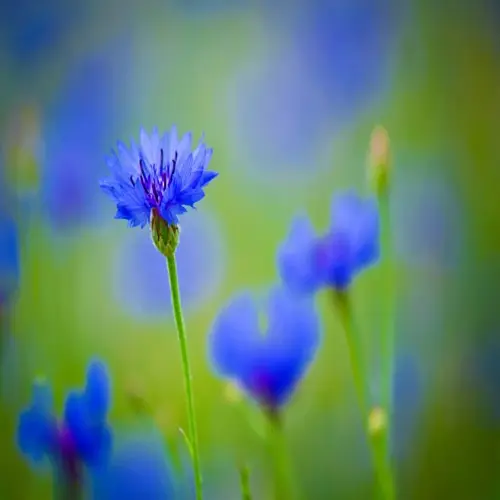
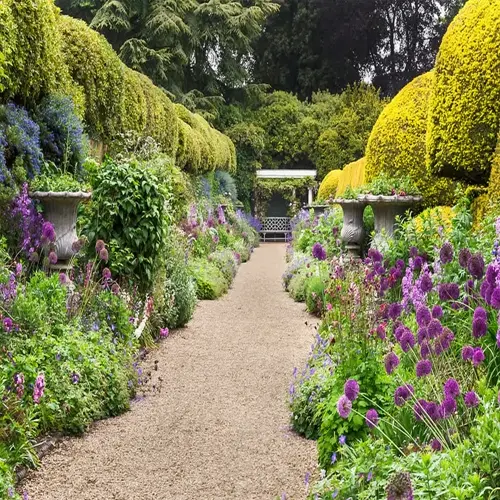
Introduction
No plant on earth makes a truly black bloom. The black flowers in every catalog are red and purple pigment packed so thick that your eye stops sorting the color and calls it black. Wang and colleagues, writing in Current Issues in Molecular Biology, state that no plant in nature is purely black. True black flowers are not a rare prize you have somehow missed. They are not out there at all.
The pigment doing the work is a group of compounds called anthocyanins. Cyanidin leans magenta and red purple. Delphinidin leans purple and blue red. A bloom only looks black when it packs in far more of both than an ordinary red or purple one ever does. Black chocolate cosmos carries 3 to 4 times the total anthocyanin of the red form, and that is the whole trick.
What that pigment is decides where you put the plant. Anthocyanin soaks up light instead of bouncing it back, so near black flowers have nothing to show unless something around them is bright. Set one against dark mulch or a shaded fence and the shape disappears. Keep the hard midday sun off the petals, put a pale leaf or a gravel path behind them, and the same flower reads black.
Most people meet these plants as a photo and then watch their own bud open maroon. That gap is not bad luck, and it is not a mislabeled plant either. Dark flowers hold the same pigment in both places. The light and the backdrop decide how much of it you see, so pick the spot before you pick the cultivar.
10 Near Black Flowers to Grow
I planted a dark bed against a pale limewashed wall, and by lunchtime the flowers read as flat purple instead of black. The Queen of Night tulip was the worst of it. It holds more total anthocyanin than any of the five cultivars Li and colleagues measured, and in bright midday sun it still comes back deep maroon.
Every flower below earns its spot on how dark the bloom reads, not on dark leaves or moody photos. For each of these 10 near black flowers you get the pigment behind the color and the light that makes it look black. Zone and height claims on cultivar pages come from seller copy, not research. Read the growing notes as general guidance and put your effort into where you plant each one.
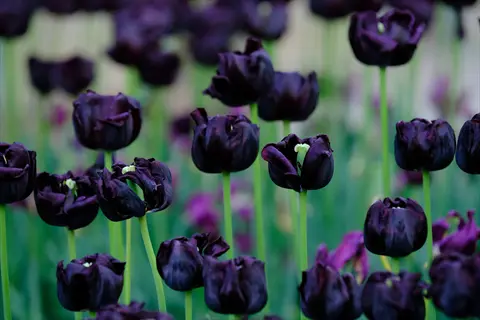
Tulip Queen of Night
- Color: Deep maroon black cups on tall stems, the dark tulip that appears on six of the seven ranking pages.
- Why it is dark: Delphinidin derivatives reach 72.2% of its anthocyanin content at bloom, and its total anthocyanin was the highest of five tulips tested.
- Reads black when: Viewed in shade or at dusk, because flat midday sun brings the maroon straight back to the surface.
- Where to site it: In front of a pale wall, silver foliage or white tulips so the flower shape stays visible.
- Growing note: Bulbs go in during autumn in free draining soil, and the display is a short spring event.
- Watch for: Scattered single bulbs vanish at a distance, so plant them in tight groups rather than dotted through a bed.
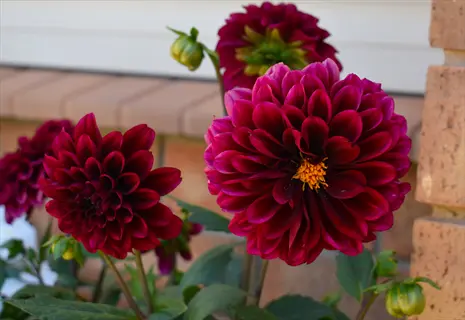
Dahlia Arabian Night
- Color: Wine red doubles that read close to black once the evening light goes flat across the border.
- Why it is dark: In black dahlias, silenced flavone synthase stops competing for substrate and lets cyanidin build up in the petals.
- Reads black when: Set beside chartreuse foliage or cream flowers that give the dark petals a visible edge.
- Where to site it: Full sun beds with room to spread, or large containers standing close to a seating area.
- Growing note: Tubers go in after the frost risk passes and are lifted for dry storage in cold winters.
- Watch for: Heavy blooms flop after rain, so stake the plants early instead of propping them up later.
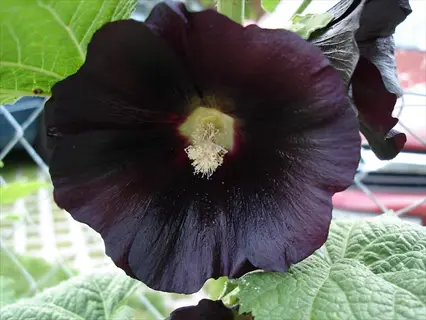
Hollyhock Nigra
- Color: Almost black single flowers stacked up tall spikes, sold under the names Nigra, Blacknight and Black Watchmen, which sources use inconsistently.
- Why it is dark: Dense anthocyanin in thin petals, which is exactly why backlight turns the flowers deep red.
- Reads black when: Backed by a pale fence or wall rather than seen against bright open sky.
- Where to site it: At the back of a sunny border where the tall spikes have shelter and support.
- Growing note: Often grown as a biennial that flowers in its second year and then self sows around the bed.
- Watch for: Rust on the lower leaves, so keep air moving between plants and clear fallen leaves through the season.
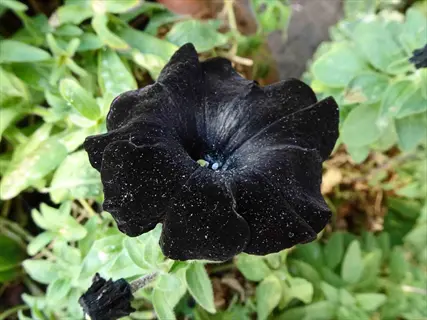
Petunia Black Velvet
- Color: Velvety near black trumpets, described by Extension growers as velvety dark purple rather than true black.
- Why it is dark: A very heavy load of anthocyanin, the pigment family the literature names as the one that paints flowers black.
- Reads black when: Grown in containers at eye level, where the velvet texture holds the dark tone all day.
- Where to site it: Sunny pots and window boxes, paired with silver or lime foliage for contrast.
- Growing note: UF/IFAS Extension lists this one as Black Cat, alongside Phantom and Pinstripe among the dark petunias for warm gardens.
- Watch for: Leggy stems by midsummer, so trim the plants back to keep new flowers coming.
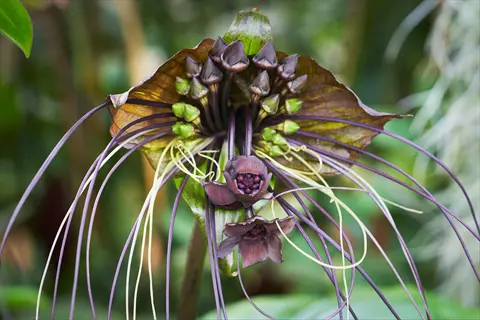
Black bat flower
- Color: Maroon black bracts shaped like wings, with long trailing bracteoles that hang down like whiskers.
- Why it is dark: Heavy anthocyanin pigmentation, covered in the same reviews that describe black tulips and black orchids.
- Reads black when: Grown in shade, which is also where the plant grows in forest understory.
- Where to site it: Warm humid shade, which outside the tropics usually means a greenhouse or a bright indoor spot.
- Growing note: Populations studied in southwest China are mostly self pollinating despite that theatrical display.
- Watch for: Dry indoor air, which this plant handles worse than the humidity it grew up in.
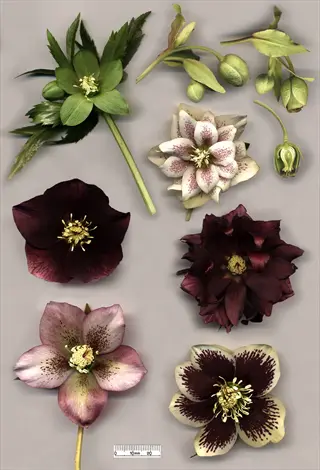
Hellebore Onyx Odyssey
- Color: Dark plum black doubles that open in late winter when almost nothing else in the garden is flowering.
- Why it is dark: Dense anthocyanin in thick sepals, the same pigment route behind every other near black flower here.
- Reads black when: Lifted toward the viewer, since the flowers nod and hide their faces toward the ground.
- Where to site it: Dappled shade beside a path, on a slope or raised bed where the flowers face you.
- Growing note: Cut the old leaves away in late winter so the new flowers are visible as they open.
- Watch for: Dark flowers disappearing into shaded soil, so lay a pale gravel mulch underneath them.
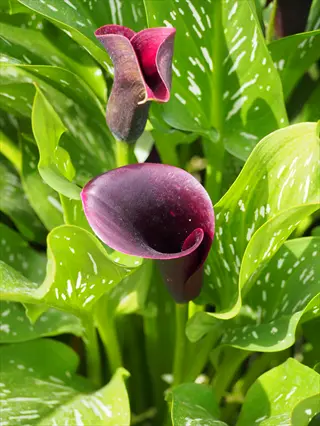
Calla lily Black Star
- Color: Glossy near black spathes with a sculptural shape that photographs darker than it reads outdoors.
- Why it is dark: Zantedeschia is one of the black flowered plants covered directly in the anthocyanin literature.
- Reads black when: The glossy surface catches one highlight against a pale background, which sharpens the outline.
- Where to site it: Warm sunny beds and containers with steady moisture right through the growing season.
- Growing note: Tubers are planted in spring and lifted for winter storage wherever the ground freezes hard.
- Watch for: Near identical cultivars sold as Odessa, Captain Black and Dark Star, so check the flower photo before buying.
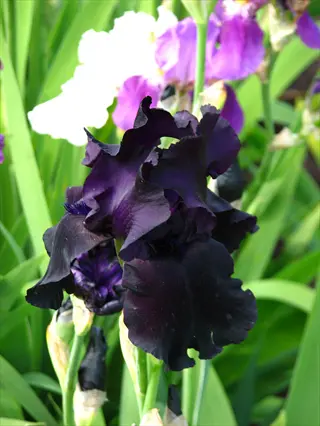
Iris Black is Black
- Color: Velvet purple black falls and standards, among the darkest bearded iris cultivars in the catalogues.
- Why it is dark: Dense anthocyanin again, which reads black in low light and turns clear purple when light passes through the falls.
- Reads black when: Light comes over your shoulder, because backlight turns the same flower clear purple.
- Where to site it: Full sun with sharp drainage, rhizomes sitting at the soil surface rather than buried.
- Growing note: Divide the clumps every few years so the plants keep flowering strongly.
- Watch for: A short flowering window, so pair it with later perennials that carry the bed through summer.
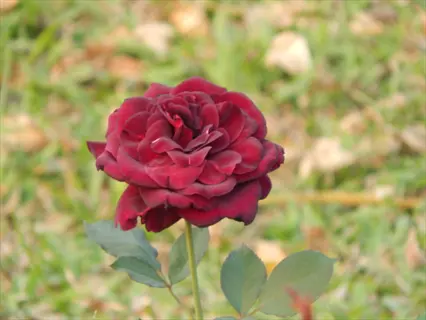
Rose Black Baccara
- Color: Very dark red, close to black in shade, and plain red once direct sun lands on the petals.
- Why it is dark: Dense red anthocyanin, and since petals hold no black pigment, the color stops at very deep red.
- Reads black when: Cut and brought indoors, or seen in shade, where the red loses most of its brightness.
- Where to site it: Full sun with good air movement, near a seat where the flowers can be seen close up.
- Growing note: Treat it as a florist type hybrid tea grown for cutting rather than for mass planting.
- Watch for: Any rose sold as pure black, which is either this kind of very dark red or a dyed flower.
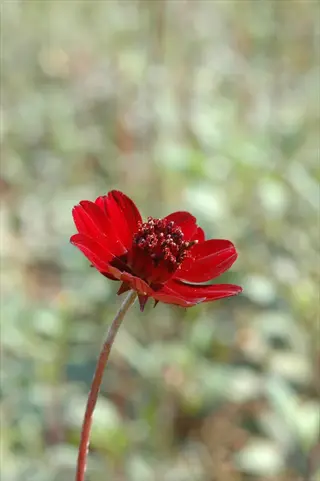
Chocolate cosmos
- Color: Small velvety maroon black daisies carried on wiry stems through summer and into autumn.
- Why it is dark: The black form carries about 3 to 4 times the total anthocyanin of the red variety.
- Reads black when: Seen close up against a pale gravel path rather than across a busy mixed border.
- Where to site it: Sunny well drained soil, or containers where the tubers can be kept dry over winter.
- Growing note: The literature names cultivars such as Choco Mocha and Brown Rouge within this species.
- Watch for: Slow starts in cold springs, since the plants only pick up once the nights warm.
Two of these need a warning before you order. The black bat flower wants warm humid shade and sulks in dry indoor air, so you want a greenhouse or a bright indoor spot rather than a border. The Black Baccara rose is a florist hybrid tea, near black in shade and plain red in sun, and it does its best work cut and brought into your house. Want a dark bloom whose pigment load has actually been measured? Plant chocolate cosmos, which carries 3 to 4 times the pigment load of the red variety.
Why No Flower Is Truly Black
Petals contain no black pigment at all. The near black tulip you buy is red and purple pigment packed so densely that your eye runs out of light to read. You will see melanin blamed for it on gardening blogs. The plant literature gives melanin no role in petal color. What you are looking at is anthocyanins, the pigment family behind a red rose and a blue cornflower.
Two of those anthocyanins do most of the darkening. Cyanidin reads magenta to reddish purple. Delphinidin reads purple and blue red, and a petal that stacks both absorbs across most of the visible range at once. Picture sheets of red and purple stage gel taped over one lamp. Keep adding sheets and the bulb still burns, but almost nothing gets through to you. The petal does that chemically, with pigment instead of plastic.
Anthocyanins do all the coloring
- What they are: The pigment family behind red, purple and blue flowers, named in the literature as the pigments that paint flowers black.
- How black happens: Stack enough of them into one petal and almost no visible light comes back out to the eye.
- What is missing: Petals hold no black pigment, which is why no plant in nature is purely black.
Cyanidin builds the red black route
- Color it gives: Cyanidin based anthocyanins read magenta to reddish purple before they stack up into near black.
- Where it leads: Cyanidin is named as the key factor in black pigmentation across flowers, leaves and fruit.
- Worked example: Black chocolate cosmos carries cyanidin 3-O-glucoside and cyanidin 3-O-rutinoside as its two main pigments.
Delphinidin builds the purple black route
- Color it gives: Delphinidin based anthocyanins read purple and blue red, which is the darker end of the flower palette.
- Worked example: In the black tulip Queen of Night, delphinidin derivatives reach 72.2% of total anthocyanin content at bloom.
- Gene behind it: High TgF3'5'H expression shifts synthesis into the delphinidin branch, and its peak reading in the black tulip at bloom was 10.4x the lowest, which was measured in a white cultivar.
Regulator genes turn the volume up
- Master switches: R2R3-MYB transcription factors sit upstream and set how much pigment the flower actually makes.
- Named examples: PeMYB11 in Phalaenopsis equestris, PeMYB7 in the Panda orchid, and CsMYB90 in purple tea leaves.
- Another route: In dahlias, silencing flavone synthase removes competition for substrate so cyanidin can accumulate freely.
How dark your flower gets depends on which branch of the flavonoid pathway the plant favors. Li and colleagues measured that split in tulips. Delphinidin derivatives made up 72.2% of the anthocyanin in Queen of Night at bloom. The gene steering that branch, TgF3'5'H, peaked at 10.4x the lowest reading in the study, which came from a white cultivar. You are still looking at no black flower pigment, only more of the same purple.
In fact, there is no plant in nature that is purely black.
So the honest label is near black, and that changes how you plant these. A bloom that leans on stacked pigment needs a bright backdrop and soft light to read black for you instead of muddy burgundy.
How Dark Do Black Flowers Really Get
Every flower sold as black is deep red, deep purple, or deep maroon that your eye rounds off. A convincing one differs from a muddy one by how much black flower pigment sits in the petal, and that load varies far more than catalog photos suggest. The darkest flower on record is not a garden plant at all. It grows wild in Mexico, and it is darker than the near black flowers at your nursery.
I planted a chocolate cosmos at my path edge, and it smells like cocoa when the sun hits it near noon. Up close the petal is dark burgundy velvet that soaks up light instead of shining. Come back at dusk and the same flower reads flat black against the gravel. Black chocolate cosmos carries 3 to 4 times the total anthocyanin of the red variety.
Lisianthius nigrescens is the benchmark no nursery plant touches. Wang and colleagues put anthocyanins in this wild Mexican gentian at about 24% of its petal dry weight. A load that heavy can soak up nearly all the light that hits the petal. Garden lists work in a different way, since they mix bred cultivars with wild dark species, so you are often putting two plants side by side that got their color by different routes. Judge them on what was measured, not on the name printed on the tag.
What Black Petals Do for Plants
Black flowers and pollinators make an odd pair. Bees and butterflies steer toward bright color, and a review by Sagheer Ahmad and colleagues (2022) calls black the least appealing color an insect can be offered. So why would a plant pour energy into a bloom most visitors look past? The answer is physics, not advertising.
Dark petals soak up the long wavelengths of light that pale petals bounce away, and that light turns into heat inside the flower. Warm petals mean warm nectar. This is the greenhouse effect in petals, and the size of it is modest rather than dramatic. Across one subalpine meadow, mean flower temperature ran from 1.6°F (0.9°C) below the surrounding air to 4.7°F (2.63°C) above it. That range covers every flower measured there, not dark ones alone. On a cold morning, warm nectar buys a plant more than a bright petal does.
The major benefit of black color is the greenhouse effect it generates by absorbing long wavelengths of light, thereby providing warmth inside petals and warm nectar to attract more pollinators during the winter.
Heat is not the only payoff. Anthocyanins and stress tolerance travel together. A pigmented flower holds up better under drought, heat and strong sun than a white one does. The same pigment load that reads as black to your eye is also the plant's own sunscreen, doing two jobs at once.
The Black Bat Flower Paradox
The black bat flower is the plant people photograph before they ever read a word about it. Two maroon black bracts spread like wings above a cluster of small dark blooms, and long thin bracteoles trail below them like whiskers. Tacca chantrieri hands you all of that on one stalk in deep shade. So what is the show for?
The easy answer is flies. A dark, drooping floral display with trailing filaments looks like textbook fly pollination, and that is how most garden writing explains the plant. Then Zhang and colleagues measured what four populations in southwest China actually do, and the numbers went the other way. Selfing rates averaged 0.86, with a low of 0.76 and a high of 0.94.
- Bat winged maroon black bracts, the signature image in almost every black flower roundup.
- Long trailing bracteoles like whiskers, a look associated with fly deceit pollination.
- A shape and color that reads as an outcrossing syndrome built to pull insects in.
- Populations studied in southwest China are predominantly self pollinating.
- Selfing rates averaged 0.86 across four populations, ranging from 0.76 to 0.94.
- Genetics agree: 90.62% polymorphism across the species, only 32.7% within populations.
Despite considerable investment in elaborate floral displays, Tacca chantrieri populations are predominantly selfing.
The genetics tell the same story. Across the species, 90.62% of 160 ISSR bands came back polymorphic, so the plant as a whole still holds plenty of variation. Inside any one population that figure dropped to 32.7%. Groups that keep breeding with themselves shed variation fast, and habitual self pollination leaves this exact pattern in the DNA.
That leaves a real hole in the science. The authors call it a mismatch between floral morphology and mating system, and the paper leaves what the bat wings are doing for the plant unresolved. They may pull in the odd insect, or they may be left over from an ancestor that needed them more. Grow one for the display you can see, and treat what it is for as an open question.
Make Near Black Read as Black
By noon the black hollyhocks I planted along the gravel path stop looking black. From the kitchen window they read plain burgundy, and against the weathered fence behind them they nearly vanish. By 7 p.m. the same stems go inky again.
Nothing about the plant changed. Near black petals hold their color against a pale backdrop, in shade or at dusk, and strong midday sun turns them burgundy or muddy brown. Apland and colleagues found that closed flowers reflecting more light across the 500 to 900 nm band stayed cooler. Dark petals do the opposite and take in more of that range, so what you see depends on the light you give them and on where you stand.
So how to make black flowers stand out? Start with what sits behind them. Contrast planting does the work for you. Put white phlox or silver artemisia at the back of a dark bloom and your eye gets an edge to read, so the flower shape steps forward instead of sinking into the soil. A black and white garden is built on that one effect, and it beats swapping cultivars until you find a darker one. Run the checklist below before your dark bloom goes in the ground.
- Backdrop: Set dark blooms against pale walls, silver foliage or white flowers so the flower shape stays readable.
- Light: Meet each plant's own light needs first, then judge the color in morning light or at dusk, when the black holds.
- Grouping: Plant in groups rather than singles, because one dark flower reads as a gap from across the garden.
- Height: Lift them into raised beds or containers so the color sits close enough to the eye to register.
- Photos: Shoot in soft overcast light and expose for the petal rather than the background behind it.
Judge a black cultivar at noon and again at dusk before you commit a whole bed to it. The two views are effectively two different flowers.
Photographing dark flowers works on the same rule. Bright sun blows out the sheen on a petal and flattens the shape. Shoot under cloud or in the hour after sunrise, and expose for the petal so the background falls away behind it. A moody garden almost always photographs blacker than it looks in person, which is worth knowing before you judge a plant by someone else's picture.
Common Myths
Black flowers get their color from melanin, the same dark pigment that colors human skin and hair.
Peer reviewed plant science credits anthocyanins, mainly cyanidin and delphinidin. Melanin has no supported role in petal color.
Catalogues sell truly black flowers, so pure black blooms clearly exist somewhere in nature already.
A 2023 review states plainly that no plant in nature is purely black. Catalogue blacks are dense red and purple pigment.
The black bat flower wears its dramatic dark display to pull in specialist pollinating insects.
Populations studied in southwest China are predominantly self pollinating, averaging 0.86, and the paper leaves the display purpose unresolved.
Dark petals are pure decoration and give the plant nothing useful in return for the pigment.
Dark petals absorb long wavelengths and warm the flower and its nectar, and pigmented flowers tolerate stress better than unpigmented white ones.
Conclusion
Order the tulip bulbs this week. Autumn planting is the one job here with a real deadline, and a bulb you skip now costs you the whole of next spring. Plant them in groups of a dozen or more, because one dark tulip alone just vanishes into a bed. Hellebores follow in late winter, the summer annuals go in last, and that order gives a gothic garden something dark in bloom for most of the year.
Put something pale behind each plant before you dig. A whitewashed wall, light gravel, silver artemisia, even a gap of bright sky at the end of a path. Dark petals have no edge of their own, so your eye needs a bright surface behind them to find the shape at all. The backing matters more than the cultivar name on the label.
The pigment sets a hard ceiling on all of this. Delphinidin derivatives make up 72.2% of the total anthocyanin in Queen of Night petals at bloom. Delphinidin is a purple blue pigment, not a black one. Stack enough of it into a petal and your eye gives up and reads the flower as black. Stand that same tulip under overhead sun at noon and the red and purple come straight back. No breeder has beaten that, so what you are planting are near black flowers.
Black flowers are red and purple pigment laid on until your eye stops sorting it out. Siting does the rest, which makes dark blooms more a question of garden design than of shopping. Plant them where the light is low and the wall behind them is bright.
Glossary
- Anthocyanin
- The pigment family that colors flowers red, purple and blue, and the pigment that makes petals look black when it builds up densely.
- Bracteole
- A small leaf like structure beside a flower; in the black bat flower these hang down as long whisker like threads.
- Cyanidin
- An anthocyanin that reads magenta to reddish purple and is the main pigment behind many near black flowers.
- Delphinidin
- An anthocyanin that reads purple to blue red and dominates the pigment in the black tulip Queen of Night.
- Petal dry weight
- The weight of a petal once all its water is removed, used to measure how much pigment it holds.
- Selfing rate
- The share of seed a plant produces using its own pollen instead of pollen from another plant.
- Spathe
- The single large sheath like bract that wraps a calla lily flower and gives it its shape.
- Transcription factor
- A regulator gene that switches other genes on or off, controlling how much pigment a flower actually makes.
External Sources
Frequently Asked Questions
Do any plants have black flowers?
No plant produces a truly black flower. Dozens of cultivars come close, reading black at dusk and dark maroon or purple in bright light.
What is the darkest flower in the world?
Lisianthius nigrescens, a wild Mexican gentian, is the darkest flower on record. Its pigment load is thought to enable near complete absorption of visible and ultraviolet light.
What is the rarest flower color?
Black sits at the rare end. Reviews call black flower color very rare in nature, produced by only a few species, and petals hold no black pigment at all.
What do black flowers symbolize?
The usual associations are mystery, elegance, power, mourning and rebirth. These readings come from florists and garden writing, not from plant science.
What are some dark and gothic flower names?
Growers lean on night, stone and shadow imagery. The names that show up most often are:
- Tulip Queen of Night, also listed as Queen of the Night
- Dahlia Arabian Night
- Petunia Black Velvet, also sold as Black Cat
- Hellebore Onyx Odyssey and Dark and Handsome
- Iris Black is Black, Hollyhock Nigra and Blacknight
What plants make a good witchy or goth garden?
Florida Extension growers point to dark petunias, near black coleus, purple black sweet potato vine, rayless sunflower and moonflower for night interest.
What is the darkest rose color?
Very deep red that looks almost black in shade. Black Baccara is the cultivar named most often, and it reads dark red in direct sun.
Is there such a thing as a true black rose?
No. Plant science is clear that no plant in nature is purely black, so a rose sold as black is a very deep red that reads black in shade and red in sun.
Why do black flowers look purple in sunlight?
Because the petals are packed with red and purple anthocyanins rather than a black pigment, and strong light brings the underlying hue back out.
Do bees and other pollinators like black flowers?
A 2022 review calls black the least attractive color to pollinators, and the same review proposes that dark petals warm nectar, drawing pollinators in cold conditions.