Introduction
Blue flowers are real, and they are rare. Most of what a plant tag or a catalog list calls blue will read violet once you get it home and it opens in your bed. Fewer than 10% of the roughly 300,000 known flowering plant species look blue to your eye. A 2021 review in Frontiers in Plant Science counted the color in just 372 of 14,038 plant genera, and in 53 of 406 plant families.
The reason sits in the pigment. Blue comes from delphinidin, and on its own it reads purple in most petals. You get true blue flowers only when the plant props that pigment up. It takes stacked sugars and acids, a metal ion, or a small shift in the pH inside the petal cell. Miss one of those and your bloom lands on lavender. If you bought a plant tagged blue and got mauve, you were not being fussy. You ran into pigment chemistry.
Shop by species, because a plant name with blue in it proves nothing. Gentian, delphinium and forget-me-not hold real blue for you. Roses, Phalaenopsis orchids, carnations and chrysanthemums never do, since they lack the enzyme that builds the pigment. Every blue rose you have seen was dyed or engineered. Rare blue flowers stay rare because no breeder can force a color the plant has no path to make.
Blue flowering plants also pull their weight with pollinators. Bees have strong vision in the short blue wavelengths and an inborn pull toward that end of the spectrum, so your blue patch does real work in the garden. One caution comes with the color. Several of the best known blues, monkshood and larkspur among them, are toxic if eaten, so keep them off the paths your children and pets use.
10 True Blue Flowers to Grow
I planted cornflower and forget-me-not once in the south-facing gravel border by the driveway. Both come up between the stones every April now. Last spring I pulled out more seedlings than I kept, and I have bought no seed since that first packet.
The ten plants below are ranked by how each one reads blue to your eye, not sorted by name. You get every group you would shop from. The blue annual flowers here are cornflower and morning glory. Delphinium and blue false indigo are the blue perennials, and grape hyacinth and Siberian squill are the blue flower bulbs. One shrub rounds out your options, and it is the only plant on the list that changes color with your soil.
Two of these plants show up in the pigment research. A 2026 review in Ornamental Plant Research names Gentiana and Delphinium as groups where aromatic acyl groups stack around the pigment and shield the color. That stacking is one way a plant holds blue instead of drifting to purple. The review names the mechanism and stops there, and so does this list, because nobody has measured which flower is bluest.
No standard says where blue stops and violet begins, so read every blue verdict above as a judgment call rather than a number off an instrument. The true blue flowers here are the ones that still read blue in flat outdoor light, and forget-me-not, cornflower and gentian sit at that end. Cultivar decides the rest for you. Morning glory reads clear blue as Heavenly Blue and as almost nothing else, and delphinium spires run from real blue to lilac depending on which named plant you buy.
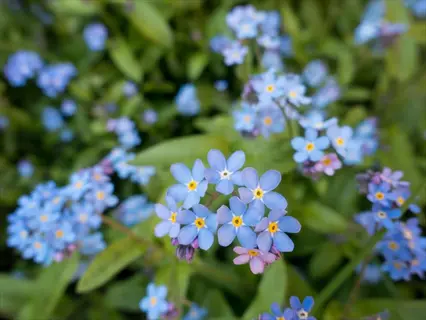
Forget-Me-Not
- Blue verdict: One of the few garden flowers that reads clear sky blue rather than lavender in flat outdoor light.
- Type: Grown as a short-lived biennial or annual that returns on its own from dropped seed year after year.
- Spread: Self-sows once established, filling gaps between later perennials without any replanting effort.
- Site: Prefers moist soil and does well in the dappled light under shrubs and small trees.
- Season: Flowers early, overlapping with spring bulbs and giving the bed a blue base before summer plants take over.
- Symbolism: Carries remembrance in traditional floral meaning, which is why it turns up in memorial plantings.
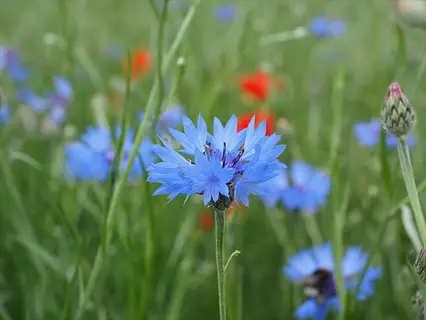
Cornflower
- Blue verdict: The classic reference blue, deep and with a violet edge, and the flower most people picture as true blue.
- Type: An easy hardy annual, also sold as bachelor's button, that suits beds, cutting rows and meadow mixes.
- Spread: Self-seeds every year, so one sowing turns into a patch that comes back each season.
- Site: Wants full sun and takes poor, well-drained ground better than rich soil, which makes it flop rather than flower.
- Season: Blooms through summer if you keep cutting the stems, which pushes the plant to make more buds.
- Symbolism: Linked to hope and devotion in floral custom, which is part of its long popularity.
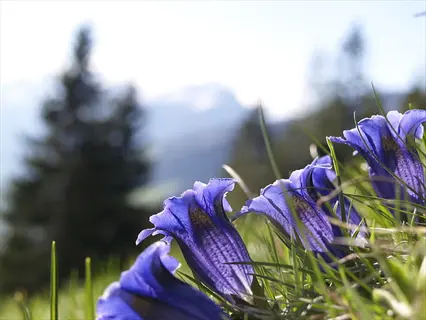
Gentian
- Blue verdict: Among the deepest true blues in the plant world, and one of the genera named in pigment research for stabilized blue.
- Pigment: Gentiana is one of the groups where aromatic acyl groups protect the blue pigment by stacking around it.
- Type: Low perennials in most species, with alpine and meadow species that suit rock gardens and cool, well-drained pockets.
- Site: Wants cool conditions and sharp drainage, and it resents hot, heavy, waterlogged ground.
- Difficulty: The least forgiving plant on this list, so treat it as a project rather than a filler.
- Symbolism: Linked to determination in floral custom, a meaning that suits how stubborn the plant can be to establish.
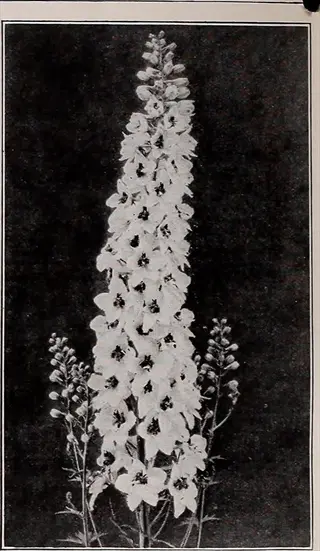
Delphinium
- Blue verdict: The tall spires include some of the truest garden blues, though many named cultivars drift into violet and lilac.
- Pigment: Delphinium is the other genus named in pigment research for acyl groups that shield the blue pigment from turning purple.
- Type: A perennial grown for vertical structure at the back of a border, where the spires read from a distance.
- Support: Tall stems need staking, since a single storm can flatten a spire that took the whole season to build.
- Site: Wants full sun, steady moisture and rich soil, and it performs best where summers stay cool.
- Selection: Read the cultivar description rather than the photo, because catalog images oversaturate blue more than any other color.
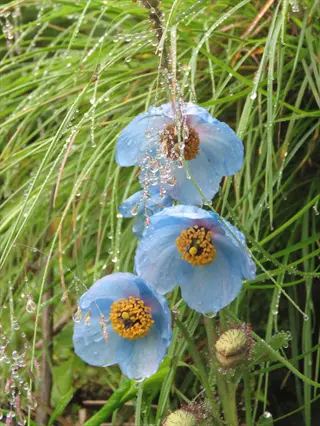
Himalayan Blue Poppy
- Blue verdict: The most talked-about blue in gardening, with wide papery petals in a clear, almost unreal shade.
- Origin: A mountain plant from the Tibetan region, which is a fair warning about the conditions it expects.
- Type: A perennial in the right climate that behaves as a short-lived plant almost everywhere else.
- Site: Needs cool summers, shelter from harsh sun and moist, humus-rich soil that never bakes dry.
- Difficulty: Reported to struggle where summers run hot, so match it to your climate before spending money on plants.
- Alternative: Where summers run hot, gentian or a good blue delphinium delivers a comparable depth of color with far less loss.
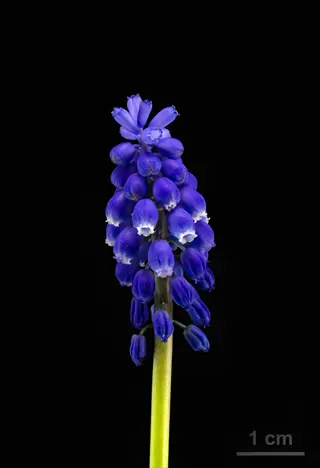
Grape Hyacinth
- Blue verdict: Muscari holds a genuine blue in most forms, though a few sold as blue lean toward violet in strong light.
- Type: A small spring bulb that plants in autumn and needs no attention after the first season.
- Spread: Spreads into drifts over several years, which is the point of planting it rather than a problem to manage.
- Site: Takes full sun or light shade and tolerates ordinary soil as long as it drains after rain.
- Design: Works as a low blue river under later perennials, and reads best planted in large groups rather than rows.
- Quantity: Sold in bags rather than singly, which suits the large drifts this bulb is grown for.
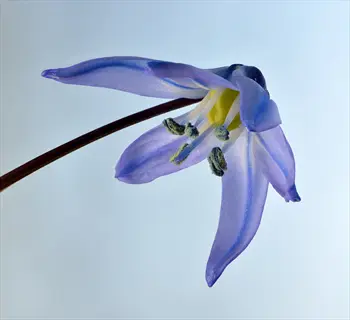
Siberian Squill
- Blue verdict: An intense, saturated blue that appears before most gardens have any other color at all.
- Type: A very small spring bulb, planted in autumn, that flowers close to the ground in early spring.
- Spread: Reported to naturalize through lawns and beds, so site it where a widening blue carpet is welcome.
- Site: Tolerates shade under deciduous trees because it flowers and feeds before the canopy closes over.
- Design: Best used in quantity beneath shrubs and trees, where a scattered handful would simply disappear.
- Maintenance: Leave the foliage to yellow before mowing or cutting, since that is how the bulb refuels for next year.
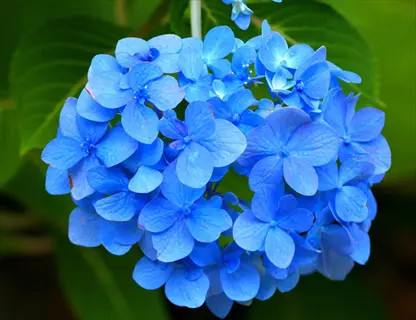
Mophead Hydrangea
- Blue verdict: Blue only when the soil cooperates, since the same plant produces pink flowers in different ground.
- Mechanism: Aluminum in the flowers makes the blue, and soil pH matters because it controls whether roots can take that aluminum up.
- Target: Extension guidance puts blue blooms at soil pH 5 to 5.5, purple at 5.5 to 6 and pink at 6 to 6.5.
- Type: A flowering shrub that gives the largest volume of blue of anything on this list when conditions suit it.
- Site: Wants moist, well-drained soil and shelter from harsh afternoon sun in hot regions.
- Patience: Soil changes take months to show, so judge the result over a full season rather than over a few weeks.
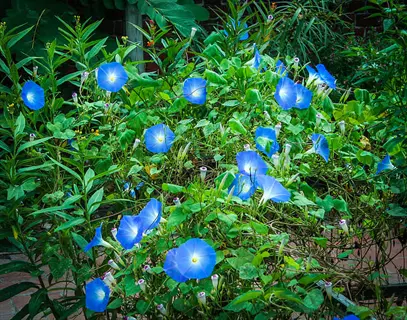
Morning Glory Heavenly Blue
- Blue verdict: The named cultivar Heavenly Blue is a genuine clear blue, unlike the purple and magenta forms sold under the same common name.
- Type: A fast annual vine that covers a trellis, fence or post in a single season from a spring sowing.
- Site: Needs full sun and something to climb, and it flowers better in lean soil than in rich, fed ground.
- Season: Opens fresh flowers in the morning and keeps producing until frost ends the plant.
- Sowing: Sown straight into the ground at the base of its support rather than started in trays.
- Caution: Some morning glory relatives seed themselves hard, so check what is considered invasive in your region first.
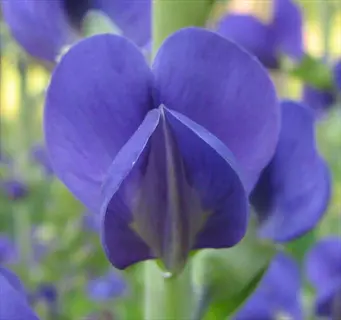
Blue False Indigo
- Blue verdict: Baptisia australis carries indigo-blue pea flowers that read blue rather than violet in most light.
- Type: A long-lived perennial that forms a shrub-sized clump and keeps its shape after flowering ends.
- History: The plant was used as a dye source by Native American communities, which is where the false indigo name comes from.
- Site: Takes full sun and dry, well-drained soil, and it becomes drought-tolerant once the deep roots are established.
- Patience: Slow to settle in, then close to permanent, so plant it where you will not want to move it later.
- Interest: Seed pods darken and rattle after the flowers finish, giving the plant a second season of interest.
What Makes a Flower Blue
Plants have no ready-made blue flower pigment to reach for. Red and yellow ask far less of the plant than blue does. What makes flowers blue is a purple pigment that the cell has to rebuild the chemistry around, and most plants never manage it. That is why you find violet on every bench at the garden center and blue on almost none.
The anthocyanin blue flowers depend on is delphinidin. Zhou and colleagues, in Ornamental Plant Research, report that delphinidin is unstable. It reads purple at the weakly acidic vacuolar pH of 4.5 to 5.5 found in most petal cells. Push that vacuolar pH toward 6.0 to 7.0 and the same pigment turns blue. The pigment is still delphinidin. Only the water around it changed.
Start With Delphinidin
- What it is: Delphinidin-based anthocyanins are the pigment family that supplies the blue chromophore in flowers.
- The catch: Delphinidin is unstable on its own and appears purple at the weakly acidic pH of 4.5 to 5.5 found inside most petal cells.
- Why it matters: Having the right pigment is not enough, which is why so many flowers land on violet instead of blue.
Raise The Cell pH
- The shift: Moving the vacuole toward a weakly neutral pH of 6.0 to 7.0 stabilizes the blue quinoidal anion form of the pigment.
- The effect: The same pigment that read purple in acidic cells now reads blue, with no second pigment involved.
- Uncommon: Few plants make this shift, which is one reason blue stays rare while violet turns up everywhere.
Wrap It In Acyl Groups
- Polyacylation: Aromatic acyl groups such as p-coumaroyl and caffeoyl stack around the pigment and shield the chromophore.
- Where it shows: This strategy is prominent in Gentiana and Delphinium, two genera gardeners already associate with strong blue.
- Result: The protection is what lets those flowers hold a saturated blue instead of fading toward purple.
Add Colorless Copigments
- Copigmentation: Colorless flavones and flavonols pair with the anthocyanin and push the color toward the blue end of the spectrum.
- Why it is clever: The helper molecules add no color of their own, so the plant shifts the hue without making a second pigment.
- Combination: Copigmentation usually works alongside pH and acylation rather than delivering blue on its own.
Recruit Metal Ions
- Metalloanthocyanins: Pigment, flavone and metal ions assemble into a complex that locks the blue color in place.
- The chemistry: Trivalent iron and aluminum ions induce blue through ligand-to-metal charge transfer, while divalent magnesium and calcium ions stabilize the assembly.
- Garden version: This is the same principle behind blue hydrangeas, where aluminum taken up by the roots decides the color.
Three strategies keep the color there once the pH is right, and a plant may lean on one of them or on several. Think of delphinidin as a dye that keeps its color only in the right water. So the plant changes the water, then wraps the dye so it cannot slip back. Gentiana and Delphinium lean hard on that wrapping step. Ask a gardener for true blue and you get a gentian or a delphinium.
Delphinidin is unstable and appears purple under weakly acidic conditions (pH 4.5-5.5) of plant vacuoles.
Blue or Just Purple?
The blue vs purple flowers argument settles outdoors in about 10 seconds. Carry the bloom into flat daylight, hold it beside something you already call blue, and see whether it still holds its own next to that. A denim sleeve works. So does a blue recycling bin. The tag claims blue and the catalog photo claims blue, but a screen is the one place you should never judge this.
The jar of forget-me-nots over my own kitchen sink goes chalky violet at 1 p.m., then snaps back to clear sky blue an hour later when cloud rolls in. Same flowers, same water, same window. I watched those three stems do it all week. Blue looks most vivid under overcast light and drifts toward violet in strong midday sun. Judge a nursery plant on a gray morning, or in the shade on the north side of the building.
Violet is the default for a chemical reason. Blue petals run on a pigment called delphinidin. It turns purple at the mildly acidic pH of 4.5 to 5.5 that most petal cells hold, and the 2026 Ornamental Plant Research review lays that out. A plant gets to blue only by pushing that pH up and propping the pigment with metal ions and copigments. Everything has to line up, so true blue flowers stay the exception and rare blue flowers earn the name. The sorting below is an honest visual call, not a measurement. No standard defines flower blue, so trust your own eyes in daylight.
- Forget-me-not stays clear sky blue in flat outdoor light.
- Cornflower is the reference blue most people picture.
- Gentian reaches one of the deepest natural blues in gardening.
- Morning glory Heavenly Blue is blue in that named cultivar, not in the seed mixes.
- Mophead hydrangea turns genuinely blue when soil pH sits between 5 and 5.5.
- Himalayan blue poppy is the blue every other blue gets measured against.
- Lavender is named for a shade that is not blue.
- Russian sage reads hazy violet from any distance.
- Butterfly bush cultivars sold as blue lean purple.
- Blue orchids on shop shelves are dyed or engineered, never naturally blue.
- Blue-labeled impatiens, sweet pea and hyacinth all land in violet territory.
Nothing in the right column is a bad plant. Russian sage earns its place in a hot dry border, and butterfly bush pulls in more insects than most shrubs you can buy. But buyers who paid for one wanting something actually blue not purple end up let down every June. Buy the left column for blue and enjoy the right column as violet you happen to like.
How Bees See Blue
If blue costs a plant that much to build, why does any plant bother with it? Do blue flowers attract bees? Yes, and the pull is there before a bee has fed from a single bloom. Honeybees, bumblebees and stingless bees all show an innate preference for short-wavelength blue, so a blue patch in your yard starts ahead.
Bee vision colors do not map onto yours. You carry receptors tuned to red, green and blue. A bee carries three too, but they sit further down the spectrum, and none of them answers to red. A 2021 review in Frontiers in Plant Science puts their peaks near 350, 440 and 540 nanometers. Their sharpest color vision sits near 400 nanometers, the spot where blue and ultraviolet overlap.
The plants line up with the eye. Blue almost never shows up in wind-pollinated species. Those flowers have nobody to signal to. It turns up far more often in flowers that need an animal to move their pollen. Altitude tells you the same story. Himalayan sites between 8,860 and 13,450 feet (2,700 to 4,100 m) carried more blue than sites at 2,950 to 6,560 feet (900 to 2,000 m), and the gap held up as significant. Those high sites are harsh, and a plant up there fights hard for a visit.
Unlike us, bees have enhanced photoreceptor activity in the blue-UV parts of the spectrum.
Keep the claim honest in your own garden. The evidence backs bees favoring the short end of the spectrum. It does not prove blue draws more pollinators than every other color, so treat blue flowers for pollinators as one strong note rather than the whole tune. Blue flowers for a bee garden earn their place next to yellow and white, with bloom times spread from spring through frost.
One more limit is worth knowing. The blue halo work from Cambridge is about petal nanostructure, not pigment, and those light-scattering ridges turn up on flowers that read yellow or white to you. A bee may pick up a blue-ultraviolet signal from a petal you would never call blue.
Blue Hydrangeas and Soil pH
Aluminum in the flower sets the color of a mophead hydrangea. Plenty of it and the blooms read blue, a trace of it gives you violet, and none at all leaves you with pink. Soil pH matters only because it decides how much aluminum the roots can take up. Aluminum stays more available at pH 5.5 or lower and drops away at 7.0 or higher. So how to make hydrangeas blue? Get the metal into the plant. Hydrangea soil pH is just the gate that lets it through.
Test the soil before you buy a single product. Mississippi State University Extension puts blue blooms at pH 5 to 5.5, purple at 5.5 to 6, and pink at 6 to 6.5, so a cheap test kit tells you how far you have to travel. Guessing costs you a season, because you can spend all spring correcting a number that was fine to begin with. The steps below run in both directions, so pink is as reachable as blue.
Measure soil pH before buying anything. Blue blooms need pH 5 to 5.5, purple sits at 5.5 to 6, and pink appears at 6 to 6.5.
Dissolve 1 tablespoon of aluminum sulfate in 1 gallon (3.8 L) of water and apply it to the soil, repeating monthly for three months from spring to early summer.
Broadcast about a half cup of wettable sulfur per 10 square feet (0.9 sq m) and water it in. This method can be applied at any time of year.
Apply the liquid drench to the ground around the plant and avoid contact with foliage, which the treatment can damage.
A granular soil change can take up to a year to show its full effect, so judge the color over seasons rather than weeks.
Broadcast about 1 cup of dolomitic lime per 10 square feet (0.9 sq m), or dissolve 1 tablespoon of hydrated lime in 1 gallon (3.8 L) of water as a drench.
Extension guidance schedules the liquid drench for March, April and May, and warns against letting the solution touch the leaves. Apply it to the soil around the plant only.
The blooms opened the same chalky pink two springs running, then came back a clean blue in the third year. I planted that Nikko Blue mophead six years ago in soil that tested at 6.4, and I fed it wettable sulfur in fall and again the next spring. A granular soil change can take up to a year to show its full color shift, and the middle of that year looks a lot like failure.
Blue hydrangea care runs on a calendar. An aluminum sulfate hydrangea drench works faster than sulfur, but it also washes out faster, so most gardens need a fresh round every year. Keep the solution off the foliage, retest the soil every year or two, and expect the color to drift back toward pink if you stop.
Native Blue Wildflowers
Blue shows up where the ground is poor. Dyer et al. tie blue flowers to harsher, resource-poor, high-competition habitats, and report that blue drops out under high-nutrient, intensively managed land. A mown and fertilized lawn edge gives you close to nothing, but a thin gravel bank along a back road can hold three or four blue species in one short stretch. Scan the rough ground first.
Work a single roadside blue through four names before you call it anything. Chicory rides a stiff, almost leafless stem near 3 feet (90 cm) tall, with ragged square-tipped petals that shut by afternoon. Blue flax hangs five round petals on thin wiry stems and drops each bloom by afternoon. Blue toadflax is far smaller, a wand of tiny spurred faces like a miniature snapdragon, and blue-eyed grass is not a grass at all but an iris with flat leaves and a yellow eye. Check stem, leaf and flower shape, because blue wildflowers identification goes wrong on petal color alone.
- Start with a park plant list: The National Park Service documents 12 blue wildflower species in the Presidio of San Francisco alone, and a park or state plant list is the fastest way to narrow your own.
- Learn four common possibilities: Chicory, blue flax, blue toadflax and blue-eyed grass are the names worth checking first for blue seen along roads and trails.
- Check native status before digging: Some familiar roadside blues are introduced rather than native, and a few carry regulatory restrictions, so identify the plant before moving it anywhere.
- Check mountain habitats: At sampled Himalayan sites, researchers found significantly more blue flowers at 8,860 to 13,450 feet (2,700 to 4,100 m) than at 2,950 to 6,560 feet (900 to 2,000 m).
- Search poor ground: Blue flowers are associated with harsher, resource-poor habitats and are lost under high-nutrient, intensively managed land, so scan thin banks rather than fertilized verges.
- Watch the visitors: Blue is almost absent among wind-pollinated plants, so a genuinely blue wild flower is nearly always working for insects.
Height sometimes helps. At sampled Himalayan sites, researchers counted significantly more blue flowers at 8,860 to 13,450 feet (2,700 to 4,100 m) than at 2,950 to 6,560 feet (900 to 2,000 m). That result covers those sites and no others, so treat elevation as a hint, not a rule. Plenty of low, dry, stony ground carries blue too.
Sort blue flowers by region and the search gets much shorter. A park or state plant list tells you which wild blue flowers grow within driving distance of your house, and it flags which ones arrived from somewhere else. Chicory is a European import that now lines roads across the country. Native blue wildflowers are the ones worth learning by sight, since a few of them carry rules about digging or moving plants, and a park list will say so.
Common Myths
The blue roses and blue orchids in florist coolers are natural varieties that breeders finally managed to develop.
Roses, carnations, chrysanthemums and Phalaenopsis orchids lack a working F3'5'H enzyme, so they cannot build blue pigment. Those blooms are dyed or genetically engineered.
Lavender, Russian sage and butterfly bush belong on any honest list of blue flowers because catalogs sell them that way.
Those read violet. Delphinidin pigment looks purple at the weakly acidic cell pH of 4.5 to 5.5 found in most petals, which is why so much marketed blue is not blue.
Blue flowers must be rare because pollinators ignore them, leaving gardeners to hunt for them in specialty catalogs.
The opposite holds. Blue is almost non-existent among wind-pollinated plants and far more common among insect-pollinated ones, and bees favor short-wavelength blue.
Pour aluminum sulfate around a pink hydrangea and the next flush of flowers will open blue within a week or two.
Color follows aluminum availability, which soil pH controls indirectly. Extension guidance applies the aluminum sulfate drench monthly for three months, and a granular soil treatment can take up to a year to show a full color change.
The blue halo scientists found on petals is a shimmer anyone can spot by looking closely at a flower.
Bees can tell a halo-bearing flower from one without it, and people cannot. The scattered light sits in the blue and ultraviolet part of the spectrum.
Conclusion
Ordering the jobs makes blue much easier. Test the soil pH first, because that one number decides whether a mophead hydrangea will ever go blue for you and what you buy next. Then sow the blue flowers from seed that ask the least of you, cornflower and love-in-a-mist, since both hand you real color in a single season. Slower blue perennials such as balloon flower and blue false indigo go in after that. They earn the space. They just make you wait a year or two for it.
Two of these jobs carry a hard deadline. The aluminum sulfate drench belongs to March, April and May, at 1 tablespoon per 1 gallon (3.8 L) of water, once a month across those three months. The second one lands in autumn, when gardening guides plant grape hyacinth and Siberian squill bulbs for blue the following spring. That window closes once the ground freezes. Plant more of both than feels sensible, because a dozen bulbs read as an accident and a hundred read as a color.
Hydrangea color moves on a scale of seasons. The drench has to reach the roots, and the shrub has to build fresh flower heads with the aluminum it takes up, so judge the result next summer rather than this one. The closer your soil already sits to pH 5 to 5.5, the less you have to do. Blue flower garden ideas are easy to collect and harder to schedule. The timeline below puts each job in the month it belongs to.
Two of these plants will test you. Himalayan blue poppy is widely reported to struggle where summers run hot. Gentian resents heavy, waterlogged ground. Gardening sources treat both as demanding rather than first-border plants. Leave them until blue is already working elsewhere in the bed. That is the whole case for planning any of this. Genuine blue is uncommon enough to be worth choosing on purpose, so the blue flowers you do plant should be there by decision.
Glossary
- Angiosperm
- A flowering plant, the group that covers almost every plant grown for its blooms.
- Anthocyanin
- A family of plant pigments responsible for most red, purple and blue colors in flowers.
- Copigmentation
- Pairing a colored pigment with colorless helper molecules to shift the flower color toward blue.
- Delphinidin
- The blue pigment molecule flowers need before they can produce any true blue color.
- F3'5'H enzyme
- The enzyme a plant needs to build blue pigment; roses and some orchids do not have a working copy.
- Metalloanthocyanin
- A complex of pigment, helper molecules and metal ions that locks a blue color in place.
- Polyacylation
- A plant trick in which extra molecules stack around a pigment to protect its blue color.
- Vacuolar pH
- How acidic or neutral the fluid inside a petal cell is, which decides whether blue pigment looks blue or purple.
External Sources
Frequently Asked Questions
How many flowers are actually blue?
Fewer than 10% of the roughly 300,000 known flowering plant species are perceived as blue. Other taxonomic and database measures give different figures rather than one number.
- 372 of 14,038 angiosperm genera contain blue flowers
- 53 of 406 plant families contain blue flowers
- 772 of 10,437 species in the TRY plant trait database are classified as blue
Why is blue the rarest flower color?
Blue needs extra chemistry beyond the pigment itself, and it clusters in flowers pollinated by insects rather than by wind.
Are there real royal blue flowers?
Yes. A small group of plants makes a deep blue with no dye involved, and gentian, cornflower and Himalayan blue poppy are the names that come up most.
Are blue roses and blue orchids real?
Not as natural varieties. Roses, carnations, chrysanthemums and Phalaenopsis orchids lack a working F3'5'H enzyme, so they cannot make blue pigment.
What do blue flowers symbolize?
By long-standing floral tradition, blue stands for tranquility, trust, loyalty, wisdom and remembrance. These meanings are cultural custom, not verified fact.
Why did my blue hydrangea turn pink?
The soil became less acidic. At pH 7.0 or higher, aluminum becomes far less available to the roots, and the blooms shift toward pink.
Do blue flowers attract more bees?
Bees show an innate preference for short-wavelength blue, and blue is nearly absent among wind-pollinated plants. That is not the same as blue outperforming every other color.
What are those blue flowers called?
Common possibilities include chicory, blue flax, blue toadflax and blue-eyed grass, though a regional plant list is what settles an identification.
Can I grow blue flowers in shade?
Yes. The blues that gardening guides name for shade are woodland plants: Siberian bugloss, Virginia bluebells, woodland phlox, lungwort and Jacob's ladder.
Which blue flowers grow easily from seed?
The blues most often named as easiest from seed are annuals and biennials: cornflower, borage, love-in-a-mist, forget-me-not and morning glory.