
Introduction
Topiary is pruning a shrub or tree into a shape you pick, from a plain ball or cone up to a living sculpture of a bird. The shape is the easy part. What matters is how much you cut and how often, because every clip that sharpens the outline also takes off leaves the plant feeds on.
What is topiary in practice? A plant held in a shape by repeat trimming, and nothing stranger than that. NC State Extension dates the first written description of topiary to a friend of the Roman Emperor Augustus, which puts the art at 38 B.C. or earlier. The topiary meaning has barely shifted in the 2,000 years since.
A sheared plant hollows out while the outside still looks sharp, and the reason sits at the center of this guide. The same shearing that builds the shape thins the plant from the inside, and once you see how that works, the whole trimming calendar makes sense.
Two limits keep you out of trouble. Never take more than a third of the crown in one year, and go lighter than that on an old plant. Then check your species before you cut hard, because clipped evergreens such as juniper, cypress, cedar and arborvitae will not push fresh growth from bare old wood. Strip more than half the foliage off one of those and it can die.
So start with a plant that forgives a bad cut and a shape you can judge by eye. Box, yew and holly all respond to hard pruning in early or mid-spring, though box is slow to fill back in. Balls, cones and cubes need no frame at all. The bird can wait.
How to Make a Topiary
The shears close over the second boxwood ball and take the top inch (2.5 cm) off, then I shuffle a step left and do the same again. Four Green Velvet boxwood balls line my front walk, and I sheared every one of them by eye. Balls, pyramids and cubes forgive that. For a shape you cannot hold in your head, hold a cut template against the plant, or set a wooden topiary frame over it while the plant is still small.
How to make a topiary from a plain nursery shrub breaks into six moves, and the cutting step is where most people go wrong. Shearing is tip-pruning without picking out individual laterals or buds, and that is what gives you a flat green surface. A heading-back cut works the other way, because it shortens one shoot back to a bud you choose. Use topiary shears for the surface and hand pruners for the heading-back cuts.
Start with a small-leaved evergreen such as boxwood, Japanese holly or yew, since these hold a crisp edge under repeated clipping.
Cut balls, cones and cubes by eye or against a template, or place a wire frame over the plant while it is still young for a detailed shape.
Shorten shoots back toward the outline you want, since the strongest regrowth breaks within 6 to 8 inches (15 to 20 cm) of every cut. For a standard, stake the leader instead and clear the lower stem a little at a time.
Clip a small amount all the way around the plant, and keep the base wider than the top so light still reaches the lower branches.
Never take more than a third of the crown in one year, and let the plant refill before you sharpen the outline again.
Spread an annual mulch of organic matter in spring to support the regrowth that repeated clipping demands.
Leave the bottom of the plant broader than the shoulders. Light has to reach the lower limbs or the leaves there thin out and drop, and a ball that flares wide at the top shades its own feet. Brown patches at the base take years of hand pruning to fill, so build that taper in from the first season.
One limit sits over every step above. Never take more than a third of the plant's crown in a single year, which is the ceiling NC State puts on any pruning job. That turns a short tutorial into a plan that runs across several seasons. Cut a little, let the plant refill, then sharpen the outline again next year.
Best Plants for Topiary
Choose the plant for how it survives a bad cut, not for how it looks the day you carry it home. That one question sorts the best plants for topiary into two groups, and the split matters far more than leaf color or price. Some shrubs push fresh shoots straight out of bare old wood. Others never do, and a cut into bare wood on those is permanent.
Yew, box and holly forgive you, though UGA warns that boxwood still recovers slowly and may even die when it is pruned severely. Juniper, arborvitae, pine, cypress and cedar forgive nothing, and one heavy session costs you years. UGA Extension warns that those needled evergreens may die if you strip off more than half the foliage, and old wood on a juniper never breaks a new shoot.
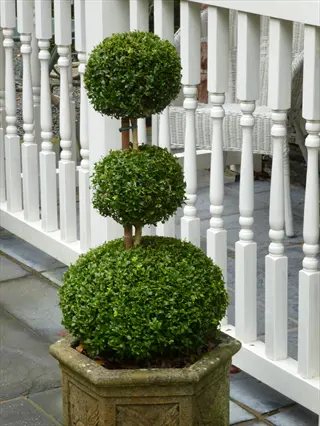
Boxwood (Buxus)
- Why it is used: Small leaves and dense twiggy growth hold a clean edge, which is why boxwood dominates clipped topiary everywhere.
- Cutting tolerance: You can shear boxwood several times through the growing season to keep a hedge or topiary form crisp.
- Recovery: UGA Extension warns that boxwoods recover slowly and may even die after a severe pruning.
- Main risk: Boxwood blight, present in the United States since 2011, and interior fungal problems such as Volutella blight and Macrophoma leaf spot.
- Shapes it suits: Balls, cubes, low knots and small standards, where the fine leaf matches a tight outline.
- Buying note: No boxwood is immune to blight, though you can buy resistant or tolerant cultivars at a good nursery.

Yew (Taxus baccata)
- Why it is used: Dark, fine foliage and a naturally dense habit make yew the traditional subject for large formal topiary.
- Cutting tolerance: RHS advises trimming with topiary shears or hedge-cutters in early or late summer, and yew holds that edge between trims.
- Recovery: RHS notes that yew is among the evergreens that respond to hard pruning in early or mid-spring.
- Main risk: Phytophthora root rot, which the RHS says can hit yew specimens especially hard in wet ground.
- Shapes it suits: Cones, cubes, obelisks and larger sculptural forms that need a big volume of even growth.
- Thinning: Like any sheared plant, yew still needs hand-thinning now and then, so the interior does not turn into a bare shell under the surface.
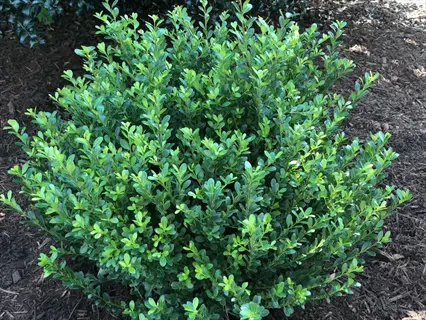
Japanese Holly (Ilex crenata)
- Why it is used: The leaf is small and glossy, close enough to boxwood in look to work as a substitute in a clipped shape.
- Cutting tolerance: It takes repeated shearing and rebuilds a dense surface after each trim.
- Recovery: Holly is on the RHS list of evergreens that respond to hard pruning in early or mid-spring.
- Main risk: It is not a boxwood, so boxwood blight is not the threat here, which is the main reason gardeners use it as a substitute.
- Shapes it suits: Balls, cones and low clipped edging where a boxwood look is wanted without boxwood risk.
- Sourcing: Buy a plant that is already dense at the base, because you build the shape on the growth it arrives with.
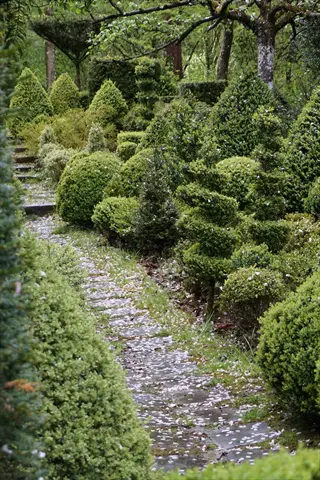
Yaupon Holly and Ligustrum
- Why they are used: Both appear on the UGA Extension list of plants often shaped into topiaries, alongside boxwood, Japanese holly, arborvitae, juniper, yew and podocarpus.
- Cutting tolerance: RHS notes that faster-growing species may need trimming twice or more each season to hold an outline.
- Recovery: The extension sources do not record how hard either species can be cut back, so stay inside the one-third annual limit rather than betting on a full refill.
- Main risk: A quick-growing specimen blurs the outline sooner between cuts, which is why RHS puts vigorous species on more than one trim a season.
- Shapes it suits: Standards, tiered balls and larger geometric forms that benefit from quick fill.
- Regional note: Both are standard southern landscape shrubs on the UGA list, which covers gardens in the southeastern United States.
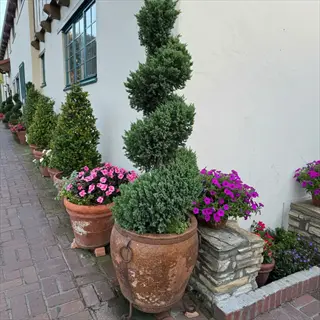
Juniper, Arborvitae and Other Needled Evergreens
- Why they are used: You see these narrow-leaf evergreens in almost every yard, and the dense, upright habit suits large shapes such as spirals and cones.
- Cutting tolerance: Light tip-pruning is fine, but cut into bare wood and you pay for it.
- Recovery: UGA Extension warns that removing over half the foliage can kill these species, and old wood never breaks new growth.
- Main risk: One over-enthusiastic session leaves a bare patch that never fills in.
- Shapes it suits: Spirals and cones, worked in small passes over several seasons rather than one weekend.
- Expert note: Clemson points to Pearl Fryar's garden, grown from plain junipers, pines and cypresses, as proof of what careful hands can do.
Work a boxwood topiary with shallow, repeated cuts and a bad session stays repairable. The ball looks lopsided for a season, then the plant fills the hole and you clip it back into line over the seasons that follow. Cut a juniper spiral back into bare wood and that stripe stays bare for the life of the plant. No clipping technique brings it back.
None of that puts junipers off limits for you. Pearl Fryar shaped a whole garden in South Carolina out of plain junipers and pines. The unforgiving species do work in hands that never over-cut. For your first shape, buy Japanese holly or yew, and save the spiral for a season when your shears already know the job.
Topiary Shapes to Start With
Which topiary shapes should you attempt first? Balls, pyramids and cubes. The RHS puts those three in the easiest group to start with, and you can cut any of them by eye or against a template or a wooden frame. A topiary ball forgives an uneven pass, because your eye reads a curve as round long before it really is.
Detailed shapes such as animals work another way. They need a galvanized or plastic-coated wire frame set over the plant in its early growth stages, so the shoots fill the outline as they grow rather than getting cut back to it later. The taper rule applies to shapes as much as to hedges. A topiary cone or a cube has to stay wider at the base than at the top, or the lower foliage sits in its own shade and thins out.
Ball or Globe
- Difficulty: One of the three shapes RHS puts in the beginner group, along with the pyramid and the cube.
- Cut type: Light shearing all over, turning the plant or walking around it so that no one side gets more attention than the others.
- Guide: Cut by eye, or check the curve against a plywood template or a length of twine as the shape tightens.
- Watch for: A base that narrows faster than the top, which shades the lower branches and leaves a bare skirt around the bottom.
Cone or Pyramid
- Difficulty: Straight lines show every wobble, so work upward from the base in small passes and step back often to check the line.
- Cut type: Shear to a taper, keeping the base wider than the top so light continues to reach the lower limbs.
- Guide: A wooden template or simple frame held against the plant keeps the taper consistent until the outline is set.
- Best plants: Yew, arborvitae and Japanese holly hold a crisp edge on a cone better than looser, faster growers.
Cube or Block
- Difficulty: Also in the RHS beginner group, though four flat faces and eight edges leave nowhere for a wandering cut to hide.
- Cut type: Shear each face to a string line or a board, then tidy the edges last once all faces sit true.
- Guide: A wooden template held against the plant keeps each face on the same plane through repeat trims.
- Watch for: Faces that creep inward at the base over successive trims, which shades the lower growth and thins it out.
Standard or Lollipop
- Difficulty: Simple to picture and slow to build, because the plant has to grow the clear stem before there is a head to clip.
- Method: Select one upright shoot as the main stem, tie it to a stake and remove the competing shoots.
- Clearing: Strip shoots and foliage from the lower stem gradually as the plant gains height rather than all in one session.
- Timeline: RHS notes that reaching the height you want this way can take several years, so buy a trained specimen if you want one sooner.
Spiral
- Difficulty: Advanced, since the cut removes wood you cannot put back and the band has to stay even from bottom to top.
- Cut type: Mark the line with tape or twine first, then cut the groove in shallow passes across several seasons.
- Best plants: Broadleaf evergreens that regrow from old wood give you a second chance that a juniper will not.
- Watch for: Cutting into bare interior wood on a needled evergreen, where the gap simply stays open.
The standard topiary is the honest outlier here. You select one upright shoot, tie it to a stake, cut away the competition, and strip the lower stem a little at a time as the plant climbs. Reaching the height you want that way can take several years, so buy a trained specimen if you want a head to clip this season.
Spiral topiary sits at the far end of the same range. The cut takes out wood you cannot put back, so mark the line with tape or twine and deepen the groove in shallow passes across several seasons. On juniper or arborvitae, a groove cut into bare interior wood just stays open, because neither plant regrows from old wood.
Why Sheared Topiary Hollows Out
From the brick walk it reads as a solid green ball. I pulled the surface of that boxwood apart by the porch steps and the green stopped almost at once. My fingers closed on dry gray wood that had not held a leaf in years. The bare stems ran most of the way in, and the leaf cover sat over them like a skin. That hollow interior is what years of neat clipping build.
The skin of leaves is the whole food supply. Shearing is tip-pruning that takes off leaves and shoots without picking out single buds. The shrub answers each cut with a bunch of leafy stems just behind it, so next summer you clip a slightly thicker surface than the one you clipped this year. The inside sits in deep shade and drops what leaves it has left. Clip long enough and a sheared topiary goes stemmy and hollow.
That shell costs the plant air as well. A dense outer layer slows air circulation inside the crown, and damp, still air there can encourage the growth and spread of fungal diseases. On boxwood, Clemson names Macrophoma leaf spot and Volutella leaf and twig blight.
- Tip-pruning without selecting individual laterals or buds, which is what makes the outline crisp.
- Each cut triggers bunches of leafy stems just behind it, thickening the surface a little more every year.
- The interior sits in deep shade behind that shell and slowly loses its leaves.
- Reduced air movement inside the plant can encourage fungal problems such as Volutella blight.
- Two or three selective reduction and removal cuts added to the same clipping session.
- Openings let more sunlight and moving air into the crown, so the interior is not held in permanent deep shade.
- A periodic hand-thinning pass clears the thin veneer of leaves that shearing builds up.
- The result looks slightly less formal, and the planting lasts longer for it.
Keep clipping, but mix the cut types. Add two or three selective reduction and removal cuts to the same session, so light and moving air reach past the surface instead of stopping at it. Then hand-thin the plant every 3 to 5 years to clear the veneer that shearing builds up. Thinning cuts cost you a little crispness in the outline. The plant lasts longer for it.
This leafy shell sustains the entire shrub, including the roots.
When to Trim a Topiary
When to prune topiary comes down to two windows for the shaping trim, and both of them sit in summer. The RHS puts the shaping cut in early or late summer, taken with topiary shears, and says an established specimen holds its shape on one or two trims a year. Vigorous species want more. The topiary trimming season runs through spring and summer, so you have room to pick a day that suits you.
Fall is the cut you skip. A trim in fall or early winter can push out tender new growth that cannot resist winter cold, and soft growth browns first when temperatures drop. Late winter, spring and summer all stay open for a plant you do not grow for its flowers.
Early to Mid Spring
The window for hard pruning an overgrown yew, box or holly, followed by feeding and mulching.
Spring
Spread an annual mulch of organic matter to fuel the regrowth that clipping demands.
Early or Late Summer
The shaping trim, cut with topiary shears or hedge-cutters in whichever of the two windows suits the plant.
A Second Trim If Needed
Vigorous species may need trimming twice or more each season; a slower specimen is finished after one.
Fall and Early Winter
Stop trimming, since late cuts can push tender growth that cannot resist winter cold.
Walk one boxwood ball through a single year and the plan is short. In spring you spread a mulch of organic matter over the root zone, which feeds the regrowth that clipping demands. Then, in whichever summer window suits you, take the annual trim by eye or against a template. If the ball throws enough growth to blur its outline by August, shear it a second time. If it does not, you are finished until spring.
How often to trim topiary is where the numbers get mixed up. Formal hedges get sheared three to five times in a growing season, but a specimen topiary is not a hedge and that figure never transfers to it. Hard pruning has its own window. Most evergreens, and yew, box and holly above all, respond to hard pruning in early or mid-spring, then need feeding, mulching and no drought stress in the seasons after.
Never remove more than a third of a plant's total crown in a single year. On juniper, arborvitae, pine, cypress and cedar, taking over half the foliage can kill the plant outright, because they do not regrow from old wood.
Tools, Hygiene and Box Blight
Two pairs of shears cover nearly every job here. Keep one sharp hand pair, sold as topiary shears, for detail work on balls and spirals, and a wider hedge shear for the long flat faces. Add hand pruners for the heading-back cuts and you can stop shopping there. What rides on the blades matters far more, because boxwood blight spores travel on pruning tools, clothing, equipment and wildlife.
"Are those the same shears you used on the hedge out front?" a client asked me, pointing at the bucket on the porch where I kept one pair of hand shears. They were. Those shears had been in three gardens that week and went back in the bucket dirty every night. Virginia Tech records a case where the disease crossed between two North Carolina landscapes on a spray hose. Disinfecting shears is a 5-minute job between plants.
- Shears: Keep one sharp pair of hand or topiary shears for detail work and hedge shears for the larger flat surfaces.
- Sanitizer: Mix bleach fresh at 1 part bleach to 9 parts water, and give tools at least 5 minutes of contact time between boxwood plantings.
- Pots and Surfaces: Allow at least 10 minutes of contact time for pots and other surfaces that have touched boxwood before you reuse them.
- Aftercare: Oil the tools once they are dry, since sanitizing products are corrosive to metal.
- Timing: Do not work in boxwood while the foliage is wet, when fungal spores are more likely to be spread.
- Symptoms: Check for brown leaf spots with dark borders and black streaking on stems before you cut anything.
- Debris: Clear clippings and fallen leaves away from healthy plants, and treat the site as still infested afterwards.
Learn the box blight symptoms before you cut anything. Circular brown leaf spots with dark borders show up first, then black streaks on green stems, then leaves that drop fast. Boxwood is not the only host either, since the fungus also hits Pachysandra terminalis, Pachysandra procumbens and Sarcococca, so a pachysandra bed under your box is part of the same problem. Wet foliage is the worst time to work.
Avoid working in boxwood plantings when the foliage is wet and fungal inoculum is more likely to be spread.
Pulling out a sick plant does not clear the site. The survival structures this fungus leaves behind can sit in the soil for 5 to 6 years, so raking up the leaves and setting a fresh boxwood in the same hole just feeds the next round. Boxwood blight reached the United States in 2011, and the fungus is Calonectria pseudonaviculata. Tool sanitation costs you a bottle of bleach and a few spare minutes.
Common Myths
Topiary is a modern garden fashion that arrived with theme parks and clipped suburban hedges in the last century.
A friend of the Roman Emperor Augustus wrote the first known description of topiary, which dates the practice to at least 38 B.C.
More shearing makes a healthier, denser plant, so the more often you clip a topiary the stronger it becomes.
Repeated shearing builds a thin outer shell of leaves over bare interior stems, cuts air movement inside the plant and can shorten its life.
Any evergreen bounces back if you cut a topiary too hard, so a bad clipping session always grows out in the end.
Junipers, pines, cypress, cedar and arborvitae do not generate new growth from old wood and may die when over half their foliage is removed.
Boxwood blight only travels on infected nursery plants, so clipping healthy-looking specimens in your own garden carries no risk.
Spores also move on pruning tools, clothing, equipment and wildlife, and soil survival structures can persist for 5 to 6 years.
Conclusion
Work through it in this order and the rest of your topiary care gets easier. Pick the plant by how well it recovers from a cut, because that one choice decides what a bad afternoon costs you later. Put the wire frame or the template over the plant before the first pass, since a guide added afterwards only tells you what you already cut off. Then set the annual trim date and hold to it.
Topiary maintenance comes down to four numbers. Never take more than a third of the crown in one year. Trim once a year in early or late summer, and add a second pass only for fast growers like privet. Hand-thin the inside every three to five years so the outer shell doesn't thin down to a veneer of leaves. Give your shears at least 5 minutes of sanitizer contact time between boxwood plantings, because blight rides on steel.
The seasonal topiary checklist is short. Mulch in spring, then hard-prune in early or mid-spring, and only on the species that take it. Take the shaping trim during summer, early or late in the season. Then put the shears away, because a cut in fall can push soft new growth that cannot resist winter cold.
One caveat before you attack an overgrown plant. Yew, box and holly come back from a hard cut in early or mid-spring, though UGA Extension warns that boxwood recovers slowly and may even die. Juniper, pine, cypress, cedar and arborvitae never regrow from old wood, so an overgrown specimen of those five is a reshaping job rather than a rescue. Trimming topiary never ends. The outline softens at whatever speed your species grows, so the shape holds only while someone keeps cutting it.
Glossary
- Boxwood blight
- A fungal disease of boxwood that spots the leaves, strips the foliage and leaves survival structures in the soil for years.
- Hand-thinning
- Removing whole shoots by hand rather than shearing, to let light and air back into the middle of a clipped plant.
- Heading-back cut
- A cut that shortens a shoot back toward a bud, used to build density and set the height of a shape.
- Old wood
- Older, leafless stems; some evergreens can sprout new growth from them and others never do.
- Shearing
- Clipping the outer tips of a plant all over without choosing individual buds, which is the cut that keeps a topiary outline crisp.
- Standard
- A plant trained to a single clear stem with a clipped head on top, sometimes called a lollipop.
- Stuffed topiary
- A wire frame packed with moss and planted with vines, so the shape comes from the frame instead of a shrub.
- Taper rule
- Keeping the base of a clipped plant wider than its top so light still reaches the lower branches.
External Sources
Frequently Asked Questions
What does topiary mean?
Topiary is the practice of pruning shrubs or trees into defined shapes or living sculptures, done mainly with shearing and heading-back cuts.
How do you start a topiary from a young plant?
Match the method to the shape you want:
- Start with a dense, small-leaved evergreen such as boxwood, Japanese holly or yew
- For a ball, pyramid or cube, cut by eye or against a template or wooden frame
- For a standard, select one upright shoot as the main stem, tie it to a stake and remove the others
- For an intricate shape, place a wire frame over the plant while it is still young
- Take no more than a third of the crown in any one year while the shape builds
Which topiary plants are easiest for beginners?
Boxwood, Japanese holly and yew are the usual starting subjects, since small leaves and dense growth hold a crisp outline under repeated clipping. Keep cuts shallow on boxwood, which UGA Extension says recovers slowly and may even die when severely pruned.
What are the different types of topiary?
A specimen can be clipped directly, or built on a frame in the two ways UGA describes:
- Clipped topiary: a shrub sheared directly into a geometric or animal shape
- Stuffed or mock topiary: vines trained on the outside of a wire frame
- Frame-trained topiary: a plant grown within a wire frame until it fills the outline
How long does it take to grow a topiary?
Plan in years rather than seasons. The Royal Horticultural Society puts clearing the stem of a standard to the height you want at several years, and regrowth into shape after hard pruning at a few more.
Will a topiary grow back if you cut it too far back?
It depends on the species. RHS names yew, box and holly among the evergreens that respond to hard pruning in early or mid-spring, though UGA warns boxwood recovers slowly and may even die when severely pruned. Juniper, pine, cypress, cedar and arborvitae do not generate new growth from old wood and may die when over half their foliage is removed.
Can you grow topiary in pots?
Yes. The Royal Horticultural Society advises a pot big enough for the specimen and well weighted, so it will not fall over in high winds or once the compost dries out.
Is boxwood still worth planting for topiary?
It can be, with open eyes. No boxwood is immune to boxwood blight, although resistant or tolerant cultivars exist, and extension lists several alternatives such as Japanese holly, yaupon holly, ligustrum, yew and podocarpus.
What is the difference between topiary, espalier and pollarding?
NC State defines them as four separate trained forms:
- Topiary: pruning a shrub or tree into a shape or living sculpture
- Espalier: formal two-dimensional training against a flat plane
- Pleaching: weaving branches into a living wall or fence
- Pollarding: heading all annual growth back to the same point each year
What do you call someone who does topiary?
A topiarist, or a topiary artist. Clemson Extension uses the second title for Mike Gibson, Topiary Artist in Residence at the Pearl Fryar Topiary Garden in Bishopville, South Carolina.