
Introduction
Purple flowers get their color from anthocyanins, the pigment family that also colors blueberries and red cabbage. One group of compounds covers the whole range you see in a bed, from pale lavender to a plum so dark it reads black at dusk. The decision that matters is not which tone you like best. It is which plants are safe around kids and pets, and which ones will run loose in your yard.
The exact tone comes down to two things. Small changes in the pigment molecule shift it, and so does the acid level inside the flower cell. In petunias, making that cell more acidic turns the bloom red, and a change the other way pushes it blue. The shades of purple in one border can all trace back to the same pigment group. Cell shape counts too, since flat surface cells bounce back more light and wash the color out.
Bees give the color real weight. Nigel Raine and Lars Chittka watched 9 bumblebee colonies forage in the field, and the colony with the strongest built-in pull toward violet carried home 41% more nectar than the colony with the weakest pull. That work set violet against blue in one German study area, so it is not a ranking of purple above every other color. But a violet bloom pays a bee back, and that is more than most garden lists can show you.
A short list beats a catalog of 90. The types of purple flowers worth planting come back on their own and stay where you put them, and a lot of popular picks fail that second test. One roundup still names purple loosestrife, a noxious weed in states including Minnesota that drops thousands of seeds per flower spike into wet ground. Several purple flowering plants on those same lists are poisonous if eaten, and only four of those seven pages mention toxicity at all.
10 Purple Flowers That Earn Space
Published purple lists run from 8 entries to 97, and you scan all of them for the handful you will really plant. These 10 purple flowers are that handful. The order here matches the order you shop and dig, with 6 perennials first, then the 2 bulbs, then a vine and a shrub at the end.
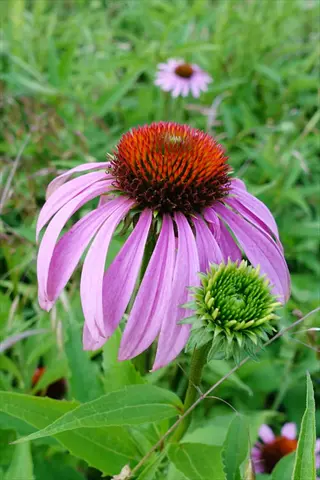
The purple coneflower I planted in a south-facing gravel bed along the driveway has gone whole summers with no water from me. It takes the heat coming off the pavement, it keeps flowering through humid weather, and the deer that graze my hostas walk straight past it. Drought tolerance like that shows up once the roots settle in, not in your first season.
Purple Coneflower
- Type: Herbaceous perennial in the daisy family, native to the central and eastern United States and recorded in 26 or more states.
- Size: Stands 2 to 4 feet (60 to 120 cm) tall and 1 to 2 feet (30 to 60 cm) wide, with NC State Extension listing 3 to 4 feet (90 to 120 cm).
- Hardiness: UVM Extension gives USDA zones 4 to 9 with some varieties hardy to zone 3, while NC State Extension lists zones 3a to 8b.
- Light and soil: Full sun of 6 or more hours gives the most flowers, in soil of pH 6.0 to 8.0 that drains, including clay, loam, sand and shallow rocky ground.
- Wildlife: Feeds Silvery Checkerspot and Wavy-lined Emerald larvae, goldfinches take the dried seed, and native bees nest inside the hollow stems.
- Bloom: Flowers June through August, up to 5 inches (13 cm) across, and the plant is drought tolerant once it has settled in.
English Lavender
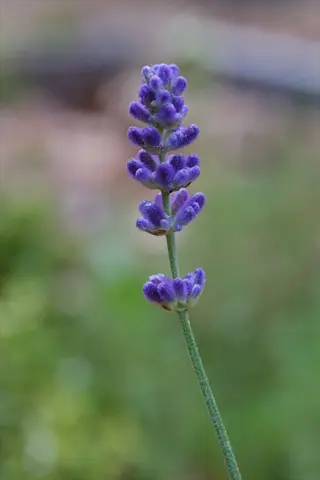
- Type: Woody-based perennial herb that appears on six of the seven top-ranking purple roundups, as often as any plant on this list.
- Color: Delivers the pale grey-violet that the word lavender now names, carried on narrow spikes above silver foliage.
- Light and soil: Wants full sun and sharp drainage, and drainage is the condition that decides whether this plant lasts.
- Wildlife: Bees work the spikes from the first open flower to the last, and browsing animals show little interest in the foliage.
- Use: Put it at a path edge or the front of a bed, where you get silver leaves long after bloom ends.
- Watch: Rich, damp soil is the usual reason a lavender fails, so treat drainage as the deciding condition rather than soil richness.
Catmint
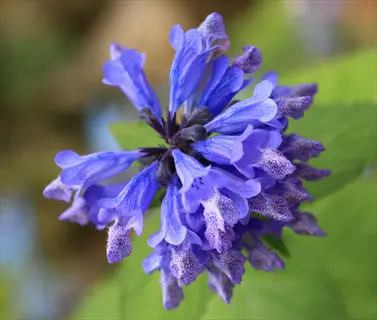
- Type: Long-blooming perennial that Purdue Extension lists among purple perennials and that six of seven competitor roundups include.
- Color: Reads as a soft blue-violet haze rather than one strong flower, which is why it works as a color wash in a border.
- Light and soil: Full sun and ordinary well-drained soil, and it holds up in dry ground once the roots take hold.
- Wildlife: Bees work it from the first flush onward, and it is one of the plants competitor pages most often flag as deer resistant.
- Use: Best along a walk or at the front of a border, where you can let it spill over a hard edge and soften it.
- Watch: It is grown for a long flowering run rather than one big display, so judge it across a season instead of a week.
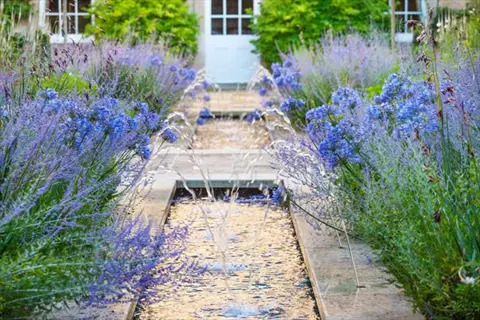
Russian Sage
- Type: Woody-based perennial that Purdue Extension names among purple perennials and that several competitor roundups carry.
- Color: Airy violet-blue spikes on silver stems, closer to a cloud of color than to a defined flower shape.
- Light and soil: Full sun and free-draining soil, and it keeps its shape through heat and dry spells in an exposed bed.
- Wildlife: Bees use the small flowers over a long late-summer window when many earlier perennials have finished.
- Use: Gives you height and haze through the middle of a border, and it sits well with the silver and white side of a purple scheme.
- Watch: Shoppers mistake it for lavender all the time, so read your plant tag rather than trusting color and spike shape.
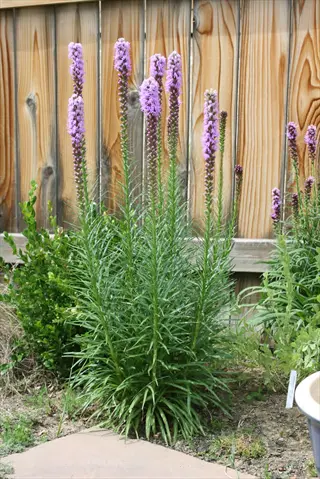
Blazing Star
- Type: Upright perennial that Purdue Extension lists among purple perennials and that several competitor roundups include.
- Color: Narrow purple spikes that give a strong vertical line in a bed otherwise full of rounded flower shapes.
- Light and soil: Full sun and well-drained soil, in the same conditions that suit purple coneflower planted beside it.
- Wildlife: Butterflies crowd the spikes, and it is the purple option to reach for instead of purple loosestrife.
- Use: Plant it in groups of three or more, so you catch the vertical accent from across the yard.
- Watch: It is the upright shape in the planting, so pair it with mounded neighbors rather than with other spike-flowered plants.
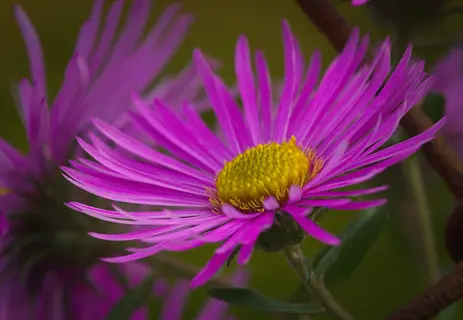
New England Aster
- Type: Perennial that carries purple into fall, with asters on five of the seven competitor roundups and Aster on Purdue Extension's purple perennial list.
- Color: Purple daisy flowers with yellow centers, dense enough on an established plant to read as a solid block of color.
- Light and soil: Full sun and average garden soil, with steady moisture through summer to keep the lower leaves in good shape.
- Wildlife: One of the last nectar sources of the season, so plant it for the bees still working when the border is winding down.
- Use: Set it toward the back of a border, where your earlier plants hide the bare lower stems.
- Watch: The plant gets tall and bare at the base by September, so you want lower neighbors in front of it.
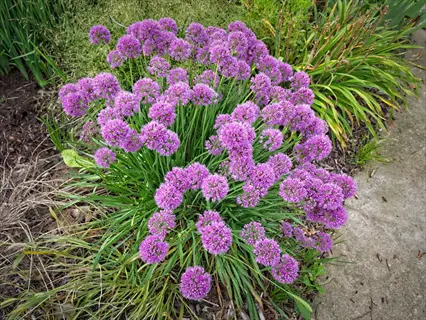
Ornamental Onion
- Type: Bulb that Purdue Extension lists among purple perennials, sold under named purple cultivars on most competitor pages.
- Color: Round violet globes held on bare stems, a shape that nothing else in a mixed bed repeats.
- Light and soil: Full sun and drainage, planted in fall along with the other spring-flowering bulbs.
- Wildlife: Bees cover the open globes while they last, and browsing animals leave the onion-scented foliage alone.
- Use: Thread it through perennials that grow up in time to cover the yellowing leaves.
- Watch: The foliage yellows and flops every year, so give it planted neighbors rather than a bare front row.
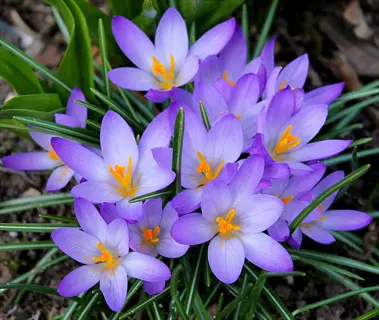
Crocus
- Type: Small spring corm, often the first purple your garden shows, grouped with the purple bulbs on competitor lists.
- Color: Cup-shaped violet and grape-purple flowers, with darker veining on the outer petals of many varieties.
- Light and soil: Sun in early spring and sharp drainage, and later shade is fine because it flowers before trees leaf out.
- Wildlife: Early bees work crocus pollen on the first warm days, well before most garden plants have anything open.
- Use: Plant it in drifts through lawn or at the very front of beds, where you still notice flowers this small.
- Watch: It flowers and disappears early, so plan what will fill the same patch of ground for the rest of the year.
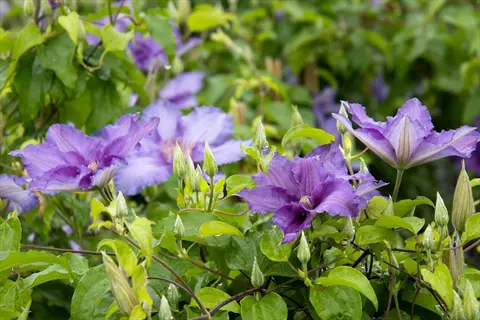
Clematis
- Type: Flowering vine that appears on six of the seven purple roundups, with named purple cultivars sold everywhere.
- Color: Large flat purple flowers, and the deepest purples available on any common garden climber.
- Light and soil: Sun on the flowers with cool, shaded soil over the roots, the pairing every grower repeats for this plant.
- Wildlife: Pollinators visit the flowers, though this plant earns its place on vertical color more than on wildlife value.
- Use: Grow it up a trellis or obelisk, or through a shrub that flowers at a different point in the season.
- Watch: Pruning depends on which group your cultivar belongs to, so keep the plant label somewhere safe.
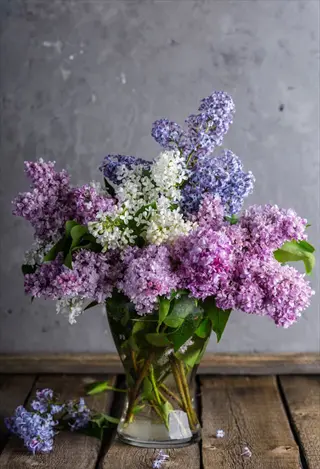
Lilac
- Type: Shrub that Purdue Extension lists among purple and blue flowering shrubs, and that several competitor roundups include.
- Color: Purple flower panicles, the exact color most people picture when they hear the word lilac used for a shade.
- Light and soil: Full sun and well-drained soil, and shade cuts flowering on this shrub more than on most.
- Wildlife: Bees and butterflies work the panicles hard during the short window when the shrub is in flower.
- Use: Use it as a screen or a backdrop, where you get structure long after bloom ends.
- Watch: Flowering lasts only a couple of weeks, which is the case Purdue makes for purple foliage as longer contrast.
Two of these go in on a different schedule. Ornamental onion and crocus are fall-planted bulbs, so you dig those in months before the perennials around them wake up. Purple flowering shrubs run on a third clock. Lilac is a plant you site once, so give it the room it will fill at full size rather than the room it takes up at the nursery.
Buy 3 coneflowers instead of 1 if your budget only stretches so far. A group reads from the far end of the yard, and it gives you bees and goldfinches worth watching. Blazing star wants the same treatment for the same reason.
Why Flowers Turn Purple
What makes flowers purple? One pigment family, and the chemistry of the fluid it floats in. Anthocyanin is the dye. The vacuole, a large sac of fluid inside each petal cell, is the water holding that dye. Make that water more acid and, in petunia, the same dye reads redder. The pH inside that vacuole is what sets the final color.
Six of these pigments do most of the work in nature. Alappat and Alappat name them as pelargonidin, cyanidin, delphinidin, peonidin, petunidin and malvidin. Between them they cover orange at one end and bluish-red at the other, so a purple bloom is not filling its petals with purple pigment at all. It is running a dye that can be tuned, and small changes to the molecule slide it along that range. More hydroxyl groups on one ring push the color bluer. Add a methyl group and it swings back toward red.
The pigment family
- What it is: Anthocyanins are polyphenol compounds that produce the pink, red, purple and blue found in flowers, vegetables and fruit.
- How wide the range goes: Six anthocyanidins dominate in nature and together they cover everything from orange to bluish-red.
- Why it matters: A purple flower is not using a purple pigment, it is using a tunable one that lands on purple.
B-ring chemistry
- Bluer: More hydroxyl groups on the B-ring of the molecule push the resulting color toward blue.
- Redder: Methylation of the same ring shifts the color back toward red, which is how a single pigment family spans lilac to plum.
- Sugars and acids: Glycosylation at C3 causes a red shift, while aromatic acylation moves the color toward blue.
Vacuolar pH
- The control: The final color of an anthocyanin is set by the pH of the vacuole inside the plant cell.
- Proof in petunia: Acidifying that vacuole turns petunia flowers red, and pH-affecting mutations push the color toward blue.
- Not your soil: This is the pH inside the plant, which is why soil alone does not repaint most purple flowers.
Cell shape and stability
- Surface optics: Conical and flat epidermal cells reflect light differently, so two equally pigmented flowers can look nothing alike.
- Fading: Anthocyanins are unstable to temperature, pH and light, so the color a flower shows is not a fixed property of the plant.
- Practical read: Judge a purple cultivar in your own conditions rather than from a catalog photograph taken elsewhere.
Vacuolar pH is the dial that sets the final hue. In petunia, acidifying the vacuole turns the flowers red, while mutations that shift that pH push the color toward blue. Read that location again. It is the pH inside the plant cell, not the pH of your soil, and bagged amendments will not repaint most purple flowers in your beds.
Pigment is only half of flower color. Conical and flat epidermal cells bounce light in different ways, so two plants carrying the same pigment load can look nothing alike, and one of them reads washed out next to the other. Anthocyanins also break down under heat, light and shifting pH. Buy a purple cultivar by judging it in your own light, in your own beds, rather than from a catalog photo shot somewhere else.
The final color of anthocyanin is controlled by the pH of the vacuole.
What Purple Does For Bees
Does planting purple actually bring more bees? The closest thing to an answer is one field study, and it put a number on what it did measure. Raine and Chittka raised 9 bumblebee colonies from wild-caught queens, tested each colony in the lab on violet and blue targets, then turned the same bees loose to forage where they wanted across 15 field days.
The bees that leaned hardest toward violet brought home the most food. Across 255 foragers and 537 foraging bouts, colony foraging rate tracked bumblebee violet bias at rs = 0.678, n = 9, p = 0.045. The strongest-biased colony collected 41% more nectar than the weakest one.
That preference was aimed at something real. Violet flowers in that local flora made more nectar than blue ones, the next best color for payoff. A bee hatched favoring violet was already headed for the better nectar reward. Taste and food supply lined up, and that is the finding worth carrying into your own choices about purple flowers for pollinators.
For your own beds the takeaway is small and useful. Purple flowers that attract bees are worth planting because that pull toward violet is built in before a bee ever reaches your yard, and in that study the violet blooms paid the best. Just keep bloom times staggered so something is open from spring through frost.
The result comes from one bumblebee population near Wurzburg, Germany, where violet flowers happened to out-produce blue ones for nectar. It is a good reason to plant purple, not evidence that purple beats every other color everywhere.
Skip This Purple Flower
A neighbor stopped at the damp roadside ditch at the bottom of my property and asked what I planted down there. Nothing. Purple loosestrife had walked in on its own, and the spikes were showing from July through September in ground that stays wet all summer.
It came from Eurasia. Ships carried it over in ballast and gardeners planted it on purpose, so it was here by the 1830s. The USDA invasive species center records that it crowds out native species, and Minnesota keeps it on the state noxious weed list. Roundups of purple perennials still hand it to readers with no warning. Put it at the top of any short list of invasive purple flowers. One spike can throw thousands of tiny seeds onto wind, water, snow, animals and boots.
How to identify it
- Habit: A semi-aquatic perennial that forms dense bushy growth of many erect stems, roughly 4 to 7 feet (1.2 to 2.1 m) tall.
- Flowers: Showy spikes carrying many individual purple flowers, each with 5 to 7 petals, most visible July through September.
- Leaves and stems: Smooth-edged, slender, pointed leaves arranged in opposite pairs along ridged stems.
Where it turns up
- Ground: It prefers wet soils or standing water, so ditches, pond edges and wetland margins are where it shows first.
- Why gardens matter: It was introduced partly as an ornamental, which means garden planting is part of how it spread.
- Spread: Each flower spike can produce thousands of tiny seeds, moved by wind, water, snow, animals and people.
Why it is regulated
- Status: It appears on the Minnesota noxious weed list, which is a legal designation rather than a gardening opinion.
- Impact: The USDA National Invasive Species Information Center records that it crowds out native species.
- History: Native to Eurasia, it was established in the United States by the 1830s through ships' ballast and ornamental planting.
What to plant instead
- Similar look: Blazing star gives an upright purple spike for an ordinary sunny border, so check it against a local extension list and plant that instead.
- Documented wildlife value: NC State Extension records purple coneflower feeding butterfly larvae, goldfinches and stem-nesting native bees.
- Check first: Noxious weed lists are set state by state, so confirm any wetland-loving purple plant locally before buying.
Bees do collect pollen from purple loosestrife, and that fact gets used to defend planting it. A plant carried on state noxious weed lists and documented as crowding out native species is still a poor trade for a few weeks of purple spikes.
Native alternatives are a local question, since noxious weed lists are set state by state. Check your own list before you buy any purple plant sold for wet ground, and take the substitute from an extension list for your region rather than a nursery tag.
How To Grow Purple Coneflower
How to grow purple coneflower comes down to sun and drainage. NC State Extension counts 6 or more hours of direct sun as full sun. Partial shade runs 2 to 6 hours, and Echinacea purpurea grows in either one, though it blooms best in full sun and makes fewer flowers where the light runs short. Soil pH can sit anywhere from 6.0 to 8.0. Clay, loam, sand and thin rocky ground all grow it, so long as water moves through instead of sitting.
Deer walk past it most years. Rabbits, chipmunks and groundhogs are less polite, and they will take bites out of new growth in spring. Watch for aphids, Japanese beetles, powdery mildew and Fusarium wilt. Aster yellows sits on that watch list too, so keep the name handy and look it up the day a plant starts to look wrong.
Early Spring
Divide crowded clumps, leaving several inches of root on each division, and cut last year's stems back to 12 to 24 inches (30 to 60 cm) so stem-nesting native bees keep the hollow stubs.
Late Spring
Plant into full sun of 6 or more hours, in soil of pH 6.0 to 8.0 that drains, whether that is clay, loam, sand or shallow rocky ground.
Summer
Flowers open June through August, up to 5 inches (13 cm) across. Watch for Japanese beetles, aphids, powdery mildew and aster yellows. NC State records the plant as drought tolerant once established.
Fall
Sow seed outside now so it gets the cold, moist stratification it needs, or divide roots instead. Leave the spent flower heads standing rather than deadheading.
Winter
Dried seed heads feed American goldfinches, and standing stems hold the plant's structure over snow until spring cutback comes around again.
Dividing coneflowers is an early spring or late fall job. Lift the clump with a fork, pull the crown apart into pieces, and keep several inches of root on each one before you replant. Seed is the slower route. It needs cold, damp weeks before it will sprout, which is why UVM Extension has you sow it outdoors in fall and let winter do that work for you. Plantlets show up the next spring, with no bag of damp sand in the fridge.
A goldfinch drops onto a bare coneflower stem outside my kitchen window. It rides the stem down and works the dried head apart while I rinse a pan at the sink. Two more wait on my back fence. This is February, and I left those stems standing back in October. By March the heads are picked bare.
Colors That Go With Purple
What colors go with purple flowers? Blue, silver and white sit beside purple without a fight, and yellow or orange set it off. The bigger issue is that purple recedes. Stand back 30 feet (9 m) from a bed of nothing but purple and it reads as a dark gap in the planting. Put something light beside it or you lose the color at a distance.
Habit decides placement more than color does. Spiked salvia and liatris pull the eye up, so they earn a spot mid border where they break a flat run of mounds. Compact catmint and low Ajuga belong at the front edge, where you look down on them. Trailing purple wants a wall or a container lip, and you waste it buried in the middle of a mixed border.
- Purple with blue: quiet, cool, and it makes a small bed feel deeper than it is.
- Purple with silver foliage: lavender and Russian sage already carry their own silver.
- Purple with white: the white does the lighting work purple cannot do on its own.
- Purple with pink: soft and safe, and it keeps a cottage border from turning heavy.
- Purple with yellow: the loudest pairing available, and the reason New England aster's yellow centers read so strongly.
- Purple with orange: high energy, best in full sun where the light can carry it.
- Purple with red: dramatic but crowded, so give both colors more space than feels necessary.
- Purple foliage against green: the contrast that keeps working after the flowers have finished.
Walk one border through a season and the hole shows up on its own. Allium opens with the spring bulbs and is finished early. Catmint and salvia run longer if you shear them back after the first flush. Purple coneflower carries June through August, and once those petals drop the purple is done unless an aster takes over. By September you can be standing in a green border that looked purple in every photo you took in June.
When you consider that most flowering shrubs and perennials are only in flower for a few weeks, colorful foliage can provide a more consistent contrast to green foliage.
That is why purple foliage does the heavy lifting. Heuchera, Ajuga, smokebush, Japanese maple and elderberry hold their color from leaf-out to frost, which is months against a few weeks. Purdue Extension counts fruit as a third source of purple too, naming beautyberry, chokeberry, silky dogwood and arrowwood viburnum. Strong purple flower garden design uses all three, and the leaves keep your bed working when nothing is in bloom.
Common Myths
Purple loosestrife belongs on a best purple perennials list because its tall spikes look good and bees visit the flowers.
Bees do use it, but Minnesota lists it as a noxious weed, the USDA records it crowding out native species, and one spike can produce thousands of seeds.
Purple flowers attract more pollinators than every other flower color, so any purple plant improves a garden.
The evidence compares violet against blue in one German bumblebee population, where violet flowers happened to produce more nectar.
Garden soil pH sets flower color, which is why the same purple plant looks different from one yard to the next.
Research ties anthocyanin color to the pH inside the plant's own cell vacuole, not directly to the pH of the soil around its roots.
A flower packed with pigment always looks intensely purple, so a washed-out bloom simply lacks pigment.
Epidermal cell shape changes how light reflects, so a pigment-rich flower with flat cells can still look color-deficient.
There is a fixed, known number of purple flowers, and the longest list on the internet contains all of them.
No verified count exists. Published roundups range from 8 to 97 entries, and no two of them agree on which plants belong.
Conclusion
Start with one bed and one plant. Purple coneflower is the safest first pick among purple perennials, and NC State Extension puts its soil range at pH 6.0 to 8.0, which is a wide band to hit. Sun hours and drainage are the two things you have to check yourself before you dig.
After that the calendar does more work than anything you can buy. Divide an established coneflower clump in early spring, as soon as the new growth pushes up and you can see where to cut. Sow seed in fall instead of spring, because the seed wants a cold, damp winter before it will sprout, and a fall sowing hands it that for free.
One thing to check before you hand over money. Any purple spike sold for wet ground deserves a look at your state noxious weed list first, because purple loosestrife still shows up on best-perennial roundups. It runs 4 to 7 feet (1.2 to 2.1 m) tall, and each flower spike can produce thousands of tiny seeds, moved by wind, water, snow, animals and people.
Planting purple flowers pays off most when the bed works as a pollinator garden first and a color scheme second. Goldfinches strip the seed heads through winter and native bees nest inside the hollow stems you did not cut. What looks untidy in January is doing the job.
Glossary
- Anthocyanidin
- The core pigment molecule behind each anthocyanin; six of them cover the natural range from orange to bluish-red.
- Anthocyanin
- The pigment family that gives flowers, fruit and vegetables their pink, red, purple and blue coloring.
- Cold, moist stratification
- A chilling period in damp conditions that some seeds need before they will sprout.
- Cultivar
- A named variety of a plant selected and propagated by growers for particular traits such as flower color.
- Epidermal cells
- The surface cells of a petal, whose cone or flat shape changes how light reflects and how strong the color looks.
- Noxious weed
- A plant a state has legally listed as harmful, which usually makes it illegal to sell, move or plant there.
- USDA hardiness zone
- A number that describes how cold a region's winters get, used to judge whether a plant survives there.
- Vacuolar pH
- The acidity inside a plant cell's storage sac, which decides the final color an anthocyanin shows.
External Sources
Frequently Asked Questions
What are the different shades of purple flowers?
This guide groups the common shade names into three bands, and the same pigment family produces all of them at different settings:
- Pale: lavender, lilac and mauve
- Mid-tone: violet, amethyst and true purple
- Deep: plum, grape and near-black
- Six anthocyanidins set the natural range, from orange through bluish-red
What is a purple flower that looks like lavender but is not?
Catmint, Russian sage and salvia carry the same purple spikes as lavender and sit beside it on the same plant lists. Purple loosestrife mimics the look too, and it is a listed noxious weed rather than a garden plant.
Which purple flower is the most popular?
Four plants share the top spot. Lavender, clematis, iris and catmint each appear on six of the seven top-ranking purple flower roundups, counted from the flower lists those pages publish, with purple coneflower on four.
Which purple flowers are best for pollinators?
Purple coneflower is the pick with the best documented wildlife record:
- Feeds Silvery Checkerspot and Wavy-lined Emerald larvae
- Goldfinches eat the dried seed through winter
- Native bees nest inside the hollow stems
- Catmint, salvia, allium and blazing star are listed purple perennials, with no comparable wildlife data behind them
Are purple flowers poisonous?
Purple is not a warning color, but several plants on purple lists are toxic:
- Monkshood, also called wolf's bane
- Foxglove
- Delphinium and larkspur
- Hellebore
- Bittersweet nightshade
- Heliotrope and sweet pea
Are purple flowers annuals or perennials?
Both. Purple coneflower, lavender, catmint, Russian sage, salvia, iris and aster are perennials where they are hardy. Petunia, heliotrope, zinnia and sweet alyssum are commonly grown as annuals, and crocus, tulip, hyacinth and allium grow from bulbs.
Do any purple flowers bloom in shade?
Some do. Purple coneflower takes partial shade of 2 to 6 hours and still flowers, though it produces fewer blooms than it does in full sun of 6 or more hours. Check any other candidate against your local extension list before you plant it in a dark corner.
Why do purple flowers fade in the sun?
The pigment itself is unstable. Anthocyanins are susceptible to temperature, pH and light, so the purple a flower shows is not a fixed property of the plant.
Why is purple the color of royalty?
Cost. Tyrian purple came from murex shellfish, was made by the Phoenician city of Tyre in the Bronze Age, and was expensive enough that only the wealthiest classes could afford it. Rome then turned purple into a mark of imperial authority.
How many purple flowers are there?
There is no verified total. Published roundups range from 8 flowers to 97, they overlap heavily without ever agreeing, and they mix true purple species with purple cultivars of other plants.