
Introduction
Orange flowers get their color from carotenoids. Those are the pigments behind yellow, orange, and red petals, as Liu and colleagues set out in the International Journal of Molecular Sciences. The shade you get depends on which ones build up in the petal and which ones fade. For a real garden bed, the short list starts with butterfly weed, orange daylily, California poppy, and marigold.
That color does more work than most plant lists let on. Penn State Extension reports that bees have three color receptors and cannot see red, though yellow and orange come through fine. Butterflies carry the widest color vision of any animal. Hummingbirds most prefer bright red, pink, and orange, but the same source notes they feed from flowers of most colors, and nectar reward and learning may explain the preference.
So orange is one of the few flower colors bees, butterflies, and hummingbirds can all see, and that is the whole case for planting it. Two orange flowering plants need a check before you buy, though. Orange daylily spreads fast by rhizomes, and NC State Extension tags it weedy. Orange hawkweed is the harder no. Washington State listed it a Class B noxious weed in 1988 and quarantined it, so transport and sale are barred there.
The types of orange flowers worth your bed space run from spring bulbs to late daisies. Mix annuals with perennials and orange blooms can carry the bed from late spring into fall. Start with butterfly weed if you want monarchs. It hosts 4 caterpillar species as a larval plant, but it needs 2 to 3 years from seed to its first flower, so a potted plant may save you some of it.
10 Orange Flowers That Earn a Spot
The list below runs in three blocks. Orange perennials come first, since those are the ones you plant once and keep. Orange annuals follow, and the last two grow from a corm and a rhizome that ask you for a decision every fall. Each entry names the group in its opening line, so you can skip to the block that suits your bed.
The third summer, the butterfly weed I planted from seed opened a flat orange head about the width of my palm. Seed-grown plants need two to three years to flower, and mine used all three. The first two years gave me a thin stem and narrow leaves I almost pulled twice.
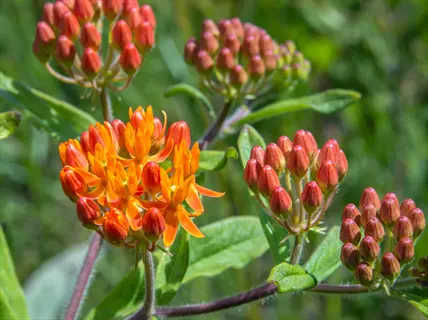
Butterfly Weed (Asclepias tuberosa)
- Type: Native perennial of eastern and southern North America, hardy in USDA zones 3a to 9b.
- Bloom: Clusters of bright orange to yellow-orange flowers open from May through August each summer.
- Size: The NC State Extension spec block lists the plant at 1 to 2 feet (30 to 60 cm) tall.
- Soil: Grows in average, dry to medium, well-drained soil in full sun, and drought tolerant.
- Wildlife: Larval host for monarch, gray hairstreak, queen, and milkweed tussock moth caterpillars.
- Watch for: The deep taproot resents transplanting and the sap can cause contact dermatitis, so wear gloves.
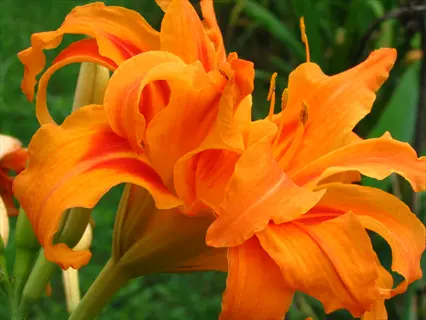
Orange Daylily (Hemerocallis fulva)
- Type: Tough perennial native to Asia, hardy in USDA zones 3a to 8b and common in older gardens.
- Bloom: Tawny upward-facing summer flowers reach up to 5 inches (13 cm) across on leafless scapes.
- Size: Scapes rise up to 6 feet (1.8 m) above the sword-like leaves in an established clump.
- Care: Full sun to partial shade and average well-drained soil, with no significant insect or disease problems.
- Spread: Spreads fast by rhizomes, and NC State Extension tags the species as naturalizes and weedy.
- Watch for: Each flower lasts a single day, and the plant is reported as toxic to cats.
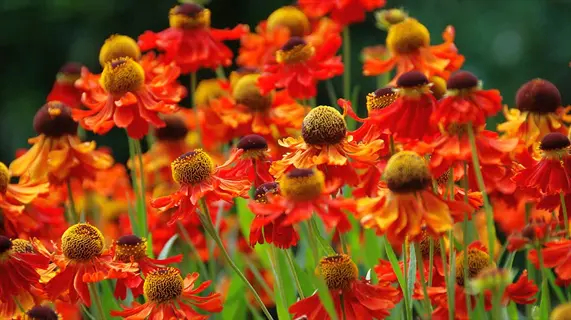
Helenium (Helenium)
- Type: Late-season perennial that carries orange, rust, and copper tones into the fall garden.
- Bloom: Flowers open from late summer onward, after most early summer perennials have finished.
- Care: Sun and soil that does not dry out suit it, and the stems grow tall by late summer.
- Design: Sits well next to blue and purple flowers, which sharpen the orange rather than muting it.
- Pollinators: Daisy-shaped heads give butterflies a flat surface to land on before feeding.
- Watch for: Height varies a lot between named forms, so read the label before placing it in a border.
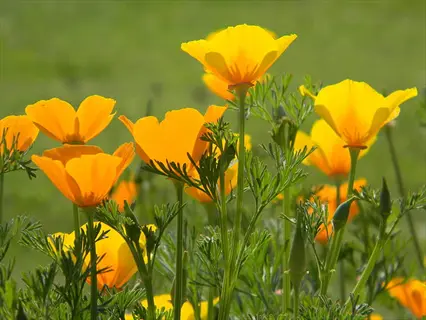
California Poppy (Eschscholzia californica)
- Type: Annual where winters are cold, state flower of California, native to the Pacific slope from western Oregon to Baja California.
- Bloom: Flowers in spring and early summer where summers are hot, and much longer near the cool coast.
- Sowing: Sow seed about 1/16 inch (1.6 mm) deep, in fall or early spring.
- Soil: Sandy, well-drained soil in full sun, with no supplemental watering in a normal season.
- Habit: Resprouts each fall from a fleshy taproot where winters are mild, and behaves as an annual where winters are cold.
- Watch for: Flowers close each night and on cloudy days, and picked petals fall off almost at once.
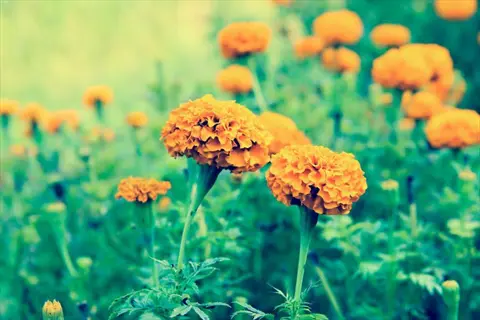
Marigold (Tagetes)
- Type: Warm-season annual grown from seed and planted out once frost has passed.
- Bloom: Dense orange and gold heads; lutein is reported at around 70% of marigold carotenoid content.
- Industry: Tagetes erecta is grown as a pigment crop for food, cosmetic, and pharmaceutical use.
- Poultry: Petal meal is fed to laying hens because its lutein and zeaxanthin deepen egg yolk color.
- Design: Dense low mounds of orange hold an edge or a container block where the color sits close to eye level.
- Watch for: African marigold is Tagetes erecta, while French and Signet marigolds are separate species, so read the label before you buy.
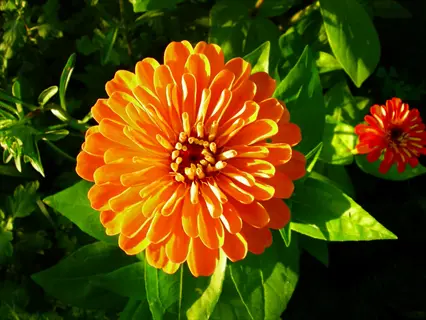
Zinnia (Zinnia elegans)
- Type: Fast annual sown straight into warm soil once the danger of frost has passed.
- Bloom: Orange forms carry through the warm months, and cutting the stems keeps new flowers coming.
- Care: Full sun, open spacing, and moving air keep the foliage clean through humid weeks.
- Cutting: One of the most productive orange cut flowers a small garden can grow in a season.
- Pollinators: Butterflies must land to feed, and the flat heads give you a reliable landing pad in the bed.
- Watch for: Plants set close together in shade stay damp, which shows first in the lower leaves.
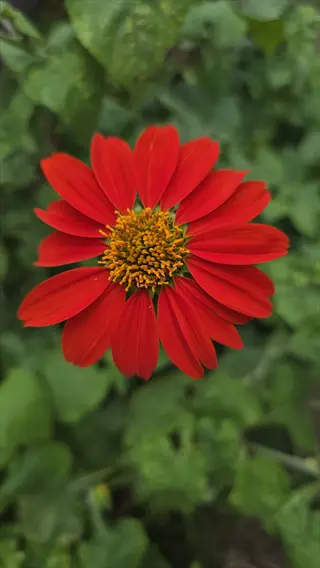
Mexican Sunflower (Tithonia rotundifolia)
- Type: Tall annual grown from seed for late-season orange in hot, sunny beds.
- Bloom: Vivid orange daisy-like heads carry the hot end of the season until frost closes it.
- Pollinators: The wide open heads give butterflies a flat landing surface for feeding.
- Care: Full sun and lean, well-drained soil keep the stems sturdy instead of soft.
- Size: Plants grow tall, so give the stems room and a spot that is not fully exposed.
- Watch for: The stems are soft rather than woody, which matters in an open, windy bed.
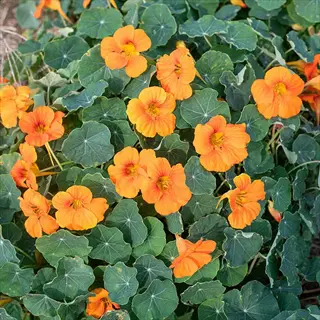
Nasturtium (Tropaeolum majus)
- Type: Easy annual sown straight into the ground, trailing or mounding depending on the variety.
- Bloom: Round, spurred orange flowers from early summer until heat or frost stops them.
- Soil: Lean soil gives more flowers, while rich soil pushes the plant into leaf instead.
- Design: Trails over bed edges and container rims where the flowers sit close to eye level.
- Pollinators: The flower carries a long spur behind the petals, a shape built around nectar.
- Watch for: The stems and leaves stay soft all season, so check them when the weather turns warm.
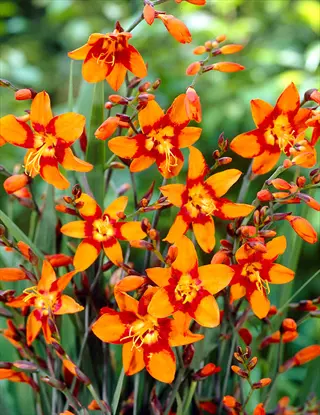
Crocosmia (Crocosmia)
- Type: Summer-flowering corm that returns each year once a clump has settled in mild gardens.
- Bloom: Arching sprays of small orange trumpets open through the middle and end of summer.
- Shape: Tubular flowers suit hummingbird feeding, which Penn State Extension links to flower shape as well as color.
- Care: Sun and soil that drains suit it, and old clumps thicken underground over time.
- Design: Plant it in a drift so the color reads from across the garden rather than as single stems.
- Watch for: Named forms differ in height and hardiness, so buy by cultivar rather than by genus.
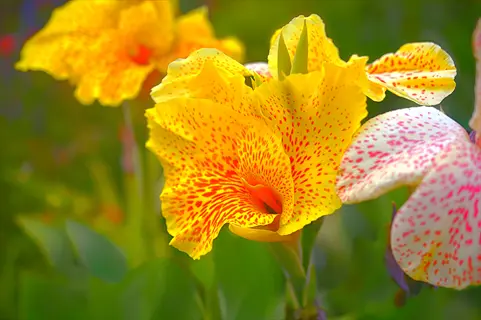
Canna (Canna)
- Type: Tender rhizome grown for bold orange flowers and broad, tropical-looking foliage.
- Bloom: Flowers open through the hottest weeks of the year and continue until frost arrives.
- Care: Full sun, steady water, and warm soil produce the strongest growth and the most flowers.
- Storage: Gardeners in cold-winter areas often lift the rhizomes in fall and store them dry until spring.
- Design: Height and leaf size make it a back-of-border plant rather than an edging plant.
- Watch for: Winter handling is the real work with this plant, not the summer growing.
Starting with an empty bed, I would plant butterfly weed for the long run and sow Mexican sunflower for this year. One takes two or three summers to pay off and the other is flowering by late summer from a packet you opened in May. California poppy does the same job in a dry strip you would rather not water, and marigold covers a pot by your door.
Two of these travel. Orange daylily spreads by rhizome and takes ground from slower neighbors. Crocosmia thickens underground until the clump sits as a solid mat. Give both an edge you can cut a spade against, unless spreading is the point in that corner of your yard.
Why Flowers Turn Orange
Why flowers are orange comes down to one family of pigments. Carotenoids are fat-soluble pigments that gather inside petal cells, and the same family gives plants yellow, orange and red. Think of a fixed set of paint tubes. The petal has no tube marked orange, so the color you end up looking at depends on which carotenoids it stacks up and which ones it takes back apart.
A 2024 study in the International Journal of Molecular Sciences measured this in Brassica rapa breeding lines. Total carotenoid content peaked at 993.6 ug/g at full bloom in the control line TY7, and the paler mutant line only reached 461.0 ug/g. Those are oilseed crops, not garden annuals. The numbers show how the shift works. They are not a goal for your own border.
Total pigment load is only half the story. In that same work lycopene ran 99.1-fold higher in the color-shifted line and beta-carotene came in 56.0-fold higher, so the shade you see tracks which carotenoids win out. No single orange pigment switch gets flipped. The team counted 22 genes with changed activity in the carotenoid pathway, and 15 of those showed up in flower tissue.
Marigold is the version of this you can buy in a six-pack. Lutein accounts for around 70% of the carotenoid content in marigold petals, which is why the crop is grown for pigment and fed to hens to deepen egg yolk color. Two orange flowers on the same bench can be running very different pigment mixes underneath.
Carotenoids represent a class of fat-soluble, naturally occurring pigments that bestow yellow, orange, and red hues to plants.
Which Pollinators See Orange
Why plant orange instead of red? Bees do not see red at all. Penn State Extension puts bee vision at three color receptors, tuned to blue, green, and ultraviolet. Do bees see orange? Yes, and that one fact carries the whole case for the color, because orange is one of very few shades that bees, butterflies, and hummingbirds can all pick out of your green bed.
Butterflies carry 6 to 15 color receptors depending on species, the broadest spectral vision of any animal, and butterfly sight runs from ultraviolet through red. The real limit is distance. Butterflies are near-sighted to about 100 feet (30 m), and each compound eye holds near 12,000 lenses, so one wide block of orange reads where six plants scattered down your border do not. A butterfly also has to land before it can feed, which puts flat heads and tight clusters ahead of narrow tubes.
Hummingbirds see the full spectrum, and prefer bright red, pink, and orange most. A hummingbird will still feed from flowers of most colors. That pull likely comes down to nectar reward and learning more than the color itself. Shape counts for more than color with hummingbird flowers. Plant tubular natives such as columbine, trumpet honeysuckle, and cardinal flower.
Bees
- Vision: Three color receptors tuned to blue, green, and ultraviolet set the limits of what a bee can see.
- Orange: Bees cannot see red, but yellow and orange sit inside the visible range.
- Planting: Orange sits inside the range a bee can see, and red does not, so an orange drift works for bees and birds at once.
Butterflies
- Vision: Between 6 and 15 color receptors depending on species, the broadest spectral vision of any insect or animal.
- Range: Butterfly sight runs from ultraviolet through red, so your placement matters more than color choice alone.
- Distance: Butterflies are near-sighted to about 100 feet (30 m), so a large single-color drift reads better than scattered plants.
- Shape: A butterfly must land to feed, which puts flat or dense flower heads ahead of narrow tubes.
Hummingbirds
- Vision: Hummingbirds see the full spectrum from ultraviolet through red.
- Preference: Most prefer bright red, pink, and orange, but feed from flowers of most colors.
- Caution: That preference likely reflects nectar reward and learning rather than an innate attraction to the color.
- Shape: Tubular flowers suit the feeding, including natives such as columbine, trumpet honeysuckle, cardinal flower, and wild bergamot.
Planting for all three
- Drift: Group one orange flower into a wide block instead of dotting single plants through your bed.
- Shape mix: Pair flat landing pads with tubular flowers so butterflies and hummingbirds both have somewhere to feed.
- Season: Stagger bloom times so your drift keeps working from late spring into fall.
In a small bed, that overlap settles your butterfly garden colors. Plant orange flowers for pollinators in one wide drift instead of singles. Mix flat landing pads with a few tubular blooms. Stagger the bloom times, and your block keeps feeding from late spring into fall.
They cannot see red, but they can see yellow and orange.
Orange Flowers to Check First
Orange hawkweed heads the short list of invasive orange flowers, and Washington State made it a Class B noxious weed in 1988, then put it on the state quarantine list that bars transport and sale. The flowerheads are showy, about 1 inch (2.5 cm) across, and they come in clusters of 3 to 7, sometimes 12 or more. Bright orange tells it apart from the other hawkweeds on sight. It spreads by seeds, stolons, and rhizomes at once, which is why it chews through lowland pasture, mountain meadows, and lawns.
The spade goes into the daylily clump by the mailbox and comes up with a mat of fat pale rhizomes, not the neat crown I expected. That clump came with the house. I dug out what I could reach, and every scrap of rhizome I missed sent up leaves again. NC State Extension tags this plant naturalizes and weedy, and orange daylily spreading by rhizome is the reason. I mowed a line around the rest.
- Check the list: Search your state noxious weed board for the plant before you buy it; orange hawkweed is a Class B noxious weed in Washington.
- Ask how it spreads: Orange hawkweed reproduces by seeds, stolons, and rhizomes at once, which is why it takes over open ground so quickly.
- Treat a shelf as no clearance: Washington bars its transport, sale, and distribution. The board also notes the plant is sold as an ornamental in nurseries, and listings differ by state.
- Watch an inherited clump: Orange daylily spreads rapidly by rhizomes and is tagged naturalizes and weedy by NC State Extension, so plan for that spread before planting and follow local guidance on containing or removing it.
It's sold as an ornamental plant in nurseries.
Status changes at the state line. Lantana and trumpet vine both get called invasive somewhere. Neither one was checked state by state for this article, so look up your own state before you trust a blanket claim. The state weed board keeps its list online. Do that search before the plant is in the cart, not after it is in the ground.
Two Natives Worth Knowing
Butterfly weed and California poppy are both native to North America. Orange daylily is not, and that split changes what shows up in your beds. A monarch needs a place to lay eggs, and a nectar flower alone will never do. Butterfly weed is the monarch host plant of the three, and NC State Extension records monarchs running one to three broods in the north and four to six in the south, so that host stays useful for months.
Native orange flowers come with a paper trail, and the poppy's starts at sea. The USDA Forest Service credits Adelbert von Chamisso with naming it. He was a naturalist aboard the Russian ship Rurick, and he chose the name for the ship's surgeon, J. F. Eschscholtz. Then he left the t out of the spelling by accident, and the error is still on plant labels today. Seed reached English gardens in the 1800s and the plant kept moving. In California it is now hard to tell which stands are wild and which came over a garden wall.
- Plant it if you want monarch caterpillars rather than only visiting butterflies, because it is a host plant they can feed on.
- NC State Extension records monarchs running one to three broods in the north and four to six in the south, so the host plant works over a long season.
- Moderately salt-tolerant as well as drought tolerant, which makes a hot drive bank or road edge a fair spot for it.
- Choose the permanent place before you sow, since a settled plant is a poor candidate for moving.
- The Perennial Plant Association named it 2017 Perennial Plant of the Year, and North Carolina named it 1985 Wildflower of the Year.
- Adelbert von Chamisso named it aboard the Russian ship Rurick for surgeon and entomologist J. F. Eschscholtz, and left the t out of the spelling.
- Seed reached English gardens in the nineteenth century, and in California it is now hard to tell native stands from garden escapes.
- Best where the ground is sandy and open and where nobody is counting on watering it through a normal season.
- A poor cut flower by the USDA Forest Service's own account, so grow it to look at rather than to bring indoors.
- Outside the Pacific slope it is a garden plant rather than a local wildflower, which matters if the goal is a native planting.
Take butterfly weed for a dry sunny bank, the sort of slope that bakes all afternoon and never sees a hose. Take California poppy for open gravel, a drive edge or a thin sandy strip where little else settles in. Butterfly weed roots deep, so pick its spot once and leave it alone. The poppy wants the ground open and sandy, so keep it out of the bed you feed and water.
Butterfly weed sap runs clear rather than milky, unlike most milkweeds, but it can still cause contact dermatitis, so wear gloves when you cut or handle the stems.
Orange Shades Through the Season
Orange flowers bloom time is not one date on the calendar. When orange flowers bloom depends on which plants you stack. California poppy runs the spring leg, butterfly weed holds the middle from May to August per NC State Extension, and orange daylily takes the hottest weeks. Think in seasonal succession rather than in single plants and the bed holds color for longer.
The orange drains out of my yard before dinner. From the kitchen window at the back of the house I watch the poppies fold petal over petal into thin closed cones. They do it again by mid-morning under a gray sky. California poppy flowers close each night and on cloudy days. I cut a few for a jar one June and the petals dropped off in my hand.
Fall or early spring
California poppy seed goes into open sandy ground. It germinates after the first fall rains or once spring soil warms.
Spring
The first clear orange arrives with California poppy, open on bright days and shut each night and on cloudy ones.
May to August
Butterfly weed carries the main pollinator season in bright orange to yellow-orange clusters.
Summer
Orange daylily opens a fresh set of tawny flowers each morning, while poppy fades and goes dormant in hot-summer areas and keeps going near the cool coast.
Late summer into fall
The palette shifts warmer as late perennials such as helenium bring rust, copper, and bronze tones in behind the clear orange.
The honest limit on summer orange flowers is a plain fact. A single daylily flower lasts one day. The show comes from the number of buds and from several clumps opening at once, not from any one bloom holding on. Poppy splits by climate. Near the cool coast it can flower most of the summer, and in hot-summer areas it dies back and goes dormant until the weather eases.
The shade shifts as the year goes on. Spring gives you a clear, almost neon orange. By late summer the bed drifts warmer, and nurseries market those tones as terracotta and apricot early, then coppery rust and bronze. Sunset orange flowers show up in that back half of the season, with burnt orange flowers behind them. Helenium carries the warmest tones in after the poppy quits.
Common Myths
Bees ignore orange flowers because insect eyes only pick up blue, purple, and ultraviolet light.
Bees have three color receptors tuned to blue, green, and ultraviolet. Penn State Extension notes they cannot see red, but they can see yellow and orange.
The orange daylilies along country roads are wild native lilies that belong in the local landscape.
Hemerocallis fulva is native to Asia and has naturalized across much of North America. NC State Extension tags it naturalizes and weedy because it spreads rapidly by rhizomes.
If a nursery has it on the shelf, the plant must be legal and safe to plant in your area.
Orange hawkweed is a Class B noxious weed in Washington and on the state quarantine list, yet the state board notes it is sold as an ornamental plant in nurseries.
A daylily flower opens and then holds for the better part of a week like most garden perennials.
Each flower lasts a single day. The genus name Hemerocallis comes from the Greek words hemera, meaning day, and kallos, meaning beauty, for exactly that reason.
Orange flowers carry official meanings, set in the Victorian language of flowers and documented ever since.
No authoritative source documents these meanings. Florists and trade publications carry them, so treat warmth, enthusiasm, and gratitude as convention, not documented fact.
Conclusion
Fall is where planting orange flowers starts. Sow California poppy about 1/16 inch (1.6 mm) deep in fall or early spring, and press the seed into the soil surface instead of burying it. If you want butterfly weed from seed, start it now and settle in for the wait, because seed-grown plants take 2 to 3 years to bloom. A nursery pot may shorten that wait.
In spring, plant in drifts. Butterflies are near-sighted and pick up color from about 100 feet (30 m) away, so a wide block of one shade reads to them from across the yard and a single plant does not. Give your orange flower garden a group of the same plant together, somewhere you pass every day. Then summer is for watching. You find out fast which plants the bees work and which ones they fly past.
Two cautions, and they are separate problems. Orange daylily spreads fast by rhizomes, so put it where you do not mind it running. Orange hawkweed is the harder one. Washington State lists it as a Class B noxious weed and its quarantine bars sale and transport there, and nurseries elsewhere still sell it as an ornamental. Come fall, check your own state noxious weed list before you order any fast spreader, because a plant on a shelf can still be banned where you live.
Orange is one of the few colors bees, butterflies, and hummingbirds can all see, and that is the case for it. It is also loud. Set next to pink or magenta it fights everything around it, so if your beds run on soft colors, keep orange to one pot by the door and leave the rest alone. Everywhere else, build the backbone out of orange perennials and fill the gaps with orange annuals you can swap out each year.
Glossary
- Carotenoid
- A family of fat-soluble plant pigments that give petals their yellow, orange, and red coloring.
- Class B noxious weed
- A state weed rating for a plant that is established in some areas and targeted for control before it spreads further.
- Larval host plant
- A plant whose leaves a butterfly's caterpillars can actually eat, as opposed to one that only offers nectar to adults.
- Lutein
- A yellow carotenoid pigment that marigold petals hold in large amounts, which is why the flowers are farmed for color.
- Quarantine list
- A state list of plants whose transport, sale, and distribution are prohibited inside that state.
- Rhizome
- A thickened underground stem that creeps sideways and sends up new shoots, which is how some plants spread on their own.
- Scape
- A leafless flower stalk that rises straight from the base of the plant, the way a daylily's flowers are carried.
- Taproot
- A single deep main root that anchors the plant and makes it hard to move once it is settled.
External Sources
Frequently Asked Questions
Why are some flowers orange and others yellow?
Both colors come from carotenoids. The shade depends on which carotenoids the petal keeps and which it breaks down, so small pigment shifts move a flower from pale yellow to deep orange.
Is an orange daylily a true lily?
No. The orange daylily is Hemerocallis fulva, a separate genus whose name comes from the Greek words for day and beauty because each flower lasts one day.
What do orange flowers symbolize?
Florists and flower guides commonly link orange to warmth, energy, enthusiasm, gratitude, and friendship. These meanings are cultural convention rather than documented fact, so treat them as a shared habit rather than a rule.
Can bees see orange flowers?
Yes. Penn State Extension notes bees have three color receptors tuned to blue, green, and ultraviolet, and that they cannot see red but can see yellow and orange.
Do orange flowers bloom all summer?
Some do and some only look like they do:
- Butterfly weed blooms May to August across USDA zones 3a to 9b.
- Orange daylily flowers in summer, but each individual flower lasts one day.
- California poppy blooms spring into early summer, then goes dormant in hot-summer areas.
Which orange flowers are easiest to grow?
California poppy needs no supplemental watering in a normal season, and orange daylily tolerates poor soil with no significant insect or disease problems. Butterfly weed is easy once established, but it takes two to three years from seed.
Is orange hawkweed legal to plant?
Not for sale or transport in Washington. Orange hawkweed is a Class B noxious weed listed in 1988 and placed on the state quarantine list, which prohibits transport, sale, or distribution of the plant, its parts, or its seed. The same board notes it is sold as an ornamental plant in nurseries, and listings differ by state.
Is orange blossom the same as an orange flower?
No. Orange blossom, also called citrus blossom, takes its name from the orange tree rather than from the color of its petals. An orange flower is any flower whose petals carry orange carotenoid pigment, such as butterfly weed or California poppy.
Are orange daylily flowers edible?
NC State Extension describes the buds and flowers of Hemerocallis fulva as edible, with a sweet-spicy or peppery flavor. The same source reports the plant is toxic to cats, which matters in a household with pets.
How long does butterfly weed take to flower from seed?
NC State Extension states the plant grows easily from seed but takes two to three years to establish and produce flowers. Once it is settled, leave it alone, because the deep taproot does not transplant well.