Houseplant · Cactaceae
Star Cactus
Astrophytum asterias
Set it in bright light and gritty soil, let the pot dry out fully between drinks, and this tiny spineless star will happily forgive a beginner.
Bright indirect
Every 14–21 days
USDA 9–11
1–2 in · 3–6 cm
Overview
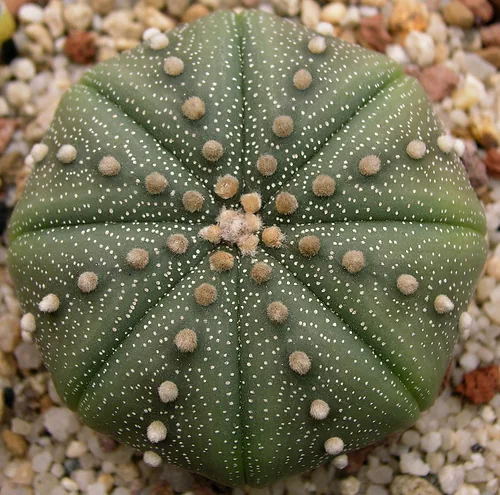
The star cactus is a little desert treasure, a smooth spineless dome ribbed like a sand dollar that has settled into the soil. It grows wild in only a narrow band of south Texas and northern Mexico, tucked low among the rocks, and it takes its time, so a plant no bigger than a coin may already be years old. Those soft woolly flecks scattered over its green body give it the gentle, starry look behind its name.
It sits in the cactus family yet quietly breaks the rules by growing no spines at all, which makes it lovely and easy to hold. That same smooth look is what leads people to confuse it with peyote, and sadly that mix-up has driven a lot of illegal collecting in the wild. Come late spring it rewards you with yellow flowers with red throats that open right on top of the body.
Here is the reassuring part: this plant asks for very little, as long as that little is the right kind of care. It is one of the most protected cacti anywhere, endangered in the wild and closely watched in trade, so the plant on your windowsill should always come from a nursery. Get the soil and the watering right and everything else falls into place on its own.
Care
The short version: give it plenty of bright light and a sharp, gritty mix that drains fast, water it deeply only after the soil has gone completely dry, and ease right off through the winter months.
Light
More than anything, give it bright light. It is happiest in bright, indirect light and will accept a little direct sun, but make any move into strong sun a slow one, since a plant used to shade can burn if it is pushed straight to a hot window.
Water
This is the one place a star cactus is most often lost, so be patient. Water it deeply only after the gritty mix has dried out completely, which tends to mean about every 14 to 21 days across the spring and summer growing season. Once winter comes, keep it nearly dry, because the plump body rots quickly if it sits cold and wet.
Soil
Settle it into a fast-draining mineral mix, the sandy or gravelly kind that holds very little organic matter. A gentle, near-neutral pH of 6.5 to 7.5 suits it well, and all that grit is what lets water slip through before it can ever rot the roots.
Temperature
It is an easygoing plant about temperature, content anywhere from about 23°F to 95°F (-5°C to 35°C), though that chilly low end only holds if the plant is kept bone dry. Warmth is what coaxes it into growth, while cold paired with damp is the real thing to guard against.
Humidity
Let the air stay on the dry side, somewhere around 20% to 40%. This little one hails from the desert, so still, muggy air only invites the rot and fungus it has no real defense against.
Feeding
Feed it lightly, and only while it is actively growing through spring and summer. A dilute, low-nitrogen cactus fertilizer given once a month is all it wants, since a heavy hand with nitrogen pushes soft growth that tends to split and rot.
Pruning
There is really nothing to prune on a star cactus, which is one less thing to worry about. A sterile blade comes out only to tidy away spent flowers or any rotted tissue, never to shape the plant.
Repotting
Plan to repot every 2 to 3 years, or a little sooner if roots start poking through the drainage holes or the body fills its pot. Ease it into fresh gritty mix, then hold off on water for a few days so any roots you disturbed have time to heal.
Size & spacing
This is a wonderfully small plant. It reaches only about 1 to 2 inches (3 to 6 cm) tall and spreads to roughly 2 to 6 inches (5 to 15 cm) across, and it grows so slowly that it will sit content in a little pot for years.
Troubleshooting
Take heart, because nearly every trouble a star cactus meets comes down to water, and the plant wears its clues right on its body. Once you can tell soft flesh from a shriveled one, or spot little cottony pests, you can step in gently before a small mistake becomes a serious one. Find your symptom below and treat it calmly.
Soft, dark, mushy spots on the body or down near the base
Those soft, dark spots are rot, and on a star cactus they almost always come back to too much water or a mix that stays soggy. It tends to begin right at the soil line, where dampness lingers against the tender body. Do not panic: stop watering straight away, use a sterile blade to cut back to firm green tissue, let the wound dry and callus in airy shade, then settle the plant into fresh gritty mineral mix.
Fix:
- Stop watering immediately
- Cut away all rotted tissue with a sterile blade until only firm green tissue remains
- Let the cut surfaces callus in dry, airy shade
- Repot into fresh fast-draining mineral mix and water only sparingly once healed
A wrinkled, shrunken, or softly sagging body
A shriveled body can mean one of two gentle-to-fix things. If the soil is bone dry and the roots feel sound, the plant is just thirsty, and a good deep soak will plump it back up. If the soil is still moist, the roots may have been lost to rot, so treat it as you would rot, trimming back to healthy tissue and letting it re-root in dry mineral mix.
Fix:
- If dehydrated, give a thorough soak and resume regular dry-down watering
- If roots are rotted, treat as rot: cut back to healthy tissue, callus, and re-root in dry mineral mix
White cottony tufts in the areoles with weak, faded growth
Those little cottony puffs are mealybugs, and they love to tuck into the woolly areoles where they are easy to overlook. Give one a gentle nudge: a pest will smear, while the plant's own white wool and flecks will not. Set the cactus apart from the others, touch each bug with a swab of 70 percent isopropyl alcohol, then come back weekly and check the roots, since root mealybugs like to hide down in the soil too.
Fix:
- Isolate the plant
- Dab visible insects with a cotton swab dipped in 70 percent isopropyl alcohol
- Repeat weekly and inspect the roots, drenching with an appropriate insecticide if root mealybugs are present
Toxicity
You can breathe easy here: the star cactus is safe around pets and people. It carries no toxin, and even with that peyote nickname there is not a trace of mescaline in it. Being spineless, it will not so much as prick a curious nose, though it still is not grown to be eaten.
Safe for
People · Cats · Dogs · Horses · Rabbits · Livestock · Birds
Cats None
Perfectly fine to share a room with. A nosy cat that nibbles the body might drool a bit or bring a little back up, but that is only because any plant matter can upset a stomach, not because of any toxin.
Dogs None
There is no poisoning risk for dogs here. One that chews a piece may get a short-lived upset tummy from the fibrous flesh, and since the cactus has no spines it will not prick the mouth either.
Horses Safe
Nothing in this little cactus can poison a horse, so there is truly no need to worry around it.
Rabbits Safe
Gentle and harmless for rabbits. It holds no toxin at all, though it is not a food plant and should not become part of their diet.
Livestock Safe
Cattle, goats, and sheep can graze right beside it with no risk of poisoning, since the plant holds nothing harmful.
Birds Safe
No toxic worry for birds. A pet bird that pecks at the flesh will come to no chemical harm.
People Safe
Safe to handle and to keep around children. Despite the peyote mix-up it holds no mescaline, though it is not grown for eating, so there is no reason to taste it.
Though spineless, handle this rare protected plant minimally and wash hands after contact with any houseplant; keep out of reach of pets or children inclined to chew it.
Varieties
A handful of named forms show up among collectors, most of them prized for the way their white flecks and wool drift across the body. These are the few that are worth getting to know.
'Super Kabuto'
A chosen cultivar dusted so heavily with big white woolly flecks that they can nearly cover the green body underneath.
var. nudum
A naturally fleckless form with a smooth, plain green body, and Kew treats it as a variety all its own.
'Ooibo Kabuto'
Loved for the unusually large, raised wool spots that perch on its areoles.
How to propagate
There are two gentle routes to more star cactus, and neither hurries. One raises the plant true from seed, while the other leans on grafting onto a stronger root to move things along a little faster.
SeedDemanding
Spring, in warmth · Several months to germinate and establish; years to reach flowering size
Seed is the main path, and the one that holds on to the most genetic variety. Sow fresh seed in spring over a sterile gritty mix, then keep it warm and humid until the little sprouts appear. The seedlings are slow and rot easily, so harden them off bit by bit and settle in for the wait, since it takes several months to establish and years more to reach flowering size.
GraftingModerate
Spring-summer, during active growth · A few weeks for the graft union to take
Many growers graft star cactus onto a lively rootstock to speed its growth and dodge the rot that claims so many seedlings, which is especially handy with prized cultivars. Carried out in spring or summer while the plant is in active growth, the graft union usually knits in a few weeks.
Myths
Star cactus is really peyote and is full of mescaline.
It gets muddled with peyote so often that one of its own nicknames is star peyote, yet the two are quite separate plants and this one carries no mescaline whatsoever. That very confusion keeps fueling illegal collection of a cactus that is already endangered.
Since it has no spines, it is tough and can be watered like a leafy houseplant.
A smooth, spineless body says nothing about how much water the plant wants. Its fleshy tissue rots quickly when watered too often, and it needs the very same dry-down and gritty soil as any other desert cactus.
It is fine to dig up or buy star cactus taken from the wild.
It is federally endangered and sits on CITES Appendix I, so pulling plants from the wild or trading wild-collected ones is against the law. Only nursery-grown plants are legal to keep.