Houseplant · Cactaceae
Golden Barrel Cactus
Echinocactus grusonii
Give it bright sun and a light touch on the watering can, and this golden globe will happily do the rest.
Full sun
50–86°F · 10–30°C
USDA 9–11
12–35 in · 30–90 cm
Overview
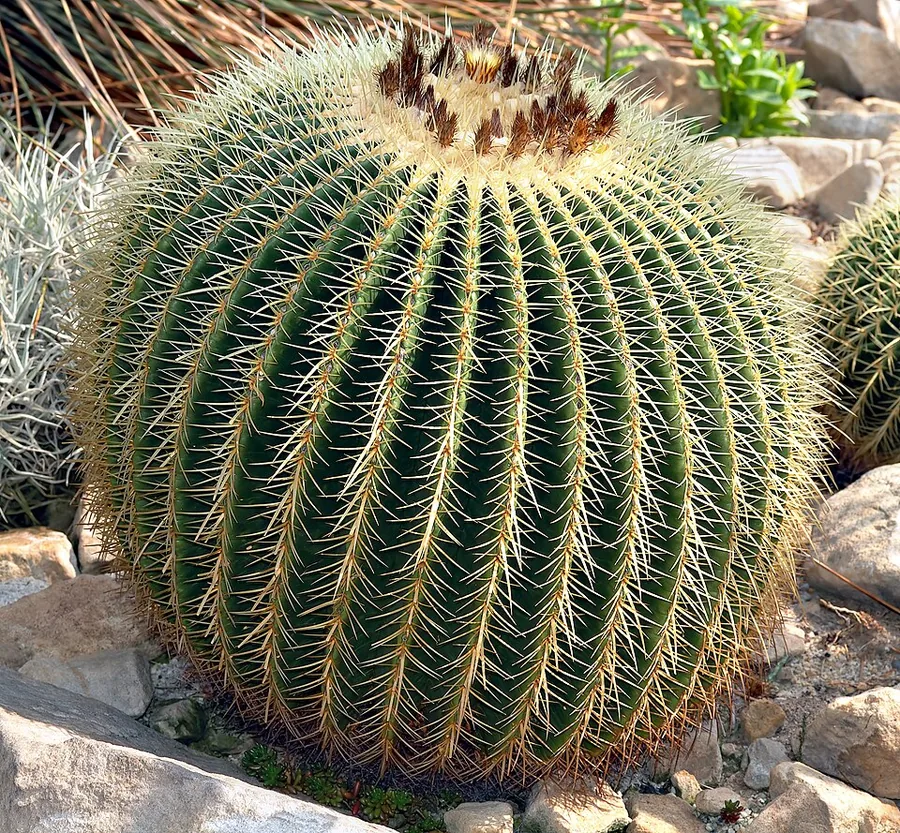
If you are new to cacti, the golden barrel is a wonderful one to begin with. Picture a near-perfect green sphere, ribbed from top to bottom and dressed in stiff golden-yellow spines. It hails from the deserts of central Mexico and carries that sun-baked toughness right into your home, asking for little beyond a bright windowsill and a pot that drains freely.
You have plenty of time to enjoy it, because this cactus grows slowly and stays a comfortable size for years before it approaches its full 12 to 35 inches (30 to 90 cm) across. That unhurried pace is really part of the charm. Set it on a sunny sill and it will keep its round shape and warm color season after season without asking much of you.
The only thing it truly minds is sitting in wet soil. This is a desert plant through and through, made to drink deeply and then dry right out. Get that rhythm right and you will find the golden barrel about as forgiving and low-maintenance as a houseplant can be, so a stumble here and there is nothing to lose sleep over.
Care
The short version: give it the brightest sun you can, a gritty mix that drains fast, and water only once the soil is bone dry. Keep it nearly dry right through winter, and reach for thick gloves so you stay clear of the spines.
Light
Offer the golden barrel the brightest light you can find, and full sun at a south-facing window is ideal. It will manage in bright indirect light too, but give it too little and the body stretches pale and loses that tidy round outline you love.
Water
Only reach for water once the soil has gone bone dry, then soak it right through and let every last drop drain away. Come winter dormancy, keep it nearly dry. Standing moisture is the single thing that undoes this cactus, bringing on quick and often fatal rot at the roots and base, so err on the dry side and you will be fine.
Soil
Pot it up in a gritty, sharply drained cactus mix that never turns soggy. Any pH from 6.0 to 7.5 will suit it well, so the feel and drainage of the mix matter far more than getting the acidity just so.
Temperature
This cactus is easygoing about warmth and settles happily anywhere from 50°F to 86°F (10°C to 30°C). Ordinary room temperatures keep it content, though a cooler, drier rest over winter is something it quietly enjoys.
Humidity
Dry air is exactly what this desert plant is after, so there is no humidity number to chase and no misting to worry about. Your everyday household air suits it perfectly.
Feeding
A little food through spring and summer, while it is actively growing, is all it wants, roughly once a month. Choose a dilute, low-nitrogen cactus fertilizer, and simply stop feeding as growth eases off for winter.
Pruning
You have nothing to prune on a golden barrel, which is one less job to remember. The only reason to pick up a blade is to trim away damaged, rotted, or diseased tissue, and that blade should always be clean and sharp.
Repotting
You only need to repot every 3 to 4 years, or whenever it clearly outgrows its pot. Watch for roots poking through the drainage holes, the plant lifting up in its container, or soil drying out unusually fast, and slip on thick gloves to move it in safety.
Size & spacing
This is an unhurried, compact grower that tops out around 12 to 35 inches (30 to 90 cm) tall and roughly as wide. It takes years to reach that point, and even a single barrel makes a lovely standout all on its own.
Troubleshooting
A healthy golden barrel will rarely put a foot wrong, and the few troubles it does run into nearly always come down to water or light. Keep a gentle eye on the base and the newest growth, since that is where the earliest hints appear. Spot them soon and your plant will almost always bounce back just fine.
Mushy dark patches spreading up the base
Take a breath, because this is root and base rot, and it usually means the plant sat in too much water or a mix that held onto it. If the base has gone soft and dark, you can still try to save it: lift the cactus out, trim every rotted part away with a clean blade, let those cuts dry into a firm callus, and settle it back into dry gritty mix. Leave the watering can alone until fresh roots have found their footing.
Fix:
- Withhold water immediately
- Unpot and cut away all rotted tissue with a clean blade
- Allow cut surfaces to callus, then replant in dry gritty mix
- Resume watering only once roots re-establish
Washed-out growth stretching tall and slim
Here your cactus is simply telling you it wants more light, a change gardeners call etiolation. The fresh growth comes in paler and taller than the tight ribbing below, and while that stretched part will not round back out, the fix from here is easy. Move it to the sunniest spot you have and let it adjust to direct sun over a week or two, so the plant never gets scorched.
Fix:
- Move to the brightest available position
- Introduce direct sun gradually to avoid scorch
Toxicity
Here is some lovely news if you share your home with pets: the golden barrel cactus carries no toxins and is safe around cats, dogs, and the rest of the household. The one catch is physical rather than chemical. Those stiff golden spines can give a nasty puncture, so set the plant out of reach and move it with thick gloves or a folded band of newspaper.
Safe for
People · Cats · Dogs · Horses · Rabbits · Livestock · Birds
Cats None
You can relax on the poison front, since nothing in this cactus will harm a cat. What you do want to watch is the spines, which can leave a sore puncture in a curious paw or nose, so give it a home well out of reach.
Dogs None
A dog that mouths this plant will not be poisoned, so no worries there. The stiff spines are the only real concern, since they can jab a muzzle or a pawing foot, so tuck the pot where a dog can't knock into it.
Horses None
Rest easy, because there is nothing toxic in this cactus for a horse. The one thing to mind is those sharp spines, which can nick the soft skin of a muzzle.
Rabbits None
Nothing in the flesh would ever hurt a rabbit, so you needn't fret about poisoning. Even so, the golden spines are far too sharp for a small animal to nose around, so keep them apart.
Livestock None
You can set aside any poisoning worries for goats, sheep, or cattle, since this plant holds no toxins. A mouthful of spines would still hurt though, so it is best kept clear of where they graze.
Birds None
There is no toxin here to trouble a bird, so that fear you can let go. The only thing to keep an eye on is a landing among those stiff spines.
People None
This is a plant you can keep in any home with confidence, because none of it is poisonous. All you need to do is respect the spines when you handle it, reaching for thick gloves or a folded band of newspaper to shift it.
The plant is densely armored with stiff, sharp golden spines that can cause painful puncture wounds. Handle with thick gloves or a folded band of newspaper and site it away from walkways, children, and pets.
Varieties
Nearly every golden barrel you meet is the plain species, though a couple of named forms do pop up now and then among collectors if you go looking.
Echinocactus grusonii var. albispinus
Its spines come in white to pale rather than the usual golden-yellow, which lends the whole barrel a softer, frostier look you may find charming.
Echinocactus grusonii 'Intertextus'
This is a tidier, more compact form whose flattened spines weave together snugly right across the ribs.
How to propagate
Making more golden barrels asks for a patient heart, since the plant grows slowly and rarely hands you a quick shortcut.
SeedModerate
Spring, in warm, bright conditions · 1 to 2 years to reach a recognizable seedling
Seed is how most golden barrels get their start, and it is a rewarding project if you are willing to wait. Sow in spring somewhere warm and bright and the seeds sprout dependably. The one thing you will need is patience, since it takes 1 to 2 years before a seedling looks like a little barrel at all.
Offsets & pupsModerate
Spring to summer when offsets are firm · Several months to root after callusing
This cactus only rarely produces offsets, so think of this as a happy bonus rather than your go-to method. If a firm pup does show up in spring or summer, slice it off cleanly, let the cut callus over, and nestle it into dry gritty mix. Give it several months and it should settle in and root.
Myths
Since you can find it in almost every shop, this cactus surely thrives just fine out in nature.
It is easy to assume that a plant on every shelf must be thriving out in nature, but the story is sadder than that. In its native Mexican range it is endangered and rare, its wild populations badly thinned by habitat loss and over-collection.
With all that water tucked in its plump body, it can happily go without ever being watered.
It is true that the thick body banks plenty of water, yet the plant still welcomes an occasional deep drink through the growing season. Overwatering is the real killer, because standing moisture quietly rots the roots and base.