Houseplant · Cactaceae
Easter Cactus
Rhipsalidopsis gaertneri
Offer it a cool winter rest and a settled corner, and your Easter cactus thanks you with scarlet, star-shaped spring blooms.
Bright indirect
Every 7–14 days
50–77°F · 10–25°C
USDA 10–12
Overview
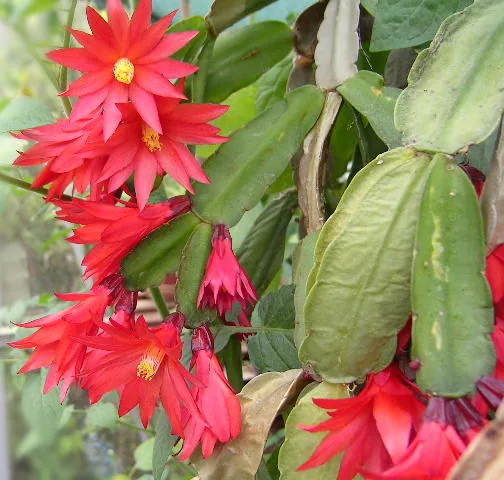
Your Easter cactus flowers in spring, around the holiday it is named for, opening scarlet stars along the tips of its flat, jointed pads. It does sit in the cactus family, yet it grew up as a forest epiphyte, settled on tree branches in the Brazilian rainforest rather than out in baking desert sand. Once you picture that leafy, shaded home, its care stops feeling mysterious: it wants gentle light, even moisture, and a little humidity, not the hot dry air a cactus name suggests.
People often confuse it with the Thanksgiving and Christmas cacti, and that is an easy mistake to make. Look closer and the differences are clear, because its segment edges are rounded and scalloped rather than clawed, and it saves its flowers for spring instead of midwinter. It is the gentler, slower grower of the three, which is exactly why a plant in full bloom feels like such a happy payoff for your patience.
The one favor it really asks is a cool, short-day rest through late autumn and winter, with cooler temperatures and less water. That calm stretch is what sets the buds, so it is well worth giving. If you skip it, or shuffle the plant around once buds appear, the buds simply drop, and the good news is that next season gives you a fresh chance to get it right.
Care
The short version: give it bright indirect light and never direct sun, letting the top few cm of mix dry between drinks. Treat it to a cool, drier rest from autumn through winter to set buds, and once those buds form, just leave the plant where it is.
Light
Settle it in bright, indirect light and shield it from direct sun, which can scorch and redden the segments. It will happily get along in medium light or a bit of shade, but the brightest spot just short of a sunbeam rewards you with the best flowers.
Water
Wait until the top few cm of mix feels dry, then water it well and let the excess run off, which usually works out to every 7 to 14 days. Remember this is a forest cactus and not a desert one, so never let it bake bone dry, yet soggy soil will rot the roots quickly. Ease back through the autumn-to-winter rest, and once buds set, keep your watering steady, since a sudden change is what makes buds tumble.
Soil
Pot it in a well-drained, organic-rich mix that holds a little moisture without turning swampy, and a blend made for cactus or epiphytes is a safe choice. It leans toward slightly acidic ground, somewhere around a pH of 5.5 to 6.5, so do not worry over getting it exact.
Temperature
Comfortable room warmth of 50°F to 77°F (10°C to 25°C) keeps it content all year. The cooler end of that range through autumn and winter, teamed with shorter days, is the gentle nudge that coaxes buds into forming.
Humidity
Everyday household humidity suits it fine, with no target number to chase. Since it hails from the rainforest, it enjoys a touch more moisture in the air, so a cluster of plants or a nearby pebble tray is a kind gesture in dry winter rooms.
Feeding
Offer a balanced, diluted liquid houseplant fertilizer roughly once a month, beginning after the flowers fade and carrying on through the summer growth. Let the feeding stop in autumn so the plant can ease into its well-earned rest.
Pruning
Once the blooms have finished, gently twist or pinch off a few of the terminal segments to encourage branching and a fuller shape. Those little pieces are not waste at all, so root them as cuttings and grow yourself some new plants.
Repotting
There is no rush here, so repot only every 3 to 4 years, after flowering, and only when the plant is genuinely crowded, since it blooms best a touch pot-bound. Roots peeking from the drainage holes, mix that dries out quickly, and growth that has stalled are all friendly signs it is ready.
Size & spacing
It stays nicely compact, reaching about 6 to 12 inches (15 to 30 cm) tall and spreading 12 to 16 inches (30 to 40 cm) across, often arching softly as the segments lengthen. That gentle trailing habit makes it a lovely fit for a hanging pot or the edge of a shelf.
Troubleshooting
Almost every Easter cactus worry comes down to two gentle culprits: watering that swings too wet or too dry, and a plant that gets disturbed while it is budding. Catch the early signs below and you can usually put things right before any flowers or roots are lost, so try not to fret.
Segments turning limp, soft, or red near the base
Soft, reddish segments most often signal root rot from soil left too wet, though the very same droop can come from letting the mix go bone dry. Give a segment a gentle tug and peek at the roots, because mushy brown means rot while firm and white in dusty mix means thirst. For rot, trim the dead roots and repot into fresh, fast-draining mix, and for drought, water well and let it drain.
Fix:
- If rotted, unpot, cut away mushy roots, repot into fresh well-drained mix, and water sparingly
- If drought-stressed, water thoroughly and let excess drain
- Salvage healthy segments as cuttings if the base is lost
Flower buds falling before they open
Bud drop is the most common Easter cactus heartbreak, and it usually springs from change rather than any neglect on your part. After buds form, the plant dislikes being moved, turned, drafted, or watered on a new rhythm, and it lets the buds go in protest. Choose one steady spot, keep the top few cm just moist, and simply let it be until it blooms.
Fix:
- Leave the plant in one spot once buds appear and avoid turning it
- Keep watering even and the top few cm just moist while budded
- Shield from heat vents, cold drafts, and doorways
White cottony tufts or a sticky film on the joints
Those cottony flecks tucked into the segment joints are mealybugs, while small bumps with a sticky honeydew sheen point to scale. Both can spread fast indoors, so move the plant away from its neighbors the moment you notice them. Lift the pests off with a cotton swab dipped in 70 percent alcohol, then follow up with insecticidal soap until the plant is clear.
Fix:
- Dab pests with a cotton swab dipped in 70 percent isopropyl alcohol
- Treat with insecticidal soap, repeating per label
- Isolate the plant until clear
Toxicity
Here is a reassuring note for a home full of pets: the Easter cactus is not toxic. The ASPCA lists the whole holiday cactus group as safe for cats and dogs, and nothing in the plant will poison people, horses, or other animals. A pet that wolfs down a big mouthful of the fibrous segments might feel briefly queasy, and that really is as bad as it gets.
Safe for
People · Cats · Dogs · Horses · Rabbits · Livestock · Birds
Cats Safe
The ASPCA lists the holiday cactus group as non-toxic to cats, so a curious nibble will not poison yours. A cat that swallows a big mouthful of the fibrous stems might drool a little or feel briefly queasy, and that is truly the whole story.
Dogs Safe
Dogs are in no real danger from this plant, so you can breathe easy. If one chews off and gulps a large piece, the rough tissue can stir up some short-lived vomiting that settles on its own.
Horses Safe
Nothing in the plant is poisonous to horses, and as a small indoor cactus it rarely ends up anywhere near them anyway.
Rabbits Safe
It is safe around rabbits, so a nibble is nothing to worry about. The fleshy segments hold no toxin, and a curious bunny comes to no harm.
Livestock Safe
There are no toxic compounds in it, so grazing animals face no danger from this little plant.
Birds Safe
Pet birds can perch and peck nearby without any worry, since the segments carry nothing harmful.
People Safe
It is harmless to people, children included, so there is no cause for alarm. It is not grown to be eaten, of course, but a tasted segment carries no poisoning risk.
Fibrous plant material can still cause mild stomach upset or vomiting if a pet eats a large amount.
Varieties
Nearly every plant sold as Easter cactus traces back to two species and the crosses between them, and these are the friendly names worth recognizing.
Rhipsalidopsis gaertneri (type)
The original species opens scarlet, star-shaped spring flowers on flat segments rimmed with rounded, scalloped, faintly bristled teeth.
Rhipsalidopsis rosea and its hybrids
This smaller pink-flowered species crosses easily with R. gaertneri to give the pink, salmon, and white-flowered Easter cactus cultivars you see for sale today.
How to propagate
Making more Easter cactus from your own plant is easy and forgiving, so one happy plant can quietly turn into several while you wait for the cuttings to root.
Stem cuttingsEasy
After flowering in late spring or early summer · Roots in about 2 to 4 weeks; flowering-size plant in 1 to 2 years
Take your cuttings right after flowering, in late spring or early summer, when the plant is most willing. Twist off a piece of 2 to 3 jointed segments, let the cut end callus over for a day or two, then stand it in barely moist, well-drained mix in bright indirect light. Roots appear in 2 to 4 weeks, and a young plant simply needs a year or two of patience before it blooms, so be kind to yourself while you wait.
Myths
Easter, Thanksgiving, and Christmas cactus are just one plant sold at different times of year.
They are three separate plants. Your Easter cactus blooms in spring and carries rounded, scalloped segment edges with star-shaped flowers, while the Thanksgiving and Christmas cacti are Schlumbergera that flower in late autumn and winter on segments with pointed or toothed edges. The Easter cactus is also the fussier, slower grower of the trio, so a little extra patience pays off.
Holiday cacti are dangerous and poisonous to pets.
The ASPCA lists holiday cactus as non-toxic to cats and dogs, so you can relax. The worst your pet might face is a brief upset stomach from the fibrous tissue, which is a far cry from real poisoning.
The Easter cactus has always carried one settled scientific name.
Its classification has wandered for years, resting in Rhipsalidopsis, Hatiora, and Schlumbergera by turns. That is why you will find it sold under all three names, with gaertneri tacked onto each, so do not be thrown if the label surprises you.