Houseplant · Crassulaceae
Kalanchoe
Kalanchoe
A forgiving little succulent that hands you bright, long-lasting blooms for hardly any effort at all.
Bright indirect
50–86°F · 10–30°C
USDA 10–12
6–35 in · 15–90 cm
Overview
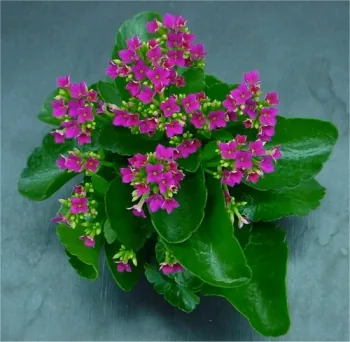
If you are new to succulents, kalanchoe is a gentle place to begin. It belongs to the stonecrop family, and most of the houseplant types trace home to Madagascar. Because it tucks water away in thick, fleshy leaves, it forgives the occasional forgotten watering and asks very little of you in return. The flowering kind on the shop bench carries dense heads of small, bright blooms that stay pretty for weeks on end.
There is more to the genus than that one cheerful florist plant. Some kinds are grown for their fuzzy silver leaves rather than flowers, others build their leaves into red-edged paddles, and a few line their leaf margins with little plantlets that drop and root all on their own. However different they look, they all crave the same simple things: plenty of light and a pot that drains in a hurry.
One caring word before you bring one home. Every kalanchoe holds cardiac glycosides that are toxic to cats, dogs, horses, and other animals, so if you share your home with pets, choose its spot thoughtfully and place it well out of their reach.
Care
The short version: offer bright indirect light, pot it in something gritty that drains fast, and only reach for the watering can once the soil has dried right out. Keep it comfortably warm, feed it lightly through the growing season, and go easy on the water in winter.
Light
Set kalanchoe where it gets bright indirect light, and once it has settled in it will happily take a little direct sun too. Skimping on light is the usual reason a plant stretches out and stops blooming, so a bright windowsill is the kindest, safest home for it.
Water
Wait until the soil has dried out completely before you water, then water it well and pour off anything that gathers in the saucer. Those plump leaves keep their own store of water, so it is standing wet, not thirst, that undoes these plants through root rot. Ease right off in winter when growth slows down.
Soil
Pot it in a gritty, well-drained cactus or succulent mix so water rushes straight through and never lingers around the roots. Sharp drainage really is the one thing your kalanchoe needs most from you.
Temperature
Keep it somewhere in the 50°F to 86°F (10°C to 30°C) range, which is comfortable ordinary room warmth. It has no tolerance for frost at all, so bring any outdoor plant inside in good time before the cold sets in.
Humidity
Plain low household humidity is just what this succulent likes, so there is no target number to fret over. Damp, still air does it more harm than good, so let it breathe.
Feeding
Feed it monthly from spring through summer while it is growing, using a balanced water-soluble fertilizer at half strength. Let it rest and skip feeding through the quiet winter months.
Pruning
Deadhead the faded flowers and pinch the leggy stems back after blooming to keep your plant compact and bushy. If you notice any soft, rotted growth, snip it out the moment you see it.
Repotting
Give kalanchoe a fresh pot every 1 to 2 years, or a little sooner if it fills out its container. Roots peeking from the drainage holes, water rushing straight through, and growth that has stalled are all its way of asking for more room.
Size & spacing
Depending on the kind, a kalanchoe reaches 6 to 35 inches (15 to 90 cm) tall and spreads 6 to 18 inches (15 to 45 cm) across. Choose a pot to suit, keeping in mind the tidy florist kinds stay well below that tallest figure.
Troubleshooting
Almost every kalanchoe hiccup traces back to the roots or to light, and the good news is that catching it early makes it easy to set right. Look for the signs below, match yours, and step in before trouble has a chance to spread.
Soft, blackening stems and a squishy base
Take heart, because this is root and crown rot, and it comes from water lingering in soil that cannot drain, not from anything you did wrong overnight. Ease the plant out of its pot and feel the roots, which go brown, soft, and sour instead of firm and pale when rot sets in. Trim off every mushy part with clean tools, settle it into fresh gritty mix, and simply wait to water again until it perks back up.
Fix:
- Remove the plant from wet soil
- Cut away all rotted tissue with clean tools
- Repot into fresh gritty, well-drained mix
- Withhold water until the plant recovers
Long, reaching stems that just won't flower
There is nothing broken here, only too little light, which leaves the stems stretched and the leaves spaced far apart as the plant leans toward the window. Flowering kinds also lean on long dark nights to form their buds, so shift yours to a brighter spot and gently pinch the lanky stems back. When you are ready for blooms again, offer the plant about six weeks of roughly 14 hours of complete darkness each night, and it will reward your patience.
Fix:
- Move to a brighter spot with bright indirect light
- For flowering kalanchoes, provide about six weeks of roughly 14 hours of complete darkness each night to trigger budding
- Pinch back leggy stems
Cottony white fluff tucked where leaves meet the stem
Do not panic at the cottony tufts and the sticky film beside them, because these are just mealybugs and they clear up with a little steady effort. Touch each one with a cotton swab dipped in 70 percent isopropyl alcohol, then wash the plant down with insecticidal soap and keep at it until every trace is gone. Set the plant apart from your other succulents for now so the bugs have nowhere to wander.
Fix:
- Dab insects with a cotton swab dipped in 70 percent isopropyl alcohol
- Treat with insecticidal soap and repeat until clear
- Isolate the plant from other succulents
Toxicity
This is one to keep gently out of reach of your animals. Every part carries bufadienolides, cardiac glycosides that bring on drooling, vomiting, and diarrhea, and in larger amounts can throw off the heartbeat. No part is edible, so treat it as toxic to pets and livestock and set it somewhere children cannot get at it.
Toxic to
Cats · Dogs · Horses · Rabbits · Livestock · Birds · People
Cats Toxic
If a curious cat nibbles the leaves, expect some drooling first, then vomiting and loose stools not far behind. A large mouthful is what truly worries a vet, since the cardiac glycosides can unsettle the heart rhythm.
Dogs Toxic
A dog that samples any part of the plant may drool, be sick, pass loose stools, and turn quiet and worn out. Bigger helpings can slow or scramble the heartbeat, so it is kindest to ring the vet without delay.
Horses Toxic
Horses take the same bufadienolides hard, and you may see drooling, colic, and loose manure. In any real quantity the toxin can upset the heartbeat and grow dangerous, so keep it well clear of paddocks.
Rabbits Toxic
Please never hand a rabbit kalanchoe to try. Even a small taste stirs up drooling and a queasy gut, and the cardiac glycosides make it a genuine risk for such a small animal.
Livestock Toxic
Cattle, goats, and sheep grazing near this plant, or clippings tossed their way, can be poisoned. The signs range from drooling and diarrhea to unsteady legs, and a heavy dose can stop the heart, so fence it off.
Birds Toxic
Give pet birds a wide berth from the foliage. The cardiac glycosides are no gentler on them, and a bird that pecks a leaf out of curiosity can end up with an upset gut and heart-rhythm trouble.
People Caution
No part of this plant is meant for eating, so leave it off the plate entirely. The sap can leave skin a touch itchy, and swallowing any amount tends to upset the stomach, so it is wise to keep it away from small children.
Sap can cause mild contact irritation; keep the plant out of reach of pets that chew foliage.
Helpline numbers

United States
ASPCA Animal Poison Control: (888) 426-4435 (fee applies)
Poison Control: (800) 222-1222



Canada
Poison Centres: 1-844-764-7669
Varieties
Kalanchoe is a wider family than the flowering plant most people picture. Here are the ones you are most likely to come across.
Kalanchoe blossfeldiana (Flaming Katy)
This is the familiar florist kalanchoe you will spot in every garden center, easy to know by its glossy scalloped leaves and packed clusters of small bright flowers.
Kalanchoe tomentosa (panda plant)
People keep this one for its plump, fuzzy silver leaves trimmed in soft brown felt, a plant loved for its foliage far more than any bloom.
Kalanchoe daigremontiana (mother of thousands)
Tiny plantlets line up all along each leaf edge, then let go and take root wherever they happen to land.
Kalanchoe luciae / thyrsiflora (paddle plant)
Its rounded paddle-shaped leaves stack up like the petals of a flower and blush deep red along their edges when the light is bright.
How to propagate
Kalanchoe is among the most forgiving succulents to multiply, and you can do it either by rooting a stem tip or by growing a fresh plant from a single leaf.
Stem cuttingsEasy
Spring to summer during active growth · 2 to 3 weeks to root
Snip a healthy stem tip in spring or summer while the plant is putting on growth, then set the cut end aside to dry and callus for a day or two before potting. Nestle it into gritty, barely moist mix, and roots follow in about 2 to 3 weeks. That little callusing pause is the quiet trick that keeps the stem from rotting on you.
Leaf cuttingsEasy
Spring to summer · 3 to 6 weeks to form plantlets
Many kalanchoes are generous enough to grow a whole new plant from one leaf laid flat on well-drained mix in spring or summer. Fresh plantlets and roots gather at the leaf base over the following 3 to 6 weeks. Let the leaf callus first and keep the mix only barely damp, and the rest tends to look after itself.
Myths
Kalanchoes are harmless succulents that make safe gift plants around pets.
It is a lovely thought, but the ASPCA lists kalanchoe as toxic to cats and dogs, and every relative in the genus carries the same danger. The plant is loaded with bufadienolides, a cardiac glycoside that stirs up drooling, vomiting, and diarrhea, and in larger amounts can unsettle the heartbeat. A cheerful bloom does not make it a safe pick for a home that shares its space with animals.