Houseplant · Crassulaceae
Jade Plant
Crassula ovata
Give it bright light and a good dry-out between drinks, and your jade plant will happily outlive most of the houseplants that came home with it.
Full sun
50–75°F · 10–24°C
USDA 10–11
1–6 ft · 0.3–1.8 m
Overview
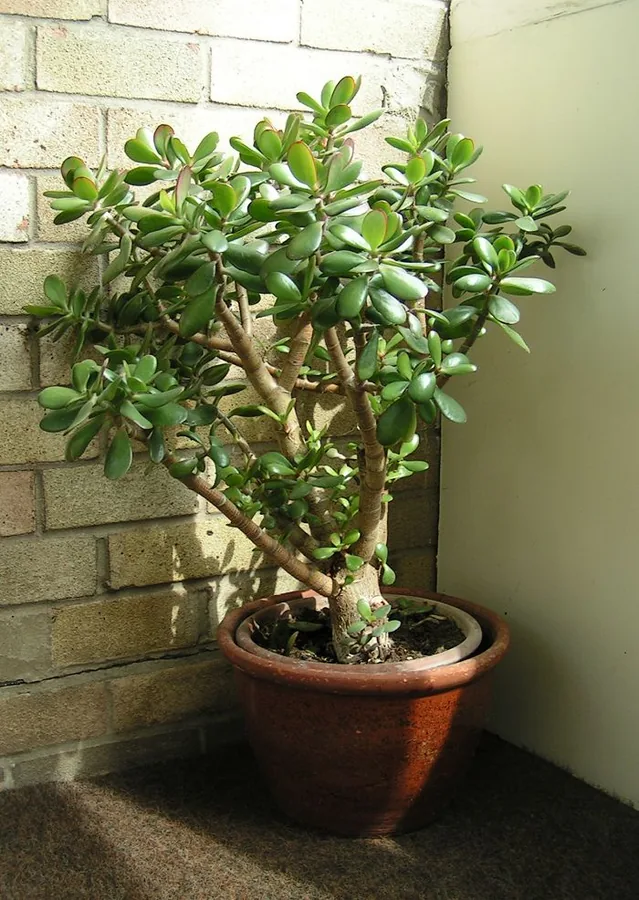
The jade plant is a succulent from southern Africa, and it has quietly become one of the most forgiving houseplants you can bring home. It tucks water away in thick, glossy leaves and a chunky woody trunk, so it takes the odd bit of neglect in stride while fussier plants give up. Set it in a bright window and leave it be, and over time it grows into the shape of a little tree.
Its growth is slow, but it is in no hurry. A jade can keep you company for decades and climb to 1 to 6 feet (30 to 180 cm) indoors, thickening into a gnarled, bonsai-like form as the years pass. The old folk names of money plant and lucky plant fit, though the real fortune is in how easygoing it is, not in any luck it carries.
The one thing it truly can't stand is a soggy pot. Nearly every jade that fails was loved with too much water, not too little. Get the watering and drainage right and you will find the rest of its care almost takes care of itself.
Care
The short version: give it bright light with a little direct sun, plant it in a gritty fast-draining mix, and water only once the soil has dried right out. Keep it warm, feed it lightly through the growing season, and gently resist the urge to overwater.
Light
Your jade loves bright light with several hours of direct sun, so a south-facing window is the happiest place for it. Give it too little and the stems begin to stretch and lean, growing pale and leggy as they strain toward the glass.
Water
Water it deeply, then simply wait until the soil has dried out completely before the next drink, easing right back in winter. Overwatering is the one thing most likely to finish a jade, whereas too little only shrivels the leaves, and they plump back up soon after a good soak.
Soil
Settle it into a gritty cactus or succulent mix that drains quickly, always in a pot with drainage holes. A slightly acidic pH of 6.0 to 6.5 keeps it content, and that loose, sandy feel stops water from lingering around the roots.
Temperature
Everyday room warmth is just right, somewhere around 50°F to 75°F (10°C to 24°C). Shield it from cold drafts and never leave it below 50°F (10°C), which can startle it into dropping its leaves.
Humidity
This is a dry-climate plant that is happiest in low humidity and dislikes damp, stuffy air. There is no need to mist it, since your ordinary household air suits it perfectly.
Feeding
Feed it once a month through spring and summer while it is growing, then let it rest over winter. Reach for a balanced or low-nitrogen succulent fertilizer diluted to half strength, because jade grows slowly and asks for very little.
Pruning
Pinch or prune in spring to coax fuller, tree-like growth and to take out any leggy or weak stems. Jade handles hard pruning with ease, and every piece you snip off will happily root as a fresh cutting.
Repotting
Repot it every 2 to 3 years in spring, or sooner if roots poke through the drainage holes and the plant starts to feel top-heavy. Move it into a pot just a size up with fresh gritty mix, and go gentle on the watering for a week or so while it settles.
Size & spacing
Indoors your jade will reach 1 to 6 feet (30 to 180 cm) tall with a spread of around 1 to 3 feet (30 to 90 cm). It takes its time growing, so give it a steady, heavy pot to keep that thickening crown from tipping over.
Troubleshooting
Nearly every jade worry comes back to water and light, so you are rarely far from the answer. Soft, mushy growth is a sign of too much water, while a wrinkled or stretched plant is quietly asking for a drink or a brighter spot. Find what you see below and you can usually set things right long before the plant is in real danger.
Soft, mushy stems and yellowing at the base
Take heart, because even a jade that has gone soft at the base can often give you a second start. What you are seeing is root and stem rot, and it comes from water lingering around the roots for too long. If the base has turned dark and mushy it won't recover as it stands, so trim away the rotten parts, let the cuts dry, or simply grow a fresh plant from a firm cutting. From here on, wait until the soil is bone dry before you water.
Fix:
- Stop watering immediately and allow the soil to dry out
- Remove the plant, cut away rotted roots and tissue, and let cuts callus
- Repot into fresh, fast-draining gritty mix
- Propagate healthy stem or leaf cuttings if the base is lost
Leaves dropping all at once
A sudden shower of leaves looks scary, but it is usually just stress from a sudden change in light, temperature, or watering, and your plant can bounce back. Think about anything that shifted lately, whether a move to a new spot, a chilly draft, or a jump from dry to soaked. Settle it into one steady home and a steady routine, keep it clear of cold below 50°F (10°C), and give it time to find its feet.
Fix:
- Stabilize location, light, and watering routine
- Protect from cold drafts and temperatures below 10°C
- Allow the plant to acclimate gradually to new conditions
Wrinkled, shriveled, or drooping leaves
Don't worry, this one is easy to put right. Soft, bendy leaves sitting on dry soil are a sign of underwatering, because your jade has used up the water it keeps tucked in its leaves. Give it a generous soak until water runs out the bottom, then return to watering only once the leaves feel a little less firm. You will see them plump up again within a day or two.
Fix:
- Water thoroughly until it drains from the bottom
- Resume a regular dry-out watering cycle
- Move out of excessive heat if leaves continue to shrivel
Stretched, leggy stems with gaps between leaves
When the stems reach out and the leaves spread far apart, your jade is simply hungry for more light, a state gardeners call etiolation. Give it a bright south-facing window with a few hours of direct sun, and turn the pot now and then so it fills out evenly. The stretched growth won't shrink back, but a little pruning of the leggy stems soon brings back that compact, tree-like shape you want.
Fix:
- Move to a brighter spot with several hours of direct sun
- Rotate the plant periodically for even growth
- Prune leggy stems to restore a compact shape
Toxicity
Please keep your jade plant out of reach of cats and dogs. The ASPCA lists it as toxic to both, and a pet that chews the leaves can be sick, grow listless, walk unsteadily, and develop a slowed heartbeat. Oddly, the exact toxin has never been named, so the safest and simplest step is to set the plant where pets can't get to it. You and the people in your home are essentially fine around it.
Toxic to
Cats · Dogs · Horses · Rabbits · Livestock · Birds
Safe for
People
Cats Moderate
A cat that nibbles the leaves will likely be sick and grow dull and sleepy. Keep a gentle eye out for a wobbly, unsteady walk, and in the harder cases a heartbeat that slows below its usual pace.
Dogs Moderate
Should a dog get into jade, expect some vomiting and a quiet, worn-out mood. A few become shaky on their legs, and a bigger mouthful can leave the heartbeat running slow.
Horses Caution
Horses aren't a known target, yet the compound behind jade's effect has never been identified. Until someone sorts that out, the kind and simple choice is to keep the plant well beyond their reach.
Rabbits Caution
Nobody has clearly documented how jade sits with rabbits, and a succulent like this has no business in their diet anyway. Treat it as off the menu and don't let them take a bite.
Livestock Caution
Grazing animals haven't been tested against this plant, and with the active compound still unknown, the safe and easy move is to fence it away from goats, sheep, and cattle.
Birds Caution
No one has confirmed what jade does to birds, though a curious parrot will chew almost anything within reach. Keep it clear of cages and perches and you have nothing to fret over.
People Low
You can relax around jade, as it isn't regarded as a hazard to handle or live alongside. It still isn't food, so there is no call to taste it, and it helps to keep small children from popping leaves in their mouths.
Helpline numbers

United States
ASPCA Animal Poison Control: (888) 426-4435 (fee applies)

United Kingdom
Animal PoisonLine: 01202 509000 (fee applies)

Australia
Animal Poisons Helpline: 1300 869 738
Varieties
Beyond the everyday jade sit a handful of cultivars grown for their unusual leaf shapes and colors. If you would like something a little different, these are the ones worth hunting down.
'Gollum'
You will spot it by leaves shaped like narrow tubes finished with reddish, suction-cup tips, which give the whole plant a coral-like charm.
'Hobbit'
Here the leaves curl and fold back into little trumpet shapes on a plant that stays noticeably tidier and more compact than 'Gollum'.
'Hummel's Sunset'
Its golden-yellow leaves pick up red edges that grow richer when the light is bright and the air turns cooler.
'Variegata' (Tricolor)
Every leaf carries streaks of creamy white and green and often blushes pink along its edges.
How to propagate
Few plants are as forgiving to multiply as a jade, which is wonderful news if you are just starting out. A single dropped leaf or a trimmed stem will root more or less on its own, and that is how one happy plant quietly turns into many.
Leaf cuttingsEasy
Spring or summer during active growth · 2 to 4 weeks to root, several weeks more to form plantlets
One leaf really is all you need to begin a whole new jade. Gently pull a healthy one in spring or summer while the plant is growing, leave the cut end to dry and callus for a few days, then rest it on top of or barely into gritty mix. Roots come along in 2 to 4 weeks, and little plantlets take several weeks more, so it is the slow yet almost can't-fail path.
Stem cuttingsEasy
Spring or summer during active growth · 2 to 3 weeks to root
If you would like a real plant sooner, a stem cutting is your friend. Snip one off during the spring or summer growth spell, let the cut callus over several days, then tuck it into dry succulent mix. Roots appear in around 2 to 3 weeks, and it settles in faster than a leaf because it already begins life as a piece of stem.
Myths
The jade plant is the true money plant that brings wealth, the same one sold as a trailing vine.
The name money plant gets attached to several plants that aren't related at all. Your jade is a succulent, while the trailing vine sold under that label is usually a pothos or a Pilea, so the two are worlds apart. The name grows out of folklore, not from any plant that truly makes you rich.
Jade plants are perfectly safe to keep in a home with pets.
The ASPCA counts jade as toxic to cats and dogs, and the curious part is that the exact compound has never been pinned down. A pet that eats it may be sick, turn listless, walk unsteadily, and slip into a slowed heartbeat. The kind thing is to keep it well out of reach of cats and dogs.