Houseplant · Crassulaceae
Burro's Tail
Sedum morganianum
Offer it bright light and dry roots, and this tumbling succulent will spill happily over its pot for years.
Full sun
Every 14–30 days
50–77°F · 10–25°C
USDA 10–11
Overview
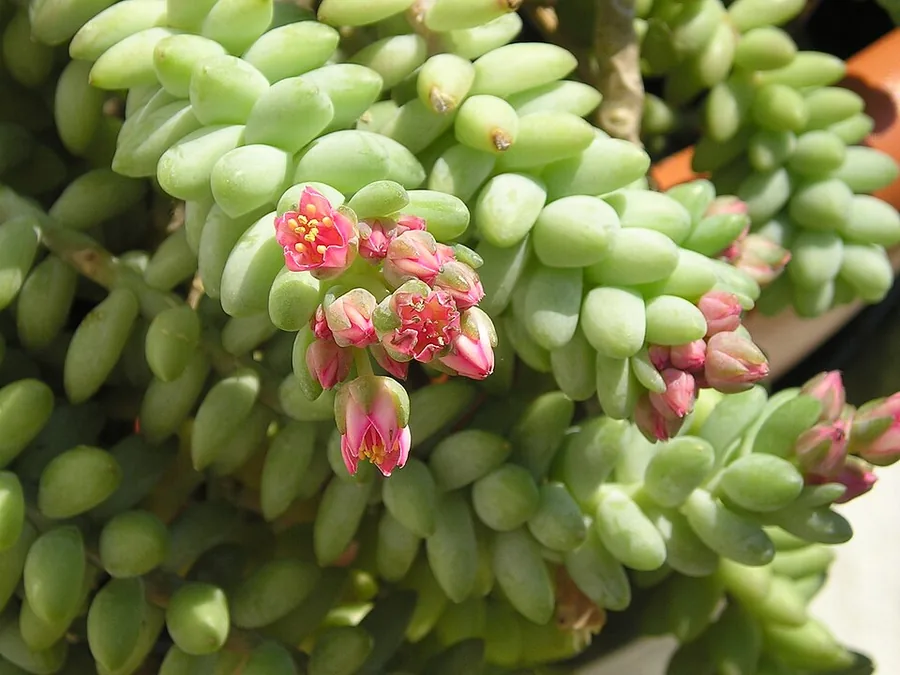
Burro's tail earns its charming name from the thick, plaited stems that drape down past the rim of a pot like a soft tail. Its home is the rocky high country of southern Mexico and Honduras, and that rugged upbringing tells you nearly everything about keeping it content. Each rounded blue-green leaf is a little reservoir of stored moisture, which is why this plant sails right through the dry spells that would undo a fussier companion.
The very thing that gives it such beauty also asks a gentle hand from you. Those snug, overlapping leaves hold on only by a thread and tumble off at the slightest contact, so a basket hung somewhere calm and untraveled really is its happiest home. Give it good care and a single plant trails for several feet, and come summer it might just crown its stems with tiny pink to red blooms, a treat that seldom appears indoors.
Take heart, because this is a plant that asks for almost nothing from you. A bright window, a pot that drains freely, and plenty of patience between drinks are all it wants, and honestly the one real pitfall is caring too eagerly with the watering can. Keep it on the dry, hands-off side, and it will keep you company for many years.
Care
The short version: set it in your sunniest window, plant it in a gritty cactus mix, and reach for the water only after the soil has nearly dried out, holding back even more through winter so rot never gets a foothold.
Light
Burro's tail loves bright light to full sun, so hand it the brightest perch in your home. A sunny sill keeps the trailing stems plump and close-knit, while a shadowy nook leaves them stretched, thin, and faded. When you move it toward stronger sun, ease it across about a week or so so the leaves never catch a scorch.
Water
Go sparing with water, waiting until the mix has very nearly dried out, which often lands at roughly once a month indoors. Those swollen leaves keep their own backup supply, so whenever you're unsure, simply hold off. Pare back even more in winter, because cold, soggy roots are the surest path to rot.
Soil
Settle it into a gritty, fast-draining cactus or succulent mix, all the better with a little extra perlite stirred through. Any pH from 6.0 to 7.5 will do nicely. The real key is that water slips straight on through rather than pooling around the roots.
Temperature
It stays content between 50°F and 77°F (10°C to 25°C), an everyday indoor range. A short, chilly dip down toward 40°F (4°C) is survivable, but bring it inside ahead of any frost, which it simply can't withstand.
Humidity
Think of this as a low-humidity plant that feels perfectly at ease in dry household air, so there's no level to fuss over and no need for misting. Stagnant, moist air does it no favors at all and only opens the door to rot.
Feeding
Feed it only rarely, a single light meal or two across the spring-to-summer growing stretch, with a balanced or diluted liquid fertilizer. It thrives on a lean diet, and over-feeding tends to set it back rather than help.
Pruning
There's barely any pruning to do. Snip back the odd leggy or overstretched stem just to keep it looking neat, and take it slow, since the stems snap easily and the leaves let go at the faintest touch.
Repotting
Only repot once it has truly outgrown its pot, and that won't come around often. Watch for roots pressing at the sides and growth that slows or starts to look crowded. Disturb it as little as you can while you move it, so the leaves stay where they belong.
Size & spacing
Those trailing stems can grow to 2 to 4 feet (60 to 120 cm) in length, spreading some 1 to 3 feet (30 to 90 cm) across. A hanging basket lets the tails cascade freely and keeps them safely out of reach of passing elbows.
Troubleshooting
Nearly every wobble with a burro's tail comes back to just two culprits: a bit too much water or not quite enough light. Catch the gentle early hints below and you can usually set things right long before your plant feels any real strain.
Squishy stems and leaves going see-through
This one is rot, and it nearly always means water has been hanging around the roots for too long. Catch it early and you have every chance of saving the plant. Put the watering can away, let everything dry out thoroughly, and trim off any soft or darkened stems so the rot can't keep creeping. Should the base be lost, simply root the firm tips that remain, then switch to a gritty, free-draining mix and ease right off the water once the cold months arrive.
Fix:
- Stop watering and allow the soil to dry out
- Remove rotted portions and repot into gritty, fast-draining mix
- Propagate healthy stem tips if the base is lost
Fuzzy white specks tucked where the leaves meet the stem
Those tiny white puffs sitting in the leaf joints are mealybugs, soft little pests that drink sap and can leave a sticky trace behind. Don't worry, they're very beatable. Touch each one with a cotton bud soaked in rubbing alcohol, set the plant apart from your others for a while, and repeat until they're gone for good. Going forward, give every new succulent a quick once-over before it joins the family, and keep your plants from sitting damp or packed too tightly together.
Fix:
- Dab insects with a cotton swab dipped in alcohol
- Isolate the plant and repeat treatment until clear
Fat little leaves scattering the moment you brush past
Please don't read this as a failure on your part. The chubby leaves cling loosely by design, so even a gentle nudge or a knocked pot will shake a few loose. The simplest answer is to hang it somewhere quiet and out of the way, then carry it by the pot itself instead of grabbing the stems. Best of all, every leaf that lands can be tucked onto the soil, where it happily roots into a brand new plant at no cost to you.
Fix:
- Place the plant where it will not be brushed against or knocked by passing traffic
- Handle by the pot rather than the stems
- Pot or scatter dropped leaves on soil, where they readily root into new plants
Long, gappy stems with leaves spaced far apart
When the stems grow lanky and the leaves turn thin and washed out, your plant is simply stretching toward light it can't quite reach, a friendly hiccup gardeners call etiolation. The fix is gentle and easy: shift it to a brighter window offering bright light to full sun. Just make that move gradually across a week or two so the stems don't burn, and before long it fills back out, snug and full again.
Fix:
- Move to a brighter spot with bright light to full sun
- Acclimate gradually to stronger light to avoid scorching
Toxicity
Lovely news if you share your home with pets or little ones: burro's tail is gentle and safe to keep close. The ASPCA counts it non-toxic for cats, dogs, and horses, and the leaves hold nothing harmful. A curious taste might leave a tummy briefly unsettled, much as any plant would, and nothing beyond that.
Safe for
People · Cats · Dogs · Horses · Rabbits · Livestock · Birds
Cats None
You can breathe easy here, since the ASPCA counts this one safe for cats. At the very worst, a curious taste might bring on a touch of drool or a passing tummy grumble, and nothing more serious than that.
Dogs None
Dogs are welcome around it as well, with no toxic substances in the leaves to fret over. The most a stem-chewing pup will feel is some mild, short-lived stomach grumbling.
Horses None
Horses get the all-clear from the ASPCA too, so a stray grazing mouthful is nothing to lose sleep over.
Rabbits Safe
With no toxins present, a nibbling rabbit comes to no harm, though those plump, water-filled leaves are gentler offered now and then rather than as an everyday green.
Livestock Safe
Sheep, goats, and cattle can have a taste without any trouble. Kept indoors as it usually is, it seldom ends up where they can reach it anyway.
Birds Safe
Your birds are perfectly fine near it, and a pecked leaf holds nothing poisonous. Those fragile stems tend to drop their leaves long before much is ever eaten.
People Safe
Nothing in it is harmful to people, so a youngster who pops a fallen leaf in their mouth is quite safe. It simply isn't a plant grown for the plate, so let it trail on the sill.
Varieties
There is one near cousin of burro's tail well worth meeting, a tidier, more compact form that's gentler to handle and every bit as forgiving to grow.
Sedum morganianum 'Burrito' (baby burro's tail)
Its leaves are shorter, rounder, and packed more snugly than the species, and they stay put far better, which makes this the kinder pick if you worry about knocking leaves loose.
How to propagate
Few houseplants share themselves so freely. Every leaf that slips off and every stem you trim can grow into a whole new plant, so you'll always have spares to pot up or hand to a friend.
Stem cuttingsEasy
Growing season (spring to summer) · Several weeks to a few months to root well
If you want a full plant in the shortest time, this is your route, and it's wonderfully forgiving. Snip a few healthy tips while it's actively growing in spring or summer, set them aside so the cut ends dry over for a day or two, then rest them on or nestle them into a gritty mix. Roots come along across several weeks to a few months, quicker than waiting on a lone leaf.
Leaf cuttingsEasy
Growing season (spring to summer) · Several weeks to a few months, slower than stem cuttings
Here's the lovely part: those leaves that keep tumbling off are little plants in waiting. Rest the dropped leaves right on top of the soil during the growing months and they'll send out roots and baby plantlets all by themselves. It rarely fails, though do give it patience, since it runs several weeks to a few months and trails a bit behind a stem cutting.
DivisionEasy
When repotting during the growing season · A few weeks to establish
Once a clump has truly filled out its pot, you can gently part it into pieces the next time you repot during the growing season. Each piece roots back down within a few weeks, and just like that one plant becomes two with hardly any effort.
Myths
Burro's tail is poisonous to cats and dogs and is unsafe around pets.
Happily, the ASPCA counts Sedum morganianum among the non-toxic plants for dogs, cats, and horses, so it belongs comfortably in a home with animals. A small nibble may upset a stomach a little, just as munching almost any houseplant might, yet there's nothing here that will do real harm.
The plant needs frequent watering to keep its plump leaves from shriveling.
Quite the opposite, really. This is a thirst-resistant succulent that tucks water away in its swollen leaves and prefers the soil to grow nearly dry before its next drink. Overdoing the water is the true danger, rotting roots and stems, so leaning toward less is always the safer choice.