Houseplant · Crassulaceae
Echeveria
Echeveria
Offer it bright light and a soil that dries quickly, and this forgiving rosette succulent will mostly take care of itself.
Full sun
50–77°F · 10–25°C
USDA 9–11
3–12 in · 8–30 cm
Overview
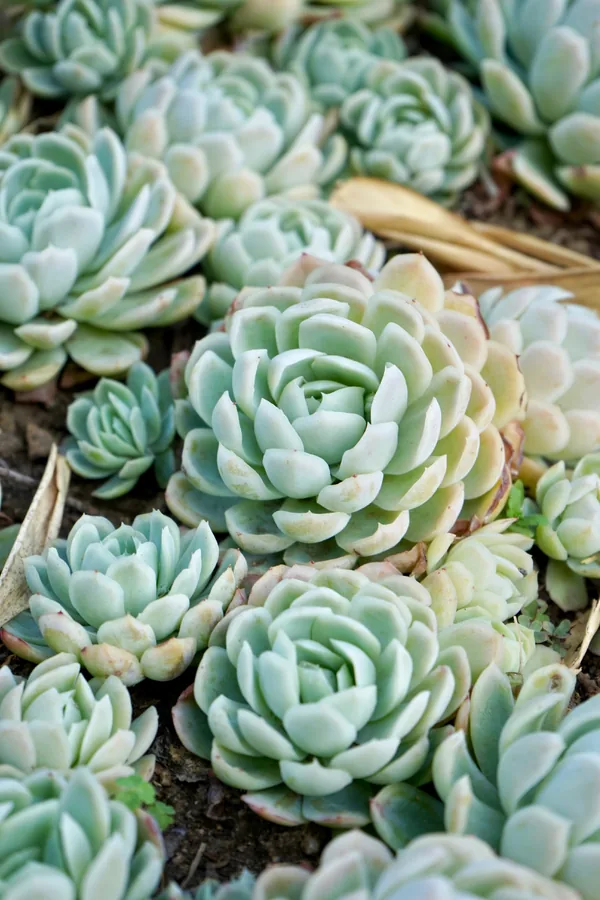
Echeveria is a rosette-forming succulent from the dry highlands of Mexico and Central America, and it is one of the kindest plants to start with on a sunny windowsill. Its fleshy leaves spiral out from a snug center into a shape that looks almost sculpted, in shades of blue-green, lavender, and silver. Many carry a fine powdery dusting called farina that lends them a soft frosted glow.
What makes it so reassuring is how little it asks of you. The plant tucks water away in those plump leaves, so it forgives a missed watering and would always rather be a touch too dry than too wet. Give it strong light and a gritty mix and it stays compact and colorful, often blushing pink or red at the leaf tips when the sun is generous.
It stays small, usually 3 to 12 inches (8 to 30 cm) across, and it quietly multiplies by pushing up little offsets around its base. Those pups are why one rosette can slowly grow into a whole shelf of plants. The two mistakes that catch people out are too much water and too little light, and the comforting part is that both are easy to head off.
Care
The short version: give it bright light, a gritty fast-draining mix, and a deep soak only once the soil has dried out completely, with a little feeding through the warm months.
Light
Echeveria longs for full sun to very bright light, several hours of it each day, to hold its tight rosette and its color. Indoors, a sunny south or west window is just right. Keep it short on light and the rosette stretches tall while the leaves lose their glow.
Water
Soak the soil right through, then wait until it has dried out completely before you water again. This is a desert plant that rots quickly in wet soil, so water at the base and never let water gather in the heart of the rosette. When you are unsure, give it another few days, and it will thank you.
Soil
Settle it into a gritty cactus or succulent mix that drains in seconds rather than holding water around the roots. A pH between 6.0 and 7.0 suits it well. Sharp drainage matters most of all, so stir in perlite or coarse sand if your mix feels heavy.
Temperature
It is most content between 50°F and 77°F (10°C to 25°C) and happy at ordinary room warmth. Frost is its one true weakness, so bring any outdoor plants inside well before the first cold snap arrives.
Humidity
Low, dry air is exactly what this plant enjoys, so there is no humidity to fuss over. Steamy bathrooms and kitchens are the wrong home for it, since trapped moisture around the leaves invites rot.
Feeding
Feed it lightly through spring and summer, while it is in active growth. A dilute balanced or low-nitrogen succulent fertilizer a few times across the season is all it needs. Set the food aside in winter when growth slows.
Pruning
There is very little to do here, which is part of its charm. Pull away the spent lower leaves and snip off faded flower stalks to keep it tidy. If a rosette has stretched and gone leggy, behead the top and re-root it to coax back the compact shape.
Repotting
Move it into a slightly larger pot every 2 to 3 years, or sooner if offsets crowd the rim and roots peek through the drainage holes. Take the moment to refresh the gritty mix and gently check the roots for any soft, rotted spots.
Size & spacing
A grown rosette stays small, reaching 3 to 12 inches (8 to 30 cm) tall and roughly as wide depending on the species. Its slow, compact way of growing makes it an easy companion for a windowsill, a small pot, or a spot in a mixed succulent dish.
Troubleshooting
Nearly every echeveria worry comes down to one of two things, too little light or too much water, and that makes it easy to set right. Look closely at the rosette and the base, and you can catch trouble while it is still small. Find what matches below, then step in early.
Soft, see-through leaves with a mushy, darkening base
When the leaves turn soft and translucent and the stem base feels squishy, that points to root and crown rot from soil that stayed too wet for too long. Once the rot has reached the crown the original plant cannot be brought back, and that is okay. Stop watering, trim away every soft part, and re-root a clean top cutting or a healthy pup in dry gritty mix to carry the plant forward.
Fix:
- Stop watering and let the plant dry
- Cut away rotted tissue and dust with no further water until callused
- Re-root healthy top growth or offsets in dry gritty mix
Soft white tufts tucked into the joints between leaves
Those little cottony clusters wedged into the leaf joints are mealybugs, gentle sap-feeders that leave a sticky film behind, and they are easy to handle once you spot them. Touch each one with a cotton swab dipped in 70 percent isopropyl alcohol, then rinse the plant and keep it away from the rest of your collection for a while. Look it over again every week until no new tufts show up, and you will have it back to health.
Fix:
- Dab insects with a cotton swab dipped in 70 percent isopropyl alcohol
- Rinse and isolate the plant
- Repeat treatment weekly until clear
A rosette growing tall with pale leaves spaced far apart
Take heart, because this is just etiolation, the plant gently reaching for light it cannot quite find. The stem grows long, the leaves drift apart and lean toward the brightest glass, and the neat rosette softens its shape. Move it somewhere brighter or set up a grow light, and you can behead the stretched top and re-root it for a fresh start.
Fix:
- Move to a sunnier spot or add grow lighting
- Behead the stretched rosette and re-root the top
- Propagate usable leaves from the bare stem
Toxicity
This is happy news for a home with pets and children. Echeveria carries no known toxins, and the ASPCA lists it as safe for both cats and dogs. A nibbled leaf might bring a brief stomach upset, the way any unfamiliar plant could, but there is nothing here to poison anyone.
Safe for
People · Cats · Dogs · Horses · Rabbits · Livestock · Birds
Cats None
You can let it share a home with your cat and breathe easy. If a curious one nibbles a leaf, the worst that tends to happen is a brief, mild tummy upset, the same as with any non-food plant, and nothing poisonous.
Dogs None
There is nothing here to worry a dog owner. A pup that chews on a rosette might drool a little or have a passing soft stool from the unfamiliar plant, and that really is all.
Horses Safe
It poses no poisoning risk to horses, though these small rosettes are houseplants at heart and offer nothing useful as forage.
Rabbits Safe
Rabbits are safe around it, since the leaves hold no toxin. If one gets nibbled, the loss is yours rather than any danger to the rabbit.
Livestock Safe
Grazing animals such as goats, sheep, or cattle face no poison from it.
Birds Safe
Pet birds take no toxicity from the plant, so a stray peck at a leaf does them no harm at all.
People Safe
Growing and handling it is risk-free for grown-ups and children alike. It is not meant for the plate, but a curious taste will not poison anyone.
Varieties
The genus stretches to hundreds of species and hybrids, yet a handful show up again and again. These are the ones worth getting to know by name.
Echeveria elegans
Often called Mexican snowball, it gathers into tight pale blue-green rosettes whose edges turn almost see-through at the margins.
Echeveria 'Perle von Nurnberg'
This hybrid is loved for dusty lavender-pink leaves softened by a fine powdery coating of farina.
Echeveria agavoides
Its crisp, triangular leaves recall a little agave and tend to finish in a bright red point.
How to propagate
Few plants are as encouraging to multiply as echeveria, and you can raise a new one from a single dropped leaf or from the pups it grows all on its own.
Leaf cuttingsEasy
Spring through summer during active growth · Several weeks to a few months to form roots and a new rosette
You can grow a brand new plant from a single leaf, and it is wonderfully simple. In spring or summer while it is growing, gently twist off a whole healthy leaf so none of it tears, let the cut end callus for a few days, then rest it on dry gritty mix and mist it now and then. Across several weeks to a few months tiny roots and a new rosette will ease out from the base.
Offsets & pupsEasy
Spring through summer · A few weeks to root once separated
The easiest path of all is the offsets, or pups, that gather around the mother rosette through spring and summer. Snap one off, let the cut surface callus over, and tuck it into dry succulent mix, where it settles in and roots within a few weeks.
Myths
Echeveria is just another name for true hens and chicks.
They do share a friendly nickname, but the two sit in different genera. True cold-hardy hens and chicks is Sempervivum, which weathers hard winters and dies after it flowers once, while Echeveria is tender and frost will kill it.
A succulent like echeveria never really needs watering.
It holds up beautifully through a dry stretch, yet it still longs for a deep soak once the soil has dried out completely. Leave one thirsty for too long and it shrivels, the leaves going soft and wrinkled as the plant quietly fades.