Tree · Cupressaceae
Dawn Redwood
Metasequoia glyptostroboides
A living fossil that warms to russet-bronze each fall and grows fast enough to watch.
Full sun
Every 3–10 days
USDA 4–8
70–100 ft · 21.3–30.5 m
Overview
Few plants have a comeback quite like dawn redwood, and that history makes it a lovely one to grow. For a long time botanists knew it only from fossils, until living trees were discovered in central China in the 1940s, and seed from those survivors carried it into gardens across the temperate world. It is that uncommon thing, a deciduous conifer, so it carries soft green needles all summer and then lets them fall when autumn comes.
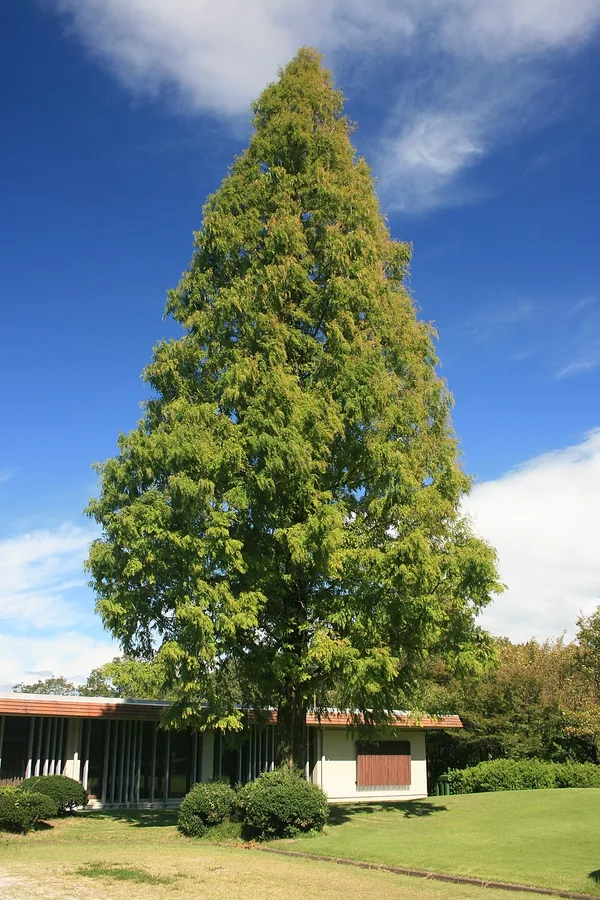
Offer it space and it pays you back quickly. The tree climbs at a brisk pace into a tidy pyramidal shape led by one straight stem, and a long-lived specimen can rise to 70 to 100 feet over a wide, fluted, buttressed trunk. All that speed and size make it a tricky pick for a small yard, yet a wonderful one for a park, a pond edge, or an open lawn where it has room to be itself.
Autumn is when it truly shines. Just before the needles let go, the entire canopy glows a soft russet-bronze to orange, a color very few conifers can offer. Through the rest of the year it asks very little of you, so long as the soil stays moist and leans toward acidic.
Care
The short version: give it full sun and deep, moist, slightly acidic soil, leave plenty of room for a large fast-growing tree, and keep the water steady while it's young and through any drought. Get those right and you'll find it a forgiving tree to grow.
Light
Set it in full sun for the best shape and color, though it accepts a touch of afternoon shade without complaint. Starved of light it grows thin and sluggish, and it never fills out into the crisp pyramidal form it's loved for, so a bright spot really pays off.
Water
This is a tree that enjoys damp feet. Keep the soil consistently moist and deep, and it will even put up with boggy or wet ground. Water it faithfully while it's young and right through any drought, because a long dry spell is the one thing it won't forgive.
Soil
Offer it deep, moist, humusy, acidic soil that still drains freely. It takes clay and wet sites in stride, yet it yellows and turns chlorotic on thin ground over rock or on high-pH alkaline soil. Aim for a pH of 5.0 to 6.5 and it will thank you.
Temperature
This is a tough tree across a wide span, comfortable in zones 4 through 8, holding up to cold as low as roughly -29°F (-34°C) and to summer heat near 100°F (38°C). Its one tender moment is that early spring flush, when a late frost can pinch the fresh shoots.
Humidity
Plain outdoor air suits it perfectly, so there's no humidity number to chase. What it genuinely cares about is steady moisture at the roots, not moisture in the air around it.
Feeding
In reasonable soil it hardly asks to be fed. Should growth seem slow, work a balanced slow-release tree fertilizer in early spring into the ground, and feel free to skip feeding altogether where the soil is already rich.
Pruning
There's little pruning to do, since the tree shapes its own strong pyramidal form around one central leader. While it rests in late winter, simply cut out any dead, damaged, or competing leaders so that clean outline stays true.
Repotting
Remember this is a landscape tree, not one for the long haul in a pot. Nursery or bonsai specimens get repotted every 2 to 3 years in early spring, and you'll know it's time when roots circle the pot, push out the drainage holes, and growth stalls and yellows.
Size & spacing
Plan for something grand. A grown tree stretches 70 to 100 feet (21 to 30 m) tall and spreads 15 to 25 feet (4.5 to 7.5 m) wide, so place it well clear of buildings, foundations, and pavement and leave the roots open ground to claim.
When to plant
You'll plant dawn redwood rather than sow it where it stands, and it feels at home in zones 4 through 8. Begin stratified seed indoors in late winter, then move young trees outside in spring once frost has passed, or settle them in during early fall. There's no flower to wait on, just that russet-bronze foliage that gently closes out each autumn.
Northern hemisphere
Southern hemisphere
Typical months for a temperate climate: start earlier in warm zones, later where spring frosts linger.
- Sow: Late winter to early spring (stratified seed, 8-10 weeks before last frost)
- Plant: Spring after last frost, or early fall
- Harvest: Non-flowering; russet-bronze to orange fall foliage in autumn before needle drop
Hardiness
USDA hardiness zones: 4–8
Temperature: down to -34°C
Troubleshooting
A happy dawn redwood gives you very little to fix, and the few problems that crop up almost always come back to stress or the wrong soil, both of which you can put right. Keep an eye on the needles and the new growth, since they flag trouble first. Find what matches below and step in early, while it still does the most good.
When new growth pales but the veins stay green
Newest leaves going pale while the veins hold their green is a sign of chlorosis, and it is very fixable. What's happening is that iron gets locked away in a high-pH or thin soil sitting over rock, so the tree can't reach it. A quick soil pH test confirms the cause. For the slow, lasting fix, nudge the pH toward slightly acidic with elemental sulfur, then use chelated iron when you want the foliage to green up quickly. A layer of mulch deepens and cools the root zone, which helps the tree help itself.
Fix:
- Test and lower soil pH toward slightly acidic with elemental sulfur
- Apply chelated iron to green up foliage in the short term
- Mulch and improve soil depth and moisture over the root zone
When sunken cankers form and growth dies back past them
Sunken, cracked, off-color bark with dead growth beyond the spot is a fungal canker, and it nearly always shows up after the tree has been through something rough like drought, frost, or a wound. Don't panic, because this is manageable. Remove the cankered wood, cutting well below the lesion, and wipe your tools with disinfectant between cuts so you don't carry it along. The lasting answer is gentle care: a tree kept steadily moist and mulched stays strong enough that cankers rarely take hold.
Fix:
- Prune out cankered wood well below the lesion, disinfecting tools between cuts
- Improve growing conditions to reduce stress
- Keep the tree adequately watered and mulched
When needles turn stippled and bronzed with a little webbing
If you spot speckled, bronzed needles laced with faint webbing, take a breath, because this is just spider mites and the tree will bounce back. They tend to arrive during hot, dry stretches, usually when a tree is already thirsty. To be sure, hold white paper under a branch, give it a tap, and watch for tiny crawling specks, then peek at the underside of the needles for webbing. A firm spray of water knocks most of them off, and insecticidal soap or horticultural oil handles the rest if you need it. Keep the roots watered and mulched and you remove the stress that invited them in the first place.
Fix:
- Spray foliage with a strong jet of water to dislodge mites
- Apply insecticidal soap or horticultural oil to affected foliage
- Keep the tree well watered and mulched to reduce drought stress
When foliage looks lacy and chewed in early summer
Shiny green-and-copper beetles gathered on lacy, see-through foliage are Japanese beetles, a familiar summer visitor on this tree. The easiest fix is also the gentlest: in the cool of early morning while they are slow, pick them off by hand into a bowl of soapy water. Save an approved insecticide for the rare heavy swarm that truly calls for it. Try not to worry over a little damage, since light feeding looks far worse than it is and an established tree shrugs it off.
Fix:
- Hand-pick beetles into soapy water in the early morning
- Treat heavy infestations with an approved insecticide if warranted
- Tolerate light feeding, which rarely harms an established tree
When a spring frost blackens the new growth
Because dawn redwood wakes up early in the season, a late-spring frost can singe the youngest shoots while the older wood stays perfectly fine. This looks alarming but is rarely serious. Once growth picks back up, snip away the dead tips, and the tree almost always sends out a fresh flush to replace them. Choosing a spot away from low pockets where cold air settles keeps it from happening again next year.
Fix:
- Prune out dead frost-killed shoots once new growth resumes
- Allow the tree to push a second flush, which it usually does
- Avoid planting in frost pockets
Toxicity
Here's a relief if you share your home with animals: dawn redwood is not toxic to pets, livestock, or people. It doesn't appear on the ASPCA's list of harmful plants, and the worst a curious nibble might cause is a brief stomach upset from eating too much greenery. Plant it freely, without a worry about who might wander beneath it.
Safe for
People · Cats · Dogs · Horses · Rabbits · Livestock · Birds
Cats None
You can relax around cats, since the needles hold nothing toxic. If a cat overdoes it on greenery of any kind, the most you might see is a short, mild tummy upset, and that's as far as it goes.
Dogs None
There's nothing here that troubles dogs, so a curious chew is no reason to fret. A big mouthful of foliage might bring on some loose stool, which is true of most plants.
Horses None
Horses are in no danger from this tree. Those soft, feathery needles carry nothing harmful, so a low branch browsed by a grazing horse is fine.
Rabbits None
Rabbits are quite safe with it. Fallen needles or low shoots make a harmless nibble, with no toxic risk at all.
Livestock None
Cattle, goats, and sheep can browse the foliage freely, with no chance of poisoning to worry about.
Birds None
Birds have nothing to fear from it, whether they perch, build a nest, or peck at the seed cones.
People None
People are safe with it too, and no part of the tree calls for careful handling. It just isn't grown for eating, so there's nothing on it worth a taste.
No special handling precautions are required; this is an outdoor landscape tree.
Varieties
Most dawn redwoods you'll find for sale are the plain species, but a few selections earn attention for their color or their shape. These are the ones it helps to know by name.
'Gold Rush' ('Ogon')
Its soft, feathery foliage stays a glowing golden-yellow right through summer, then shifts to orange-brown in fall, and it climbs more gently than the ordinary species.
'National'
A strikingly slim, columnar form chosen in 1958 at the U.S. National Arboretum for its tight pyramidal habit.
'Miss Grace'
A scarce weeping dwarf whose branches spill downward, staying low and rounded unless you stake it to grow upright.
How to propagate
Dawn redwood takes to propagation kindly, whether you begin with cold-treated seed or root a cutting from a tree you already love.
SeedModerate
Late winter to spring after cold stratification · 1-2 years to a sturdy seedling
A tree known only from fossils until living ones turned up in China in the 1940s, dawn redwood is surprisingly willing to grow from seed once that seed has had a cold-stratification chill. Sow from late winter into spring, then give it 1 to 2 years to fill out into a sturdy seedling, and you'll find it forgiving along the way.
Stem cuttingsEasy
Softwood cuttings in early summer or hardwood cuttings in late fall to winter · 2-4 months to root, then a season to establish
Cuttings are the dependable path and a kind one for a first try. Take softwood cuttings in early summer, or hardwood cuttings from late fall on into winter, and most root within about 2 to 4 months before needing a full season to settle in.
Myths
Dawn redwood is just another name for bald cypress or the evergreen coast redwood.
Dawn redwood stands on its own as Metasequoia glyptostroboides, and a handful of plain traits tell it apart. Look at how the needles pair up opposite one another, where the similar bald cypress sets its needles alternately and pushes woody knees up out of standing water. Unlike the evergreen coast redwood, dawn redwood is deciduous, letting its needles go every fall once they have warmed to russet-bronze.