Ornamental · Asteraceae
Stokes Aster
Stokesia laevis
A forgiving native perennial that gives you fringed blue flowers through summer with hardly any effort on your part.
Full sun
Every 5–10 days
USDA 5–9
12–24 in · 30–61 cm
Overview
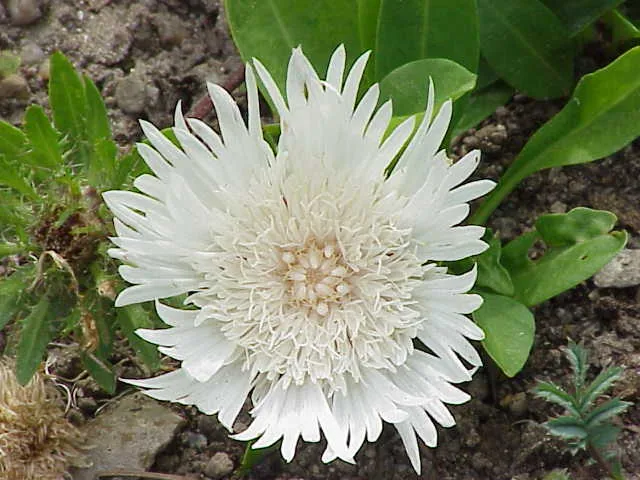
If you are just getting started, Stokes aster makes a gentle first choice. It grows in neat clumps, hails from the southeastern United States, and carries the name of the botanist Jonathan Stokes. Its fringed, daisy-like flowers come in soft lavender-blue, white, and creamy yellow, held over a ground-hugging rosette of shiny, strap-shaped leaves, and although it looks delicate, it brushes off the heat and humidity that would flatten a fussier plant.
The flowers are the reason to grow it, and they are easy to enjoy. Each bloom can reach up to 5 inches (13 cm) across, opening in early summer and returning for weeks as long as you snip off the faded heads, all while bringing in bees and butterflies. Even when the flowering slows, the evergreen rosette stays put through mild winters, so you are never left looking at bare ground.
Once it settles in, this is a plant that mostly takes care of itself. Full sun, soil that drains, and a simple division every few years cover almost everything it needs. The single thing it truly cannot handle is soggy soil through winter, and getting that one detail right is what separates a clump that widens happily for years from one that quietly fades. If you ever slip up, do not worry, most missteps here are easy to put right.
Care
The short version: settle it into full sun and average, well-drained soil, water it steadily while it is growing, and take real care to keep it dry through winter, because cold, waterlogged soil is the one thing that will finish it off.
Light
Give your Stokes aster full sun and it rewards you with the strongest stems and the fullest show of flowers. A little afternoon shade is fine, but plants left in too much shade tend to stretch, lean, and bloom far less, so lean toward the brighter spot when you can.
Water
Aim to keep the soil at average to medium moisture while the plant is growing, offering a drink roughly every 5 to 10 days whenever rain runs short. Do not fret about a perfect schedule, since good drainage matters far more than exact timing, and it is standing water in winter, not a missed watering, that does the real harm.
Soil
Average soil that drains well is all it really asks for, and it happily copes with sandy ground and a spell of summer wetness. Shoot for a pH somewhere between 5.5 and 7.0, and if your spot tends to stay wet, sorting out the drainage first will save you a lot of worry later.
Temperature
This is a genuinely tough perennial, comfortable from roughly -20°F to 95°F (-29°C to 35°C) and dependable across USDA zones 5 through 9. Southern heat and humidity barely register, and if you garden toward the colder edge of its range, a layer of winter mulch will help it come through in good shape.
Humidity
Everyday outdoor humidity suits it just fine, so there is no figure you need to chase. What helps most is steady airflow, which keeps the leaves dry and the crown healthy through damp stretches.
Feeding
Go gently with feeding. One light spring feeding of balanced fertilizer, or a simple topdressing of compost, gives it everything it wants for the year, and piling on more only encourages soft, floppy stems you would rather avoid.
Pruning
Snip off spent flowers as they fade to coax a longer show and to keep any ragged leaves looking neat through the season. Every few years, lift and divide the clumps, which is a small job that keeps them full of life.
Repotting
A potted Stokes aster only needs moving when it outgrows its container or when the crown grows crowded and the flowers start to thin. Out in the garden, dividing the clump every 3 to 4 years does the same refreshing job.
Size & spacing
Expect plants to stand 12 to 24 inches (30 to 61 cm) tall and spread 12 to 18 inches (30 to 46 cm) wide. Giving each one roughly that much room lets air move freely between them and leaves space for every clump to fill in nicely.
When to plant
Stokes aster follows the warm season, so there is no rush. Sow seed indoors in late winter, move young plants outside in spring once the frost has gone, and watch the fringed flowers open from early summer into July, often circling back for a gentle second flush in fall.
Northern hemisphere
Southern hemisphere
Typical months for a temperate climate: start earlier in warm zones, later where spring frosts linger.
- Sow: Late winter to early spring (about 6-8 weeks before last frost)
- Plant: Spring after danger of frost has passed
- Harvest: Early to mid summer (May to July), sometimes reblooming into fall
Hardiness
USDA hardiness zones: 5–9
Temperature: down to -29°C
Troubleshooting
Happily, Stokes aster gives you very little to fret over. Floppy stems and a few chewed leaves look worse than they are and stay cosmetic, while winter crown rot is the only issue that can truly end a plant, so watch for that one and act promptly if you see it.
The plant does not come back after a soggy winter
If a plant simply never reappears in spring, the culprit is almost always crown rot brought on by cold, waterlogged soil. Roots and crown that sat wet through winter turn soft and dark, and the plant either collapses or quietly fails to wake up. It feels disheartening, but the fix is straightforward: clear away any rotted crowns, then improve the drainage by raising the bed or planting on a slope, and add a winter mulch where the cold runs deep.
Fix:
- Improve drainage by amending soil or planting on a raised bed or slope
- Remove and discard rotted crowns
Stems lean or sprawl once the rain sets in
Do not be discouraged if the tall stems lean over after a downpour, since top-heavy blooms simply catch the rain and wind and bend under the weight. Too much shade or overly rich soil makes it worse by pushing soft growth that never firms up. Move it into full sun, ease off the feeding, and slip a grow-through support beneath the taller varieties before they bloom, and they will hold themselves far better.
Fix:
- Provide light staking or grow-through support for tall cultivars
- Site in full sun to promote sturdier stems
- Avoid over-fertilizing
Leaves look chewed and ragged
Ragged holes and a scatter of dark droppings usually mean caterpillars have been grazing. It can look alarming, but it rarely comes to much, and the plant carries on happily while feeding pollinators all season. Simply pick off the caterpillars when you spot them and let the plant get on with the rest.
Fix:
- Handpick caterpillars
- Tolerate minor feeding as the plant supports pollinators and is generally pest-free
Toxicity
Here is a reassuring note for homes with pets and children: Stokes aster is completely non-toxic. No extension office or botanical garden lists it as poisonous, and nobody reports skin irritation from it, so you can tuck it wherever a curious nose or small hand might wander.
Safe for
People · Cats · Dogs · Horses · Rabbits · Livestock · Birds
Cats None
Nothing about Stokes aster is toxic to cats, so a curious nibble is no cause for concern. A cat that gorges on any plant might still bring a little back up or have a passing tummy upset, much as it would after chewing grass.
Dogs None
Dogs are perfectly safe near this plant, which holds no poisonous compounds at all. The worst a big mouthful might bring is a bit of mild stomach upset that clears up on its own.
Horses Safe
No toxicity warnings apply to horses, so it is quite safe to grow along a pasture edge or in a bed they can nose into.
Rabbits Safe
Rabbits can nibble the leaves with no harm done, since the plant carries no toxins. They will gladly munch the foliage and flowers, though, so pop a little fence around the clump if you are hoping for blooms.
Livestock Safe
Grazing animals like cattle, goats, and sheep run no risk of poisoning from Stokes aster. No extension office or botanical garden counts it among the plants that cause livestock trouble.
Birds Safe
Birds have nothing to fear from it. The flowers bring in bees and butterflies, and seed-eating birds can pick over the faded heads quite safely.
People Safe
Stokes aster is non-toxic to people, with no cases of poisoning or skin irritation on record. It is not a food plant, so there is nothing meant to be eaten, but a child who tastes a bit by accident will come to no harm.
No special handling precautions noted; wash hands after gardening as general practice.
Varieties
Most of the named Stokes asters differ mainly in flower color and how compact they stay, and these are the ones you are most likely to find at a nursery.
Blue Danube
This one stays compact yet opens surprisingly large lavender-blue flowers, reaching up to about 5 inches (13 cm) across.
Alba
A crisp white-flowered form for anyone who prefers a cool, pale look over the familiar blue.
Mary Gregory
Its soft creamy-yellow blooms are a real surprise on a plant that usually leans blue.
Peachie's Pick
A tidy, generous bloomer that keeps producing deep blue flowers over a long stretch of the season.
How to propagate
Making more Stokes aster is refreshingly simple, whether you divide a clump, gather a little seed, or root a cutting.
DivisionEasy
Spring (or early fall) · One growing season
The simplest route is to lift and split a settled clump in spring, or in early fall if that suits you better. Doing this every few years also revives an older clump once its center begins to thin, and each fresh division takes hold over a single growing season.
SeedModerate
Spring; readily self-sows in the garden · Blooms typically in the second year from seed
You can start seed indoors in late winter or scatter it straight outside in spring, and the plant is happy to self-sow gently around the garden on its own. Just bring a little patience, since seedlings usually hold off until their second year before they flower.
Stem cuttingsModerate
Growing season · Several weeks to root; root cuttings are also effective
Take stem cuttings during the growing season and allow them a few weeks to settle in and root. Root cuttings work just as well, so a small piece of the rootstock will grow into a new plant if you would rather try that.
Myths
Stokes aster belongs to the true aster genus, Aster.
The name leads people astray. The plant actually sits in its own genus, Stokesia, honoring the English botanist Jonathan Stokes, and it shares only the wider daisy family with the true asters. So the flower may look the part, yet the plant is more of a distant cousin than a genuine Aster.
Because it grows wild in bogs and savannas, Stokes aster wants soil that is always wet.
It is true that it enjoys damp ground while it is actively growing, and that is where the bog reputation comes from. Even so, sharp drainage is not optional, and wet winter soil is what kills it more often than anything else. Keep it moist through summer and let it sit dry over winter, and it will be perfectly content.