Ornamental · Asteraceae
Goldenrod
Solidago canadensis
Give it full sun and lean soil and goldenrod rewards you with weeks of late-summer color and a garden full of happy pollinators.
Full sun
Every 7–14 days
USDA 4–9
2–6 ft · 0.6–1.8 m
Overview
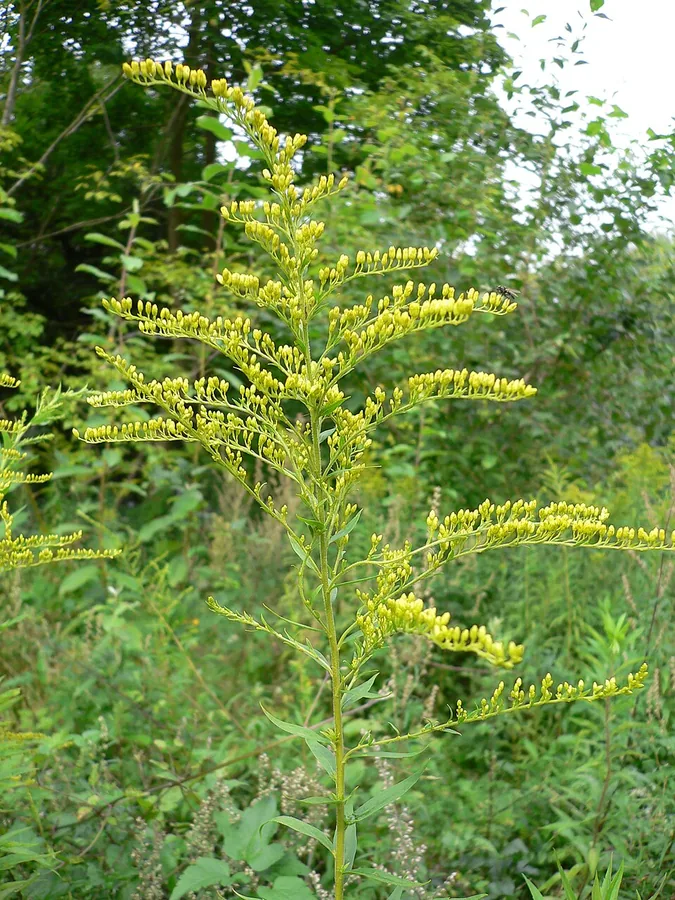
Goldenrod is that cheerful plant that sets fields and roadsides glowing gold in late summer, lifting plumes of tiny flowers on tall, leafy stems. It sits in the aster family and grows wild across most of North America as a tough, long-lived perennial, which means it is very hard to disappoint. Ask it for almost nothing and it hands you weeks of color just as the rest of the garden winds down.
You will be amazed at what it does for pollinators. The flowers hum with bees, butterflies, and beneficial insects right when food runs short, and the seedheads carry birds through the cold months. If you want a planting that supports wildlife, goldenrod is a wonderfully reliable place to start.
The one thing to keep an eye on is how eagerly it spreads. Tall goldenrod travels through a bed by rhizome and self-seeds freely, so without a little guidance it can crowd its softer neighbors. Do not worry, though: choose a clump-forming species for a tidy border, or simply divide the vigorous types every few years and you stay firmly in charge.
Care
The short version: give it full sun and ordinary to poor, well-drained soil, and you are most of the way there. Water only through long dry spells and let the rain handle the rest, skip the fertilizer entirely, and divide vigorous clumps every few years to keep them friendly.
Light
Give goldenrod full sun and it flowers its best and stands tall and proud. It will put up with some partial shade if that is what you have, but the stems tend to stretch and flop and the blooms thin out the darker its spot.
Water
Goldenrod is happiest in soil that stays evenly moist but never soggy, and once it is established it shrugs off a short dry stretch with ease. In most temperate gardens the rain does the watering for you, so reach for the hose only during a prolonged drought.
Soil
It settles happily into clay or loam as long as water drains away, and it forgives poor ground that would stop fussier plants cold. Any pH from 5.5 to 7.5 suits it fine, and honestly, lean soil keeps its growth all the sturdier.
Temperature
You will find goldenrod wonderfully hardy, riding out cold down to -29°F (-34°C) and heat above 95°F (35°C) without missing a beat. That generous range is exactly why it grows untended across so much of the continent.
Humidity
Ordinary outdoor humidity is all it asks for, so there is nothing here to measure or worry about. What matters far more is air movement, since still, muggy air is what tempts rust and powdery mildew onto the leaves.
Feeding
Feel free to skip the fertilizer everywhere but the very poorest ground. Goldenrod actually loves lean soil, and too much nitrogen only grows floppy, weak stems, so at most treat it to a light spring topdressing of compost.
Pruning
Snip off the spent flower stems after bloom, or leave the seedheads standing to feed the birds all winter, whichever you prefer. Cut every stem to the ground in late winter before new shoots appear, and a simple pinch in early summer keeps the tall ones from flopping over.
Size & spacing
Plants reach from 2 to 6 feet (61 to 183 cm) tall and spread 4 to 6 feet (122 to 183 cm) across, so do give each clump plenty of elbow room. That roomy spread is also the reason the vigorous species need an occasional division to stay where you planted them.
When to plant
Goldenrod moves with the seasons, and it is easy to follow along. Start seed in late winter or sow it outside in fall, set young plants out in spring once the frost has gone, and then simply wait for the flowers to pour out from late summer deep into fall.
Northern hemisphere
Southern hemisphere
Typical months for a temperate climate: start earlier in warm zones, later where spring frosts linger.
- Sow: Late winter, 8 to 10 weeks before last frost; seeds benefit from cold-moist stratification and need light to germinate
- Plant: Spring after the last frost, or in early fall
- Harvest: Late summer through fall (August to October)
Hardiness
USDA hardiness zones: 4–9
Temperature: down to -34°C
Troubleshooting
Goldenrod rarely runs into anything serious, and almost everything that does show up is only cosmetic, so there is no need to fret. Crowding and damp leaves cause most of the trouble, which means good airflow solves more than any spray ever could. Find what you are seeing below and step in only when it truly bothers you.
Orange powdery spots dotting the leaf undersides
If you turn a leaf over and find raised orange or brown blisters that smear into colored powder, that is rust, and it is more of a nuisance than a threat. It moves quickest through packed, damp clumps, so you have real control here. Pick off the worst leaves, give the plant more breathing room by thinning or dividing, and water low at the roots so the foliage stays dry.
Fix:
- Remove and destroy heavily infected leaves
- Improve air circulation by thinning or dividing crowded clumps
- Avoid overhead watering and water at the base
A pale coating creeping over the leaves and stems
That gray-white dust across the leaves is powdery mildew, and it usually turns up late in the year when nights grow humid or the plant is sitting in shade. Take heart, because it looks far scarier than it acts and almost never harms a settled clump. Trim off the coated growth, let in more sun and moving air, and sweep up the fallen debris before winter.
Fix:
- Cut back affected foliage
- Increase spacing and sun exposure to improve air movement
- Remove infected debris at season end
Small bugs clustered on the shoot tips, leaving stickiness
Little soft-bodied aphids love to cluster on fresh growth and flower buds, and the sticky honeydew they leave often brings ants along. Please do not panic over a few, since goldenrod feeds so many helpful insects that a small colony is worth leaving alone. When a group gets thick, a firm spray of water sends them packing, and insecticidal soap is there as a gentle backup if they linger.
Fix:
- Spray off with a strong jet of water
- Tolerate where possible since goldenrod supports many beneficial insects
- Use insecticidal soap only if infestation is heavy
Ball-like bumps forming here and there on the stems
Those odd round or spindle-shaped bumps are galls, and they form when the goldenrod gall fly tucks an egg inside and a larva grows within the stem. They almost never do the plant any harm, and they quietly feed birds and other wildlife through the cold season. If the look bothers you, snip the swollen stems off, but leaving them there costs the plant nothing at all.
Fix:
- Prune out and discard galled stems if appearance is a concern
- Otherwise leave in place as galls rarely harm the plant and feed wildlife
Toxicity
You can plant goldenrod with complete peace of mind, because no part of it is toxic to people, pets, or livestock. It carries the old blame for hay fever, but the fault really lies with ragweed. Let it grow freely where children and animals wander, and you can even steep its leaves into a gentle herbal tea.
Safe for
People · Cats · Dogs · Horses · Rabbits · Livestock · Birds
Cats None
You can relax with cats around goldenrod, because nothing in its leaves or flowers will hurt them. If a curious cat sneaks a nibble, the worst you might see is a brief, mild tummy upset, just like any greenery a cat isn't meant to eat.
Dogs None
Dogs are perfectly fine near goldenrod, since it holds no toxic compounds to worry about. A dog that wolfs down a big mouthful of leaves might drool a bit or pass it loosely, and even that eases up on its own.
Horses Safe
Horses are safe grazing near true goldenrod, which shows up in plenty of pastures without any trouble. Rest easy that it is not the poisonous lookalike people sometimes mix it up with, so nibbling beside it does no harm.
Rabbits Safe
Rabbits can browse goldenrod safely, and wild ones happily do just that. Its leaves and flowers carry no toxins, though as with any fresh green, easing it in slowly is the kindest approach.
Livestock Safe
Cattle, goats, and sheep are all fine around goldenrod with nothing to fear from it. It isn't toxic to them, and they usually wander past it toward softer, more tender forage anyway.
Birds Safe
Birds face no danger from goldenrod, and they actually gain a great deal, feasting on its seeds and on the insects its flowers gather. Nothing about the plant will do them any harm.
People Safe
Goldenrod is safe for people too, and its leaves and flowers have long been steeped into a soothing herbal tea. Do not blame it for hay fever, because its pollen is far too heavy to ride the wind and reach your nose.
Varieties
Goldenrod is not one plant but a whole family of them, and the species differ a lot in size and temperament, which is good news for you. Here are the ones most worth getting to know before you choose.
Solidago rugosa 'Fireworks'
A well-behaved little pick at 3 to 3.5 feet, it sends out arching sprays of tiny blooms that scatter like a burst of fireworks, and it creeps by rhizomes without ever running wild.
Solidago canadensis
This is the strong, tall species that reaches 2 to 6 feet with wide pyramid-shaped flower heads, and it travels fast by both seed and rhizome.
Solidago speciosa (Showy goldenrod)
An upright clump-former, it settles happily into poor, dry ground and behaves far more politely than its tall cousin.
Solidago caesia (Bluestem/wreath goldenrod)
A gentle woodland type with bluish arching stems, it tucks its flowers into the leaf joints and takes shade without complaint.
How to propagate
Making more goldenrod is genuinely easy, whether you split a clump you already have or begin fresh from seed.
DivisionEasy
Spring or early fall; divide established clumps every 2 to 3 years to control spread and maintain vigor · One growing season
Splitting a clump is the easiest way to grow more goldenrod, and it doubles as a gentle way to keep a spreader in line. In spring or early fall, lift the plant, tease it into sections that each hold roots and shoots, and get them back in the ground straight away. Do this every 2 to 3 years and the clump stays lively, settling in again within a single growing season.
SeedEasy
Sow in fall outdoors or stratify and start indoors in late winter · Blooms typically in the second year from seed
Starting goldenrod from seed is easy work, it just asks for a bit of patience and a little light. Scatter the seed on the surface outdoors in fall, or chill it and sow indoors in late winter, but never cover it, because it needs light to wake up. Flowers usually arrive in the second year, and once the plant is settled it will happily self-seed for you.
Myths
Goldenrod is the flower that sets off late-summer sneezing fits and allergies.
Take a breath, because goldenrod is almost certainly not what is making you sneeze. Its pollen is large, sticky, and heavy, so insects ferry it flower to flower and it barely ever floats on the breeze. The true source of those late-summer sniffles is ragweed, which blooms at the very same moment and releases clouds of light, airborne pollen while goldenrod simply stands nearby looking guilty.