Vegetable · Cucurbitaceae
Winter Squash
Cucurbita maxima, Cucurbita moschata, Cucurbita pepo
Offer winter squash sun, space, and warm soil, and it rewards you with fruit that lasts long past the garden.
Full sun
Every 3–7 days
50–95°F · 10–35°C
80–110 days
Overview
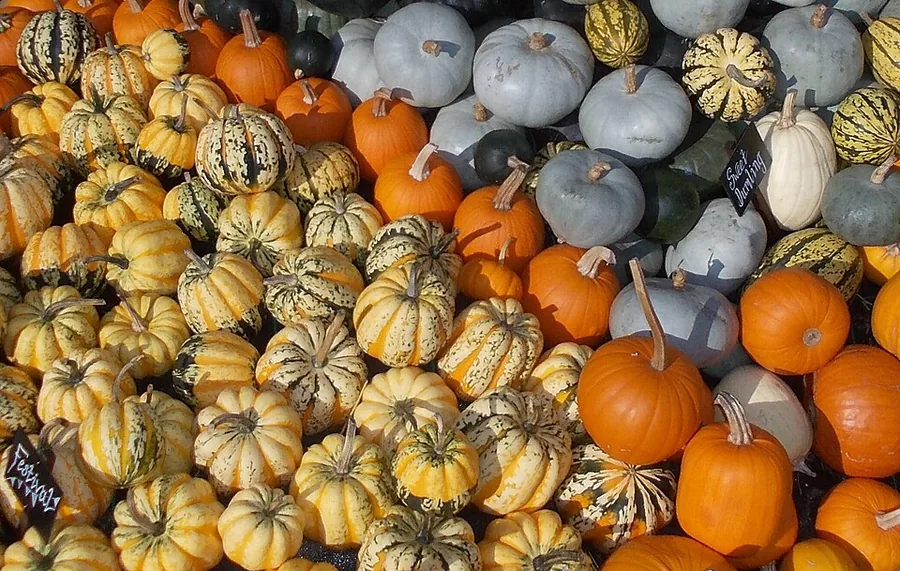
Do not let the name worry you, because winter squash has little to do with cold-weather planting. You put the seed in the ground in late spring, let the vines wander all summer, and pick the fruit in fall once its rind turns firm. It is a welcoming group to grow, running from tan-skinned butternut and ribbed acorn to squat kabocha and the big blue-gray Hubbard, all cousins across three species of Cucurbita.
These plants are hungry and thirsty, and more than anything they want elbow room. One hill of a vining kind can spread across 50 to 100 square feet, so give it that space with a light heart and it will hand back fruit that keeps for months in a cool cupboard. The flesh is sweet, the seeds roast up nicely, and that is why most of a squash patch is grown to store rather than eaten straight away.
Once the seedlings are up and going, the rest is gentle work, and small mistakes are easy to recover from. Two things really shape your harvest, though: keeping a kind eye out for the vine borer and squash bug, and letting each fruit ripen all the way before you cure it for the shelf.
Care
The short version: give winter squash full sun, plenty of elbow room, and steady moisture in rich, well-drained soil, with a balanced feed mixed in before you plant. Let each fruit harden fully, then cure it before it goes to storage.
Light
Winter squash truly wants full sun, a good 8 hours a day, and it has no patience for shade. Give it less and you will get lush leaves but a thin, disappointing crop on weak vines, so pick your brightest spot.
Water
Aim to give the plants at least 1 inch of water a week, soaking down about 6 inches rather than just dampening the top. That moisture matters most while the fruit is setting and filling out. Watering at the base with a drip line or soaker hose keeps the leaves dry and gives disease far less to grab onto.
Soil
Settle them into fertile, well-drained loam with lots of organic matter, and lean on hills or raised beds if your ground stays soggy. They are happiest at a pH of 6.0 to 6.5, just a touch acidic, so no need to fuss much beyond that.
Temperature
These are warm-season growers, content anywhere between 50°F and 95°F (10°C to 35°C), with no tolerance at all for frost. Hold off sowing until the soil reaches 60°F to 65°F (16°C to 18°C), since cold ground simply rots the seed and leaves you replanting.
Humidity
Ordinary outdoor air suits them fine, so there is no humidity number to chase. What really helps is good airflow, because damp, crowded leaves are exactly where powdery mildew likes to begin.
Feeding
Mix a balanced fertilizer like 5-10-10 into the bed before planting, ideally guided by a soil test. Once the vines start to run or the first flowers open, side-dress with a little nitrogen, but keep it modest, since an over-fed plant pours its energy into leaves instead of fruit.
Pruning
There is no real pruning to worry about. Late in summer you can pinch the vine tips to steer the plant's strength into the fruit it already carries, and pull any diseased leaves as soon as you see them. Fruit set too late to ripen before frost is fine to remove as well.
Size & spacing
The vines themselves stay low, only about 12 to 24 inches (30 to 60 cm) tall, but they reach a long way out, some 6 to 15 feet (1.8 to 4.6 m) across. Give each plant that full run so air moves freely and every fruit has room to size up in comfort.
When to plant
Winter squash loves warmth and needs a long, frost-free stretch to finish. Sow the seed in late spring once the ground has warmed, let the vines settle in over summer, and harvest in fall ahead of a hard frost while the rinds are still firm. There is no rush and no trick to it.
Northern hemisphere
Southern hemisphere
Typical months for a temperate climate: start earlier in warm zones, later where spring frosts linger.
- Sow: Start indoors 2-4 weeks before the last frost in individual pots; harden off before transplanting (seedlings resent root disturbance)
- Plant: Direct seed or transplant after all danger of frost when soil reaches at least 60-65°F at seeding depth, typically late May to early June in northern regions
- Harvest: Harvest in late summer to fall before hard frost, when rinds are hard and cannot be dented with a thumbnail; cure most types about 10 days in warmth, then store at 50-55°F
Hardiness
USDA hardiness zones: 2–11
Temperature: down to -46°C
Troubleshooting
Most squash troubles turn up on the vines, at the flowers, or in storage, and nearly all of them are easier to handle when you catch them early. Look your plants over now and then, match what you notice to the list below, and act while a fix still does some good. A little attention goes a long way here.
A vine suddenly wilts, with sawdust-like frass down near the base
This is the work of a squash vine borer, and just one grub inside the stem can pull down a whole vine in short order. Do not panic: slit the stem the long way, lift out the fat white larva, and heap moist soil over the cut so the vine can root afresh. If a cut stem instead weeps sticky strands, you are looking at bacterial wilt carried by cucumber beetles, and sadly those plants will not bounce back.
Fix:
- Slit infested stems, remove borers, and mound moist soil over the wound to encourage rooting
- Remove and destroy plants with bacterial wilt; they will not recover
- C. moschata (butternut) types resist vine borer, so replant with those if pressure is high
A white, powdery film on the leaves as summer winds down
This is powdery mildew, a fungus that settles on the oldest leaves first and rubs away like fine talc. Take heart, since it is manageable: pull the worst-hit leaves, open the patch up so air can move through, and water low at the base to keep the foliage dry. When pressure is heavy, a labeled fungicide at the first sign gives real help.
Fix:
- Remove badly affected leaves
- Apply a labeled fungicide at first sign if needed
- Improve air movement by giving vines full spacing
Blossoms fall or little fruit shrivel before they set
Early on this is usually nothing to fret over, because the very first blooms a squash opens are male only, and the female flowers follow a bit later. Once the females arrive, poor pollination in wet, cold, or hot spells can leave them unfed, so a tiny fruit rots at its tip. In the morning you can move pollen from a male bloom onto a female by hand to set fruit yourself, and never reach for insecticide while the plants are in flower.
Fix:
- Wait, fruit set usually improves as female flowers appear
- Hand-pollinate by transferring pollen from a male flower to a female flower in the morning
- Avoid spraying insecticides while plants are blooming
Ragged yellow patches with shield-shaped bugs hiding beneath
Squash bugs are at work, sipping from the leaves until they yellow, brown, and tear at the edges. Turn the foliage over and check along the veins for the gray adults, the little gray nymphs, and the tidy clusters of bronze eggs. Crush those eggs, pick off the adults, and lay a board beside the plants to trap bugs you can gather and destroy each morning.
Fix:
- Hand-pick adults and crush egg masses
- Trap bugs under boards laid near plants and destroy them each morning
- Treat young nymphs with a labeled insecticide if populations are heavy
Stored fruit goes soft or rots not long after picking
Squash that fails in storage was almost always picked too early, touched by frost, or never cured. A ripe fruit has a rind you cannot dent with a thumbnail, so cook anything soft or bruised right away rather than shelving it. Cure the sound fruit for about 10 days at 80°F to 85°F (27°C to 29°C), then keep it at 50°F to 55°F (10°C to 13°C) where the air can move.
Fix:
- Use damaged or immature fruit promptly instead of storing
- Cure sound fruit about 10 days at 80-85°F, then move to 50-55°F with 50-75 percent humidity and ventilation
Toxicity
You can relax about winter squash, since it is food from top to bottom and gentle on people and pets alike. The flesh and seeds are good to eat, and nothing in the plant is listed as poisonous. Two small notes: the leaves and stems carry prickly hairs that can itch at picking time, so slip on gloves, and if a squash ever tastes sharply bitter, simply throw it out.
Safe for
People · Cats · Dogs · Horses · Rabbits · Livestock · Birds
Cats Safe
A little plain cooked squash sits just fine with most cats and does them no harm. It is the salt, butter, and spices you want to leave off, since those trouble a cat far more than the squash ever would.
Dogs Safe
Plain cooked squash is a gentle, well-loved treat for dogs, and it is often used to ease an upset stomach. Keep the helping modest, though, so a big scoop does not simply bring on gas.
Horses Safe
Horses take squash without any bother, and some enjoy it as a change from their usual feed. Cut it into pieces first so no large chunk can catch in the throat.
Rabbits Safe
Rabbits do well with a little squash flesh now and then as a treat. Keep the portions small, since their tummies run best on hay and leafy greens rather than starchy fruit.
Livestock Safe
Cattle, goats, sheep, and pigs all tuck into squash happily, and any surplus or cull fruit makes a fine bit of extra feed. Break the big ones open so an animal cannot choke on a whole fruit.
Birds Safe
Backyard hens and parrots love both the cooked flesh and the raw seeds, which they pick out with ease. Nothing in the plant will do them any harm.
People Safe
Winter squash is a kitchen favorite, with sweet flesh and seeds you can roast. The one thing to watch is a sharply bitter taste, a rare sign of high cucurbitacins, so spit out any piece that tastes off.
Leaves and stems have prickly hairs that can irritate skin during harvest, so gloves are helpful. Very rarely, squash from stray or saved seed can taste strongly bitter due to cucurbitacins; do not eat bitter-tasting squash.
Varieties
Winter squash covers many species and a whole parade of shapes, but a few keep turning up in home gardens for good reason. These are the friendly names worth getting to know first.
Waltham Butternut (C. moschata)
Its tan, bottle-shaped fruit hide deep orange flesh, and the solid stems brush off the vine borer while the crop keeps for months on the shelf.
Table Queen acorn (C. pepo)
These small, ribbed, dark green fruit ripen in about 80 to 85 days, and they are one of the few squash you are better off storing without curing.
Blue Hubbard (C. maxima)
A large old-fashioned keeper, bumpy and blue-gray with a teardrop shape, that often tips the scale past 15 pounds.
Kabocha/buttercup types (C. maxima)
Squat and dark green, with dense, sweet, dry orange flesh that turns wonderful in the oven.
Spaghetti squash (C. pepo)
An oblong yellow fruit whose cooked insides comb out into pasta-like strands.
Delicata (C. pepo)
Small, striped in cream and green, with a thin skin you can eat, though it will not keep as long as the tougher-rinded types.
Companions
Plant near
corn: Traditional three sisters planting: sprawling squash vines shade soil between corn, conserving moisture and suppressing weeds
beans: Three sisters companion: beans fix nitrogen that benefits the heavy-feeding squash
nasturtium: Extension-recommended companion flower that attracts pollinators and can help deter squash pests
Keep apart
potato: Traditional extension lists pair them poorly; both are heavy feeders and compete, and digging potatoes disturbs squash roots and vines
How to propagate
Winter squash grows happily from seed, and it comes up quick and easy once the soil has warmed enough to welcome it.
SeedEasy
Direct sow after the last frost when soil is at least 60-65°F, or start indoors in individual pots 2-4 weeks before transplanting · Seeds germinate in 5-10 days in warm soil; plants reach harvestable maturity in 80-110 days
Nearly everyone starts winter squash from seed, and it could hardly be simpler. Tuck the seed 1 inch deep in hills or rows once the soil reaches 60°F to 65°F (16°C to 18°C) after the last frost, or get a head start indoors in pots 2 to 4 weeks early. In warm ground the seedlings pop up in 5 to 10 days, and the plants run on to a ripe, storable crop in 80 to 110 days. Vining kinds want plenty of room, up to 50 to 100 square feet per hill, and they dislike having their roots disturbed, so set any transplants out in peat or other plantable pots.
Myths
Winter squash must be grown during winter.
In truth you plant it in spring after the frost, grow it right through summer, and harvest it ripe in fall. The hard rind is what earns the name, since it lets the fruit keep and feed you through the cold season, not anything about when it grows.
If squash cross-pollinates with cucumbers, melons, or nearby squash, this year's fruit turns out deformed or bad-tasting.
Set part of this worry down: squash cannot cross with cucumbers or melons at all. When two squash varieties do cross, it only shows up in the seeds, which means odd fruit appears only if you save and replant that seed the next year.