Ornamental · Asteraceae
Shasta Daisy
Leucanthemum × superbum
Plant it in sun and free-draining soil, and this gentle daisy will hand you armfuls of white flowers all summer.
Full sun
Every 7–10 days
USDA 5–9
12–35 in · 30–90 cm
Overview
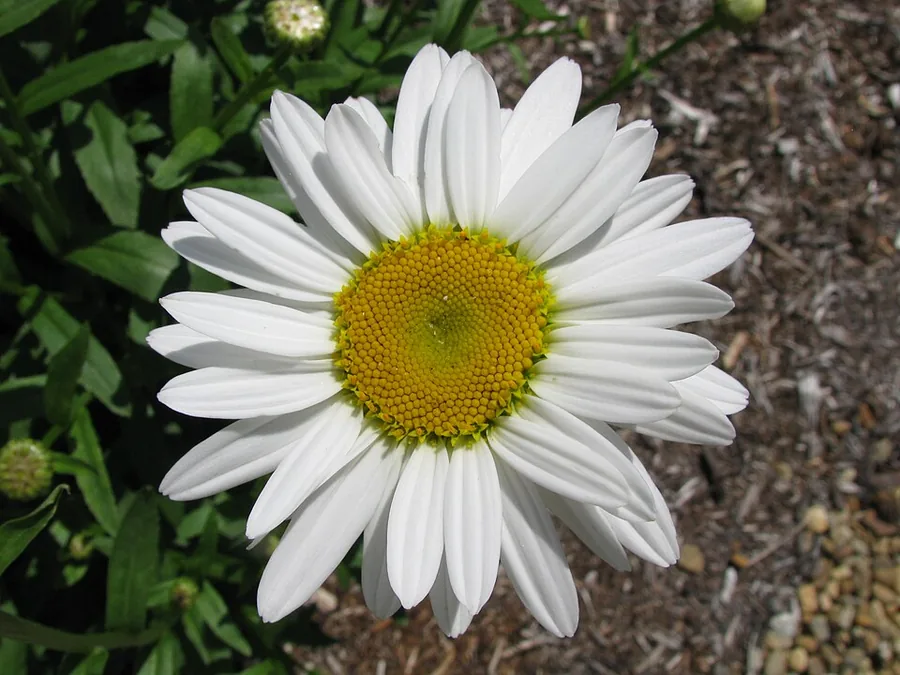
If this is your first perennial, the Shasta daisy is a kind place to start. It lifts cheerful white flowers with sunny golden centers on straight stems above neat, dark green leaves. Bred in the aster family from the humble oxeye daisy, it was shaped to be sturdier and more generous than its wild parent, and once it settles in it comes back on its own from June into September.
The care list is short and hard to get wrong. Set it where it gets plenty of sun and soil that drains freely, and it will take heat and dry stretches in stride. The one real misstep is leaving it in soggy ground through winter, so if you plant somewhere that never puddles, you have already done the important part.
Heights range from compact edging plants to taller kinds grown for cutting, so there is a size for any bed. Because it is a short-lived perennial, the clumps like to be split every couple of years, and that is good news for a beginner: each division gives you a brand new plant for free.
Care
The short version: give it full sun and free-draining ground first of all, wait to water until the upper half of the soil feels dry, keep snipping faded blooms all summer, and divide the clump every 2 to 3 years so it stays vigorous.
Light
Shasta daisies flower most happily in full sun, which means about six hours or more of direct light each day. A little afternoon shade is fine, but heavy shade leaves you with lanky, leaning stems and only a scattering of blooms.
Water
Wait until the upper half of the soil has dried before you water again, which usually lands around every 7 to 10 days. Once its roots are settled the plant handles drought with ease, so the real risk is giving too much water rather than too little, above all through a wet winter.
Soil
Ordinary well-drained soil suits it fine, be that leaning to loam, clay, or sand. It is relaxed about pH and content anywhere from 6.0 to 8.0, though drainage is the one point it will not bend on, since standing wet rots the crown.
Humidity
Everyday outdoor air is all it needs, and there is no target reading to fuss over. What counts far more is steady airflow, because damp, crowded leaves are what open the door to leaf spot and crown rot.
Feeding
This is a light eater, so a gentle spring feed of balanced general-purpose fertilizer is all it wants. Piling on rich soil or extra food only encourages soft, floppy stems that struggle to hold their flowers.
Pruning
Keep removing the spent flowers through the season and fresh buds will keep arriving. When the main show winds down, cut the stems right back to the low basal leaves, which rejuvenates the plant and adds a little more life to this short-lived perennial.
Size & spacing
Depending on the type, plants reach 12 to 35 inches (30 to 90 cm) tall and settle into a clump 12 to 24 inches (30 to 60 cm) across. Leave each one about that much elbow room so air can circulate and disease has little chance to take hold.
When to plant
Shasta daisies keep an easy, predictable calendar. Sow the seeds indoors in the last weeks of winter, move the young plants outside once hard frost is behind you, and enjoy flowers from June into September. That same early-spring window is the moment to lift and divide older clumps.
Northern hemisphere
Southern hemisphere
Typical months for a temperate climate: start earlier in warm zones, later where spring frosts linger.
- Sow: 6 to 8 weeks before the last spring frost
- Plant: Spring after danger of hard frost has passed
- Harvest: June to September
Hardiness
USDA hardiness zones: 5–9
Temperature: down to -29°C
Troubleshooting
Almost every problem here comes down to soggy soil or a clump that has grown old, and both are easy to head off. Watch the leaves and the crown for the first small signs, and you can usually help the plant long before anything is lost. Find your symptom below and act while it still makes a difference.
Stems flopping and collapsing even after a good watering
A daisy that wilts and topples while the soil stays moist is almost always failing at the roots. In poorly drained ground, verticillium wilt or a crown and root rot takes over, and once the crown goes soft and brown the plant cannot be brought back. Lift and bin the lost ones, sort out the drainage, then split any firm, healthy crowns and move them somewhere that drains better.
Fix:
- Remove and discard severely affected plants
- Improve drainage and avoid overwatering
- Divide and replant healthy crowns in a better-drained site
A hollow, dead middle with blooms only around the edge
When a clump flowers just around its rim and dies away in the center, it has plainly outgrown its space, and it is really asking to be divided. Dig it up in early spring, discard the woody, dead heart, and replant the strong outer sections to bring the flowering back in force.
Fix:
- Divide the clump in early spring
- Replant vigorous outer divisions and discard the woody center
Dark spots scattered across the foliage
Spots that darken and spread through damp spells are the mark of a fungal or bacterial leaf spot, and they tend to appear on the lowest leaves first. Putting it right is straightforward. Pick off the spotted leaves, keep water off the foliage when you can, and thin the planting so the air can move through freely.
Fix:
- Remove and destroy affected foliage
- Avoid overhead watering
- Improve air circulation
Curled shoot tips, sticky leaves, or fine pale speckling
Twisted young tips coated in a sticky film usually mean aphids are busy on the tender new growth. If instead the leaves look mottled and stippled or carry faint winding trails, suspect spider mites or leaf miners. Knock the aphids off with a firm spray of water, save insecticidal soap for a heavy outbreak, and simply remove any leaves that have been mined.
Fix:
- Hose off aphids with a strong stream of water
- Apply insecticidal soap if infestation is heavy
- Remove and destroy mined leaves
Toxicity
This one is not completely harmless for animals, so it helps to know what to expect. As a relative of the toxic chrysanthemum it holds pyrethrin-like sesquiterpenes, and a pet that bites the leaves or flowers might drool, be sick, or come up in a rash. The upset is usually mild and the bitter flavor stops most animals quickly, but it is still wise to keep inquisitive pets and little ones from nibbling.
Toxic to
Cats · Dogs · Horses · Rabbits · Livestock · Birds · People
Cats Mild
A curious cat that mouths the leaves might drool, gag, or bring its food back up, and the sap can leave its lips or skin a touch sore. Happily, the bitter flavor puts most cats off before they swallow enough to cause any real trouble.
Dogs Mild
A dog that gulps down a few flower heads can wind up with a queasy stomach, some drooling, and loose stools. Handling the cut stems now and then brings on a mild, itchy rash on dogs with thin skin.
Horses Mild
Horses seldom bother with the bitter leaves, though a grazed mouthful may cause a little drooling and a short spell of tummy upset. Where the sap touches the muzzle, it can leave the skin slightly sore.
Rabbits Caution
Those same pyrethrin-like compounds make this a poor pick for rabbits, so keeping it well out of reach is the safe choice. Give them their familiar greens rather than letting them graze on the foliage.
Livestock Caution
Cattle, goats, and sheep nearly always walk past the bitter plant, yet a hungry animal that eats a good deal could get a mild bout of digestive upset. To be on the safe side, keep it away from overgrazed paddocks.
Birds Caution
Birds have little cause to eat it, and because of the irritant compounds it is sensible to keep cage birds clear of the cut flowers. Wild birds dropping by the blooms for seed are in no danger.
People Caution
No part of a Shasta daisy is grown for the table, and the sap can turn sensitive skin red and itchy after you handle it. Keep small children from chewing the flowers, although one stray petal is nothing to worry about.
Most pets ignore the bitter foliage; a nibble may cause mild stomach upset or skin irritation rather than serious harm.
Helpline numbers

United States
ASPCA Animal Poison Control: (888) 426-4435 (fee applies)
Poison Control: (800) 222-1222



Canada
Poison Centres: 1-844-764-7669
Varieties
Over the years, growers have given the Shasta daisy a lovely spread of heights and flower shapes. Here are the named kinds worth getting to know.
Becky
A tall selection climbing to 3 to 4 feet on stems stiff enough to stand without staking, topped with 3 to 4 inch white flowers ringing golden center disks.
Crazy Daisy
A double-flowered kind whose frilly, gently shaggy ray florets give each bloom a fuller, softer, looser appearance.
Snowcap
A neat, compact grower reaching only 15 to 18 inches, perfect for the front of a bed or tucked into a pot.
How to propagate
Making more Shasta daisies is genuinely simple, whether you would like faithful copies of a cultivar you love or a whole tray of seedlings for a new bed.
DivisionEasy
Early spring, every 2 to 3 years · One growing season to re-establish and resume strong flowering
Splitting is the most reliable way to keep a clump youthful, so dig it up in early spring every 2 to 3 years. Toss the woody, worn-out center, tuck the healthy outer pieces back into well-drained soil, and let them have a full growing season to settle and flower strongly once more.
SeedEasy
Start indoors 6 to 8 weeks before the last spring frost, or sow outdoors in spring · Often blooms the first or second year from seed depending on sowing time
The species and plenty of cultivars grow readily from seed, started indoors 6 to 8 weeks before the last frost or scattered straight outside in spring. Seedlings often flower in their first or second year. Named cultivars, on the other hand, stay true to type only when you divide them.
Myths
Shasta daisies are perfectly safe, so a pet can munch them without any worry.
They belong to the same family as the toxic chrysanthemum and hold similar pyrethrin-like sesquiterpenes, so a pet that chews them can drool, be sick, or get a skin rash. The bitter Shasta daisy is a mild irritant rather than a safe treat, even though it is nowhere near as risky as a true mum.
Shasta daisies are dependable, long-lived perennials that ask for nothing.
In truth they are short-lived, and a clump tires quickly unless you divide it every 2 to 3 years. Sharp drainage and a hard trim after flowering are what keep them thriving, so a small amount of care wins you several extra seasons.