Shrub · Rosaceae
Raspberry
Rubus idaeus
Offer it full sun, rich soil, and one prune a year, and this forgiving berry rewards you with handfuls of fruit.
Full sun
Every 3–7 days
59–77°F · 15–25°C
USDA 3–8
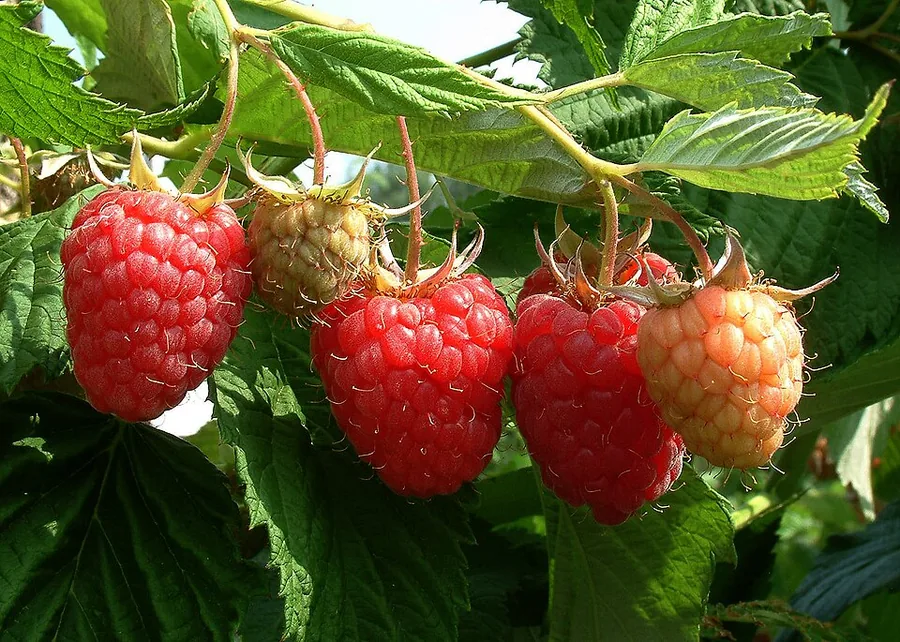
Overview
A warm raspberry straight off the cane is one of the garden's easy rewards, and the good news is that the plant makes it simple. As a member of the rose family, it grows wild through the cooler parts of the world, so it takes hard winters in stride where tender crops give up. Expect an easygoing stand of upright canes, hardy from zone 3 through zone 8, that spreads happily once it feels at home.
The one decision that matters early on is which type you plant, and either way is forgiving. Summer-bearing raspberries hand you a single crop early to midsummer, borne on last year's canes. Everbearing ones ripen on this season's fresh canes through late summer and into fall, and once you know your type, the pruning plan sorts itself out.
Beyond sun, even moisture, and a bit of air through the row, raspberries ask for very little, so do not fuss over them. Treat them well and they fruit generously for years, though those roaming roots mean a little tidying to keep the patch in bounds. The canes wear sharp prickles, so gloves and covered arms make picking comfortable and worry-free.
Care
The short version: give raspberries full sun, deep and lightly acidic soil enriched with compost, and roughly an inch of water each week. Prune to match your cane type once a year, then either let the roots roam free or hem them in with a barrier, and you are set.
Light
Give your raspberries full sun and they will reward you, ideally with six or more hours of direct light each day. A little afternoon shade will not ruin them, but in dim spots the canes grow lanky and the crop tails off, so brighter is always better.
Water
Keep the soil pleasantly damp with about an inch of water each week, and a touch more once the berries begin to swell. Even moisture is what you are after, so avoid letting the roots sit in soggy ground, which brings on rot and softens the fruit.
Soil
Set them into deep, well-drained loam that is generous with organic matter. Raspberries lean toward slightly acidic ground, a pH of 5.6 to 6.5, and if the new leaves start to yellow, the soil has likely drifted too alkaline for their liking.
Temperature
Cool to mild weather suits them best, somewhere around 59°F to 77°F (15°C to 25°C). The canes are hardy enough to shrug off deep winters down to zone 3, yet a fierce summer can leave the plants stressed and the berries scorched, so a bit of shade in a heat wave helps.
Humidity
There is no humidity number to stress about, since average air of 40% to 70% keeps them content. What truly matters is movement, because still, muggy air trapped among crowded canes is exactly where gray mold takes hold.
Feeding
One feed a year is plenty. As growth wakes up in early spring, scatter a balanced fertilizer such as 10-10-10 or top the soil with aged compost or manure. That one seasonal helping is enough to see the canes through a full crop.
Pruning
Prune according to your type and it becomes easy. For summer-bearing plants, take out the spent floricanes as soon as harvest ends and thin the fresh primocanes; everbearing kinds are even simpler, since a late-winter mow right down to ground level gives one strong fall crop.
Repotting
Raspberries are happiest in open ground, not a pot, so repotting almost never enters the picture. Should you keep one in a container, shift it to something larger once the roots begin to circle and the mix dries out too quickly.
Size & spacing
Canes climb to about 3 to 6 feet (90 to 180 cm) and fan out to roughly 2 to 4 feet (60 to 120 cm) across. Leave generous space between rows and add a trellis so air flows freely and the thorny canes keep their distance from your arms.
When to plant
Timing here is gentle and forgiving. Raspberries prefer an early start, planted while the canes are still asleep and the soil is only beginning to stir. Put your young plants in the ground in early spring, and depending on the type, harvest runs from early summer well into fall.
Northern hemisphere
Southern hemisphere
Typical months for a temperate climate: start earlier in warm zones, later where spring frosts linger.
- Plant: Early spring while plants are still dormant
- Harvest: Summer-bearing types ripen early to midsummer; everbearing types crop late summer into fall
Hardiness
USDA hardiness zones: 3–8
Temperature: down to -40°C
Troubleshooting
If something looks off, take heart, because raspberry problems tend to show up in just three places: the fruit, the canes, and the tender new leaves. Spot them early and a simple snip or a small change to how you water usually puts things right. Find your symptom below, then step in before it travels down the row.
Mushy berries under a coat of gray fuzz
Do not panic, this is gray mold from the fungus Botrytis cinerea, and it settles in when damp weather meets a packed, stuffy row. Harvest often and toss any soft berry right away, because the spores can tear through a whole basket once it is picked. Give the canes a good thinning so air can move, and water down at the base rather than over the leaves.
Fix:
- Remove and discard infected berries promptly
- Harvest frequently and keep fruit dry
- Improve air circulation by thinning canes
Drooping cane tips circled by two scars
A pair of girdling rings sitting just under a wilting tip is the calling card of the raspberry cane borer, and dark, sunken spots at the nodes hint at a cane disease such as spur blight. Snip the troubled cane well beneath the injury and get rid of it, then pull out any wild brambles nearby that give these pests a home. Trimming away old and diseased canes every season and keeping the rows slim is really all it takes to hold both at bay.
Fix:
- Cut and destroy affected canes below the damage
- Remove all wild brambles nearby
- Maintain open, thinned plantings
Young leaves paling between still-green veins
If the freshest leaves fade to yellow while their veins hold their green, you are most likely seeing iron chlorosis, which shows up when the soil sits too alkaline. A quick soil test will show a pH above the range they like, and a dose of chelated iron gives fast relief while you fix the ground for good. Blend in organic matter, nudge the soil toward a pH of 5.6 to 6.5, and go lighter on the lime.
Fix:
- Test soil and acidify toward pH 5.6 to 6.5
- Apply chelated iron as a short-term correction
- Incorporate organic matter
Toxicity
Here is a reassuring fact for anyone with curious pets or kids: the raspberry is friendly from root to fruit. Nothing on it is poisonous to animals or people, so a swiped berry or a chewed leaf will not cause any harm. The only real thing to keep in mind is physical rather than chemical, the sharp prickles along the canes that can nick bare skin.
Safe for
People · Cats · Dogs · Horses · Rabbits · Livestock · Birds
Cats None
No part of a raspberry can poison a cat, so a chewed leaf or a pinched berry is nothing to worry about. Just keep an eye on the prickles, which might scratch an inquisitive nose.
Dogs None
A dog can enjoy ripe raspberries with no trouble at all, and the foliage and canes are just as harmless. The one thing to watch is the sharp prickles, which are the actual risk here.
Horses None
Horses may browse the leaves and berries with ease, as nothing in the plant is toxic to them. It is worth fencing off the thorny canes so a soft muzzle stays unscratched.
Rabbits None
Rabbits nibble the leaves and fruit with no risk, and plenty of them relish the greenery. Only the prickly stems call for any caution.
Livestock None
Cattle, goats, and sheep can graze raspberry safely, since the plant holds no toxin at all. The prickles are the only detail to keep watch over.
Birds None
Birds gorge on ripe raspberries and scatter the seeds far across the countryside as they go. Nothing on the plant can hurt them.
People None
People treasure raspberries as a fresh treat, and they are wholly safe to eat, leaf and fruit alike. The lone caution is the prickles on the canes, so slip on gloves before you prune or pick.
Most raspberry canes are armed with sharp prickles/thorns that can scratch or puncture skin; wear gloves and long sleeves when pruning or harvesting.
Varieties
You will find hundreds of raspberries out there, but only a handful of tough red kinds show up in most backyard patches. These few are well worth learning by name.
Heritage
A reliable everbearing red that bears on first-year canes to give you a steady fall harvest.
Latham
A tough summer-bearing red heirloom that gardeners in cold regions have leaned on for generations.
Boyne
A summer-bearing red so hardy it fruits happily where far northern winters turn harshest.
Caroline
A strong-growing everbearing type loaded with big, richly flavored berries right into fall.
Companions
Raspberries do best beside aromatic plants that push pests away, and worst near their nightshade neighbors, which trade soilborne wilt back and forth.
Plant near
Garlic: Aromatic alliums may help deter some pests around the planting.
Marigold: Often interplanted to discourage nematodes and some insect pests.
How to propagate
Making more raspberries is almost effortless, and there is a method suited to every kind you might grow, from the suckers that red types send up to the bending tips of the black and purple ones.
DivisionEasy
Early spring or fall while dormant · One growing season
By far the easiest route to new raspberries is lifting the rooted suckers that spring up around the crown. Work in early spring or fall while the plant rests, tuck the offsets into their new spots, and give them one growing season to take hold.
LayeringModerate
Late summer · One season to root
Black and purple raspberries respond well to tip-layering: in late summer, arch a long cane over and sink its growing tip into the soil. Leave it undisturbed and that buried tip roots across the season into a fresh young plant you can cut free and move.
Stem cuttingsModerate
Spring to early summer · Several weeks to root
Both root cuttings and softwood cuttings do the job, taken from spring into early summer, and they root in several weeks. Most growers pass them by, though, since dividing off suckers is so much simpler.
Myths
Raspberries will poison dogs and cats.
Relax on this one: berries, leaves, and canes are all perfectly safe for cats and dogs, and a ripe raspberry makes a lovely little treat. The prickles are the single real danger, and at worst they scratch a curious nose or paw.
Every raspberry cane should be cut down each winter.
This is true only for everbearing raspberries, which crop on first-year canes and take happily to a hard mow. Summer-bearing types fruit on second-year canes, so leveling them all robs you of the coming season's berries.