Shrub · Rosaceae
Black Chokeberry
Aronia melanocarpa
Hardy, kind to beginners, and edible from spring bloom to winter berry, chokeberry asks very little of you.
Full sun
Every 5–10 days
USDA 3–8
3–8 ft · 0.9–2.4 m
Overview
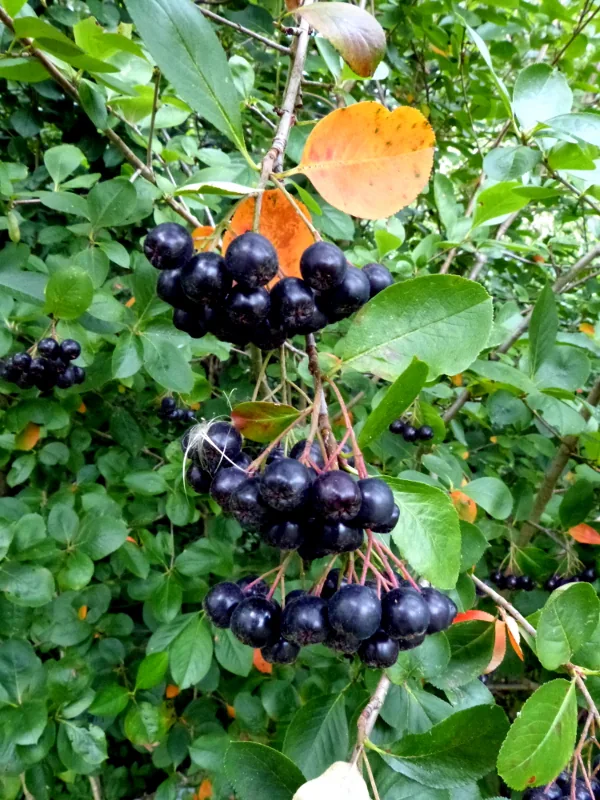
Black chokeberry is a native shrub you can grow with confidence, and it gives back all year. Spring brings a cloud of white flowers, summer keeps it dressed in glossy leaves, and come fall the foliage warms into rich red and purple. The dark blackish-purple berries ripen in late summer and stay on the plant well into winter, so there is always something to enjoy.
It is a member of the rose family and has no relation to chokecherry, the plant people sometimes mistake it for. That difference is reassuring to know, because chokecherry is poisonous while chokeberry is not. The Aronia berries are edible and full of antioxidants, only sharply astringent raw, which is why they are usually made into juice, jam, or jelly.
Honestly, few shrubs forgive a beginner so freely. It takes cold down to -40°F (-40°C) without flinching, copes with soggy ground or a dry stretch, and grows in sand, loam, or clay. The single habit worth planning for is suckering, since the roots will spread into a colony if you give them room.
Care
The short version: give it full sun for the finest fruit and fall color, plant it in ordinary to moist soil that leans acidic, and then enjoy how little it asks of you once it is settled.
Light
Set it in full sun and you will get the heaviest fruit and the brightest fall color. It carries on growing in partial shade too, so a less sunny spot is forgiving, but expect fewer flowers and a lighter berry crop there.
Water
Aim for steady, medium moisture and the fruit and flowers reward you for it. Beyond that the plant is wonderfully easygoing, taking wet, boggy ground or the odd dry spell once it is established, so watering every 5 to 10 days keeps most plantings content.
Soil
It happily grows in sand, loam, or clay, wet or well drained, and even shrugs off compacted or salty ground. It does lean acidic, around pH 5.1 to 6.5, yet tolerates higher, so most gardens will suit it just fine.
Temperature
This is a genuinely tough little shrub, hardy across USDA zones 3 to 8 and untroubled by anything from -40°F to 95°F (-40°C to 35°C). Cold is one thing you will never have to lose sleep over with chokeberry.
Humidity
Plain outdoor air is all it asks, so there is no number to chase. Good air movement matters more, since crowded, damp leaves are what tempt the occasional leaf spot in.
Feeding
It is a gentle feeder that often wants nothing at all. On poor soil, a single spring helping of balanced granular fertilizer is more than enough to keep it happy.
Pruning
It flowers on old wood, so do any shaping right after the blooms fade. Cut the oldest stems down to the base every so often to refresh the plant, and pull out root suckers to keep the colony gently in bounds.
Repotting
A container plant rarely needs moving on. Step it up to a bigger pot only when the roots start circling, water rushes straight through, or new growth quietly stalls.
Size & spacing
A mature plant reaches 3 to 8 feet (91 to 244 cm) tall and spreads 2 to 6 feet (61 to 183 cm) across. Give each shrub room to fill out and air to move through, and leave a little extra if you plan to let it sucker into a friendly colony.
When to plant
Chokeberry keeps time with the seasons, so you can simply follow its lead. White flowers open in May and June, the dark fruit ripens from August into September and clings on through winter, and the kindest time to set a new plant out is spring after the last frost or early in fall.
Northern hemisphere
Southern hemisphere
Typical months for a temperate climate: start earlier in warm zones, later where spring frosts linger.
- Sow: Late winter, after 2-3 months of cold moist stratification of cleaned seed
- Plant: Spring after last frost, or early fall
- Harvest: White flowers in spring (May to June); blackish-purple fruit ripens late summer to early autumn (August to September) and persists into winter
Hardiness
USDA hardiness zones: 3–8
Temperature: down to -40°C
Troubleshooting
Chokeberry gives you very little to fret over, and the thing you are most likely to meet is its own urge to spread rather than any pest. Glance at the leaves and twigs now and then for a passing fungus, and match what you see below before reaching for the pruners.
Twig tips and young berries darkening and dying back
If shoot tips blacken and the small berries shrivel, with cankers where the trouble starts, you are looking at a twig and fruit blight. Don't worry, you can manage it: cut back well past the spoiled tissue, burn or bin the prunings, and wipe the blades between cuts so nothing travels along with them. A strong, well-spaced plant fights this off most easily of all.
Fix:
- Prune out and destroy blighted twigs well below affected tissue
- Clean pruning tools between cuts
- Remove and discard infected fruit
Fresh stems gathering close around the base
Take heart, because this is simply the shrub being itself, not a sign anything has gone wrong. Root suckering is how chokeberry naturally builds colonies, sending out side roots that push up new shoots. You can lift the suckers out whenever they show, run a mower around the edge to cut the runners, or pick a tidier reduced-suckering cultivar if a neat outline matters to you.
Fix:
- Dig or cut out unwanted suckers at the root as they appear
- Mow or shallow-cultivate around the planting to sever spreading shoots
- Choose a reduced-suckering cultivar for formal landscapes
Brown or purple marks showing up on the leaves
When the leaves stay damp and air sits still inside the shrub, a fungal leaf spot can settle in, and it is gentle enough to recover from. The little spots widen as summer wears on, and the worst leaves let go early. Gather the dropped leaves and bin them, open up any crowded stems for airflow, and pour water at the roots so the foliage can stay dry.
Fix:
- Rake up and dispose of fallen infected leaves
- Improve air circulation by thinning crowded stems
- Avoid overhead watering that wets the foliage
Toxicity
You can breathe easy here, because every part of black chokeberry is safe. The berries are edible for people and a wildlife favorite, with nothing in them to harm pets or livestock. The only caution is a name mix-up, so keep this gentle shrub clear in your mind from the unrelated, poisonous chokecherry.
Safe for
People · Cats · Dogs · Horses · Rabbits · Livestock · Birds
Cats Safe
You can relax with a cat in the house, since nothing on this shrub holds a toxin. A nibble might bring on a touch of drool or a passing upset tummy, the way any unfamiliar plant might, and it passes on its own.
Dogs Safe
Dogs are perfectly fine around it. The sharp, astringent berries usually taste off-putting enough to send a dog elsewhere, and even a greedy mouthful only risks a loose stomach for a day, never poisoning.
Horses Safe
Horses can graze the leaves and fruit with no harm at all. Just keep it clear in your mind from chokecherry, a different plant whose wilted leaves and pits truly are dangerous to horses.
Rabbits Safe
Rabbits browse chokeberry happily and stay well. They may nibble young shoots and bark over winter, which troubles the shrub more than it ever troubles the rabbit.
Livestock Safe
Cattle, goats, and sheep can graze it without any worry. None of the cyanide that makes the chokecherry namesake a real danger to grazing animals is present here.
Birds Safe
Birds adore the fruit, and it nourishes them well. Because the berries cling on deep into winter, thrushes, waxwings, and others lean on them once the easy meals are gone.
People Safe
The ripe berries are wholesome to eat and treasured for their antioxidants. Raw they pucker the mouth hard, so most folks gently cook them down into juice, jam, or jelly first.
No special handling precautions are required. Do not confuse this plant with chokecherry (Prunus virginiana), an unrelated plant whose foliage and seeds are cyanogenic.
Varieties
A handful of named selections are worth knowing, whether you are after heavy fruit, glowing fall color, or a smaller plant to tuck into a snug corner.
Viking
A compact selection that growers favor commercially because it sets such a generous load of large berries.
Autumn Magic
Loved for its glossy leaves and an autumn show that flares into rich red and purple.
Iroquois Beauty (Morton)
A small, gentle form that holds at about 2 to 3 feet tall, just right where a big shrub would overwhelm the spot.
Ground Hog (UCONNAM012)
A very low, spreading kind that settles in almost like a ground cover.
How to propagate
Chokeberry is wonderfully easy to multiply, and because the suckers root so freely, division turns out to be the simplest route of all for a first try.
Stem cuttingsModerate
Summer, taking softwood cuttings in about July · 4 to 8 weeks to root, then one season to establish
Softwood cuttings taken in midsummer, around July, root readily, and a little rooting hormone makes it even kinder to your odds. Keep them humid and they will form roots in 4 to 8 weeks, then ease into the following season to settle in.
DivisionEasy
Early spring or fall · One growing season
Since the shrub suckers so willingly, division is the gentlest route and a lovely first project. In early spring or fall, separate a rooted sucker from its parent, replant it, and it will find its feet over a single growing season.
SeedModerate
Sow after cold stratification; outdoors in fall or indoors in late winter · Several weeks to germinate after stratification; 2 to 3 years to fruiting
Clean the seed from ripe fruit and give it 2 to 3 months of cold, moist stratification before sowing outside in fall or indoors in late winter. Seedlings come up a few weeks after that cold rest, though it will be 2 to 3 years before they fruit, so think of this as the patient path.
Myths
Black chokeberry is poisonous like chokecherry, so the berries should never be eaten.
You can let this worry go, because black chokeberry is not the same plant as chokecherry, which is a Prunus that does carry cyanide in its leaves and pits. Aronia berries are safe to eat, just wonderfully astringent, and people turn them into juice, jam, and jelly. The name only describes the way the raw fruit puckers your mouth, and it has nothing to do with poison.