Houseplant · Euphorbiaceae
Crown of Thorns
Euphorbia milii
Offer it sun, dry roots, and a gentle hand, and crown of thorns will bloom for you nearly all year.
Full sun
Every 7–14 days
50–86°F · 10–30°C
USDA 9–11
Overview
Crown of thorns lives up to its name in two ways, with woody stems edged in sharp spines and small blooms that come along almost without a break above them. It is part of the spurge family and grows as a succulent, banking water in those plump stems so it can sail through dry spells that would do in a softer plant. Most folks keep it happily as a houseplant on a bright windowsill, where it flowers on and off all year.
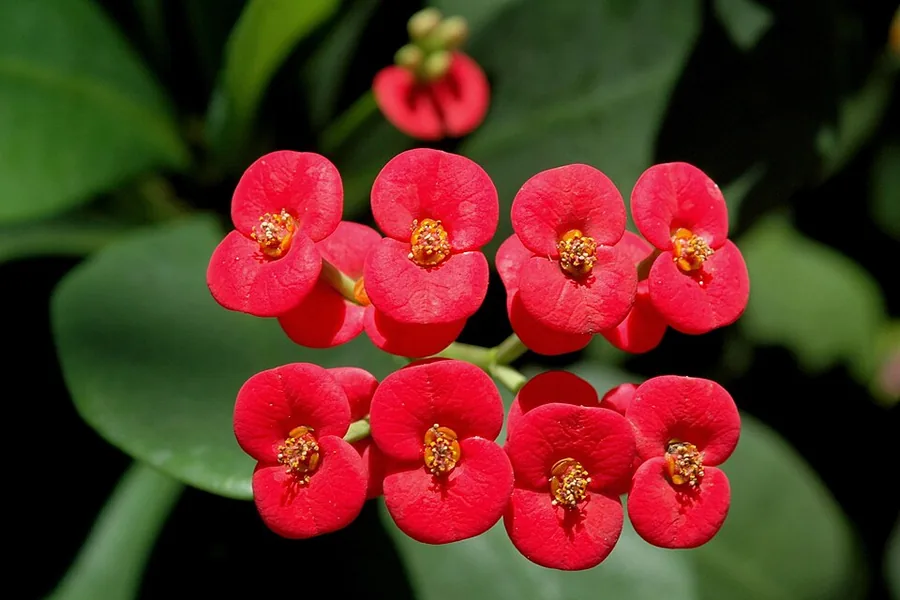
What you might take for the flower is really a pair of colored bracts, modified leaves in red, pink, or yellow that cradle the tiny true blooms in the middle. Indoors it keeps to a friendly size and asks for so little: strong light, a pot that drains in a hurry, and a good long dry spell between drinks. Its slow, easygoing growth means it rarely outgrows the spot you give it.
The one thing worth your respect is the milky latex held inside every stem. It burns skin and eyes and bothers the mouth and gut if chewed, and the spines add a second thing to mind. Handle it with gloves and keep it out of reach of pets and children, and you will have a tough, long-lived plant that gives back far more than it ever asks of you.
Care
The short version: give it the brightest light you can, ideally direct sun, a gritty mix that drains in seconds, and water only once the soil has dried out completely. Feed it lightly through the warm months and always handle it with gloves.
Light
Set it in the brightest spot you have, ideally where it can soak up several hours of direct sun on a south-facing sill. It will manage in bright indirect light, but flowering falls away quickly as the light fades, and a shaded plant tends to stretch and go bare.
Water
Let the mix dry out completely between waterings, then give it a good soak and let it drain. In practice that lands somewhere around every 7 to 14 days, and a good deal less in winter. Soggy soil is the surest way to lose it, so do remember to tip out the saucer.
Soil
Pot it in a gritty, fast-draining mix meant for cacti and succulents, the sort water simply runs straight through. It is content across a pH of 6.0 to 7.5, so the drainage matters a great deal more than hitting an exact number.
Temperature
Ordinary room warmth suits it nicely, anywhere from 50°F to 86°F (10°C to 30°C). Keep it above 50°F and clear of cold drafts, since chill paired with damp soil is what tips it toward rot.
Humidity
This is a low-humidity plant that wants no part of misting or a damp corner. Plain dry indoor air is exactly to its liking, and a bit of good airflow helps hold rot at arm's length.
Feeding
Feed it monthly through spring and summer while it is growing, using a balanced or low-nitrogen liquid feed at half strength. Skip it through winter and go gently on the whole, since too much nitrogen nudges it toward leaves rather than flowers.
Pruning
Prune in spring to shape it and keep its size in check, and treat this as the job that asks for the most care. Wear gloves and eye protection, because cut stems bleed caustic latex and carry sharp spines. Make clean cuts, keep the sap off your skin, and wash your tools and hands when you finish.
Repotting
Move it up a pot size every 2 to 3 years, or whenever roots circle the bottom and water races straight through. Repot in spring into fresh gritty mix with your gloves on, and there is no need to rush it into a pot much bigger than it really needs.
Size & spacing
Indoors it reaches roughly 2 to 6 feet (60 to 180 cm) tall over many patient years, spreading 1 to 2 feet (30 to 60 cm) across. The slow growth keeps it neat, so a single plant settles happily on a sill without crowding a thing.
Troubleshooting
Almost every wobble with crown of thorns comes back to water or light, and the good news is that both are easy to put right. Soft stems mean too much of one, and shy flowering usually means too little of the other. Find what matches below and make a small change before it has a chance to grow into rot.
Yellowing leaves and soft, mushy lower stems
When the lower stems turn soft and start to blacken, you are looking at stem and root rot, and the cause is nearly always water sitting in soil that cannot drain. Don't panic, because plants often pull through. Set the watering can aside, let the mix dry out hard, and trim away anything mushy with a clean, sterile blade. Should the rot have crept further than you would like, move it into fresh gritty mix and wait until the soil is bone dry before you water again.
Fix:
- Stop watering and let the soil dry out completely
- Remove rotted tissue with sterilized tools
- Repot into fresh gritty, fast-draining mix if rot is advanced
Plenty of growth but few or no flowers
Here is some reassuring news: a shy bloomer is usually just a plant that wants more light, since crown of thorns flowers on brightness. A spot too far from a sunny window holds it back, and a heavy hand with nitrogen makes things worse by coaxing out leaves instead of bracts. Shift it to the sunniest place you can find, full sun if you have it, and switch to a gentle low-nitrogen feed at half strength. You will likely see it respond.
Fix:
- Move to the brightest spot available, ideally full sun
- Switch to a low-nitrogen fertilizer at half strength
Leaves dropping in late autumn and winter
If a few leaves let go as autumn fades, take heart, because this is often just natural dormancy and nothing to worry about, provided the stems still feel firm. Ease back on watering through this quiet rest, and pick up your usual routine as the light strengthens in spring. A warm, bright home keeps the shedding gentle, so you have less to fuss over.
Fix:
- Reduce watering during the rest period
- Resume normal care as light increases in spring
Toxicity
This is a plant to handle with care, though there is nothing to fear once you know its quirks. Every stem bleeds a caustic milky latex that burns skin and eyes and inflames the mouth and gut if chewed, and the sharp spines add a hazard of their own. Keep it well out of reach of pets and children, and slip on gloves and eye protection any time you prune or move it.
Toxic to
Cats · Dogs · Horses · Rabbits · Livestock · Birds · People
Cats Toxic
A curious cat that nibbles a stem ends up with a mouthful of caustic latex, so look for drooling, pawing at the face, and often vomiting. Sap that lands on the fur or in the eyes leaves a raw, weeping soreness, and one of those sharp spines can prick a tender nose.
Dogs Toxic
A dog that chews the plant gets a burning mouth and gut, so heavy drooling, a sore mouth, vomiting, and a sudden loss of appetite are all common. The latex stings skin and eyes wherever it touches, and the spines bring a real chance of cuts.
Horses Toxic
That same caustic sap blisters the lips and mouth and unsettles the gut, so a horse that mouths the plant may drool, turn away from feed, and show signs of colic, while the spines snag at the soft muzzle.
Rabbits Toxic
This is one to tuck safely out of reach. The irritant latex inflames a rabbit's mouth and its delicate digestive system, and such a small animal has very little room to spare for the kind of upset it causes.
Livestock Toxic
Cattle, goats, and sheep that browse the stems get a burning mouth and gut from the diterpene-ester sap, which brings drooling, off-feed behavior, and digestive distress. Most stock steer clear of the spiny stems unless grazing runs short.
Birds Toxic
The caustic latex is just as unkind to birds, irritating the beak, mouth, and crop if one pecks or chews a stem. Place the plant somewhere a pet bird simply cannot get to it.
People Caution
No part of this plant belongs on a plate, and the milky sap is the real worry. It raises burning, blistering dermatitis on bare skin and can bring serious pain or injury if it reaches the eyes, while the spines deliver sharp punctures, so slip on gloves and eye protection and keep it away from small children.
Wear gloves AND eye protection when pruning or handling; the stems also bear sharp spines that puncture skin. If latex contacts skin, wash it off promptly with soap and water; if it reaches the eyes, flush with water immediately. Keep cuttings and sap off bare skin.
Helpline numbers

United States
ASPCA Animal Poison Control: (888) 426-4435 (fee applies)
Poison Control: (800) 222-1222



Canada
Poison Centres: 1-844-764-7669
Varieties
Crown of thorns turns up in a handful of named forms, from tidy dwarfs to the big-bracted Thai hybrids. These are the ones you are most likely to come across.
Euphorbia milii var. splendens
This is the strong, eager grower of the bunch, carrying bigger, brighter red bracts on thick stems that are very well armed with spines.
'Short and Sweet'
A neat little dwarf that stays small enough to perch on a windowsill and settles into indoor life with ease, which makes it a kind choice for a first try.
Giant crown of thorns (Thai hybrids)
These hybrids reward you with unusually large bracts in red, pink, yellow, and pretty two-tone blends.
How to propagate
Crown of thorns is one of the easier plants to multiply from cuttings, as long as you mind the caustic sap with a little care first.
Stem cuttingsEasy
Spring or early summer during active growth · 4 to 8 weeks to root
Making more of this plant is wonderfully simple, and cuttings are the friendly way to do it, taken in spring or early summer while it is growing. Pull on your gloves and eye protection first, rinse or blot the caustic latex from the cut end, and let the cutting callus over for a few days before it goes into a gritty, barely moist mix. Keep it warm and bright, and roots tend to follow in 4 to 8 weeks.
Myths
The colorful red parts are the plant's true flowers.
It is an easy thing to assume, but those bright red, pink, or yellow paddles are bracts, modified leaves rather than petals. The true flowers are the tiny clusters tucked at their center, so small and quiet that they slip past most eyes against all that color.
Crown of thorns is a kind of cactus.
With all those spines it certainly plays the part, yet it sits in the spurge family Euphorbiaceae and grows as a succulent rather than a cactus. The telltale sign is the milky latex it bleeds when cut, which no cactus does, and that sap happens to be caustic.