Shrub · Bignoniaceae
Crossvine
Bignonia capreolata
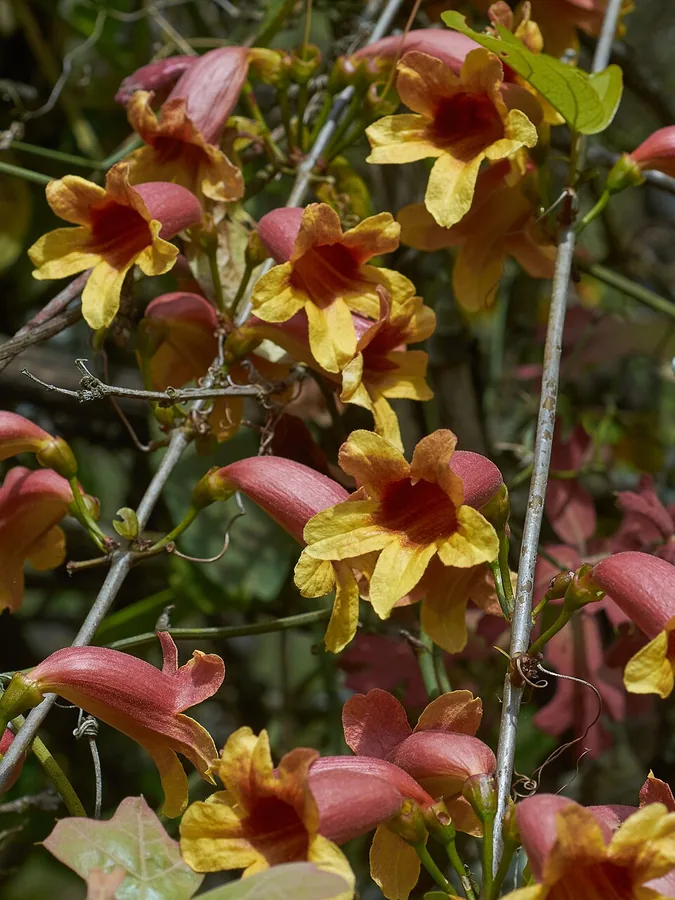
A forgiving native climber that hands you a curtain of spring trumpets and keeps the hummingbirds dropping by.
Full sun
Every 7–14 days
USDA 5–9
30–50 ft · 9.1–15.2 m
Overview
If you are nervous about vines, crossvine is a gentle place to start. This woody native of the southeastern United States climbs on its own, taking hold of fences, walls, and arbors with tendrils tipped in tiny sticky disks, so you will not be fussing with ties and trellises. Its name comes from the cross-shaped pattern hiding inside an older stem when you cut across it. Each early spring it rewards you with trumpet flowers that bring the hummingbirds in close.
You really do not need a green thumb here. Crossvine is happy in full sun or deep shade, forgives poor soil, copes with drought once its roots settle, and stands up to winters across zone 5 to zone 9. The one thing to watch is how eager it is to grow. Given its head it reaches 30 to 50 feet and pushes up suckers from the roots, so it will thank you for a strong support and a friendly trim once a year.
One easy mix-up worth avoiding: people sell it next to the pushier trumpet creeper, but they are not the same. Crossvine flowers earlier, keeps its manners, and will not leave your skin itching the way its cousin sometimes does.
Care
The short version: give it full sun for the most flowers, set it against a sturdy support to climb, water deeply only while it is settling in, and prune hard right after the spring bloom so it stays in bounds. You really cannot go far wrong.
Light
Crossvine settles happily into anything from full sun to full shade, which is a big part of why it is so forgiving. It does shine in sun, though, giving you fuller growth and far more of those spring trumpets. Tuck it into deep shade and it grows leggy and flowers little, so lean toward brighter spots when you can.
Water
While your new vine is getting established, aim to keep the soil evenly moist and it will reward your care. Once it is settled it turns genuinely drought tolerant, so a deep drink during a long dry spell is all it needs. The rest of the time rainfall usually takes care of things, so relax.
Soil
There is no need to fret over soil. Average, well-drained loam or sandy ground suits crossvine nicely, and it adapts to a wide range, content anywhere from a pH of 6.0 to 8.0. Rich, organic ground grows it best, but it gets along almost anywhere you put it.
Temperature
This is a tough, cold-hardy native that takes roughly -20°F to 100°F (-29°C to 38°C) in stride, covering zones 5 through 9. Winter will not faze it, and summer heat is no trouble either, so you can plant it and breathe easy.
Humidity
Average outdoor humidity is all crossvine asks of you, so there is no target number to chase. What helps more is good air movement, since crowded growth in still, damp air is what tempts the occasional leaf spot.
Feeding
Feeding is one less thing to worry about, because crossvine barely needs it. A light dose of balanced fertilizer or compost in spring is plenty for this vigorous native, and going heavy on nitrogen only grows leaves instead of the flowers you are hoping for.
Pruning
Reach for the pruners right after it finishes flowering to keep the vine tidy on its support, since cutting before the bloom would sacrifice that year's flowers. Pull up root suckers as they appear, a small, easy habit that keeps the plant from wandering where you do not want it.
Repotting
Crossvine is a landscape climber, so it rarely lives in a pot for long and you will seldom need to repot. If you are growing one in a container, move it up only when it has clearly outgrown its space, shown by roots circling or escaping the pot, fast-drying soil, and stalled top growth.
Size & spacing
Do give this vine plenty of room and it will reward you. It climbs 30 to 50 feet (9 to 15 m) tall and spreads 6 to 9 feet (180 to 275 cm) wide, so choose a spot where a large, fast climber is welcome and back it with a strong arbor or fence.
When to plant
Crossvine is hardy from zone 5 to 9, and the kindest time to plant it is spring or fall, when the weather is mild and the roots can settle before summer heat or winter cold arrives. It blooms in late winter to early spring, easing toward May or June in the colder parts of its range, so a little patience pays off.
Northern hemisphere
Southern hemisphere
Typical months for a temperate climate: start earlier in warm zones, later where spring frosts linger.
- Plant: spring or fall
- Harvest: late winter to early spring (May to June in colder zones)
Hardiness
USDA hardiness zones: 5–9
Temperature: down to -29°C
Troubleshooting
Take heart: crossvine almost never struggles with pests or disease. The small troubles it does run into come from its own eagerness, a bit too much shade, or pruning at the wrong moment, and every one is easy to put right. Find what matches below and step in gently.
The vine outgrows its support and swallows nearby plants
Crossvine is a fast climber by nature, and its tendrils hold on with sticky disks that grab whatever they reach, so a little sprawl is normal. Heavy shade makes it worse, because the vine stretches toward the light. Cut it back hard right after it blooms and set it against a sturdy arbor or fence built for a 30 to 50 foot climber, and you will keep it in hand.
Fix:
- Prune hard after flowering to reduce size
- Provide a sturdy, large support such as an arbor or fence
- Site in full sun for denser, more floriferous growth
New shoots popping up in the lawn away from the main plant
Those wandering shoots are simply root suckers, the way crossvine naturally spreads underground, so there is nothing wrong with your plant. Pull or dig them the moment you notice them, and mow over any that turn up in the grass. If you would rather keep it in one spot, sink a root barrier or plant it in a contained bed where a little spread does not matter.
Fix:
- Pull or dig up root suckers as soon as they are spotted
- Mow or cut suckers in lawn areas
- Install a root barrier if confining the plant
A leafy, healthy vine that barely flowers
When crossvine grows lush and green but holds back its trumpets, too much shade is usually behind it. Pruning at the wrong time can do it too, since cutting before the spring bloom takes the buds with it. Move or train the vine into more sun, ease off the nitrogen, and prune only once it has finished flowering, and the blooms should return.
Fix:
- Move or train the vine into more sun
- Prune only after the spring bloom, not before
- Avoid excess nitrogen fertilizer
Dark spots scattered across the leaves
These are almost always just fungal leaf spot, a minor cosmetic blemish on a plant that otherwise shrugs off pests and disease. Thin the growth so air moves freely, pick off the worst leaves, and water at the base instead of overhead. Crossvine has no serious insect or disease problems, so spots like these rarely come to anything.
Fix:
- Improve air circulation by thinning growth
- Remove and dispose of badly affected leaves
- Avoid overhead watering
Toxicity
Lovely news if you have curious pets or little ones around: crossvine is not toxic. It does not appear on the ASPCA's list of poisonous plants and is treated as safe for cats, dogs, and people. The only thing to keep straight is not confusing it with trumpet creeper, the related vine whose sap can irritate skin.
Safe for
People · Cats · Dogs · Horses · Rabbits · Livestock · Birds
Cats Safe
Crossvine is not on the ASPCA toxic list, so a curious cat that nibbles a leaf will be just fine. A big mouthful of any plant might bring a little drooling or a soft stool, but nothing more worrying than that.
Dogs Safe
Dogs can chew the foliage without coming to harm. At most you might notice a touch of mild stomach upset if one bolts down a large amount, and that settles on its own.
Horses Safe
There is no toxin here that bothers horses. They can graze around crossvine in safety, though it is wise for no animal to live on any single plant.
Rabbits Safe
Rabbits can browse the leaves without any risk. Just bring in new greens slowly, since a sudden heap of fresh foliage can loosen a rabbit's gut.
Livestock Safe
Cattle, goats, and sheep face no danger from this vine. It holds none of the compounds that make a few pasture plants a worry.
Birds Safe
Crossvine poses no threat to birds at all. Its spring trumpet flowers even welcome hummingbirds, which sip the nectar without any harm.
People Safe
This is the well-behaved crossvine, not its prickly cousin the trumpet creeper, so handling it will not irritate your skin. It is safe around children and pets alike, so you can plant it with confidence.
No special handling required; as with any plant, large quantities of ingested foliage may cause mild, non-specific GI upset.
Varieties
A handful of named selections are worth knowing for their flower color and habit, and these are the ones you are most likely to spot at a nursery.
Tangerine Beauty
Far and away the favorite, Tangerine Beauty covers itself in warm tangerine to apricot-orange trumpets and blooms more freely than the plain species.
Atrosanguinea
Atrosanguinea is a gentler, shorter grower carrying darker purplish-red flowers and narrow, lance-shaped leaflets.
Dragon Lady
Dragon Lady is loved for its deep red-orange flowers.
How to propagate
Making more crossvine is wonderfully simple, and much of the time the plant does the work for you, self-seeding and rooting wherever a low stem rests on the ground.
SeedModerate
Fall or spring after pods mature · 1 to 2 growing seasons
Collect seed from the long, bean-like pods once they ripen, then sow it in fall or spring. Crossvine self-sows readily on its own, so volunteers often turn up without any effort from you. Give a sown plant a growing season or two to settle in, and it will soon find its stride.
Stem cuttingsModerate
Summer · Several weeks to root
Take softwood cuttings in summer and they send out roots over several weeks. Root cuttings work too and are a documented method for this species, which is handy when you want copies of a selection you love.
LayeringEasy
Spring to summer · One season
This is the easiest route by far, and a lovely confidence builder. Pin a low stem against the soil in spring or summer and it roots on its own within one season, much the way the vine naturally spreads as it sprawls.
Myths
Crossvine and trumpet vine are the same plant.
They belong to the same family, but they are not the same vine. Crossvine climbs with tendrils tipped in adhesive disks, blooms in early spring, and stays comparatively gentle. Trumpet creeper is the rowdy one, flowering in summer, and its foliage and sap can leave your skin itchy, so it helps to know which one you have.