Shrub · Bignoniaceae
Trumpet Vine
Campsis radicans
Set it in full sun with something strong to climb, and your trumpet vine will call hummingbirds in all summer.
Full sun
Every 7–14 days
730–1095 days
USDA 4–9
Overview
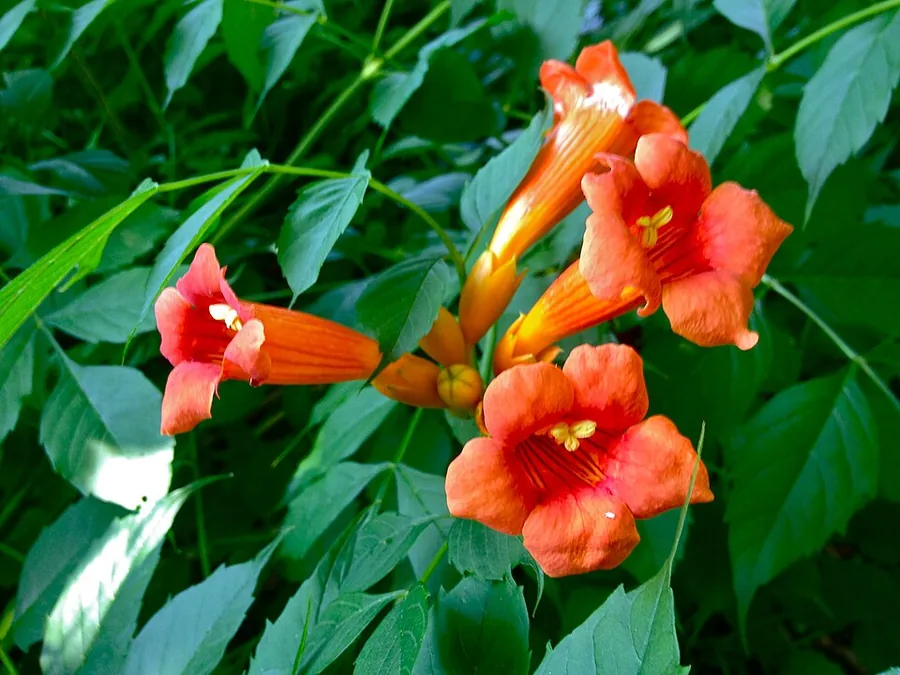
If you have never grown a big climber before, the trumpet vine is a kind place to start. It is a fast, woody native of the eastern United States, and its orange-red trumpets bring hummingbirds around from the middle of summer into fall. Holding on with little aerial rootlets, it can reach 25 to 40 feet (7.5 to 12 m) up an arbor, fence, or wall. Hardy through zones 4 to 9, it takes cold, heat, drought, and thin soil in stride, so a rough patch of weather will not undo your work.
The one thing to keep an eye on is how eagerly it grows. Left to itself, it runs outward on underground root suckers and drops plenty of its own seed, building thick stands, and its weight and holdfast roots can wear on whatever it leans against. None of that has to put you off. It just means the trumpet vine wants an open, forgiving spot rather than the neat wall of a house, and whatever it tries, you can always cut it back.
Here is the reassuring part: the recipe is short. Grow it on a heavy support that stands on its own, keep it in lean soil, and give it one firm prune a year, and you get all the flowers with none of the regret. Its old nickname, cow itch vine, is worth honoring too, since the sap can nettle your skin, so slip on gloves before you work and you will be fine.
Care
The short version: full sun, lean soil, and a support strong enough to lean on. Give young plants a little water until their roots take hold, then relax and let them be, leave the fertilizer in the shed, and prune firmly in late winter to keep everything in bounds.
Light
Your trumpet vine will flower best in full sun, six or more hours of it each day. It will still grow in partial sun or a bit of shade, but shade trades those blooms for foliage, and you end up with a lush green climber and hardly any color to show for it.
Water
While a young plant is settling in, give it steady water to help those roots find their footing, then you can ease right off. Once it has taken hold it is drought tolerant and lives happily on rainfall across dry to moist soils, so an established vine will rarely ask you for a drink.
Soil
This is a forgiving plant at the roots. It settles into clay, sand, loam, or even poor ground, and copes with a broad pH span of 5.5 to 8.0. Lean soil is truly what you want, since rich earth just fuels its vigor and steals your flowers, and it shrugs off spells that run dry to a little wet.
Temperature
Few climbers are this unbothered by weather. It comes through anywhere from about -29°F to 100°F (-34°C to 38°C), which is exactly what keeps it happy across zones 4 through 9. A brutal winter and a scorching summer are both within its comfort, so you can plant it with confidence.
Humidity
There is no humidity number to chase here. Plain outdoor air is all it wants, and it grows contentedly across a wide sweep of climates without a second thought about moisture in the air.
Feeding
You can happily leave the fertilizer alone. Rich soil and generous feeding only bring more leaves and fewer flowers, so this vine truly does better a little hungry, and lean ground has the bonus of keeping its already-eager growth calmer.
Pruning
Prune it hard in late winter or early spring, and do not feel shy about it. Because it flowers on new growth, cutting back never costs you a single bloom, and a yearly thinning of the woody stems along with pulling any root suckers is really what keeps it off your fences and walls.
Repotting
This is a vine for the open ground, not a pot on the sill, so repotting almost never enters the picture. In the rare event yours lives in a container, watch for roots crowding the pot and suckers poking out of the drainage holes as your cue.
Size & spacing
Plan for a genuinely big climber. It runs 25 to 40 feet (7.5 to 12 m) tall and fans out 5 to 10 feet (1.5 to 3 m) across, so give it honest room and a solid structure, and keep it a comfortable distance from anything you would rather it did not swallow whole.
When to plant
There is no rush with this one. Put plants out in spring once the frost has passed, or in fall if your winters stay mild, and take the shears to it hard in late winter before it wakes up. The orange trumpets arrive across summer, from June into September, all on the fresh wood it makes each year.
Northern hemisphere
Southern hemisphere
Typical months for a temperate climate: start earlier in warm zones, later where spring frosts linger.
- Sow: Late winter to early spring; seed needs cold stratification, though the plant is usually propagated from root cuttings or suckers rather than seed.
- Plant: Spring after frost, or fall in mild zones
- Harvest: Summer (June to September)
Hardiness
USDA hardiness zones: 4–9
Temperature: down to -34°C
Troubleshooting
Almost every hiccup with a trumpet vine comes back to how strongly it grows, not to bugs or disease, which is honestly good news. It wanders where you did not invite it, leans hard on its support, and now and then puts out all leaves and no bloom. Find your issue below, and you will see none of it is hard to set right.
Walls, mortar, and gutters taking a beating from the vine
The trumpet vine holds on with clinging aerial rootlets that push into mortar, wood, and the smallest gap, and a grown plant carries enough woody weight to buckle a fence or a flimsy trellis. Peel it off a wall and it brings the surface along with it. Keep this one on a heavy, free-standing support such as a metal arbor or masonry rather than the house itself, and prune it back firmly each year to hold the weight down.
Fix:
- Grow only on a very sturdy freestanding support such as a heavy metal arbor or masonry, not on house walls or wooden structures
- Keep the vine off buildings, gutters, and weak fences by pruning back hard
- Avoid clinging vines on wood, which can be damaged or rot from trapped moisture
Surprise shoots turning up well away from the plant
What you are seeing is aggressive suckering, the trumpet vine's signature move. Underground runners travel outward and the bean-like pods scatter seed, so fresh shoots and seedlings pop up a good distance from the original plant and, left alone, can crowd out their neighbors. It is easy to stay ahead of, though: lift or pull each sucker the day it shows, run the mower over any that reach the grass, and snip the seed pods off before they open.
Fix:
- Dig or pull root suckers as soon as they appear, removing as much root as possible
- Mow suckers repeatedly where the plant adjoins lawn to exhaust them
- Remove spent flowers and seed capsules before they split to limit self-seeding
- Site it near concrete or mowable areas to make suckers easier to control
Plenty of leaves but the flowers are holding back
A trumpet vine that grows with real gusto yet will not bloom is almost always young, shaded, or overfed. A newly set plant can need a few seasons to settle before it flowers, and both shade and rich, nitrogen-heavy soil tip its energy toward leaves. Move it into full sun, put the fertilizer away, and let it mature, because the flowers come more freely as the years go by.
Fix:
- Site or relocate in full sun (6 or more hours)
- Be patient; allow the plant to mature, as blooming improves with age
- Avoid nitrogen-rich fertilizer and grow in leaner soil
- Root-prune or restrict the roots slightly to encourage flowering
Toxicity
Trumpet vine is not a dangerous poison, though it is not completely innocent either. The part to mind most is your own skin, because the leaves, flowers, and sap can raise the itchy rash that earned it the name cow itch vine. A pet that chews a bit will usually get only mild irritation, so wear gloves when you handle it and gently steer curious animals away from nibbling.
Toxic to
Cats · Dogs · Horses · Rabbits · Livestock · People
Safe for
Birds
Cats Mild
A curious cat that chews a leaf or flower might drool a little or feel briefly off in the stomach, and the sap can leave its mouth or skin faintly irritated. Real poisoning simply is not something to worry about here.
Dogs Mild
A dog nosing at the foliage is unlikely to get anything worse than some drooling and a short bout of tummy upset, with maybe a bit of mouth or skin irritation where the sap touched.
Horses Mild
A horse that samples the vine may show mild irritation around the mouth or skin and a little digestive grumbling, but this is not a plant that puts one in danger.
Rabbits Caution
There is barely any record of how rabbits handle it, so the kind move is to keep it out of their reach rather than let them treat it as a snack.
Livestock Caution
Grazing animals usually pass it by, and any upset from a curious mouthful stays mild, yet it is still best fenced off from pasture rather than offered as feed.
People Caution
Handling the leaves, flowers, or sap can bring on contact dermatitis, with skin redness, itching, and blistering, plus eye irritation for good measure. The old name cow itch vine tells the whole story, so pull on gloves and long sleeves before you prune.
Birds Safe
Birds have nothing to fear from it, and they come for the nectar far more than the leaves. Hummingbirds especially crowd around the blooms all season.
Not internally poisonous to pets, but the leaves, flowers, and sap can cause contact dermatitis with skin redness, itching, and eye irritation in sensitive people who handle the plant (hence the folk name cow itch vine). Wear gloves and long sleeves when pruning or handling.
Helpline numbers

United States
ASPCA Animal Poison Control: (888) 426-4435 (fee applies)
Poison Control: (800) 222-1222



Canada
Poison Centres: 1-844-764-7669
Varieties
A handful of named forms and one close cousin from Asia give you a little room to choose your color and how wild you want things to get. These are the ones worth having on your radar.
'Flava' (Yellow Trumpet, f. flava)
This one swaps the familiar orange-red for soft yellow to orange-yellow trumpets.
'Madame Galen' (Campsis × tagliabuana)
A hybrid of C. radicans and C. grandiflora, it opens cantaloupe-orange to salmon-red flowers and still suckers and self-seeds, just with a touch more restraint than the plain species.
Campsis grandiflora (Chinese trumpet creeper)
This Asian species carries big orange-and-yellow blooms, climbs far more gently with fewer aerial rootlets, and needs a little help to stay upright.
How to propagate
If anything, this plant makes more of itself far too readily, whether from cuttings, division, seed, or a stem that simply flops onto the ground and roots. Most gardeners spend their effort holding it back rather than coaxing out new plants.
Stem cuttingsEasy
Summer (softwood) cuttings · 4 to 8 weeks to root
Softwood cuttings taken over summer root with almost no trouble, usually striking in about 4 to 8 weeks, which makes this one of the easiest plants to start from a cutting.
DivisionEasy
Dormant season or early spring · One season
Because the vine keeps offering up its own rooted suckers, the simplest way to make more is to dig one during the dormant season or early spring and move it where you want it. A divided sucker usually settles in within a single season.
SeedModerate
Spring after cold stratification · Several years to first bloom
Seed from those bean-like pods comes up willingly once it has had a cold rest, sown in spring after stratification. Do be patient, since a seedling can take several years to give you its first flowers.
LayeringEasy
Spring to summer · One season
Let a stem lie along the soil from spring through summer and its rootlets and nodes will anchor themselves without any help from you. Within a season that layered stem is ready to cut free and move.
Myths
Trumpet vine is poisonous enough to badly hurt a dog or cat that chews it.
Campsis radicans does not appear on ASPCA toxic-plant lists, and what little effect eating it has stays mild, so a pet that takes a bite is looking at some drooling or a queasy stomach at worst. The genuine risk is contact dermatitis, an itchy reaction on the skin and eyes of people who handle the leaves or sap, rather than any poisoning from the inside.
It is a neat, mannerly climber to run up the side of a house.
Tidy is the last word for it. It builds dense colonies by way of root suckers and self-seeding, and its gripping roots and heavy woody growth can chew up siding, mortar, wood, gutters, and any weak support. Give it a strong support of its own and one hard prune a year, and keep it well away from the walls of your house.