Tree · Bignoniaceae
Northern Catalpa
Catalpa speciosa
A forgiving native shade tree that puts on showy white flowers and grows fast almost anywhere you plant it.
Full sun
Every 7–21 days
USDA 4–8
40–70 ft · 12.2–21.3 m
Overview
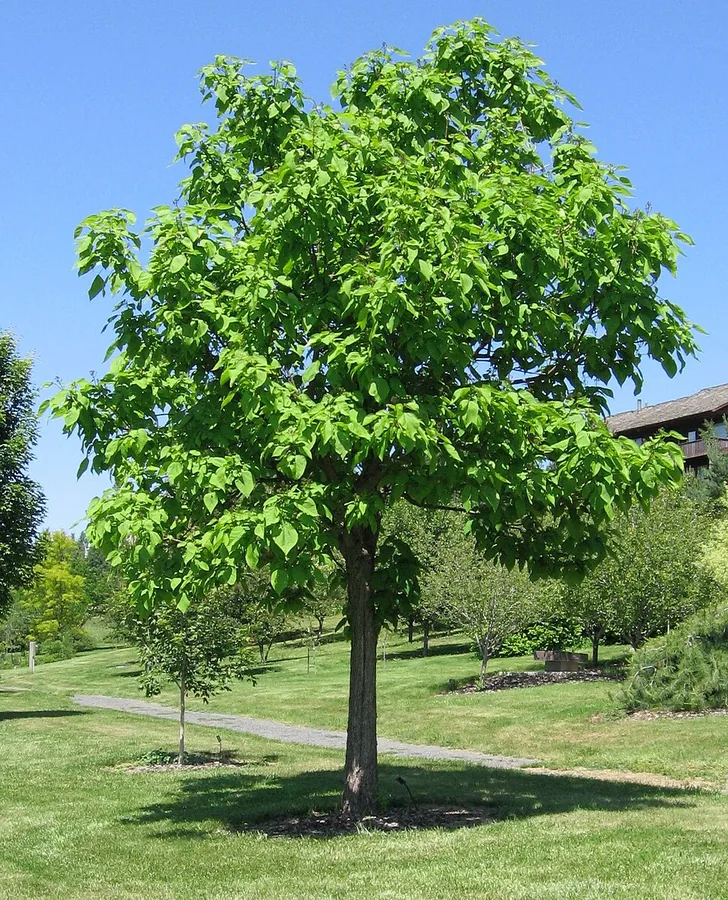
If you have been nervous about planting a big tree, northern catalpa is a kind one to start with. It grows quickly into welcome shade, and each late spring it covers itself in showy white flowers that look like tiny orchids. By fall it dangles long, slender pods, the reason for friendly old names like cigar tree and Indian bean tree. The heart-shaped leaves grow large, which is part of its charm.
The best part is how little this tree asks of you. It settles happily into wet ground or dry, into clay, thin soil, and city air, and it carries on through everything from -29°F to 100°F (-34°C to 38°C) without fuss. That easygoing nature is exactly why it thrives where other trees would struggle, so you can relax and let it do its thing.
There is a little cleanup to plan for, and the wood is on the brittle side, so the odd limb may come down in a storm. Neither is anything to worry over. Just give it open space away from patios and walks, shape it gently while it is young, and it will pay you back with many years of quick, generous shade.
Care
The short version: give it full sun to part shade and just about any soil, wet or dry, and it will mostly look after itself. Once it has settled in it rarely wants feeding or extra water, so your main jobs are a little early pruning for strong structure and a spot where falling limbs and leaf litter won't bother anyone.
Light
Catalpa is happiest in full sun, but it takes part shade in good stride, so don't worry if your spot isn't perfectly bright. More sun simply brings heavier flowering and a fuller, sturdier crown, while a shadier corner still raises a healthy tree.
Water
Once it has found its feet, this tree copes with both seasonal flooding and drought, so watering rarely falls to you. The exception is a young tree, which appreciates steady moisture through its first year or two as the roots reach down. Simply let the top half of the soil dry out between drinks and you can't go far wrong.
Soil
Few trees are this easy to please. Catalpa would love a moist, fertile loam with some organic matter, yet it gets on just fine in clay, soggy low spots, dry poor ground, and rough city conditions, so almost any patch will do.
Temperature
This is a wonderfully cold-hardy and heat-tough tree, at home across USDA zones 4 to 8 and able to ride out anything from -29°F to 100°F (-34°C to 38°C). Once it is planted, temperature is one thing you can stop thinking about.
Humidity
Everyday outdoor humidity suits it perfectly, so there is no number to chase and nothing to mist. What helps more is good air movement, which keeps the leaf-spot and mildew fungi from settling in, and that comes free with an open spot.
Feeding
This easygoing native hardly ever needs feeding, which is one less chore for you. If the growth ever looks weak, a single balanced, general-purpose tree fertilizer in spring is all it asks, and most years you can skip it with a clear conscience.
Pruning
Prune in late winter to early spring to take out dead, weak, or crossing branches and to coax a strong central leader. Because the wood is brittle and snaps easily, a little shaping while the tree is young really does pay off for the rest of its long life.
Repotting
Catalpa is meant for the open ground rather than a pot, so repotting rarely comes up at all. If you are holding a young one in a container for a while, just move it up a size when roots circle inside, poke through the drainage holes, or water starts running straight through.
Size & spacing
This is a large, generous tree, reaching 40 to 70 feet (12 to 21 meters) tall and spreading 20 to 50 feet (6 to 15 meters) wide. Give it plenty of open room, well clear of buildings, walks, and power lines, and it will have all it needs to grow into itself.
When to plant
There is no need to fret over timing, because catalpa is patient. Set it out in spring once the last frost has gone, or wait for fall, and then look forward to the white flower panicles in May and June, with the long pods forming gently behind them all summer.
Northern hemisphere
Southern hemisphere
Typical months for a temperate climate: start earlier in warm zones, later where spring frosts linger.
- Sow: Late winter to early spring; seed needs no special pretreatment.
- Plant: Spring after the last frost, or in fall.
- Harvest: Showy white orchid-like flower panicles in late spring to early summer (May to June), followed by long bean-like seed pods.
Hardiness
USDA hardiness zones: 4–8
Temperature: down to -34°C
Troubleshooting
Take heart: catalpa is a sturdy tree, and most of what comes its way is cosmetic rather than dangerous. The one thing worth learning to spot is verticillium wilt, since it has no cure. Match what you are seeing to the notes below before you reach for any treatment, and you will know just what to do.
Quick wilting and branch loss, usually starting on one side
Verticillium wilt is a soilborne fungus that clogs the wood from within, and sadly there is no chemical cure. To confirm it, cut a wilting branch and look for brown or greenish streaks under the bark. Prune out the affected limbs, keep the tree well watered to hold its strength, and if it does succumb, choose a different, resistant species for that spot.
Fix:
- Prune out and dispose of affected branches
- Keep the tree vigorous with proper watering, as there is no chemical cure
- Avoid replanting susceptible species in the same soil if a tree dies
Broken branches and torn leaves once a storm passes
Catalpa wood is naturally brittle, so a strong wind, ice, or hail can break limbs and shred the big leaves. It looks dramatic, yet it is easily managed: after a storm, find any snapped or hanging branches and prune them off cleanly. Guiding a young tree toward a strong central leader early, and planting where a falling limb won't reach a patio or walk, saves trouble down the road.
Fix:
- Prune cleanly to remove broken or hanging limbs
- Develop a strong central leader and good branch structure with early structural pruning
Foliage nibbled down or a whole tree bared by late summer
When you see leaves vanishing in mid to late summer, the culprit is almost always the catalpa sphinx caterpillar, fondly called the catalpa worm, which eats nothing but catalpa. They feed in crowds and can strip a tree bare, yet it re-leafs and comes through just fine, so there is little to fear. Pick them off a small tree if you wish, or leave them, since many anglers treasure them as fish bait.
Fix:
- Handpick caterpillars from small trees, or simply tolerate them since trees easily re-leaf
- Harvest them as fish bait, for which catalpa worms are prized
- Apply a labeled caterpillar control such as Bt or a recommended insecticide only for heavy infestations on small or young trees
A dusty white coating or dark flecks across the foliage
These marks come from powdery mildew and leaf spot fungi, sometimes with a little twig blight that kills off small shoots. Heavy mildew can yellow the leaves and drop them early, but the harm stays cosmetic and rarely needs a fungicide, so you can breathe easy. Just rake up and bin the fallen leaves and open the canopy a bit for better airflow.
Fix:
- Rake and dispose of fallen infected leaves
- Improve air circulation
- These foliar problems are largely cosmetic and rarely require fungicide
Toxicity
Here is some reassurance for homes with pets: catalpa is not toxic. It never appeared on the ASPCA poison-plant lists, and the long bean-like pods, though not for eating, are not a poisoning danger. The only small thing to mind is the foliage, which can leave sensitive skin a touch itchy, so slip on gloves for a big tidy-up.
Safe for
People · Cats · Dogs · Horses · Rabbits · Livestock · Birds
Cats Safe
Catalpa isn't on the ASPCA toxic list, so a curious cat batting at a fallen pod is in no danger at all.
Dogs Safe
Nothing here will poison a dog. One that chews a stray pod might get a mild tummy upset from the bulk, but the tree itself is not toxic.
Horses Safe
Catalpa carries no known toxin for horses and doesn't appear on any poison-plant lists, so grazing nearby is fine.
Rabbits Safe
The leaves and pods hold nothing harmful to rabbits, so a nibbled leaf is perfectly safe.
Livestock Safe
Cattle, goats, and sheep can graze around a catalpa without any risk, since the tree is not a recognized poisoning hazard.
Birds Safe
Birds come to no harm from the foliage or the long seed pods, so you can welcome them in.
People Safe
The tree is safe to live with. The pods aren't for eating, and the foliage can leave sensitive skin a little itchy, so pop on gloves for a big cleanup.
The long seed pods and large leaves create heavy litter, and the foliage can cause minor contact dermatitis in sensitive people, so wear gloves when handling.
Varieties
A handful of catalpas show up in gardens and along streets, from the tall northern and southern species to a couple of selections kept for their shape or their color. These are the friendly few worth knowing by name.
Catalpa speciosa (Northern catalpa)
The larger, hardier of the two main species, this one grows tall and upright with green-scented leaves and takes the cold in stride right down through zone 4.
Catalpa bignonioides (Southern catalpa)
A smaller, rounder tree whose foliage carries a fetid scent, with flowers more heavily spotted in purple that tend to open a little later in the season.
Catalpa bignonioides 'Nana' (Umbrella catalpa)
A dwarf, non-flowering form grafted onto a standard trunk, so it settles into a dense, rounded umbrella of a head.
Catalpa bignonioides 'Aurea'
A golden-leaved selection loved for its bright yellow to yellow-green foliage.
How to propagate
Catalpa is generous about making more of itself, so whether you sow seed straight from the pods or take a cutting from a tree you already love, you are in good company.
SeedEasy
Collect seed from the long bean-like pods in fall and sow in late winter to spring. · 1 to 2 seasons
Seed is the simplest path and a lovely place to begin. Gather it from the long pods in fall and sow from late winter into spring, with no soaking or chilling needed beforehand. It sprouts readily, and because the tree is so fast it fills out to landscape size within a season or two.
Stem cuttingsModerate
Softwood cuttings in early summer or hardwood cuttings in the dormant season. · 1 season to root
You can also raise catalpa from cuttings, taking softwood in early summer or hardwood while the tree rests, and they take about a season to root. Root cuttings work as well. Named forms like 'Nana' are usually grafted rather than struck from cuttings, since they don't come true on their own roots.
Myths
Once catalpa worms move in, they devour the leaves and the tree dies.
The catalpa sphinx caterpillar can indeed strip a tree bare, and yet it leafs out again and recovers fully, even when the same thing happens several years in a row. The defoliation looks alarming but does no lasting harm, so you can almost always simply let it pass.
Those long seed pods will poison a cat or dog.
Catalpa never appeared on the ASPCA toxic-plant lists and is counted as non-toxic, so there is no need to worry. The long pods are inedible but not a poisoning hazard for cats or dogs.