Houseplant · Lentibulariaceae
Bladderwort
Utricularia
Offer it pure water, lean soil, and bright light, and this little hunter takes care of its own meals.
Bright indirect
Every 1–3 days
50–86°F · 10–30°C
USDA 9–11
Overview
Bladderwort ranks among the most surprising plants you could ever grow, a hunter that gathers its own dinner beneath the water. It sits in the genus Utricularia, part of the Lentibulariaceae family, and turns up wild on every continent but Antarctica. A few kinds settle into wet ground while others bob about in calm water, yet they all hunt alike, using tiny bladder traps that snap closed on microscopic prey.
Those traps tell you everything. Each is a little hollow sac that pumps the water out of itself, and the moment a drifting protozoan or water flea grazes a trigger hair, it flings open in a heartbeat and draws water and dinner in together. That clever hunting is how the plant gathers what its nutrient-poor home simply cannot offer, which is exactly why feeding or fertilizing tends to backfire.
Looking after one asks you to picture a bog rather than a typical houseplant. Keep the medium soaked at all times with mineral-free water, set it somewhere bright, and then mostly let it be. Once the water is sorted, you will find the rest comes along without much effort.
Care
The short version: bright light, nothing but distilled water or rainwater, and a lean peat-and-sand blend kept wet at all times. Skip the fertilizer entirely, and don't let it dry out.
Light
Set bladderwort where it gets bright, indirect light, although it copes with partial to full sun once it has eased into it. Flowering runs on light, so a plant that stays leafy yet never blooms is simply asking, kindly, for a bit more.
Water
Here is where the whole thing comes together. Reach for only distilled, reverse-osmosis, or rainwater, because tap or mineral water will do it in. Stand terrestrial types in a tray of 1 to 3 cm of pure water to keep them soggy, let aquatic types live submerged or free-floating, and take care that the medium never dries out.
Soil
Set it into a lean blend of peat and silica sand, about half and half, with nothing added. A pH of 4.0 to 6.0 holds it in the acidic zone it loves, and aquatic types ask for no soil whatsoever.
Temperature
Bladderwort feels at ease across a generous stretch, from 50°F to 86°F (10°C to 30°C). Ordinary room warmth falls neatly inside that span with margin to spare, so most homes will suit it just fine.
Humidity
It prefers the air a touch damp, somewhere from 50% to 80%. A standing tray around terrestrial types raises the humidity nearby all on its own, and aquatic types are already at home in water.
Feeding
Leave the feeding to the plant. The bladder traps gather every nutrient it needs from microscopic prey, and any fertilizer you offer will more than likely finish it off.
Pruning
There is hardly any pruning to think about. Trim away spent flower stalks and tidy up any dead or decaying mat so the medium stays clean.
Repotting
Give it a refresh every 1 to 2 years, since the peat slowly breaks down and loses its body. Move it on when the mat tumbles over the pot edges, the medium has crumbled, or its energy and flowering begin to slip.
Size & spacing
Bladderwort keeps things compact, rising just 2 to 12 inches (5 to 30 cm) tall, with a mat that reaches roughly 4 to 12 inches (10 to 30 cm) wide. A broad, shallow pot welcomes its creeping habit far better than a deep one.
Troubleshooting
Nearly every bladderwort hiccup comes back to water, light, or that tempting urge to feed it, so there is rarely a mystery to solve. Match the symptom to its cause below, and more often than not the cure is just fresh water or a sunnier shelf. Spot trouble early and the mat tends to spring right back, so try not to worry.
Mat browning and dying back
A mat that turns brown and slumps is usually reacting to salt or mineral buildup from tap or hard water, or to a medium that was allowed to dry. Don't panic, just move to distilled, RO, or rainwater straight away and rinse the peat well to carry the salts out. Keep that tray filled so the medium stays damp, because a single dry stretch can knock the plant back, though it forgives you once the water is right again.
Fix:
- Switch to distilled, RO, or rainwater immediately
- Flush the medium thoroughly with pure water
- Keep the tray topped up so the medium stays soggy
Soft, mushy growth turning to rot
Soft, mushy patches that slide into rot tend to follow fertilizer or nutrient-rich water the plant simply can't process, or aquatic types left in warm, still water. These little carnivores thrive on lean living, so the kind thing is to halt all feeding right now. Settle it into fresh nutrient-poor peat and sand, rinse with pure water, and you have handed it a fresh start.
Fix:
- Stop all fertilizing
- Repot into fresh nutrient-poor peat/sand mix and flush with pure water
Healthy mat that refuses to bloom
If your plant looks lush yet stubbornly skips the flowers, take heart, because the answer is nearly always not enough light or a little mineral creep in the water. Shift it to a sunnier spot or set up a grow light, then rinse the medium through with distilled or RO water to wash away anything that has gathered. Give it brighter days and clean water, and the blooms will come along in their own time.
Fix:
- Move to a brighter location or add supplemental light
- Flush the medium with distilled/RO water to remove accumulated minerals
Algae smothering aquatic plants
With aquatic bladderworts, algae moves in whenever the water holds too many nutrients or sits beneath harsh light. Swap out part of the water for pure water and lift away any rotting matter that is feeding the green growth. Dial the light back a touch, and that film will stop creeping in, so this is an easy one to recover from.
Fix:
- Perform partial water changes with pure water
- Reduce light intensity and remove decaying organic matter
Toxicity
Lovely news for a home full of curious noses: bladderwort is safe across the board. The ASPCA leaves it off its list of plants toxic to cats and dogs, and no extension or botanical source marks it as a threat to people or other creatures. Its traps grab nothing larger than a water flea, so there really is nothing here to fret over.
Safe for
People · Cats · Dogs · Horses · Rabbits · Livestock · Birds
Cats None
Gentle on cats. If one sneaks a taste of the wet mat it won't be poisoned, though that soggy peat could leave a tummy a little unsettled.
Dogs None
Dogs have nothing to fear here. A lick of the leaves or a sip from the tray carries no poison at all.
Horses Safe
Horses face no known toxicity, and this little bog plant is far too modest a morsel to matter to one anyway.
Rabbits Safe
Rabbits are perfectly safe, since the leaves and stems hold no toxins. The bladder traps reach only for microscopic prey.
Livestock Safe
Cattle, goats, and sheep are in no danger from bladderwort, a bog dweller they would seldom graze on.
Birds Safe
Birds are fine around it. Nothing in the plant can harm them, and its traps are far too tiny to trouble anything bigger than a water flea.
People Safe
People have nothing to worry about. Those traps grab only microscopic aquatic prey, so it is a safe plant to handle and keep at home.
No special handling precautions; the bladder traps capture only microscopic aquatic prey and pose no risk to pets or people.
Varieties
Bladderworts come in their hundreds, ranging from bog-loving rooters to free-floating swimmers. Here are the ones most likely to land in your care or cross your path.
Utricularia sandersonii
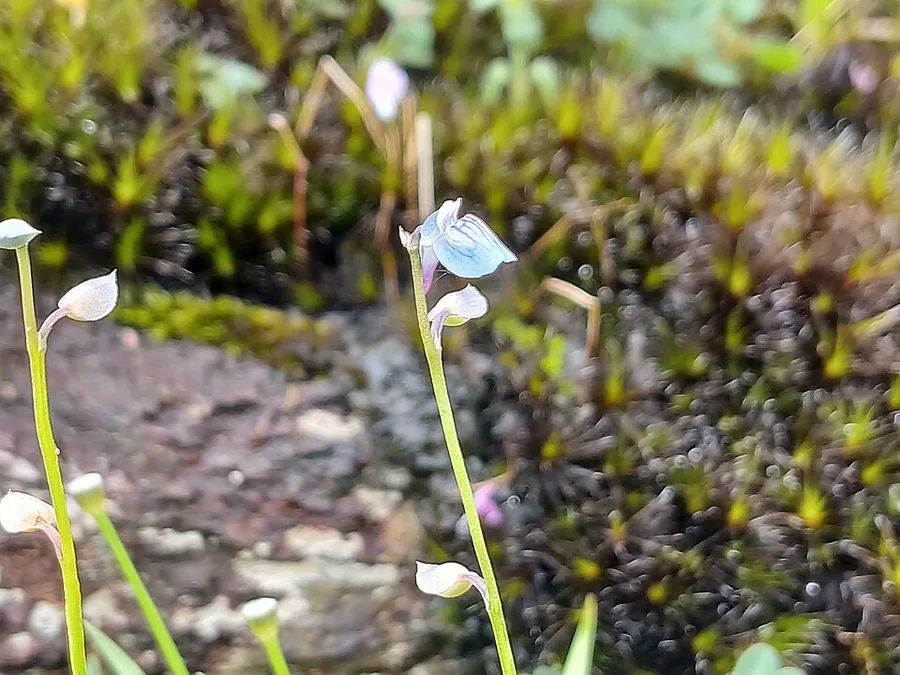
A friendly, beginner-loving terrestrial whose soft blue-white blooms resemble tiny snapdragons traced with violet veins.
Utricularia livida
A forgiving species from Africa and Mexico that builds thick mats dotted with little lilac-and-white flowers.
Utricularia vulgaris
A free-floating aquatic with delicate, trap-laden underwater stems and cheerful yellow blooms that rise above the surface.
Utricularia graminifolia
A grassy terrestrial that drifts toward semi-aquatic, prized by aquarists for the low carpet it forms.
Utricularia subulata
A tiny, far-traveling terrestrial with yellow flowers that has a habit of showing up unbidden in other bog-plant pots.
How to propagate
Once it feels at home, bladderwort spreads happily, whether you part the mat or sow its dust-fine seed for those willing to wait.
DivisionEasy
Spring or early summer during active growth · A few weeks to a couple of months
The simplest path to more plants is to split the mat in spring or early summer while growth is strong. Ease out a section, tuck it into fresh nutrient-poor peat and sand, and keep it constantly wet with pure water. Give a new piece a few weeks to a couple of months and it will find its feet.
SeedDemanding
Spring · Several months to over a year
Starting from seed asks for a little patience, but it is well within reach. Scatter the fine seed across damp peat and sand in spring, then settle in to wait, since germination is slow and the seedlings arrive small and tender. Anywhere from several months to over a year may pass before they truly take hold.
Myths
Bladderworts must be fed meat or insects like a Venus flytrap.
Those bladder traps are built for microscopic prey such as protozoa and water fleas, not bites of food. Tuck in meat or an insect and it simply rots in the medium. The plant feeds itself from the water and needs no help from you.
Carnivorous plants need fertilizer to grow well.
Bladderworts grew up in nutrient-poor bogs and draw what they need right out of the water. Fertilizer or mineral-rich water usually kills them, which runs counter to almost everything you have been told about feeding plants.