Ornamental · Sarraceniaceae
American Pitcher Plant
Sarracenia
Offer it full sun, rain-pure water, and a cold winter rest, and the pitcher plant will catch its own dinner.
Full sun
Every 1–3 days
1460–1825 days
USDA 6–8
Overview
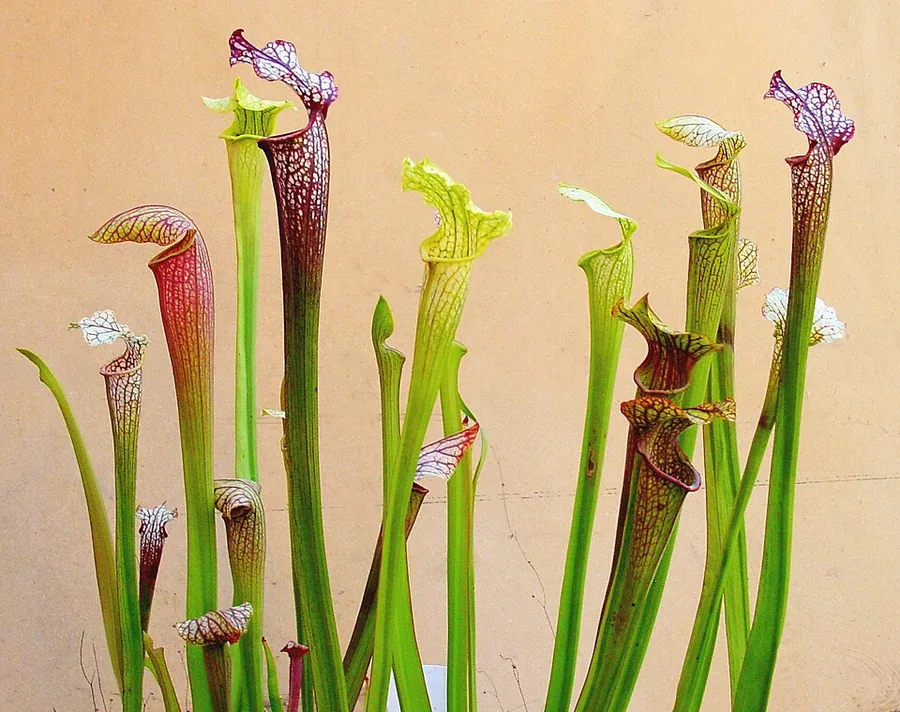
The American pitcher plant gently flips what you expect of a plant: rather than drawing meals from rich earth, it traps and digests insects to feed itself. That clever habit grew up because Sarracenia live in nutrient-poor acidic bogs, ground that offers them next to nothing. Every pitcher is really a reshaped leaf, a slippery trap sweetened with nectar that coaxes insects down toward the base.
Being temperate plants, native to the wetlands of eastern North America, they ask for care that mirrors their home. They love bright sun, wet roots through the growing season, and a true cold rest in winter. Leave out the winter dormancy and the plant slowly slips away, however lovingly you tend it the rest of the year.
None of this makes them difficult so much as clear about what they like, and that is reassuring. Hand them rainwater in place of tap, a peat-and-sand mix in place of potting soil, and a sunny seat in a water tray, and they become sturdy, long-lived perennials that return fuller each spring. Miss the water or the dormancy and you may see brown pitchers and a rotting crown, but those are recoverable when you catch them.
Care
The short version: full sun, a pot kept always wet in a tray of rain or distilled water, a lean peat-and-sand mix that never sees fertilizer, and a cold winter rest so the plant can settle into dormancy.
Light
Settle your plant in full sun, ideally with 6 or more hours of direct light each day. That sunlight is what draws out the red and purple veining and keeps the pitchers standing tall and proud. Down in shade the traps tend to slump, fade, and catch far less.
Water
Keep the mix constantly wet through the growing season by standing the pot in a shallow tray of water, bog-style, while letting the rhizome and crown sit above the waterline. Reach only for mineral-free water, meaning distilled, reverse-osmosis, or rainwater, since the salts dissolved in tap water gather up and burn the plant. Come winter, ease back and let the mix go just damp instead of flooded.
Soil
Pot it up in a lean carnivorous mix of sphagnum peat moss with sand or perlite, near enough half and half. Aim for an acidic pH that rests between 4.0 and 6.0. Steer clear of ordinary potting soil, and never reach for fertilizer or lime, as any of those will harm it.
Temperature
These plants happily handle a broad swing in temperature, from around 5°F to 95°F (-15°C to 35°C), which spans a hot bog summer and a freezing winter. That tolerance for cold is part of the gift: they lean on the chill to ease into dormancy.
Humidity
Everyday humidity in the 40% to 70% band suits them perfectly, and the wet tray beneath the pot keeps the air around the pitchers moist enough on its own. You can skip the misting and stop chasing a higher number.
Feeding
Please leave this plant unfed entirely. The pitchers trap and digest their own insects, and any fertilizer worked into the soil, or fatty food dropped into a trap, will burn it. As long as it is catching bugs and soaking up sun, it already has all it needs.
Pruning
In early spring, just before fresh growth and flowers arrive, cut away the dead brown pitchers. Let that old foliage rest in place through winter, where it shelters the crown from the cold. Trim spent flower stalks once the bloom has finished.
Repotting
Repot every 2 to 3 years in early spring, which also happens to be the perfect moment to divide the rhizome. Step up when the rhizome crowds the pot rim, roots push out the drainage holes, or the medium has broken down and stopped holding water. Use fresh peat-and-sand each time.
Size & spacing
Grown plants reach 6 to 36 inches (15 to 91 cm) tall, depending on the species, and spread 6 to 24 inches (15 to 60 cm) across. The tall trumpets and the low purple types sit at the far ends of that range.
When to plant
Pitcher plants move with the seasons, and once you see the rhythm it feels natural. Their flowers open in spring as the new pitchers rise, the traps stay busy through the warm months, and the whole plant browns off and rests over a cold winter before it begins again.
Northern hemisphere
Southern hemisphere
Typical months for a temperate climate: start earlier in warm zones, later where spring frosts linger.
- Sow: Late winter; seed needs about 4-8 weeks of cold-moist stratification before sowing
- Plant: Spring, after the last hard frost
- Harvest: Spring (flowers open in spring as or just before new pitchers emerge)
Hardiness
USDA hardiness zones: 6–8
Temperature: down to -23°C
Troubleshooting
Almost every pitcher plant worry comes back to water, light, or a winter rest that was missed, so you are rarely far from a fix. Read the pitchers and the rhizome and you can usually tell an ordinary seasonal shift from genuine harm. Find what matches what you see below before you make a change.
Brown tips, slowed growth, and a pale crust on the medium
Scorched leaf tips paired with a white crust on the surface usually mean mineral salt damage, often from tap water, fertilizer, or regular potting soil, and the good part is that you can turn it around. Begin watering only with distilled, reverse-osmosis, or rainwater, then flush the mix thoroughly to carry the built-up salts away. Should there be garden or potting soil in the pot, settle the plant into fresh peat-and-sand, and remember the soil never needs feeding.
Fix:
- Switch to distilled, reverse-osmosis, or rainwater only
- Flush the medium repeatedly with mineral-free water to leach salts
- Repot into fresh peat-and-sand mix if ordinary potting soil was used
- Never fertilize the soil
A soft, dark rhizome and a plant that has slumped
A mushy rhizome with a sour smell points to crown rot, and it tends to follow a crown left too wet, stagnant air, or a winter spent too warm. Even here you have a real chance to save it: lift the plant gently, trim every soft section away, and replant the firm, healthy pieces in fresh damp peat-and-sand. From then on water only from below using the tray method, keeping the crown up above the waterline so it is never left sitting in wet.
Fix:
- Lift the plant and cut away all rotted tissue
- Repot firm sections into fresh damp peat-and-sand mix
- Keep the crown above the waterline and wet only from below via the tray method
Soft, pale pitchers that have lost their color
If the pitchers are leaning over and their red and purple veining has washed out, the plant is simply hungry for light, and that is an easy thing to put right. Bring it somewhere with full sun and 6 or more hours of direct light, and the next round of growth comes up firm and richly marked. Just move it over a little at a time if it has been somewhere dim, because going straight into strong sun all at once can scorch the leaves.
Fix:
- Move to full sun with 6 or more hours of direct light
- Acclimate gradually if moving from a low-light spot to avoid scorch
When your pitchers brown and fade through autumn and winter
Take a breath, because this is winter dormancy and not a sign anything has gone wrong. As daylight grows short and the air cools, the plant quietly steps back and lets its old pitchers brown while the rhizome stays firm and healthy below the surface. You can simply let that tired foliage stay put through the cold months, where it cushions the crown, keep the mix barely damp, and tidy the brown pitchers away come early spring as fresh growth begins to rise.
Fix:
- Treat as normal seasonal behavior, not disease
- Keep the medium just damp (not deeply flooded) through dormancy
- Trim the dead pitchers in early spring before new growth
Toxicity
Here is some welcome news for pet owners: the American pitcher plant is not toxic. It holds no known poison, and the digestive fluid tucked inside the pitchers is far too weak to harm an animal or a person. The plant is delicate, though, so the real reason to keep it up out of reach is to protect those brittle traps, not the curious nose having a sniff.
Safe for
People · Cats · Dogs · Horses · Rabbits · Livestock · Birds
Cats Safe
There is no known toxic compound here, so a curious cat that paws or chews a pitcher is in no danger of poisoning. The only thing you really need to watch is those delicate leaves, which break easily.
Dogs Safe
Your dog can sniff or nibble at this plant without coming to harm, since the fluid inside the pitchers is so weak. At most, a large mouthful of plant matter might leave its tummy a little unsettled for a while.
Horses Safe
There is nothing in this plant that poisons horses, and you can take comfort that the related California pitcher plant appears on the ASPCA non-toxic list.
Rabbits Safe
A rabbit that helps itself to a stray pitcher faces no risk of poisoning at all. The plant simply holds no harmful toxin to worry about.
Livestock Safe
Grazing animals have nothing to fear from these bog plants. They seldom cross paths in any case, because pitcher plants live in wet, acidic ground far from where stock graze.
Birds Safe
There is no toxic threat to birds from either the leaves or the trapping fluid. A little bird is far more likely to help itself to the trapped insects inside than to be harmed in any way.
People Safe
Touching or brushing past the plant does no harm, and the weak fluid in the pitchers is no poison either. There is nothing here to eat, so think of it as a plant to admire rather than a crop.
No toxic principle is known; the digestive fluid in the pitchers is mild. The plants are fragile, so keep them out of reach mainly to protect the plant rather than the pet.
Varieties
Sarracenia gathers together a handful of distinct species, from soaring yellow trumpets to ground-hugging purple cups. Some are easy to find in cultivation, while a couple are rare enough that the law steps in to protect them.
Sarracenia flava (Yellow trumpet)
Its tall yellow-green trumpets climb to roughly 90 cm with a flaring lid, and in spring it lifts up gentle, nodding flowers of bright yellow.
Sarracenia leucophylla (White-topped pitcher plant)
You will know it by the upright pitchers crowned in white with fine red veining, and it kindly offers a strong second wave of growth come autumn.
Sarracenia purpurea (Purple or Northern pitcher plant)
These low, squat purple pitchers rest near the ground and cup rainwater, and being the hardiest of the bunch in cold, they reach all the way north into Canada.
Sarracenia oreophila (Green pitcher plant)
Because it is Federally Endangered and listed on CITES Appendix I, collecting or trading it from the wild is held back by law.
Sarracenia rubra subsp. jonesii (Mountain sweet pitcher plant)
Also Federally Endangered, it raises slim red-veined pitchers and sweetly scented flowers at only a handful of spots in Carolina.
How to propagate
You can grow more pitcher plants the quick way or the patient way: by splitting a mature rhizome or by raising seedlings that take some years to reach flowering size.
DivisionEasy
Early spring before active growth, typically while repotting · 1-2 growing seasons
Division is the kindest, surest way to grow your collection, and it is well within your reach. Early in spring, before the plant wakes into active growth and often right when you are repotting, part the rhizome into sections so each one keeps its own roots and a growing point, then tuck them into damp peat-and-sand. Allow the new divisions a season or two to settle and fill out.
SeedModerate
Sow in late winter or early spring after 4-8 weeks of cold-moist stratification · 4-5 years to flowering size
Raising plants from seed asks for patience, so be gentle with yourself if it feels slow. The seed wants 4 to 8 weeks of cold-moist stratification before it will sprout, so sow in late winter or early spring once that chill has done its work. The seedlings come along slowly and will not reach flowering size for 4 to 5 years.
Myths
Feeding pitcher plants hamburger or fertilizer makes them grow faster.
There is no need to wait on this plant at mealtime, because it feeds itself by catching insects in its pitchers. Fatty scraps and fertilizer only burn it, and the soil should never be fed at all. Let the pitchers catch their own meals.
Pitcher plants can be watered with ordinary tap water like other houseplants.
The minerals and salts dissolved in tap water slowly gather in the mix and poison these bog plants as time goes on. Use only distilled, reverse-osmosis, or rainwater.
Carnivorous pitcher plants are dangerous or poisonous to pets.
Those traps may look a little fierce, yet Sarracenia carry no toxin that harms animals. The closely related California pitcher plant rests on the ASPCA non-toxic list for cats, dogs, and horses, and the fluid inside the pitchers is far too weak to do a pet any harm.
Pitcher plants are tropical and should be kept warm all year.
These are temperate bog plants rather than tropicals, and a warm winter wears them down little by little. They need a cold winter dormancy so they can return strong each spring.