Houseplant · Asphodelaceae
Zebra Haworthia
Haworthiopsis attenuata
Give this friendly striped succulent bright indirect light and a good dry spell between waterings, and it will happily look after itself.
Bright indirect
Every 14–21 days
50–77°F · 10–25°C
USDA 9–11
Overview
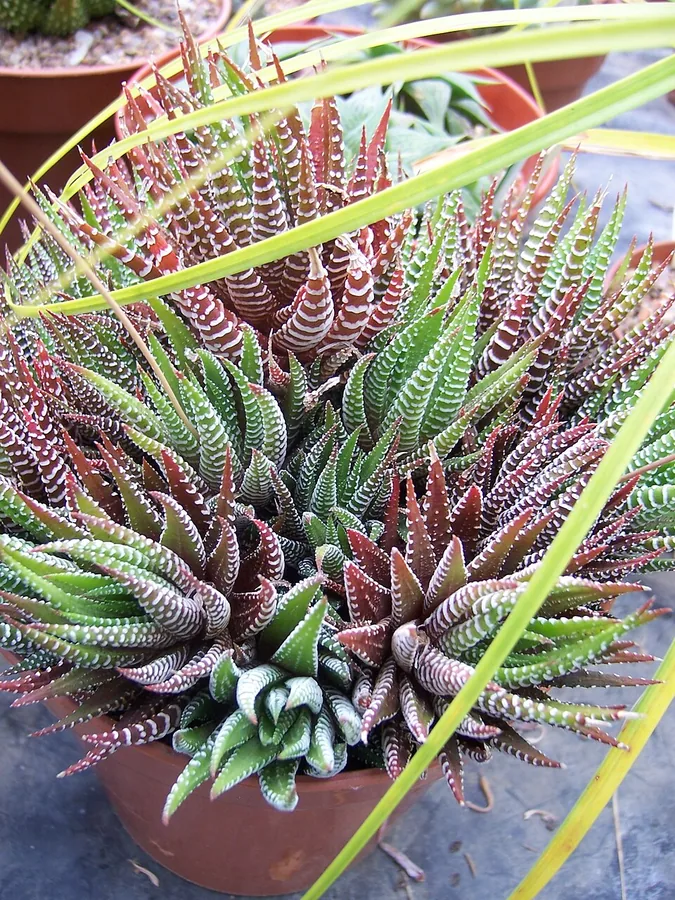
If you have never kept a succulent before, the zebra haworthia is a lovely place to start. Its dark green leaves wear pale white stripes that earn it the zebra name, and they gather into a tidy little rosette of firm, pointed leaves. It stays small its whole life, seldom spreading past 4 to 6 inches (10 to 15 cm), so a sunny windowsill, a corner of your desk, or a shared bowl of succulents suits it beautifully.
This plant belongs to the Asphodelaceae family and comes from South Africa, where it grows tucked in the light shade of taller plants rather than out under open desert sun. That background is reassuring, because it means bright indirect light keeps it happier than any blazing window ever could. Given a few years, a settled plant may lift a slender stalk of small tubular white flowers in spring or summer, though most people simply enjoy its striped leaves.
Few houseplants are this forgiving, so try not to worry. The plump leaves hold their own water, which means a forgotten watering does no harm and the plant genuinely likes to dry right out between drinks. The single thing it cannot cope with is soggy roots, and if you simply keep it on the dry side you will find it hard to go wrong.
Care
The short version: offer bright indirect light, a gritty mix that drains in a flash, and a proper soak only after the soil has gone bone dry. Water even less in winter, and your plant will happily manage the rest.
Light
Set it where the light is bright but indirect, near a window that never takes the full blast of midday sun. It will happily cope with partial sun and medium indirect light as well, though very harsh rays can scorch the leaves and fade those pretty stripes.
Water
Water it well, then step back and leave the soil completely alone until it has dried all the way through, which tends to fall around every 14 to 21 days. Because the leaves keep their own little reservoir, leaning too dry is always kinder than leaning too wet. Ease right off in winter, when cold, damp soil can quickly turn to rot.
Soil
Pot it in a gritty cactus or succulent mix that lets water rush straight through and never stays wet. Any pH between 6.0 to 7.5 will do just fine, so the openness of the mix matters far more than getting the chemistry exactly right.
Temperature
Ordinary room warmth is all it wants, ideally somewhere between 50°F and 77°F (10°C to 25°C). Just keep it clear of frost and chilly draughts, since it has no defence against freezing.
Humidity
Happily, this is a low-humidity plant that feels right at home in ordinary dry indoor air. There is no need to mist it or chase a target number, and stuffy, damp air will only do it harm.
Feeding
Feeding is barely on the list. Across spring and summer you can treat it to a dilute, half-strength cactus or succulent feed that is low in nitrogen, given only now and then through the season. Leave it be through autumn and winter while it rests.
Pruning
There is next to no pruning to do. Simply ease away any withered outer leaves and the odd spent flower stalk right at the base, and that really is everything. You will never need to shape it or cut it back.
Repotting
You only need to repot every 2 to 3 years, or a touch sooner if pups have filled the pot. It is asking for a bigger home when offsets crowd the rim, roots peep from the drainage holes, or the mix dries out almost the moment you water.
Size & spacing
This is a naturally small plant, reaching only about 4 to 6 inches (10 to 15 cm) tall and roughly as wide. One rosette sits contentedly in a little pot, and a family of pups will happily share a single shallow dish.
Troubleshooting
Almost anything that troubles this plant comes down to a little too much water or a little too much sun, and the good news is that most of it is easy to put right. Look for the early clues on the leaves and rosette, gently match them to the notes below, and you will usually turn things around.
Base leaves going soft, mushy, and see-through
Soft, translucent leaves like this mean root and crown rot, and it nearly always comes from water lingering in soil that drains too slowly. Try not to panic. Stop watering, ease the plant out of its pot, and trim away every soft brown root with a clean blade. Let the cuts dry and callus, settle it back into dry gritty mix, and give only a light drink once it has found its feet again.
Fix:
- Stop watering immediately
- Remove the plant and cut away all soft, rotted tissue with a clean blade
- Allow cut surfaces to callus, then replant in fresh dry gritty mix
- Resume watering sparingly only once re-established
Pale, stretched growth with gaps opening between leaves
That stretching is etiolation, the plant simply reaching for light it cannot find. The neat rosette loosens and the whole thing tips toward the window. Move it into steady bright indirect light, and give the pot an occasional turn so it fills back out evenly.
Fix:
- Move to a brighter location with bright indirect light
- Rotate the pot periodically for even growth
Leaves blushing red, orange, or washed-out white
Colour like this is sunburn, showing up on whichever side meets the strongest light, and it usually follows a move to a brighter spot. Bring the plant back to bright indirect light and give it some shade from fierce midday sun. When you next want it brighter, build up the exposure gently over a week or two so it has time to adjust.
Fix:
- Move to bright indirect light
- Shade from intense midday sun
- Acclimate gradually to brighter spots over one to two weeks
Toxicity
You can relax if you share your home with pets. The zebra haworthia is non-toxic and gentle company for cats, dogs, and everyone else in the house. It does not appear on the ASPCA toxic list, and nothing in its leaves will poison a curious nibbler. At worst, a determined chewer might feel a little queasy from the firm, bulky leaves, and that soon passes.
Safe for
People · Cats · Dogs · Horses · Rabbits · Livestock · Birds
Cats None
Perfectly safe around cats, with no toxic reaction to fear. If one does gnaw a leaf or two, the most that might happen is a brief tummy upset, just as with any plant it was not meant to nibble.
Dogs None
There is no poisoning risk for dogs here. A curious pup that mouths the firm rosette might drool or bring a little back up from the sheer bulk, but nothing in the plant can actually hurt it.
Horses Safe
Nothing in this plant is toxic to horses, and as a tiny windowsill succulent it is unlikely to ever come their way.
Rabbits Safe
Rabbits are quite safe with it. The thick, tough leaves carry no toxins, though they are hardly a treat a bunny would go looking for.
Livestock Safe
Grazing animals such as cattle, goats, and sheep have nothing to worry about, as it holds no compounds that could trouble them.
Birds Safe
Pet birds can share a room with it in complete safety, since it contains nothing toxic, and the firm leaves are too tough for most to bother pecking.
People Safe
It is harmless to people, little ones included. No one grows it to eat, of course, but a curious taste will do no more than perhaps a mild, passing stomachache.
Varieties
Only a handful of forms show up in shops, and they are easy to muddle, especially with the look-alike that borrows the same common name. Here are the ones you are most likely to bring home.
Haworthiopsis attenuata var. attenuata
This is the everyday form, with raised white tubercles that band right across both the top and the underside of each leaf.
Haworthiopsis attenuata 'Concolor'
Here the white tubercles are scattered evenly across the leaf instead of gathering into the crisp stripes most people expect.
Haworthiopsis fasciata (true zebra haworthia)
True fasciata keeps its inner leaf surfaces smooth and wears tubercles only on the outside, yet nearly every plant sold under that name turns out to be H. attenuata.
How to propagate
Once your plant feels settled, making more of it is wonderfully simple and costs nothing at all. You can gently lift the little pups it raises around its base, or divide a crowded clump the next time you repot.
Offsets & pupsEasy
Spring to summer during active growth · 4 to 8 weeks to root once potted
The gentlest way to make more is to lift the offsets, the little pups clustering around the base of the parent. Wait for spring or summer while it is growing, let any cut surface dry and callus, then settle each pup into dry gritty mix. Once it has taken hold give it a light drink, and roots should follow in around 4 to 8 weeks.
DivisionEasy
At repotting in spring or summer · 4 to 8 weeks
You can also split a mature clump the next time you repot it in spring or summer. Gently ease it into rooted pieces, keep each one dry while it settles, and it should feel at home within roughly 4 to 8 weeks.
Myths
Zebra haworthia and the zebra plant, Aphelandra, are one and the same.
They are actually two quite different plants that happen to share a nickname. This little one is an Asphodelaceae succulent with striped, fleshy rosettes, while Aphelandra squarrosa is a leafy Acanthaceae plant grown for its big veined leaves and yellow bracts.
Zebra haworthia is a desert cactus that loves full, baking sun.
It is a succulent in the Asphodelaceae and not a cactus at all, and out in the wild it often shelters in partial shade. Indoors it is happiest in bright indirect light, and harsh direct sun will only scorch those lovely leaves.