Ornamental · Asphodelaceae
Red-hot Poker
Kniphofia uvaria
Give red-hot poker all-day sun and quick-draining ground, and it rewards you with torches of flame-colored spikes right through summer.
Full sun
Every 7–14 days
USDA 5–9
2–4 ft · 0.6–1.2 m
Overview
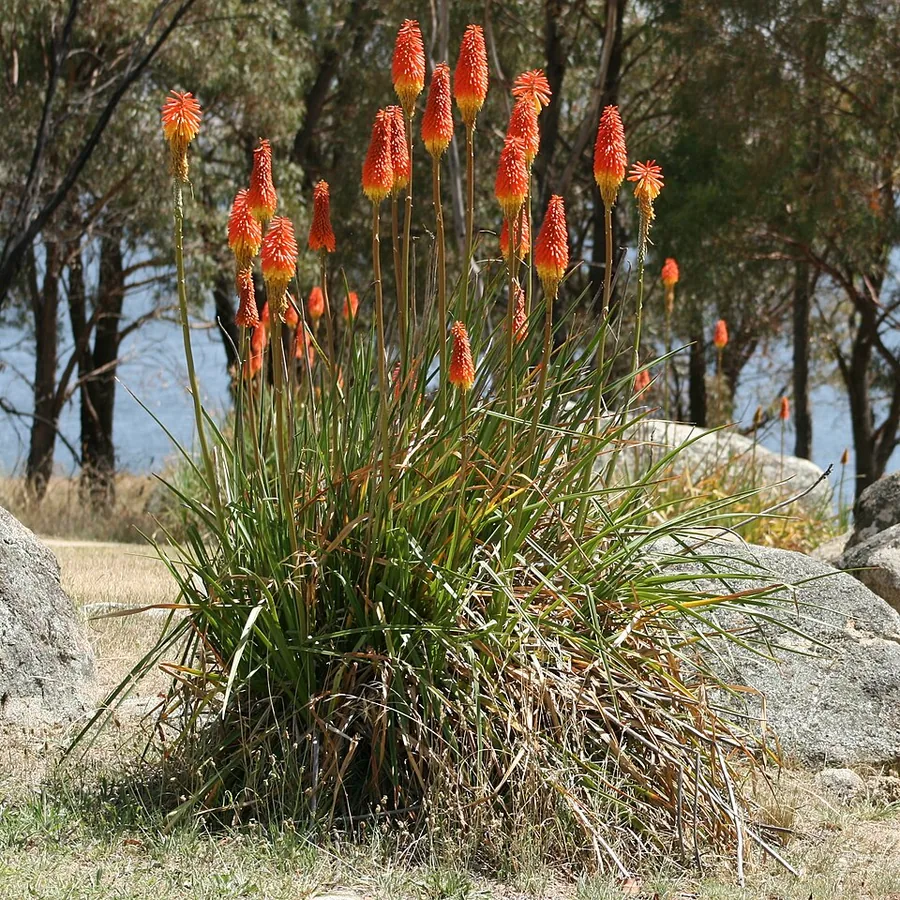
Red-hot poker lives up to its name, and it makes that easy to see. Every stem lifts a packed torch of tubular blooms that start red in bud and soften to yellow as they open, so a single spike carries both colors together. The plant grows as a grassy clump of arching leaves, and since it shares a family with the aloes, it has the same tough, fleshy nature that makes it so forgiving.
If you are just starting out, this is a kind plant to learn on. It is a relaxed perennial for a sunny spot, hardy right through USDA zones 5 to 9, and once it has settled in it asks almost nothing of you. Heat, dry spells, and thin sandy ground barely faze it. The single thing it truly dislikes is wet, heavy soil pooling around its crown, and that is an easy mistake to sidestep.
You will have plenty of company at the flowers. Hummingbirds and butterflies visit the nectar-filled spikes all through the warm months, while deer and rabbits usually walk right past. One kind note before you dig in: red-hot poker has turned invasive in some parts of the U.S., so a quick look at local guidance will set your mind at ease.
Care
The short version: sun and sharp drainage carry this plant, and the rest is forgiving. Water it while it finds its feet, then let it look after itself, keep the crown dry over winter, and snip off finished spikes to keep new flowers coming.
Light
Give red-hot poker full sun, aiming for at least 6 hours of direct light each day. A touch of partial shade is fine, so do not fret over a stray shadow, but if it goes short on sun you will get lots of leaves and only a handful of those lovely spikes.
Water
While the plant is settling in, keep the soil lightly moist, then you can ease right back, because a rooted clump copes well with dry spells. The thing to steer clear of is wet, heavy, or soggy ground, above all through winter, since that is what rots the roots and undoes your hard work.
Soil
Set it in well-drained loam or sand, average to rich, with a little compost mixed through. It is relaxed about pH and happily takes anything from 6.0 to 8.0, acidic or alkaline, so the one thing to get right is that water drains away quickly rather than lingering.
Humidity
Plain outdoor air suits it just fine, so there is no humidity target to chase. What really matters is simply that the crown and roots stay dry rather than damp.
Feeding
A little all-purpose balanced fertilizer during the growing season is plenty, given whenever the plant looks like it wants a lift. This one is happy in lean soil, so there is no need to feed it heavily or feel you are neglecting it.
Pruning
Snip off faded flower spikes as they finish and the plant answers with fresh ones. Let the leaves stand through winter to keep the crown cozy, and where the cold bites hard, mulch over the top or tie the foliage together so water cannot gather and freeze in the middle of the plant.
Size & spacing
In bloom the clumps stand 2 to 4 feet (60 to 120 cm) tall and spread 24 to 35 inches (60 to 90 cm) across. Give each plant that much elbow room and the leaves stay open, with air moving freely through them.
When to plant
Red-hot poker keeps a gentle warm-season schedule, and there is room to relax into it. Sow seed indoors in late winter, move plants out or divide clumps in spring once the frost has gone, or set them in during fall. Either way, the spikes begin to glow from early summer and carry on into early autumn.
Northern hemisphere
Southern hemisphere
Typical months for a temperate climate: start earlier in warm zones, later where spring frosts linger.
- Sow: Start seed indoors in late winter, about 6 to 8 weeks before the last frost
- Plant: Transplant or divide in spring after frost danger passes, or in fall
- Harvest: Late spring to early fall, with main flush from early summer; spikes are red in bud and mature to yellow
Hardiness
USDA hardiness zones: 5–9
Temperature: down to -29°C
Troubleshooting
This is a sturdy plant, so try not to worry: most of its troubles come back to one simple thing, soil that stays too wet. Keep a gentle eye on the crown, the leaves, and how many spikes appear, and you can catch almost anything early. Find your plant's symptom below, then step in before it has a chance to spread.
The crown turns soft and brown and the plant keels over
Do not panic, this is root rot, and it comes from soggy soil rather than any pest or disease. The plant really dislikes heavy, wet ground, and water sitting in the crown over winter is the usual culprit. Work in some sand or compost to loosen things up, water more sparingly, and if the ground stays waterlogged, lift the plant to a raised, free-draining spot where it can recover.
Fix:
- Improve drainage by amending with organic matter or sand
- Avoid overwatering and standing water
- Relocate to a raised or well-drained site if soil stays wet
Hardly any bloom spikes appearing
More often than not, too little sun is why the spikes stay away. Move the plant somewhere in full sun with at least 6 hours of direct light and the blooms tend to follow. An old, crowded clump can also lose steam, so leave a settled plant in peace and only divide it once it has grown truly congested.
Fix:
- Site in full sun with at least 6 hours of direct light
- Leave established clumps undisturbed
- Divide only when clumps become overcrowded
Stippled leaves marked with pale, silvery streaking
Those marks come from tiny thrips scraping at the leaves and leaving silvery scarring behind. Look closely and you should spot the slim little insects sitting on the foliage. A firm jet of water knocks off a light visit, trimming away the worst-marked leaves helps too, and you only need to reach for an insecticidal control if they refuse to budge.
Fix:
- Hose off light infestations with water
- Remove and destroy heavily damaged foliage
- Treat persistent infestations with an appropriate insecticidal control
Toxicity
Here is a reassuring bit for pet owners: red-hot poker is non-toxic all round. The ASPCA gives torch lily the all-clear for cats, dogs, and horses, and there is nothing poisonous here for other animals or for children either. The most a stray nibble might bring is a short upset stomach, just as any big mouthful of leaves can.
Safe for
People · Cats · Dogs · Horses · Rabbits · Livestock · Birds
Cats None
The ASPCA marks torch lily as non-toxic to cats, so a curious taste is nothing to lose sleep over. A cat that gobbles a lot of any plant might bring a little back up, but the leaves themselves hold no poison.
Dogs None
A dog can chew on the leaves without any harm, since red-hot poker is rated non-toxic to them too. About the worst you might see after a leafy feast is a brief, passing tummy upset.
Horses None
Horses are perfectly safe around this plant, which the ASPCA clears for them as well. Neither the leaves nor the flower spikes carry a toxin, so a stolen bite will not hurt them.
Rabbits Safe
Nothing in red-hot poker is poisonous to rabbits. They usually leave it be in any case, since it is known to be rabbit resistant, so most clumps stay untouched in the border.
Livestock Safe
Grazing animals like cattle, goats, and sheep run no risk of poisoning from this plant. Its tough, fibrous leaves are seldom a favorite, but a mouthful will do no harm.
Birds Safe
There is no toxin here that could hurt a bird. Better still, hummingbirds and other pollinators come flocking to the nectar-rich spikes, which is one of the plant's real joys in the garden.
People Safe
Red-hot poker is safe to handle and to grow around children. No part of it is meant for eating, but there is nothing poisonous to fear if small hands touch the leaves or a dropped flower.
Varieties
The named kinds mainly vary the color and the size, running from warm oranges to neat little dwarfs. These are the ones you are most likely to meet at the garden center.
Echo Mango
This one swaps the usual fiery red for gentle, mango-orange spikes.
Redhot Popsicle
A small plant from the Popsicle group, it sends up bright red-and-yellow spikes across an unusually long flowering stretch.
POCO Orange
A little dwarf standing around 20 to 24 inches tall, its clear orange flowers suit a small bed or the front edge of a border.
How to propagate
There are two easy ways to make more red-hot poker, by dividing a clump or by sowing seed, and both simply ask for a little patience before the flowers arrive.
DivisionModerate
Spring or fall · One to two growing seasons
Splitting a clump is the most reliable way to make more, and you can do it in spring or fall. Be ready for the root system, which is so tough and vigorous that a shovel, a saw, or even an axe may be needed to divide a mature plant. The new pieces take one to two growing seasons to find their feet, so leave anything already thriving right where it is.
SeedModerate
Start indoors in late winter or sow when ripe · Seed-grown plants may take a few years to reach flowering size
You can also raise the species from seed, started indoors in late winter or sown fresh as soon as it ripens. Just keep your expectations gentle, because seed-grown plants often need a few years to reach flowering size. Seed gathered from a hybrid is a gamble, since those seedlings rarely turn out like the parent.
Myths
Red-hot poker will poison your pets.
That blazing color plays a trick on people, but there is no poison in this plant at all. The ASPCA lists torch lily (Kniphofia) as non-toxic to dogs, cats, and horses, so a curious nibble is no reason to phone the vet.
You should cut the leaves right down in fall to keep the plant safe.
It actually works against you. Leave the foliage standing through winter so it wraps and shelters the crown, and in cold areas gather the leaves together or mulch over them to keep water from pooling and freezing at the heart of the plant.