Shrub · Vitaceae
Virginia Creeper
Parthenocissus quinquefolia
A forgiving native vine that gives you glorious fall color in exchange for a little steady trimming.
Full sun
Every 7–14 days
USDA 3–9
30–50 ft · 9.1–15.2 m
Overview
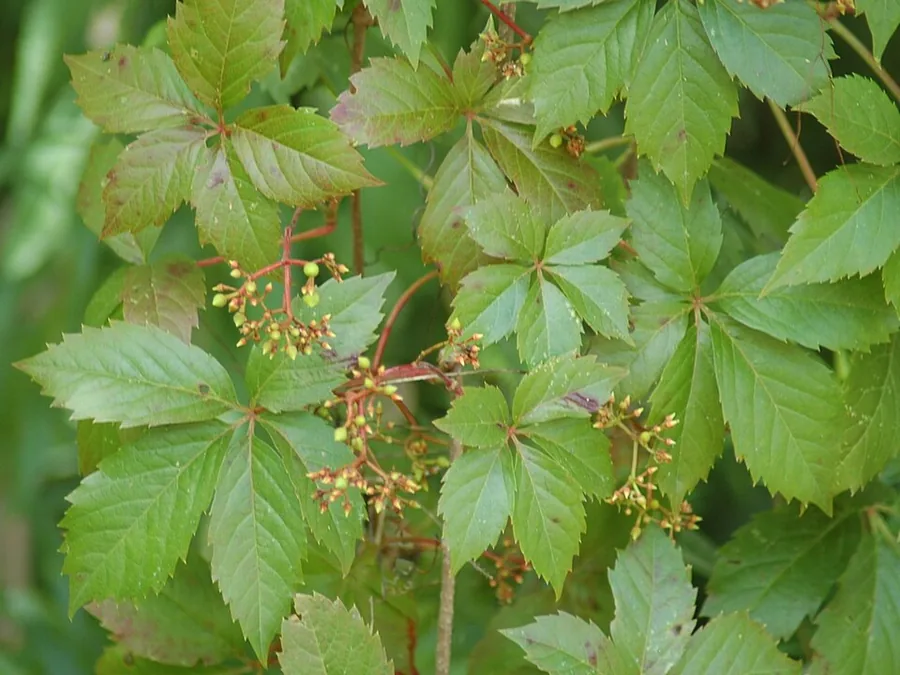
If you are nervous about growing a vine, Virginia creeper is a lovely place to begin, because it is a fast, woody native of eastern North America that mostly looks after itself and pays you back with blazing scarlet leaves each fall. Its leaves grow in fives, spread open like a hand, and that easy count is your reassurance that this is not the three-leaflet poison ivy. Offer it a fence, an arbor, or a bare slope, and it will settle in and cover the space within a season or two.
The trait that makes it climb is also the one to keep an eye on, so no need for alarm, just awareness. The vine holds on with disk-tipped holdfasts that grip almost any surface, which lets it sail up trees, walls, and trellises far above your head. Because that same grip tugs at paint and mortar, the kindest thing you can do is give it a spot of its own with a little breathing room from the house.
Once it has rooted in, this plant asks almost nothing of you, and small slips are easily forgiven. Full sun or deep shade, sandy ground or heavy clay, dry spells or cold all the way down to -40°F (-40°C) all sit fine with it. The one thing to remember comes later in the year, when it hangs clusters of dark blue-black berries that look like tiny grapes but are not safe for people or animals to eat.
Care
The short version: tuck it into almost any well-drained soil, choose full sun for the richest fall color or settle for shade if that is what you have, keep it watered until it feels at home, and after that your main job is simply trimming it back to where you want it.
Light
Here is a real gift in a climber: Virginia creeper is content in anything from full sun to full shade. Sun coaxes out the deepest red come fall, while shade still gives you a strong, healthy vine, just with softer, more restful color.
Water
While a young plant is finding its feet, give it a good drink every 7 to 14 days and let the top half of the soil dry out before the next. Once it has settled, it becomes very drought tolerant and asks for little more than the rain that falls.
Soil
It happily takes clay, loam, or sand, asking only for decent drainage and a bit of organic matter to work with. The pH range is generously wide, from 5.0 to 8.0, so the soil you already have will very likely suit it just as it is.
Temperature
Few vines are as hardy as this one, which is a comfort. It shrugs off winters as low as -40°F (-40°C) and summer heat up to 100°F (38°C), and that toughness is exactly what lets it grow happily across so much of the country.
Humidity
Everyday outdoor air suits it perfectly, so this is one thing you can stop fretting over. Good airflow matters far more than any moisture reading, since it is close, still air that invites the odd leaf spot or dusting of mildew.
Feeding
You can relax about feeding, because this vigorous native rarely wants any. Should the growth ever look tired, a light balanced feed in spring is all it needs, and going further only fuels the runaway growth you will later be trimming back.
Pruning
Pruning is really the heart of caring for this plant, and it is easy to get right. Cut it hard in late winter or early spring, then tidy it through the season to keep it off masonry, gutters, shutters, and wiring, since an untended vine travels fast and far.
Repotting
In the ground it never needs repotting, and even in a pot it seldom asks. Only shift it up a size when roots begin circling the base or water slips straight through without the soil drinking any in.
Size & spacing
Given its head, this vine can climb a remarkable 30 to 50 feet (9 to 15 m) and spread 5 to 10 feet (1.5 to 3 m) wide. Give it that much room on a strong support, and keep it a comfortable distance from the house.
When to plant
This is a tough perennial vine rather than a crop on a clock, so timing is really about helping it settle in, not beating the first frost. Plant it out in spring or fall, look for the small greenish flowers from May into July, and enjoy the dark berries and that famous red glow arriving from late summer through fall.
Northern hemisphere
Southern hemisphere
Typical months for a temperate climate: start earlier in warm zones, later where spring frosts linger.
- Plant: spring or fall
- Harvest: Greenish-white insignificant flowers May to July, followed by blue-black berries in late summer to fall
Hardiness
USDA hardiness zones: 3–9
Temperature: down to -40°C
Troubleshooting
Virginia creeper is so healthy it is almost too much of a good thing, and nearly all its troubles come from size rather than sickness. The one to watch is the vine wandering onto walls and gripping tight. Catch its handful of minor leaf blemishes early, and you can keep this plant looking beautiful with very little effort.
Vine reaching the wall and leaving sticky spots you cannot wipe off
Take heart, those clinging pads are just adhesive holdfasts, the little disk-tipped tendrils the vine uses to haul itself upward, and nothing has gone wrong. Near a house they do work into mortar and paint and clog the gutters, and yes, the marks linger after the stems come away, but it is all fixable. Cut the vine back with confidence, ease the stems off before those disks harden, and coax the new growth onto a trellis set a comfortable distance from the walls.
Fix:
- Cut vines back hard and pull stems off surfaces before disks set
- Trim regularly through the growing season to keep growth in bounds
- Redirect onto a sturdy trellis, fence, or arbor away from buildings
A few spotted leaves or a soft white dusting on the foliage
Try not to worry if you spot dark marks or a chalky bloom, since the dark ones are fungal leaf spot and the pale film is powdery mildew, and both simply like the shade and heavy, unmoving air. A vine this sturdy takes them in stride, so what you are treating is really just its looks. Open up any crowded stems, gather the sorriest leaves, and pour your water low at the roots so the leaves stay dry and happy.
Fix:
- Improve air circulation by thinning crowded growth
- Remove and dispose of badly affected foliage
- Avoid wetting foliage when watering
Nibbled or freckled leaves with bugs riding on them
The likely visitors are Japanese beetles, which eat the soft leaf right down to its veins, along with leafhoppers that leave a fine speckling and scale that cling as little bumps on the stems. A settled vine carries this kind of damage without missing a beat, so you can relax. Flick the beetles into a cup of soapy water, rinse or snip away any small patch that flares up, and only bring out horticultural oil if the scale really takes hold.
Fix:
- Hand-pick beetles into soapy water
- Hose off or prune out localized infestations
- Treat scale with horticultural oil if severe
Toxicity
Think of the whole plant as something to admire, never to eat. Every part holds sharp calcium oxalate crystals, and the dark berries add oxalic acid on top, which is why they have made cats, dogs, horses, livestock, and people ill. The fruit is the real concern here, resembling wild grapes so closely that curious children and pets are drawn to try it, so keep it well out of reach.
Toxic to
Cats · Dogs · Horses · Rabbits · Livestock · Birds · People
Cats Toxic
Every part of the vine holds tiny needle-like calcium oxalate crystals that sting the moment a cat bites down, so expect heavy drooling, pawing at the mouth, and perhaps some vomiting. Watch for a little puffiness around the lips or throat, and call your vet if it worries you.
Dogs Toxic
If a curious dog mouths the leaves or those grape-like berries, its mouth will burn and sting, the drool will run, and its stomach may turn with vomiting or loose stools. The berries carry the most oxalic acid, so they cause the roughest reaction of all.
Horses Toxic
A horse that grazes the vine ends up with a sore, stinging mouth and a churned-up gut, showing drool, tenderness, and colicky unease. Keeping any creeper trimmed away from the paddock line spares them the trouble.
Rabbits Toxic
Those same crystals mean this plant is never rabbit food, and even a small taste can leave the mouth tender and the tummy out of sorts. It helps to keep every cutting and dropped berry well clear of the hutch.
Livestock Toxic
Cattle, goats, and sheep that browse the leaves or fruit come away with a stinging mouth, running drool, and an unsettled gut. Clearing the vine from pasture edges before the herd finds it keeps everyone comfortable.
Birds Toxic
Wild birds happily eat the ripe berries and carry the seed off, yet the acid-rich fruit does not suit a pet bird at all. A companion bird that gets a bite can end up with a sore mouth and a queasy stomach.
People Caution
No part of this vine belongs on a plate. Those dark berries mimic wild grapes closely enough to have poisoned people, young children most of all, bringing a burning mouth and throat, drooling, and vomiting, while the sap may raise a rash on tender skin.
Sap and oxalate crystals can cause skin irritation or contact dermatitis in sensitive people; wear gloves when pruning or removing the vine.
Helpline numbers

United States
ASPCA Animal Poison Control: (888) 426-4435 (fee applies)
Poison Control: (800) 222-1222



Canada
Poison Centres: 1-844-764-7669
Varieties
Most gardeners plant the plain species, but a handful of named forms give up a bit of vigor in return for finer color or patterned leaves. These are the ones you are most likely to come across.
var. engelmannii (Engelmannii)
Gentler than the wild species, it carries smaller leaflets and a warm bronze-red autumn glow that together give the plant a tidier, softer-textured feel.
'Monham' (Star Showers)
A cheerful variegated choice dappled with creamy paint-like flecks on green leaves that warm to gentle pink as the cool weather settles in.
'Troki' (Red Wall)
It opens bronze in spring, cools to green for the summer, then rewards you with a bold fire-engine red once fall arrives.
How to propagate
This vine is so eager to spread that making more of it feels almost too easy. You can root a few cuttings, peg a stem down to layer, or start from seed if you are happy to wait out a cold spell first.
Stem cuttingsEasy
Late spring to summer from softwood or semi-hardwood · 4 to 8 weeks to root
You will find cuttings wonderfully forgiving here. Snip softwood or semi-hardwood pieces from late spring into summer, settle them in, and most take root within 4 to 8 weeks with hardly any coaxing. Stray stems will even root themselves wherever they rest against damp soil.
LayeringEasy
Spring through summer · One growing season
If cuttings still feel daunting, layering could not be kinder. Any time from spring through summer, a trailing stem roots at the nodes where it presses into the earth, and once you pin a shoot down it is usually ready to free after one growing season.
SeedModerate
Sow outdoors in fall or cold-stratify before spring sowing · Germination after cold stratification
Seed simply asks for a little patience and a spell of cold to break its rest. Sow it outside in the fall, or give it a chilled stretch before sowing in spring, and the sprouts follow that cold spell in their own time. Out in nature, the birds handle all of this for you, eating the berries and scattering the seed far and wide.
Myths
Virginia creeper is just poison ivy, so any vine with five leaflets is poison ivy.
You can set that worry aside by simply counting leaflets, because the two are easy to tell apart. This vine wears five, which is where the friendly saying 'leaves of five, let it thrive' comes from, while poison ivy wears three, 'leaves of three, let it be.' It carries none of the urushiol that gives poison ivy its dreadful itch, though the oxalate crystals in its sap can leave a mild rash on skin that reacts easily.