Ornamental · Saxifragaceae
Foamflower
Tiarella cordifolia
A gentle shade native that lifts frothy white spires each spring and settles into a soft green carpet the rest of the year.
Partial shade
Every 3–7 days
USDA 3–9
5–12 in · 13–30 cm
Overview
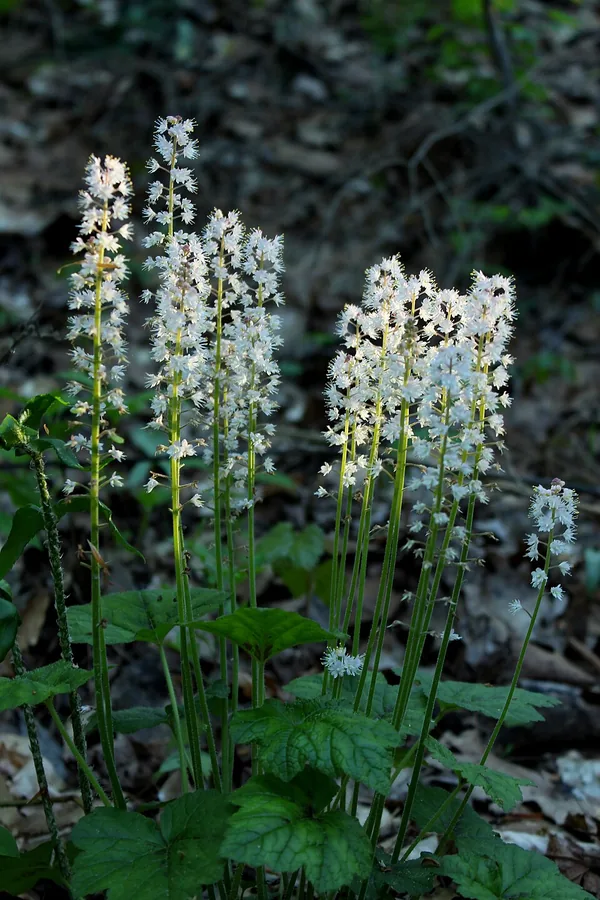
If a shady corner has you stumped, foamflower makes a kind place to start. Come spring it lifts slender spikes crowded with little flowers, white blushing toward pink, that seem to float above the leaves like drifting foam, which is how the plant came by its name. It belongs to eastern North America as a woodland native in the saxifrage family, and it travels the ground on spreading rhizomes and stolons, quietly knitting itself into a low, leafy mat with no fuss asked of you.
The heart-shaped, often lobed leaves do most of the work, and they are wonderfully easy to like. They hold on as semi-evergreen foliage well into winter, and many forms warm to bronze or deep red veining once the chill arrives. Hardy through USDA zones 3 to 9, foamflower keeps going in the sort of dense, dry shade where most flowers simply give up, so a tricky spot is no reason to worry.
What it asks of you is refreshingly small: shade, steady moisture, and rich woodland soil. Give it those and it mostly tends itself, easing a little wider each season. Deer tend to pass it by, the trouble list is short, and once a clump settles in you can split it every other spring for free plants, so early mistakes are easy to recover from.
Care
The short version: foamflower is happy in part to full shade with rich, humusy soil kept evenly moist and draining freely through winter, and it needs almost no feeding in good woodland ground, so relax and let it settle.
Light
Foamflower feels most at home in part shade to full shade, so a spot under trees or along the cool north side of the house suits it beautifully. It is one of the rare flowering ground covers that keeps performing even in heavy shade, which makes those gloomy corners far less of a problem.
Water
Keep the soil evenly moist and try not to let it dry out, since this little plant has no real tolerance for drought. A drink every 3 to 7 days works for most spots, but go gentle in winter, because ground that stays cold and wet can rot the crown before you notice.
Soil
Foamflower loves rich, humusy soil that stays moist yet still drains, much like the soft leaf litter of a forest floor. Aim for a pH of 6.0 to 7.0, anywhere from slightly acidic to neutral, and mixing in a generous helping of compost or leaf mold before planting sets it up to thrive.
Humidity
There is no humidity number to chase here, since ordinary outdoor air is plenty. What foamflower truly cares about is steady soil moisture, so put your attention there and the plant will be content.
Feeding
This is a light feeder that gets along fine in good woodland soil without much help from you. A thin topdressing of compost or a balanced fertilizer just once in the growing season covers everything it wants, and piling on more does nothing good.
Pruning
Pruning is barely a chore, more of a gentle tidy. As the growing season opens, snip away any tattered or winter-worn leaves, and a flush of fresh foliage soon rises to take their place.
Size & spacing
Foamflower stays low and tidy, reaching 5 to 12 inches (13 to 30 cm) tall and easing out to 12 to 24 inches (30 to 60 cm) wide over time. Set each plant about a spread apart and they will drift together into one soft, continuous carpet.
When to plant
Foamflower keeps time with the woods, and following that rhythm makes things easy. Settle new plants into cool, damp ground in spring or early fall, then look forward to the flower spikes rising in spring and peaking in May before the leaves carry the show through the rest of the season.
Northern hemisphere
Southern hemisphere
Typical months for a temperate climate: start earlier in warm zones, later where spring frosts linger.
- Sow: Late winter; seed germination can be slow and plants are largely self-incompatible.
- Plant: Spring or early fall in shaded, moist sites.
- Harvest: Blooms in spring, peaking in May, with spikes of small white to pink flowers.
Hardiness
USDA hardiness zones: 3–9
Temperature: down to -40°C
Troubleshooting
Take heart, because foamflower rarely gives much grief, and nearly everything that does go sideways comes back to soil that has turned too dry or too soggy. Watch the leaves and crown for the first quiet hints, then step in early while the fix is still simple. Match what you are seeing below to sort out the cause.
Crowns rotting and plants failing over winter
It is sitting in cold, wet ground through winter, not the cold itself, that undoes foamflower. Waterlogged soil brings on crown and root rot, and the crown that should feel firm turns soft and discolored instead. A rotted crown cannot be nursed back, so do not fret over it: lift out the worst, work in organic matter to open up the drainage, or move the plant to higher ground where water will not pool.
Fix:
- Improve drainage by amending with organic matter
- Relocate to a better-drained site
- Remove and discard rotted crowns
Leaves going limp and brown in hot, dry weather
Foamflower simply cannot cope with drought, and the leaves scorch and brown fast once the ground dries out. Slip a finger a few centimeters down to check, then give it a deep, soaking drink to draw the moisture back. A snug mulch of compost or leaf mold locks that moisture in, and a bit of extra shade over the hottest part of the day eases the strain.
Fix:
- Water deeply to restore even moisture
- Apply a layer of leaf-mold or compost mulch to retain moisture
- Provide additional shade in hottest part of day
Notched leaf edges with plants losing strength
Neat, C-shaped bites taken out of the leaf margins are the calling card of the black vine weevil. The adults nibble those edges after dark, though the deeper harm is done underground by their larvae, pale legless grubs that feed on the roots. Look over the leaf edges and dig a little to turn up the grubs, then soak the soil with beneficial nematodes and pick off or trap the adults once night falls.
Fix:
- Remove and destroy affected debris
- Apply beneficial nematodes to soil for larvae
- Hand-pick or trap adult weevils at night
Toxicity
Here is a reassuring bit for anyone with pets or little ones underfoot: foamflower counts as non-toxic to animals and people alike. It shows up on neither the ASPCA toxic plant list nor Cornell's poisonous plants database, so you can tuck it into a shady bed and let curious cats, dogs, and children wander without a second thought.
Safe for
People · Cats · Dogs · Horses · Rabbits · Livestock · Birds
Cats Safe
Foamflower is safe to have around cats. It is absent from both the ASPCA toxic list and Cornell's poisonous plants database, so a curious nibble will not do any harm.
Dogs Safe
Nothing toxic has been recorded for dogs. A pup that paws at the leaves or swallows one will be fine, though wolfing down a large helping of greenery can unsettle a tummy for a while.
Horses Safe
There is no history of foamflower harming horses, and it holds none of the compounds known to trouble them.
Rabbits Safe
Rabbits can browse the foliage without any worry. Since the plant carries no toxins, a handful of chewed rosettes costs you nothing beyond appearances.
Livestock Safe
Grazers like goats, cattle, and sheep have nothing to fear from this gentle woodland ground cover.
Birds Safe
Birds that pick at the foliage or the flower stalks face no danger from foamflower.
People Safe
The plant is treated as non-toxic to people. It is not grown for eating, yet there is nothing here that would trouble a youngster who chews on a leaf.
Varieties
Alongside the wild species sit a few named selections worth getting to know, most of them chosen for prettier cut-leaf foliage or a soft wash of pink in the flowers.
Oakleaf
Its leaves are cut into deep lobes shaped like an oak's, a clear step away from the heart-shaped foliage of the plain species.
Montrose 13
This one is loved for flowers that open with a gentle wash of pink instead of the usual plain white.
Cygnet
Gardeners grow it for its finely divided, distinctively cut leaves.
How to propagate
Making more foamflower is one of the easiest wins in a shade garden, and splitting a settled clump gives you faster, surer results than fiddling with seed.
DivisionEasy
Spring or early fall; benefits from being divided or transplanted at least every other year. · One growing season
Division is the simplest and most dependable route to more foamflower, and it is hard to get wrong. Because the plant already spreads itself on rhizomes and stolons, in spring or early fall you can gently lift a clump and tease apart the rooted rosettes, each one primed to grow on as a new plant. The clumps are all the happier for it, so divide or move them at least every other year, and a fresh division roots in comfortably over just one growing season.
SeedModerate
Sow in late winter to spring. · Multiple seasons to flowering size
Starting from seed calls for patience, so treat it as the slow-and-steady path. Sow from late winter into spring, but be ready for slow, patchy germination, and expect a few seasons to pass before the young plants grow big enough to bloom. Foamflower is also largely self-incompatible, which means you need more than one plant trading pollen before any seed will set.
Myths
Foamflower needs full sun to flower well.
Not so, since this is a woodland soul at heart, most content in part shade right through to full shade. It makes a first-rate ground cover for heavy shade, exactly the kind of dim corner where most blooming plants would sulk and sputter.
Foamflower is poisonous to cats and dogs.
You can set that worry aside, because it appears on neither the ASPCA toxic plant list nor the Cornell University poisonous plants database. It is considered non-toxic, which makes it a safe, easy pick for a shady bed where pets like to explore.