Houseplant · Cactaceae
San Pedro Cactus
Echinopsis pachanoi
Give this tall columnar cactus bright sun and a long dry spell between drinks, and it will climb happily for years.
Full sun
Every 10–21 days
50–95°F · 10–35°C
USDA 8–11
Overview
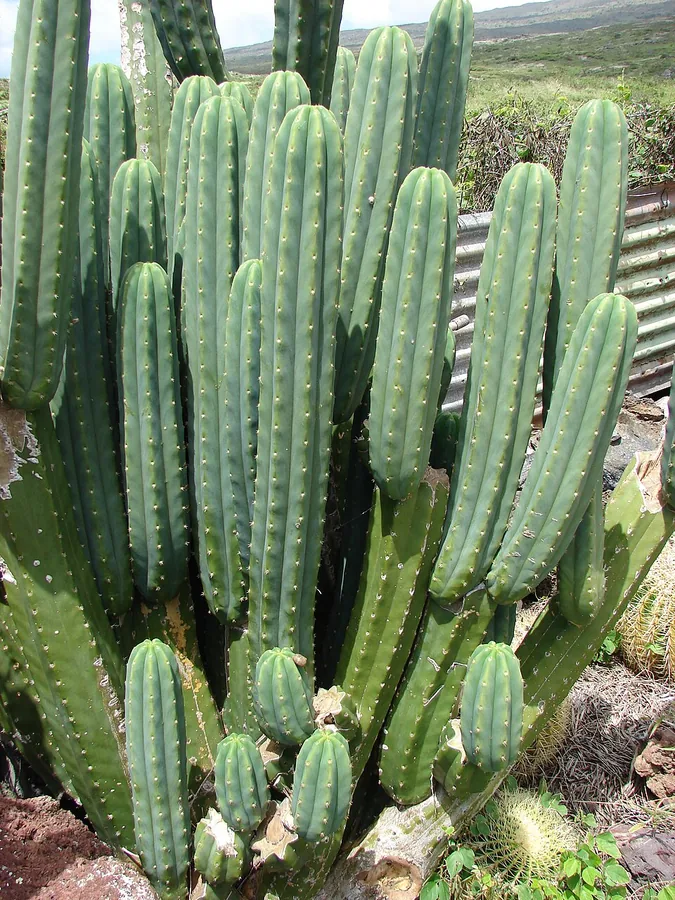
San Pedro comes from the rocky Andean slopes of Ecuador and Peru, and it settles into a sunny home with very little fuss. It sends up tall, ribbed green columns that slowly rise past head height, so even a first try can turn into a real showpiece. Get the watering rhythm right and this forgiving cactus mostly looks after itself, which makes it a kind plant to learn on.
The happy surprise is how quickly it grows. With full sun and warm days, the stems put on real height each season, and older plants open big, fragrant white flowers on summer nights. The clone most people pass around, the one simply called 'PC', is an especially eager grower, so do not be shy about giving it a bright spot.
One thing to hold in mind is that the flesh carries mescaline and related alkaloids, the reason it has a long place in traditional Andean practice and why the law asks for care. Keeping it as an ornamental is fine in most places, but no part of it belongs on a plate. Enjoy it as a handsome plant to admire, and both you and the plant will do just fine.
Care
The short version: give it as much direct sun as you can, pot it in a gritty mix that drains fast, and water deeply only after the soil has gone completely dry. Keep it warm, go easy on water through winter, and it will nearly grow itself.
Light
Give it full sun wherever you can manage, a bright window is ideal. It will cope in bright indirect light or partial sun, but too little light leaves the new growth thin and stretched. If daylight is short, a grow light running 14 to 16 hours a day keeps it sturdy and content.
Water
Water deeply so it runs out the base, then let the mix go completely dry before the next drink, which usually lands somewhere around every 10 to 21 days while it is growing. In winter, keep it almost dry and water only now and then. Too much water is the quickest way to lose this plant to rot, so err on the dry side and relax.
Soil
Pot it in a gritty, fast-draining cactus mix, such as one part potting soil blended with one part coarse sand. A pH anywhere between 6.0 and 7.5 keeps it happy. What matters most is that water slips straight through and never sits around the roots.
Temperature
It stays comfortable across a wide range, from 50°F to 95°F (10°C to 35°C). Warmth is what drives that lovely fast growth in summer, while cold and damp invite rot, so bring it indoors or keep it dry before the chill arrives.
Humidity
Low humidity is exactly what this cactus prefers, somewhere around 10% to 40%. Plain, dry indoor air suits it perfectly, so there is no need to mist or worry over moisture in the air.
Feeding
Feed lightly from late spring through summer with a phosphorus-rich houseplant fertilizer cut to half strength. Once or twice across the whole season is plenty. Go gentle, since too much nitrogen pushes soft, weak growth that tends to stretch.
Pruning
Pruning is not something you have to do here, which is one less thing to worry about. Step in only to take off damaged or rotting segments, using a clean blade and letting each cut callus over before it meets any moisture again.
Repotting
Move it into a fresh pot every 2 to 4 years, or a little sooner if roots poke through the drainage holes, the plant turns top-heavy, or the mix dries out surprisingly fast. Repot into dry gritty mix and hold off on water for about a week so any disturbed roots can settle and heal.
Size & spacing
Given time, it can rise from 6.5 to 19.5 feet (2 to 6 m) tall, spreading 1 to 6 feet (30 to 180 cm) across as it branches and offsets. A mature plant grows heavy up top, so give it room and a steady, weighted pot to lean on.
Troubleshooting
Almost anything that goes wrong here comes back to water or light, and the good news is that most of it is fixable. A soggy pot is the one real danger, since rot can set in, while stretched or scorched stems are just the plant asking for a change. Find your symptom below and step in early, and the plant usually bounces back.
Soft, mushy patches going brown or black on the stem
This is rot, and it nearly always begins with water lingering too long around the roots. Cold, soggy mix lets fungus and bacteria creep in through the smallest wound, and the soft tissue spreads out from there. Take heart though: cut back to firm green flesh with a sterile blade, let the wound dry and callus, then re-root the healthy top in dry, gritty mix and it can carry on.
Fix:
- Cut away all soft and discolored tissue back to firm green flesh with a sterile blade
- Let the cut surface callus in a dry, airy, shaded spot for 1-2 weeks
- Re-root the healthy upper section in dry, gritty mix
- Withhold water until new roots form
Thin, pale new growth leaning toward the window
This is etiolation, simply the plant stretching for more light than it is getting. The newest growth arrives skinny and pale beside the older ribbed sections, and it tilts toward the brightest part of the room. Ease it into full sun over a couple of weeks so it does not scorch, cut back on feeding while it settles, and it will firm up again.
Fix:
- Move to the brightest available spot or full sun
- Acclimate gradually over 2-3 weeks to avoid sunburn
- Reduce or stop fertilizing
Bleached tan patches on the side facing the sun
This is sunburn, and it turns up when a shade-grown plant meets fierce direct sun all at once. The scorched patches sit only on the sunny side and will not soften or spread the way rot does, so there is no need to panic. Move it somewhere bright but lightly shaded, then bring the full sun back slowly over two to three weeks.
Fix:
- Move to a bright but lightly shaded position
- Reintroduce to full sun gradually over 2-3 weeks
Toxicity
This is a cactus to look at, not to taste. Its flesh holds mescaline and related alkaloids, so chewing any part can upset the stomach and affect the nerves in pets, livestock, and people alike. The firm spines are a second thing to watch, ready to prick a curious mouth, paw, or hand, so a spot out of reach of children and animals keeps everyone comfortable.
Toxic to
Cats · Dogs · Horses · Rabbits · Livestock · Birds · People
Cats Caution
The ASPCA does not list the genus as poisonous to eat, but the flesh does carry mescaline and related alkaloids, so a cat that nibbles it might drool, be sick, or seem jittery and off. The sharp spines are the more pressing worry, since they prick a curious mouth or paw so easily. A spot out of reach keeps a cat safe and settled.
Dogs Caution
A dog that gnaws on a stem can take in those same alkaloids and end up with an upset stomach, vomiting, or a wobbly, muddled mood. The stiff spines can also scratch at the mouth and gums. Most dogs walk right past it, but the determined chewer is the one to keep an eye on.
Horses Caution
There is no record of a horse being poisoned by it, yet the mescaline-bearing flesh would unsettle the gut and could leave a horse dull or unsteady if it ate much. The spines alone make it a poor choice to keep near a paddock, so fence it off to be kind.
Rabbits Caution
A rabbit is small enough that even a little of the alkaloid-rich flesh could bring on digestive upset and odd, sluggish behavior, so it really is not a safe nibble. Keep the pot well clear of any free-roaming bunny and everyone stays happy.
Livestock Caution
Grazing animals such as goats, sheep, and cattle could take in the alkaloids along with the flesh and show an upset stomach or dull, off-balance behavior. Fencing the plant off from anywhere stock can reach is the gentle, sensible move.
Birds Caution
Not much is written down for birds, but the same alkaloids that trouble mammals make a pecked stem a poor idea, and the spines can hurt a probing beak. It is kindest to treat it as off-limits for pet birds.
People Caution
The flesh holds mescaline, a psychoactive alkaloid, so eating any part can bring on vomiting and neurological effects and simply is not safe. Children can also be hurt by the spines, so grow it as an ornamental and keep it up out of reach where it can be admired in peace.
Wear thick gloves and lift larger plants with folded newspaper or foam padding; the rigid spines readily puncture skin. Keep within reach limited for children and pets to avoid spine injuries.
Helpline numbers

United States
ASPCA Animal Poison Control: (888) 426-4435 (fee applies)
Poison Control: (800) 222-1222



Canada
Poison Centres: 1-844-764-7669
Varieties
Most San Pedro you will come across is the plain species, though a couple of named forms show up in collections now and then. Here are the two that are worth getting to know.
'Monstrose' (San Pedro Monstrose)
A quirky mutation gives this one lumpy, knobby, irregular growth with few or no spines, and it is grown purely as an ornamental novelty.
'PC' (Predominant Cultivar)
This is the most widely circulated clone in the US, loved for its vigorous, fast growth and its short spines.
How to propagate
Making more San Pedro is genuinely easy, and most growers happily skip seed in favor of rooting a cutting or a pup from a plant they already have.
Stem cuttingsEasy
Spring to early summer · 4-8 weeks to root
Cuttings are the friendly, low-stress way to start new plants, taken in spring or early summer while the cactus is in growth. Slice off a segment, stand it in the shade for one to two weeks until the cut face calluses over, then set it in dry, gritty mix and water sparingly. Roots usually form in about four to eight weeks, so a little patience pays off.
Offsets & pupsEasy
Spring to summer · 4-8 weeks to root
Older plants send out pups and basal branches that you can gently detach in spring or summer. Twist one free, let the wound callus just as you would with a cutting, then root it in dry substrate, where it takes hold in roughly four to eight weeks.
SeedModerate
Spring · Several months to a year
Seed is the slow, patient route, sown in spring on a gritty surface and kept warm and humid until it sprouts. The little seedlings inch along at first and can take anywhere from several months to a full year to establish, which is why most growers happily reach for cuttings instead.
Myths
San Pedro and peyote are the very same cactus.
They are actually two different plants. Peyote is the small, button-shaped Lophophora williamsii, while San Pedro is the tall, columnar Echinopsis pachanoi. Both hold mescaline, yet they are not the same species at all.
Simply growing a San Pedro cactus is against the law in the US.
Keeping the living plant as an ornamental is perfectly legal in most US states. The line gets crossed only when mescaline is extracted or prepared from it, which is a Schedule I controlled-substance offense, and a handful of areas add limits of their own.