Houseplant · Araceae
Pink Princess Philodendron
Philodendron erubescens 'Pink Princess'
Give it bright indirect light and steady moisture, and your Pink Princess will keep its candy-pink leaves all year.
Bright indirect
65–85°F · 18–29°C
USDA 10–12
2–60 ft · 0.6–18.3 m
Overview
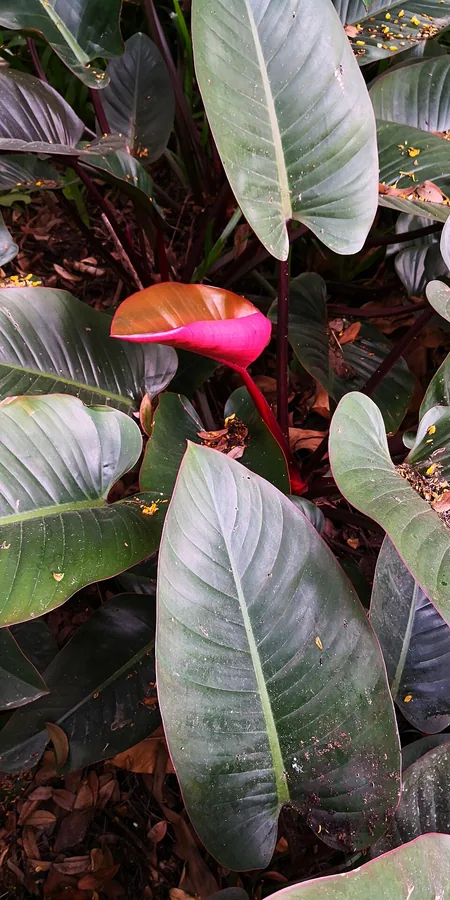
The Pink Princess is a climbing philodendron from the arum family, loved for the splashes of bubblegum pink that run through its dark green, heart-shaped leaves. Every leaf arrives a little different, and no two match. That surprise is the joy of it, and it is also why the plant asks for a bit of attention, though nothing you cannot handle.
The pink is a chimeral variegation, which just means it lives in only part of the plant's tissue and is not promised to the next leaf. A stem can turn plain green and, if you leave it, grow past the pink for good. Learning to read the new growth and snip in the right place is all it takes to hold onto the color, and it comes quickly with practice.
Indoors it stays a friendly size, usually around 3 feet (90 cm) on a moss pole or trellis, even though the species can climb much higher out in the wild. Give it warmth, bright indirect light, and a mix that drains freely, and it grows at a steady, forgiving pace that leaves room for the odd mistake.
Care
The short version: bright indirect light, warmth between 65°F and 85°F (18°C to 29°C), and a moist but free-draining mix, and prune any reverted green stems back so the pink stays with you.
Light
Set it in bright indirect light near a window but out of the hot, direct beam, which can scorch the leaves. Good light is also what feeds the pink, so a corner that is too dim tends to leave you with weak, mostly green growth. A brighter, softer spot keeps it happy.
Water
Keep the mix evenly moist but never soggy, and let the extra water drain right through each time. Waterlogged soil is the quickest path to root rot, so when in doubt, lean toward draining well rather than watering often, and the roots stay healthy.
Soil
Plant it in a rich, well-draining mix built around organic matter such as loam or silt. An acidic to neutral pH suits it nicely, and the drainage matters more than the exact recipe, since standing water is what rots the roots. Do not fuss over getting it perfect.
Temperature
It is happiest in a warm room between 65°F and 85°F (18°C to 29°C). Keep it clear of cold drafts and chilly winter windowsills, since it has no tolerance for the cold, and it will reward you by staying comfortable.
Humidity
This plant enjoys high humidity and thanks you for it with fuller, healthier leaves. It will settle in fine with average room air too, so do not stress, though a humidifier or a pebble tray nearby helps it look its best.
Feeding
Feed it monthly through spring and summer with a balanced liquid houseplant fertilizer at half strength. Ease right off through the darker months when growth slows, since the plant is not taking up much then and a rest does it good.
Pruning
Prune to shape the plant and, more importantly, to protect the pink. When a stem reverts to all green, cut it back to a node that still bears pink, or that eager green growth will take over. It is a small, forgiving job.
Repotting
Repot in spring once it is root-bound, which you will notice when roots fill the pot or push out through the drainage holes. Step it up just one pot size so the fresh mix does not sit wet around the roots, and it settles in with ease.
Size & spacing
24–720 in (61–1829 cm) tall
Troubleshooting
Most Pink Princess hiccups turn up in the leaves and roots, and watering and light are behind nearly all of them. Spot the early signs and the fixes are gentle and quick. Find the picture below that matches yours, then step in before it spreads, and you will be fine.
Droopy yellow foliage and potting mix that stays wet for days
Soft brown roots under wet soil that will not dry point to root rot, and the good news is it comes from something you can change: too much water, or a mix that stays soggy. Healthy roots feel firm and pale, so once they turn soft and dark it is time to act. Ease the plant into a fresh, fast-draining mix, trim the roots that have gone, and water a little less from here on, and it can come back.
Fix:
- Reduce watering frequency
- Repot into a fresh, well-draining, organic-rich mix
- Trim away rotted roots
Fresh leaves unfurling plain green with no pink at all
Do not worry if a new leaf shows up plain green, because the pink is a chimeral variegation the plant cannot always keep, and a green stem will slowly outpace the pink if it is left alone. Dim light nudges it the same way. Trim that green stem back to a node where you can still see pink, then set the plant somewhere with bright indirect light, and the pretty growth gets its chance to catch up.
Fix:
- Prune the reverted stem back to a node that still bears pink variegation
- Provide bright indirect light
Brown blotches with halos creeping over the foliage
Neat spots on the leaves, some with a soft yellow ring around them, usually mean a fungal or bacterial leaf spot, and it settles in when the air is still and the leaves stay damp. There is a gentle fix here: pick off the marked leaves and give the plant a little more room so air can drift around it. Try to keep the leaves dry the next time you water, and it should settle down.
Fix:
- Remove affected leaves
- Improve air circulation
- Avoid wetting the foliage
Fine webs, sticky film, or white fluff appearing on the plant
Fine webbing, a sticky film, or little cottony specks are the signs of sap-feeding pests like spider mites, mealybugs, aphids, scale, and thrips, and plenty of growers meet them at some point. Webbing tends to be mites, the cottony bits are mealybugs, and stickiness means something is quietly feeding. Rinse or wipe the bugs away, treat the plant with insecticidal soap or horticultural oil, and keep it apart from your others until it is in the clear.
Fix:
- Wipe off or rinse away pests
- Treat with insecticidal soap or horticultural oil
- Isolate the affected plant
Pale, crispy patches where the light hits the leaves
Pale or crispy patches on the side that faces the window are simply sun scorch from too much direct light, and they are easy to head off. This plant loves bright light, just softened rather than a hot beam straight through the glass. Slide it back from the window or tuck a sheer curtain between it and the sun, and the new leaves will come in clean.
Fix:
- Move to bright indirect light, out of direct sun
Toxicity
This is a toxic houseplant, so give it a home that is well out of reach of pets and children. Every part holds insoluble calcium oxalate crystals that sting and burn the mouth the moment they are chewed, and the sap can leave bare skin irritated. Nothing on this plant is meant to be eaten, and a little care keeps everyone safe.
Toxic to
Cats · Dogs · Horses · Rabbits · Livestock · Birds · People
Cats Moderate
When a cat chews a leaf, sharp calcium oxalate crystals are released and burn the mouth straight away. You may see drooling, pawing at the face, and vomiting, and your cat may hold off swallowing because the mouth and tongue feel sore and swollen.
Dogs Moderate
A dog that bites the leaves gets a mouthful of those stinging crystals. Watch for heavy drooling, retching or vomiting, puffy lips and tongue, and a hard time swallowing not long after.
Horses Moderate
Those same crystals inflame a horse's mouth and throat and bring on drooling, sore swelling, and trouble swallowing. Since horses cannot vomit, the burning tends to stay put in the mouth and gut.
Rabbits Caution
The oxalate crystals sting a rabbit's mouth just as they do with other animals, so it is best kept well out of reach. Even one nibbled leaf can leave a rabbit sore-mouthed and reluctant to eat.
Livestock Caution
Grazing animals that mouth the leaves meet the same burning and drooling. It is not a pasture plant, but a curious goat or sheep that reaches it can end up with a sore, swollen mouth.
Birds Caution
A bird that bites the leaves runs into the same irritant crystals, with swelling and soreness in the mouth. Keep pet birds gently away from the leaves and stems.
People Caution
No part of this plant is for eating. A chewed leaf burns the mouth and lips, and the sap can leave skin red and itchy, so slip on gloves when you prune and keep it away from small children.
Sap can cause contact dermatitis - wash hands or wear gloves when pruning
Helpline numbers

United States
ASPCA Animal Poison Control: (888) 426-4435 (fee applies)
Poison Control: (800) 222-1222



Canada
Poison Centres: 1-844-764-7669
How to propagate
You can grow more Pink Princess plants from the one you already have, as long as you start from growth that already carries pink. Both methods are gentle and beginner-friendly once you begin from a variegated node.
Stem cuttingsModerate
Spring to summer, during active growth · Several weeks to root
Take your cuttings in spring or summer while the plant is growing well, and be sure each one holds at least one node showing pink variegation. A piece cut from an all-green section will only ever grow green, since the variegation is chimeral, so choose your spot with that in mind. Settle it into a moist medium and let it have several weeks to root at its own pace.
LayeringModerate
Spring to summer, during active growth · Several weeks to root before separating
Layering is the kinder, lower-risk route, and it works best in spring or summer during active growth. You let a stem root while it is still joined to the parent, wait the several weeks it needs to root, and only then cut it free to stand on its own.
Myths
Pink variegation is permanent, so every future leaf will arrive with the same pink markings.
The pink is a chimeral variegation that is not fixed, so the plant can slip back to all green whenever it likes. Left to its own devices, a strong green stem will outgrow the pink parts. Prune reverted growth back to a pink node to keep the color coming, and you stay in charge of it.
Give a fully green stem enough time and the pink will return by itself.
Once a stem has gone all green it holds there, because the green tissue is stable and will not find its variegation again. That is not a loss though. Cut it back to a node that still shows pink and fresh variegated growth can start again from that point.