Houseplant · Araceae
Anthurium
Anthurium andraeanum
Offer it warmth, steady moisture, and humid air, and your anthurium will reward you with those glossy spathes month after month.
Bright indirect
65–85°F · 18–29°C
USDA 11–12
12–18 in · 30–46 cm
Overview
Your anthurium hails from the warm, rain-soaked forests of Colombia and Ecuador, where it lives as an epiphyte, perching on tree branches instead of taking root in soil. Once you know that, the rest of its care falls into place naturally: bright but softened light, air that holds its moisture, and a pot that lets water run right through. It shares a family with the peace lily and philodendron, and it carries that same calcium oxalate that makes those plants something to watch around pets.
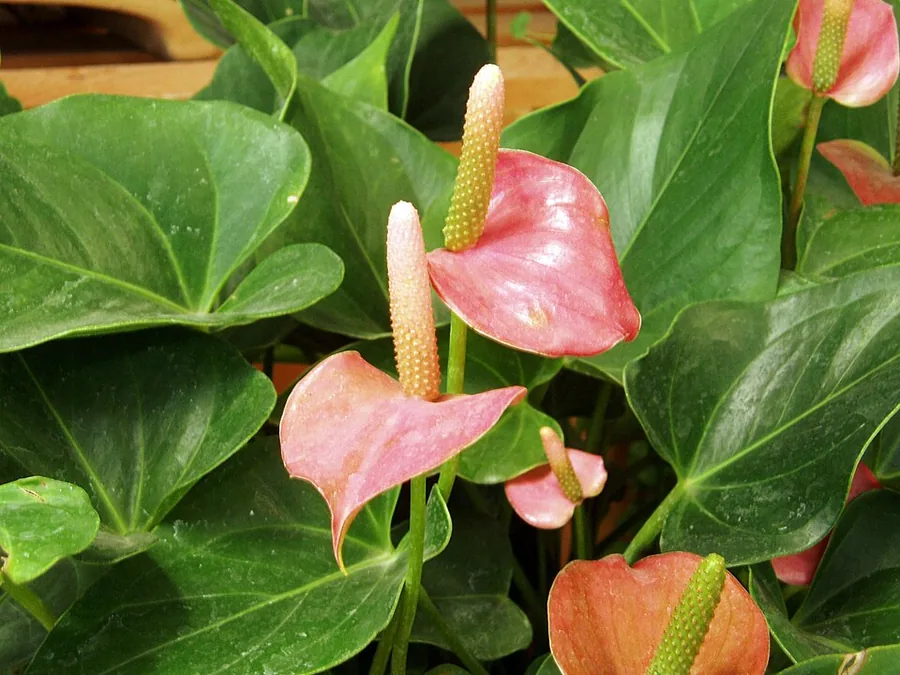
Here is a lovely surprise: what looks like the flower really is not one. The waxy heart of red, pink, orange, or white that catches your eye is a spathe, a modified leaf, and the true flowers are the little bumps clustered along the pale spadix that rises from its center. When your plant is content, it keeps offering up fresh spathes through much of the year, which is how it earned cheerful names like flamingo flower and painter's palette.
This plant does ask for a bit of attention, and that is perfectly alright. It thrives with gentle, regular care and lets you know quickly when something is off, easing back in dry rooms or in pots that stay too wet. The good news is that those signals are easy to read and to correct, and once the light, water, and humidity suit it, it stays glossy and in bloom far longer than most houseplants you will meet.
Care
The short version: offer bright indirect light, soil that stays evenly moist but never soggy, gentle warmth above 65°F (18°C), and humid air around 60% to 80%. A weekly feed through spring and summer and a fresh pot every couple of years keep it happy.
Light
Set it where it gets bright, indirect light near a window but tucked out of the sun's direct reach. Direct rays will scorch the leaves, and too much shade leaves you with greenery but no blooms, so a bright, filtered corner is just right and easy to find.
Water
Water when the top inch of soil dries out, keeping the mix evenly moist all year while never letting it go bone dry or sit in a puddle. Too much water is the surest way to harm one, because soggy soil rots the roots, so when in doubt, wait a touch. Rainwater or filtered water pleases it more than hard tap water does.
Soil
Give it a light, peaty mix that drains freely, the airy sort of blend its epiphytic roots are made for. A slightly acidic mix at a pH of 6.0 or just below suits it nicely, and that quick drainage is your best friend for keeping root rot away.
Temperature
Keep things warm, between 65°F and 85°F (18°C to 29°C), and try not to let it slip below 60°F (16°C) over winter. Cold drafts and a chilly windowsill are the two things it really cannot abide.
Humidity
This is the part that trips most people up, so do not worry if you have missed it before. Anthurium loves high humidity, around 60% to 80%, well beyond what a heated room usually gives, and dry air quickly browns the leaf tips. A pebble tray, a humidifier, or a steamy bathroom each make a real difference.
Feeding
All through spring and summer, treat it to a weekly liquid fertilizer, and a high-phosphorus formula coaxes out more blooms. As the days shorten and growth eases, simply scale the feeding back.
Pruning
Snip away spent blooms to gently encourage the next round, and give the broad leaves an occasional wipe so dust does not dull their shine. Pop on gloves first, since the sap can irritate skin.
Repotting
Move it into a slightly larger pot every two years. Fresh mix clears out the mineral salts that gather from feeding, and it offers the roots a little more room before they begin to circle the pot.
Size & spacing
Indoors it keeps a tidy size, growing 12 to 18 inches (30 to 46 cm) tall and reaching 9 to 12 inches (23 to 30 cm) across. That gentle footprint makes it a comfortable fit on a shelf or tabletop.
Troubleshooting
The reassuring thing about anthurium is how plainly it speaks to you. Thirsty air turns up at the leaf tips, too little light shows in missing blooms, and overwatering reveals itself down at the roots. Find what you are seeing below, and you will find the simple fix right alongside it.
Droopy yellow leaves and soil that never dries
Soil that stays wet while the leaves yellow and sag is a sign the roots are struggling, but this is recoverable if you act soon. Overwatering and poor drainage are behind it, leaving the hidden roots brown and soft. Water less, settle the plant into a light, fast-draining mix in a pot with drainage holes, and gently trim off any roots that have rotted.
Fix:
- Reduce watering and allow excess water to drain
- Repot into a light, well-drained mix, removing rotted roots
- Use a pot with drainage
Sticky film, fine webs, or white fluff on the foliage
Like most houseplants, an anthurium can attract the familiar indoor sap-suckers: aphids, spider mites, mealybugs, scale, whitefly, and thrips. Keep an eye out for stippled leaves, a sticky film, fine webbing, or small cottony tufts. Catching it early is half the battle, so move the plant away from the others, wipe the pests off, and treat it before they travel.
Fix:
- Inspect plants regularly and isolate affected plants
- Wipe leaves and remove pests
- Treat with appropriate control measures
Dark spots or soft rotting areas spreading across the leaves
Spots and soft rotted patches on the leaves usually point to fungal or bacterial disease, which settles in when the air sits still and the soil stays too wet. The cure is straightforward: let air move freely around the plant, switch to a light, well-drained mix, and remove the leaves that are affected.
Fix:
- Improve air circulation
- Use light, well-drained soil mixes
- Remove affected foliage
Plenty of leaves but few or no flowers
If your plant is all leaf and no color, take heart: the usual culprit is simply too little light, and it is an easy thing to put right. Give it a brighter spot that stays out of direct sun, trim off any tired old spathes, and offer a high-phosphorus feed to gently encourage fresh flowers.
Fix:
- Move to a spot with bright, indirect light, out of direct sun
- Remove spent blooms
- Apply a high-phosphorus fertilizer to encourage flowering
Crisp brown edges creeping onto healthy green foliage
Crispy edges on green leaves are simply the plant asking for more moisture in the air, which is dry air at work and very common in a heated room. Lift the humidity nearby and ease the plant away from heating vents and drafts, both of which dry the foliage and crisp those tips.
Fix:
- Raise humidity around the plant
- Move away from drafts and dry-air locations such as heating vents
Pale scorched marks where the sun touches the leaves
Pale, burned patches are a gentle warning that the plant is getting direct sun, which anthurium leaves simply cannot handle. Move it to where the light is bright yet filtered, and keep it clear of drafts and parched corners that only make the burning worse.
Fix:
- Move out of direct sunlight to bright, indirect light
- Relocate away from drafts and very dry spots
Toxicity
This is a plant worth keeping up and away. Every part of it holds sharp insoluble calcium oxalate crystals, the same irritant shared across the arum family, and a bite of any of it triggers burning and swelling in the mouth. The sap can bother bare skin as well, so slip on gloves before you prune and set the plant well out of reach of pets and children.
Toxic to
Cats · Dogs · Horses · Rabbits · Livestock · Birds · People
Cats Moderate
Should a cat take a bite of a leaf, the sting is immediate: a burning mouth, drooling, and pawing at the face. Swollen lips and tongue, vomiting, and difficulty swallowing tend to follow.
Dogs Moderate
A dog that has chewed a piece reacts in much the same way, drooling heavily and turning away from food. The lips, tongue, and mouth swell and grow sore, and vomiting commonly comes next.
Horses Moderate
On contact the crystals sting a horse's mouth, bringing pain, swelling, and a flood of drool that makes swallowing hard. Since horses cannot vomit, the trouble stays put in the mouth and throat.
Rabbits Toxic
Those same oxalate crystals scald a rabbit's tender mouth and gut, so set the plant somewhere truly out of reach and never let any piece of it be offered.
Livestock Toxic
Grazing animals that taste the foliage take in a mouthful of stinging crystals, which brings on drooling, mouth pain, and an upset stomach. Wherever stock can reach, fence the plant off.
Birds Toxic
A curious bird pecking at the leaves or sap runs into the very same irritant crystals, which inflame the mouth and crop. Keeping it out of any room where birds fly loose is the safest choice.
People Caution
No part of an anthurium is for eating, and a bite brings burning and swelling to the mouth. Its sap can also leave skin red and itchy, so reach for gloves when handling it and keep children at a distance.
Sap and tissue contain insoluble calcium oxalate crystals (raphides) that can cause skin/contact dermatitis; consider wearing gloves when handling or pruning
Helpline numbers

United States
ASPCA Animal Poison Control: (888) 426-4435 (fee applies)
Poison Control: (800) 222-1222



Canada
Poison Centres: 1-844-764-7669
Varieties
Anthurium andraeanum arrives in a number of named cultivars, sorted mostly by the color of the spathe. Here are several that NC State Extension lists.
'Acropolis'
A named Anthurium andraeanum cultivar that NC State Extension recognizes.
'Baron'
Yet another A. andraeanum selection that appears on the NC State Extension roster of named cultivars.
'Cheers'
An Anthurium andraeanum cultivar that NC State Extension has documented.
'Florida'
An A. andraeanum cultivar entered into the records of NC State Extension.
'Midori'
An Anthurium andraeanum cultivar catalogued by name at NC State Extension.
'Rosee Choco'
Still another A. andraeanum cultivar found among the named selections of NC State Extension.
How to propagate
Anthurium is increased by splitting an established plant or by rooting a cutting, and both go more smoothly on a settled, mature specimen than on a young one.
DivisionModerate
Best done at repotting (every 2 years) · Unknown
The kindest, easiest way to grow your collection is to divide a mature plant as you repot it, which lands at roughly every two years. Gently coax the clump apart so each section holds onto its own roots, and then settle the divisions into their own pots.
Stem cuttingsModerate
During active growth · Unknown
Rooting a stem cutting taken while the plant is actively growing is another approach within reach. NC State Extension names this method beside seed for propagating anthurium, and at home the cutting tends to be the friendlier choice.
Myths
That pretty red heart an anthurium shows off is its actual bloom.
That shiny heart of red, pink, orange, or white is actually a spathe, which is a modified leaf and not a bloom at all. The real flowers are the tiny bumps crowded onto the spadix, the pale white or cream column rising from the middle of the spathe.