Tree · Betulaceae
Paper Birch
Betula papyrifera
Give it a cool, moist root run and the paper birch will thank you with bright white bark for many years to come.
Full sun
Every 3–7 days
USDA 2–7
50–70 ft · 15.2–21.3 m
Overview
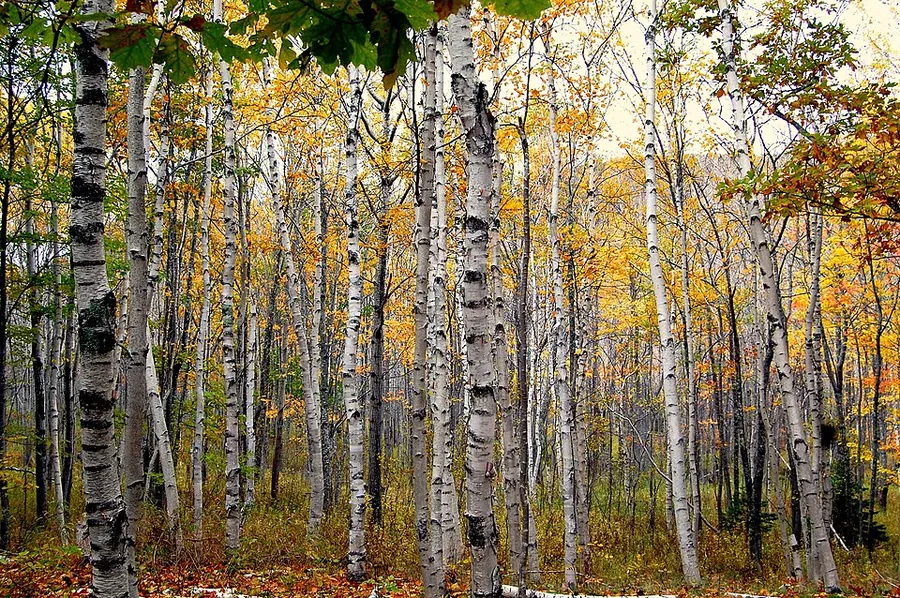
Not many trees light up a winter yard the way a paper birch does, with its bright white bark curling off in soft papery sheets. It grows quickly and is native to the far north, spreading right across the continent through the cool woods of Canada and the northern states. Long ago, Indigenous peoples turned that waterproof bark into canoes, and that is where the friendly name canoe birch comes from.
This is a tree that loves the cold, standing up to fierce winters yet unhappy where summers turn hot and dry. It shoots up fast, often reaching 50 to 70 feet (15 to 21 meters), though it does not linger for centuries the way some trees do, easing off after a few decades. Plant it somewhere the soil stays cool and damp and it will flourish for you; ask it to cope with a baking city lot and it tends to fade early.
The one thing that really shapes how a paper birch does is the bronze birch borer, a bug that seeks out trees under strain. Keep the roots cool, the soil moist, and the tree in good health, and you have already done most of what it takes to grow a beautiful one.
Care
The short version: give it full sun with cool, evenly moist, slightly acidic soil, a generous layer of mulch to keep the roots cool, and steady water through heat and drought, and you will hold the borer at bay.
Light
Paper birch loves full sun and will not put up with shade for long, since it is a pioneer that dashes into open clearings. It will accept a touch of partial sun, but the more light it soaks up, the finer the bark and the stronger the tree.
Water
Keep the soil cool and evenly moist, because this is a tree that truly hates to dry out. Water it deeply through heat and drought and tuck a layer of mulch over the roots to keep them cool, since drought stress is just what draws in the bronze birch borer. Dry, packed ground is one thing it cannot forgive.
Soil
Offer it moist, well-drained, sandy or silty loam that leans acidic. A pH between 5.0 and 6.5 keeps it in good health; drift much higher and the leaves start to yellow with chlorosis.
Temperature
This is a cold-hardy tree right to its core, taking winters down to -49°F (-45°C) without a shiver. The heat is where it feels the strain, growing uncomfortable once summers climb past about 86°F (30°C).
Humidity
Everyday outdoor humidity suits it just fine, so there is no number to chase. What counts far more is good airflow through the canopy, which helps keep leaf-spot fungi from settling in during a wet spell.
Feeding
A balanced tree fertilizer in spring keeps a paper birch vigorous, and that vigor is its best shield against the borer. Feed it through the season as it needs to hold that strength.
Pruning
Aim your pruning for summer through early fall, and stay well away from late winter and early spring, when fresh cuts bleed sap heavily. Take out dead and borer-infested branches whenever you spot them.
Repotting
not applicable - landscape tree
Size & spacing
This is a big tree, rising 50 to 70 feet (15 to 21 meters) tall with a spread of about 30 to 35 feet (9 to 11 meters). Give it plenty of open space and a spot where the roots can stay cool and shaded.
When to plant
Paper birch is a cold-country tree, most content in the northern zones where summers stay gentle. Plant it in spring or fall while the air is still cool, and watch for the dangling catkins to open in spring, somewhere around April to May.
Northern hemisphere
Southern hemisphere
Typical months for a temperate climate: start earlier in warm zones, later where spring frosts linger.
- Plant: Spring or fall
- Harvest: Catkins in spring (April to May)
Hardiness
USDA hardiness zones: 2–7
Temperature: down to -46°C
Troubleshooting
Almost every paper birch worry traces back to a stressed tree and the pests that follow. Keep a kind eye on the crown and the leaves through the season and act early, because the most serious trouble tends to begin quietly right at the top.
Top of the crown thinning and fading, with D-shaped holes dotting the bark
Take a breath, because this one has a clear cause and a clear answer. When the very top of the crown thins and dies back and you find little D-shaped exit holes in the bark, the bronze birch borer is at work, tunneling under the bark and cutting off the water the tree needs. Here is the reassuring part: these grubs cannot take hold in a tree that is cool, well watered, and thriving, so keeping your birch happy is the whole defense.
Fix:
- Prune out and destroy infested and dead branches
- Reduce stress by watering deeply and mulching to cool the roots
- Apply a registered insecticide when adults are active in June
- Maintain tree vigor; larvae do not survive in healthy trees
Spotted, browning leaves by midsummer, dropping ahead of time
Brown spots and blotches that arrive around July come from Marssonina leaf spot and anthracnose, fungi that get busy in a wet, damp season and can pull leaves off early. You have simple tools here: rake up and get rid of the fallen leaves so the spores do not linger, and thin the canopy a little for better airflow. Even after a rough year of leaf loss, a healthy tree comes back leafy and green the following spring.
Fix:
- Rake and destroy fallen infected leaves
- Improve air circulation and avoid overhead wetting
- Keep tree vigorous with proper watering and mulch
Light patches on the foliage darkening to brown blotches
If you notice pale patches that darken into brown blotches inside the leaves, the gentle news is that this is only the birch leafminer, whose tiny larvae feed between the leaf surfaces. Hold a leaf up toward the light about ten days after the buds break and you can catch them in the act. It looks worse than it is, and a tree that gets steady water carries on without missing a beat.
Fix:
- Treat with a registered systemic insecticide when larvae first hatch and begin feeding
- No control is needed once large brown blotches appear, as larvae have already left
Crinkled, yellowing foliage coated in a sticky film
Leaves that pucker, curl, and wear a sticky coating are simply hosting aphids that sip on the tender new growth. There is little to worry about with a light group, and the ladybugs and other helpers that turn up usually clear them out for you. Should a colony really pile up, a firm blast of water from the hose knocks it right off.
Fix:
- Tolerate light infestations, as natural predators usually provide control
- Wash off heavy infestations with a strong stream of water
Toxicity
Here is welcome news for a home with pets or grazing animals: paper birch is not toxic to any of them. There is no poison in the leaves, bark, twigs, or sap, and the spring sap is even tapped and boiled down into birch syrup. At most, a curious nibble brings a mild, passing tummy upset.
Safe for
People · Cats · Dogs · Horses · Rabbits · Livestock · Birds
Cats None
You can relax about the cat, since a paper birch holds nothing that could poison one. A nosy nibble might lead to a bit of drool or a passing upset tummy, the way any off-limits plant would, and that is truly as far as it goes.
Dogs None
Your dog is safe around paper birch. Gnawing a dropped branch or a strip of bark will not poison a pup, though a big helping of any leafy stuff can leave the stomach loose for a day.
Horses Safe
Horses are fine with paper birch, and the leaves and twigs are sometimes browsed with no trouble at all. Nothing toxic hides in it, so there is nothing to fret about out on pasture or along a paddock fence.
Rabbits Safe
Rabbits can nibble the bark and twigs in complete safety. Wild rabbits and hares strip young birch through winter every year, and the tree carries no poison for them.
Livestock Safe
Cattle, goats, and sheep can browse paper birch without any harm coming to them. The leaves and bark hold nothing toxic, so an animal that reaches the low branches is perfectly all right.
Birds Safe
Birds are wonderfully safe around paper birch. Many rely on it, feeding on the catkin seeds and the insects tucked in the bark, and the tree poses no danger to them at all.
People Safe
People are safe with paper birch too, as no part of it is poisonous. The spring sap is even tapped and simmered down into birch syrup, much the way maple syrup is made.
No special handling required; ingestion of plant material may still cause mild stomach upset in pets.
Varieties
Most paper birch you will find for the yard is the plain wild species, though a couple of named picks stand out for their bark and their toughness.
Renaissance Reflection
This selection is a lovely, forgiving choice, chosen for its bright white bark and extra vigor along with better resistance to the bronze birch borer than the wild tree.
Varen (Prairie Dream)
A tough, cold-hardy pick with bold white bark, bred to shrug off the harsh, exposed conditions of the far north.
How to propagate
Paper birch is raised almost entirely from seed, since cuttings tend not to cooperate.
SeedModerate
Sow in fall or after cold stratification in spring · 1 to 2 growing seasons
Seed is the friendliest and most dependable way to raise a paper birch. Scatter the tiny seeds in fall, or chill them and sow in spring, and give them light and bare, moist mineral soil to wake up on. Be patient, as a young tree needs one to two growing seasons to find its feet.
Stem cuttingsDemanding
Summer (softwood) · Variable; often unreliable
Do not be hard on yourself if cuttings disappoint, because paper birch simply does not take to them. Softwood cuttings taken in summer root poorly and stay unreliable at best, which is exactly why almost everyone comes back to seed.
Myths
A paper birch will shrug off any yard just as easily as a river birch.
It is easy to assume these two birches are the same, but they really are not. Paper birch is much more likely to be found by the bronze birch borer than river birch, and at heart it belongs in cool country. Set it in a hot, dry, or packed city spot and it will struggle and fade early, while river birch shrugs off that same heat.