Shrub · Hydrangeaceae
Mock Orange
Philadelphus coronarius
Give it sun and one well-timed prune, and mock orange will fill your early summer with orange-blossom scent.
Full sun
Every 7–14 days
USDA 4–8
10–12 ft · 3–3.7 m
Overview
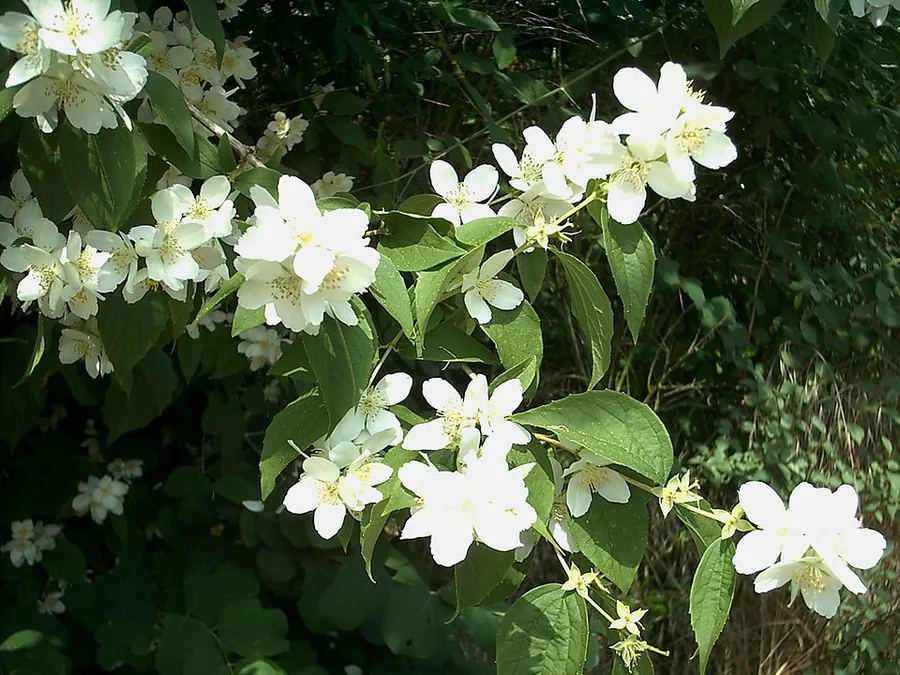
If you want one reason to love this shrub, it is the white, four-petaled flowers that open in late spring and carry a rich orange-blossom scent you can catch clear across the garden. Mock orange is a deciduous member of the hydrangea family, native to southeastern Europe and Asia Minor, and it fills out into a generous, multi-stemmed mound of arching canes.
You will find this a very forgiving plant to grow. It stands up to cold all the way down to zone 4, learns to handle drought and wind once its roots take hold, and settles happily into sandy, loamy, or clay soil, even where the pH leans alkaline. All it really wants from you is sun, because shade thins the flowers and invites mildew.
The one thing to watch is age. Left to its own devices, the shrub grows leggy and twiggy, with the blooms drifting up to the tops of long bare canes. A yearly trim of the oldest stems keeps it lush and flowering, and honestly that is nearly all the work this plant will ever ask of you.
Care
The short version: full sun brings the fullest bloom, keep the soil moist and well-drained while it settles, and give one prune right after flowering to keep an older shrub full and sweetly scented.
Light
For the fullest, most fragrant flowers, settle it into full sun. It will still grow in partial shade and look fine, but shade quietly trades blossoms for leaves and lets powdery mildew creep onto the crowded inner branches.
Water
While the shrub is finding its feet, keep the soil moist but well-drained, and once it has settled you can ease right off, because an established plant takes drought and wind in stride and asks for little extra water. A drink every 7 to 14 days is plenty when things turn dry. The only thing it truly dislikes is soggy, poorly drained ground.
Soil
Mock orange is wonderfully easygoing about soil and grows in sand, loam, or clay as long as the water drains away. Any pH from 4.0 to 7.0 suits it just fine, and it even shrugs off the alkaline range that stops many other shrubs in their tracks.
Temperature
This is a hardy, good-natured shrub that stays comfortable from about -29°F to 100°F (-34°C to 38°C). It rides out the hard winters of zone 4 and takes summer heat in stride without any fuss from you.
Humidity
Everyday outdoor humidity is all it needs, so there is no dial for you to watch. What matters far more is good air movement, since still, crowded branches are exactly what let powdery mildew take hold.
Feeding
A shrub this vigorous barely needs feeding, so please do not overthink it. A balanced fertilizer or just a light layer of compost in spring is plenty, and going heavier only pushes soft new growth that aphids adore.
Pruning
Here is the one bit of timing worth remembering, since mock orange flowers on old wood: prune right after the blooms fade in early summer, never in fall or winter. As it ages and grows leggy, cut about a third of the oldest stems to the ground each year and it will come back fresh.
Repotting
This is a garden shrub rather than a pot plant, so repotting almost never comes up. If you do need to move it, gently dig and transplant young suckers in early spring or fall, while it is dormant or just stirring awake.
Size & spacing
Do give it elbow room, because a grown plant reaches 10 to 12 feet (3 to 3.7 m) tall and spreads 8 to 10 feet (2.4 to 3 m) across. Choose a spot where that lovely arching mound can billow out without pressing against a wall or path.
When to plant
There is no rush and no wrong start, since mock orange takes to the ground happily in spring or fall while the soil stays cool and damp. The fragrant white flowers arrive in late spring to early summer, roughly May into June, and though the show is brief, you will look forward to it every year.
Northern hemisphere
Southern hemisphere
Typical months for a temperate climate: start earlier in warm zones, later where spring frosts linger.
- Plant: Spring or fall
- Harvest: White fragrant flowers in late spring to early summer (May to June)
Hardiness
USDA hardiness zones: 4–8
Temperature: down to -34°C
Troubleshooting
Take heart, because mock orange asks very little and forgives a lot. Most of what you might notice is only skin deep, and even a shrub that skips its flowers can be coaxed back with the right timing. Find your symptom below and you will know just what to do.
Few flowers on long, bare stems
Take heart, because this almost always comes down to timing: mock orange blooms on old wood, so a cut in fall or winter removes next spring's buds and leaves you short on flowers. Deep shade and years without attention do the same. Prune only just after the blooms fade, remove a third of the oldest canes each year, and give it fuller sun.
Fix:
- Prune only immediately after flowering, not in fall or winter
- Renewal prune by removing about one third of the oldest canes to the ground
- Move or site in fuller sun for best bloom
A soft white dusting spreading over the leaves
That pale coating is powdery mildew, a fungus that moves in wherever the air sits still and the shrub gets too much shade. Do not worry, since a few thoughtful cuts to open the canopy and the removal of the worst leaves usually settle it. A sunnier spot, where the foliage dries quickly, keeps it from returning.
Fix:
- Prune to open up the canopy and improve air circulation
- Remove and dispose of badly affected foliage
- Site in full sun where foliage dries quickly
Dark spots and blotches dotted across the leaves
Those marks are fungal leaf spots, and on this easygoing shrub they look far scarier than they are. Simply rake up the fallen leaves where the spores wait out winter, thin a stem or two so air can flow, and try to keep water off the foliage. Most years the plant just shrugs it off.
Fix:
- Rake and remove fallen, infected leaves
- Thin stems to improve airflow
- Avoid wetting foliage when watering
Curled young shoots covered in tiny insects
The little visitors are almost always aphids, soft insects that gather on tender tips and leave a sticky film behind. A firm blast of water knocks them right off, and insecticidal soap is only needed if they keep returning. Pale winding trails inside the leaves point to leaf miners instead, so just pick off and destroy those leaves.
Fix:
- Dislodge aphids with a strong spray of water
- Use insecticidal soap if populations are heavy
- Remove and destroy mined leaves
Toxicity
You can relax on this one. Mock orange is non-toxic through and through, so nothing in the leaves, stems, or flowers will harm a cat, dog, horse, rabbit, bird, or child. At worst a stray mouthful brings a little tummy upset, the same as nibbling any plant.
Safe for
People · Cats · Dogs · Horses · Rabbits · Livestock · Birds
Cats None
Mock orange is safe to have around cats. A curious nibble of leaf or flower will not poison them, though chewing any plant can lead to a little drool or a passing upset stomach.
Dogs None
Dogs are perfectly fine near this shrub. Nothing in the foliage or blooms is toxic, so a sneaky mouthful is nothing to fret over beyond the occasional touch of mild tummy trouble.
Horses Safe
Horses can graze happily beside mock orange with no worry. It holds no toxins that affect them, which makes it a friendly choice along a paddock edge or pasture border.
Rabbits Safe
Rabbits are in no danger from mock orange. The leaves and stems carry nothing harmful, so a wandering rabbit that tastes a low branch comes away just fine.
Livestock Safe
Cattle, goats, and sheep can browse this shrub in safety. It contains nothing that troubles ruminants, so it poses no threat where your stock roam.
Birds Safe
Birds are completely safe around mock orange and often nest and shelter in its dense, twiggy growth. Neither the leaves nor the flowers hold anything that could harm them.
People Safe
Mock orange is harmless to people, little ones included. It is not grown as food, yet a stray taste of leaf or petal will not cause any real trouble.
No special handling required; as with any plant, discourage pets and children from chewing foliage to avoid mild stomach upset.
Varieties
The plain species is lovely on its own, but if you feel like exploring, a handful of named picks reward you with extra color or hardier, heavier bloom.
'Aureus'
New growth on 'Aureus' emerges a cheerful golden-yellow before softening toward green as summer warms up.
'Variegatus'
On 'Variegatus', every green leaf wears a clean, creamy-white edge that brightens a shady corner beautifully.
'Nanus'
'Nanus' is a compact dwarf that happily stays well below the towering height of the species.
'Minnesota Snowflake'
'Minnesota Snowflake' is a cold-hardy favorite that covers itself in richly fragrant double white blooms.
How to propagate
Making more mock orange is easier than you might expect, and you have three gentle options to choose from depending on the season and how hands-on you feel like being.
Stem cuttingsEasy
Softwood cuttings in late spring to early summer; hardwood cuttings from dormant stems in late fall to winter · 4 to 8 weeks for softwood cuttings to root
Cuttings are the simplest way to grow more of this shrub, and they rarely let you down. Take softwood cuttings in late spring to early summer or hardwood cuttings from dormant stems through late fall and winter, and the softwood pieces will root for you in 4 to 8 weeks.
DivisionEasy
Early spring or fall · One growing season
Because mock orange sends up suckers from its base, you can dig and separate the rooted ones in early spring or fall, which is easier than it sounds. Each little division settles in comfortably over a single growing season.
LayeringEasy
Spring to summer · One growing season or more
Layering asks almost nothing of you. Pin a low branch down against the soil any time from spring through summer, and it quietly roots where it meets the ground over a season or more.
Myths
Every shrub called mock orange is one and the same plant.
Several unrelated plants happen to share the name, which trips up a lot of gardeners. The true mock orange, Philadelphus coronarius, is a deciduous shrub in the hydrangea family with four-petaled white flowers, while Pittosporum tobira is an evergreen with clustered five-petaled blooms and Murraya paniculata is a tropical evergreen that sets red fruit. They come from entirely different genera and share only that sweet orange-blossom scent.