Tree · Fagaceae
Southern Live Oak
Quercus virginiana
A sprawling, long-lived shade tree that asks for room to grow and little else once it has settled in.
Full sun
Every 7–14 days
USDA 8–10
40–80 ft · 12.2–24.4 m
Overview
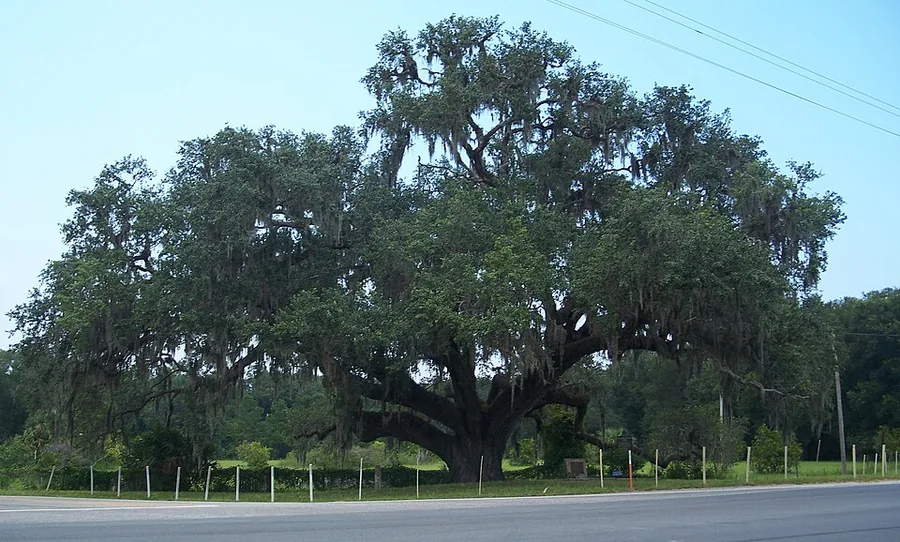
The Southern live oak is the broad, mossy shade tree you picture across the coastal South, and if you have ever felt unsure about planting a tree, this is a forgiving one to start with. Its limbs can reach far wider than the tree is tall, and it keeps most of its leaves through winter, so it reads as evergreen even though the old foliage drops in spring as fresh growth comes in. Give it decades and a single tree grows into a local landmark.
The reassuring part is how little it asks of you. It is happy in sand, loam, or clay, it shrugs off salt spray near the coast, and it stands up to drought once the roots reach down. Hardy through USDA zones 8 to 10, it grows at a calm, moderate pace and lives for generations, which is exactly why so many people plant one they may never see fully grown.
The one thing to plan for is size. A mature live oak can throw a crown 40 to 80 feet (12 to 24 m) across, with heavy horizontal limbs that need open ground. Set it well clear of the house, the sidewalk, and the power lines, and you will be rewarded with shade nothing else can match.
Care
The short version: give it full sun and almost any soil, water it regularly only while it is young, and take a careful summer prune to keep oak wilt at bay, and after that it mostly looks after itself.
Light
Give your live oak full sun and it will build the strongest, most balanced crown. It will still do well in partial sun or light shade, but a tree out in the open fills in denser and more even, so pick the sunniest spot you can.
Water
Water a young tree on a steady schedule, roughly every 7 to 14 days, until the roots take hold and it can fend for itself. Once it is established, a mature live oak is highly drought tolerant and rarely needs any watering at all.
Soil
Few trees are this easygoing about soil, which takes a lot of pressure off. It handles sand, loam, or clay, accepts both acidic and alkaline ground from pH 5.0 to 7.5, puts up with the odd wet spell, and tolerates coastal salt. It simply grows best in moist, well-drained, slightly acidic soil.
Temperature
Built for the warm South, it takes anything from about 10°F to 100°F (-12°C to 38°C) in stride. That span covers hard summer heat and the occasional deep freeze at the cool edge of its zones.
Humidity
Ordinary outdoor air suits it just fine, so there is no humidity target for you to fuss over. It is right at home in the muggy coastal South where it grows wild.
Feeding
An established tree in decent soil needs no feeding at all, which is one less thing on your list. Only reach for a balanced slow-release tree fertilizer in spring if growth has clearly stalled.
Pruning
Aim your pruning for mid to late summer, when the beetles that carry oak wilt are least active. Take out dead, crossing, or weak branches and shape good structure while the tree is young, since heavy cuts on an old oak are best left alone.
Repotting
A live oak is not a container plant for the long haul, so there is no repotting cycle to keep up with. Move it from the nursery pot into the ground before the roots start circling, and once it is planted, it stays put for life.
Size & spacing
This is a big tree, reaching 40 to 80 feet (12 to 24 m) tall with a crown that can spread 60 to 120 feet (18 to 37 m) across. Give it that much open room from the start, well away from buildings, walks, and utilities.
When to plant
There is no rushing a tree this size, and happily there is no season to chase either. Set a young live oak out in fall or early spring, when the soil is easy to work and the roots have time to settle before summer heat or hard cold. The flowers are easy-to-miss spring catkins, and the acorns ripen and drop in fall.
Northern hemisphere
Southern hemisphere
Typical months for a temperate climate: start earlier in warm zones, later where spring frosts linger.
- Plant: Fall or early spring
- Harvest: Inconspicuous spring catkins; acorns mature in fall
Hardiness
USDA hardiness zones: 8–10
Temperature: down to -12°C
Troubleshooting
A healthy live oak gives you very little to worry about, and most of what turns up is only cosmetic. The one disease worth taking seriously is oak wilt, which is the whole reason pruning is timed the way it is. Match what you are seeing below before you pick up the saw.
When leaves wilt and brown and the tree starts slipping
If the crown is fading and branches are dying back one after another, the likely culprit is oak wilt, a fungus that clogs the tree's plumbing from within. Try not to panic, but do look closely for dark streaks in the wood as you go. Because there is no cure once it settles in, it helps to get it confirmed by an extension office or lab, then keep any pruning to mid to late summer and separate root grafts from nearby oaks where you are told to.
Fix:
- Avoid pruning during active beetle season; prune only in mid-to-late summer
- Remove and properly dispose of infected trees per extension guidance
- Sever root grafts between adjacent oaks where recommended
Odd bumps or blister spots dotting the leaves and twigs
Take a breath, because these almost always look far worse than they are. Rounded lumps are usually insect galls from gall wasps or mites, and raised blisters come from a leaf fungus called Taphrina, and neither one hurts a settled tree. You can rake up fallen leaves to ease the blister and simply let the galls be, knowing a healthy oak takes them in stride.
Fix:
- Tolerate galls, which rarely harm the tree
- Rake and remove fallen infected leaves to reduce leaf blister
- Maintain tree vigor with proper watering
Toxicity
This is a much-loved shade tree, but its acorns, buds, and young leaves hold tannins that are not safe to eat. Dogs and cats that nibble them get an upset stomach, while horses and grazing livestock that eat a lot risk serious, sometimes fatal kidney damage. Keep animals from feeding on fallen acorns and clippings, especially in fall.
Toxic to
Cats · Dogs · Horses · Rabbits · Livestock · Birds · People
Cats Mild
Should your cat sample a leaf or an acorn, you will most likely see an upset stomach, some vomiting, loose stool, and a meal or two skipped. It usually settles by itself, and a tender belly for a day is nothing unusual.
Dogs Mild
A dog that chews acorns or leaves often gets vomiting, diarrhea, and a flat appetite. One thing to watch is a swallowed acorn, which can lodge and block the gut, so if your dog keeps straining or retching, a vet visit is the safe call.
Horses Severe
Horses feel the tannins hard once they eat much, so this one deserves real care. Colic and stomach upset arrive first, and a heavy binge on acorns or young leaves can scar the kidneys badly enough to be fatal.
Rabbits Toxic
Oak is not good forage for a rabbit at all. Their gut relies on steady, gentle greens, and the tannins in leaves and acorns throw it off, so keep any clippings and fallen acorns well away from the hutch and run.
Livestock Severe
Cattle, goats, and sheep that graze acorns and buds in quantity are the ones most at risk. What starts as constipation can turn to dark, bloody diarrhea, and in the worst cases the kidneys fail outright.
Birds Caution
Plenty of wild birds crack acorns without a hitch, yet the raw tannins are hard on smaller pet birds. To be safe, keep oak leaves and whole acorns away from cage birds and offer nothing from the tree.
People Caution
No one eats raw acorns, since the tannins are bitter and can turn the stomach. They only become edible after a long leaching, so the kind thing is to keep small children from mouthing acorns off the ground.
Keep pets and livestock from grazing on fallen acorns, buds, and leaves, particularly in fall.
Helpline numbers

United States
ASPCA Animal Poison Control: (888) 426-4435 (fee applies)
Poison Control: (800) 222-1222



Canada
Poison Centres: 1-844-764-7669
Varieties
Most live oaks you will find for sale are simply the species, but a couple of selected forms exist for gardeners who need a particular shape.
Cathedral Oak
This selected cultivar is loved for the even, symmetrical dome it settles into as the years go by.
Highrise
Reaching taller and narrower than the usual broad, sprawling shape, it fits happily into tighter spots where room is short.
How to propagate
Live oaks come along easily from their own acorns, and the only real catch is timing, since the seed will not wait around for you.
SeedEasy
Sow fresh acorns in fall as soon as they mature · Germinates within weeks to a few months; several years to a sapling
Growing a live oak from its own acorns is well within reach, so do not be shy about trying. Gather ripe acorns in fall and sow them right away, since they lose the ability to sprout if they dry out or sit in storage. A fresh one roots within weeks to a few months, and then, with a little patience, it takes several years to grow into a sapling.
Myths
Spanish moss hanging in a live oak is a parasite that slowly kills the tree.
You can relax about the moss, because it is an epiphyte that merely rests on the branches for support and draws its moisture and food from the air. It takes nothing from the tree and does no harm at all, so there is no need to pull it down.