Ornamental · Polemoniaceae
Creeping Phlox
Phlox subulata
Give it full sun and sharp drainage, and creeping phlox rewards you with a spring carpet of color.
Full sun
Every 7–14 days
USDA 3–9
4–6 in · 10–15 cm
Overview
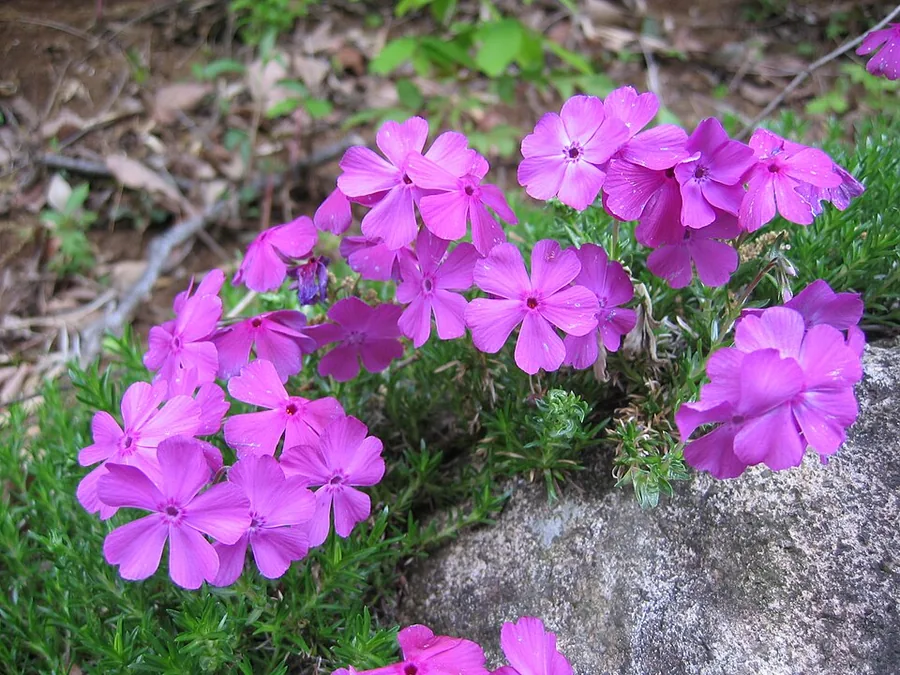
If you have ever wanted a groundcover that makes spring feel effortless, creeping phlox is a kind place to start. This low, mat-forming perennial spreads into a thick carpet of needle-like foliage and then vanishes beneath a blanket of bloom in early to mid spring. It happily takes the dry, rocky ground of slopes, walls, and rock gardens where fussier plants give up.
The good news is that it pulls its weight long after the flowers pass. Its evergreen mat stays put through baking summers and harsh winters, holding firm against cold as deep as -40°F (-40°C). Once it has found its feet, it asks for almost nothing beyond sunshine and soil that drains.
Try not to muddle it with garden phlox, the tall summer cousin that borrows the same name. Creeping phlox stays ankle high and creeps outward instead of climbing, and that gentle, sprawling habit is just what makes it such a forgiving filler between stones and along the front of a bed.
Care
The short version: give it full sun and sharp-draining sandy or gravelly soil, and once it has settled in, water only through long dry spells. After the flowers fade, shear it back by half to keep the mat full, and you will do just fine.
Light
Creeping phlox blooms its best in full sun, and it will accept partial shade, though the flowers grow sparser the more shade it gets. Give it an open, sunny corner and it will cover itself in color for you.
Water
Once it has settled in, the plant is drought tolerant and only wants water through long dry spells. It likes fast-draining ground and even copes with dry, rocky spots, so simply let the top half of the soil dry out between waterings.
Soil
Set it into sandy or gravelly, humus-rich soil that drains freely, since soggy feet are the one thing it cannot abide. A pH from 5.5 to 7.0 keeps it content, and a slope or raised bed gives the water somewhere to go.
Temperature
This is a wonderfully tough, cold-hardy plant that handles everything from -40°F to 95°F (-40°C to 35°C). It needs no winter coddling anywhere in its range and returns faithfully each spring.
Humidity
Plain outdoor air suits it fine, so there is no humidity level to fuss over. Good drainage and airflow count for far more, because damp, still conditions are what invite leaf trouble.
Feeding
It thrives on lean ground and barely asks to be fed. A light feed of balanced general-purpose fertilizer in spring is plenty, and going heavier only pushes soft, floppy stems.
Pruning
As soon as the flowers fade, cut the stems back by about half. That single shearing keeps the mat dense and compact, stops the center from turning woody and bare, and leaves the whole planting looking neat.
Size & spacing
The mat stays low, only 4 to 6 inches (10 to 15 cm) tall, while each plant reaches 24 to 35 inches (60 to 90 cm) across. Give it that elbow room and it will weave itself into a solid, even carpet.
When to plant
Creeping phlox is grown for its spring display, so the year really comes down to planting it and giving it one tidy-up at the right time. Set new plants out in spring or early fall, soak up the bloom from April into May, and shear the mat back once the flowers have finished.
Northern hemisphere
Southern hemisphere
Typical months for a temperate climate: start earlier in warm zones, later where spring frosts linger.
- Sow: Usually propagated vegetatively rather than from seed; not typically sown indoors.
- Plant: Plant in spring or early fall in a sunny, well-drained site.
- Harvest: Blooms in early to mid spring, roughly April to May.
Hardiness
USDA hardiness zones: 3–9
Temperature: down to -40°C
Troubleshooting
Most years creeping phlox stays easygoing, and the few hiccups that do appear show up on the leaves or as a thinning mat. Get to know the handful of signs below and you can lend a hand early. Find the one that matches, then act while it still does some good.
Pale, dotted foliage under wispy little webs
If the foliage looks pale and speckled with faint webbing beneath it, spider mites have likely moved in during a hot, dry stretch, and they pull the color from the leaves. Don't worry, this is an easy fix. Rinse the plants with a firm spray of water, keep them from drying out, and reach for insecticidal soap or horticultural oil only if the mites refuse to leave.
Fix:
- Spray foliage with a strong jet of water to dislodge mites
- Improve airflow and avoid drought stress
- Treat with insecticidal soap or horticultural oil if needed
Warped, patchy foliage after weeks of rain
Long runs of warm, soggy weather can let foliar nematodes slip into the leaves and twist them out of shape, but the plant recovers well once you step in. Snip away and bin any damaged foliage as soon as you notice it. Water at the base, give the planting room to breathe, and the trouble tends to settle down on its own.
Fix:
- Remove and destroy affected foliage
- Avoid overhead watering and improve drainage
Stems nibbled short close to the soil
Neat, clean cuts on the stems low to the ground are a sure sign that rabbits have been grazing your mat, and that is nothing to feel discouraged about. A low fence or a simple repellent settles the matter. New plantings tempt them most, so start by protecting those wherever rabbits are common.
Fix:
- Use fencing or repellents to deter rabbits
The mat's center slowly thinning to bare wood
When the middle turns woody and hollow while the edges keep spreading, the plant is simply asking for a haircut it has missed. Shear the stems back by roughly half just after the flowers fade, and fresh, full growth follows. If you like, lift a few of the strong outer pieces and tuck them into the gap to fill it back in.
Fix:
- Shear stems back by about half after bloom to promote dense regrowth
- Divide and replant vigorous outer sections
Toxicity
Here is some welcome reassurance for pet owners and anyone with grazing animals: creeping phlox is safe across the board. The ASPCA lists moss phlox as non-toxic to cats, dogs, and horses, and it poses no risk to other animals or to people. Plant it wherever you like with an easy mind.
Safe for
People · Cats · Dogs · Horses · Rabbits · Livestock · Birds
Cats Safe
You can relax around curious cats, because the ASPCA lists moss phlox as non-toxic to them, and a stray nibble will not cause any harm.
Dogs Safe
A dog is welcome to sniff and chew at the mat, since this plant holds nothing that would upset them.
Horses Safe
Horses grazing alongside a planting are perfectly fine, as creeping phlox carries no poison for them.
Rabbits Safe
Rabbits love to browse the foliage, and although they will trim it down, they come to no harm doing so.
Livestock Safe
Cattle, goats, and sheep can graze nearby with no worry, because nothing in the plant is toxic to farm animals.
Birds Safe
Birds pecking at the flowers or seeds will be just fine, as this plant poses no danger to them.
People Safe
People are in no danger from it either, though it is grown for its beauty rather than for the table.
Varieties
There are many named cultivars to choose from, told apart mostly by flower color and how well they fend off disease. A few of them are well worth getting to know.
Emerald Blue
A much-loved choice whose bluish purple flowers gather thickly over a low, even mat.
Fort Hill
A reassuring pick that holds up against Phytophthora, the root and stem rot that brings down frailer plants.
White Delight
A crisp white-flowered cultivar that also brushes off southern blight with ease.
How to propagate
Making more creeping phlox is wonderfully simple, whether you split a tired old mat or coax a few cuttings from a plant you already love.
DivisionEasy
Divide in early spring or after flowering. · One growing season
The friendliest way to grow your stock is to dig up and split a settled mat in early spring or once the blooms fade. Ease the healthy outer pieces away from the worn-out middle and set them into well-drained soil, where they take hold comfortably over a single growing season.
Stem cuttingsEasy
Take cuttings in late spring or early summer. · Several weeks to root
Rooting a few stem cuttings in late spring or early summer works just as well. Settle them into moist, well-drained media and let them be, and in a few weeks they root happily, each one a faithful copy of the plant it came from.
Myths
Garden phlox and creeping phlox are simply one plant sold under two names.
It is easy to mix them up, but they have little in common beyond the name. Creeping phlox keeps low and forms a mat that blooms in spring, while garden phlox stands tall and upright and flowers through summer. They are two different species with their own habits, so a quick glance at the label before buying saves any confusion.
Pets can be harmed if they chew on creeping phlox.
There is no need to fret over this one. The ASPCA lists moss phlox as non-toxic to dogs, cats, and horses, so a pet that takes a bite of the leaves stays perfectly safe. That means you can plant it freely wherever your animals like to wander.