Bulb · Araceae
Caladium
Caladium bicolor
Give it warm soil, soft dappled shade, and steady moisture, and your caladium thanks you with heart-shaped leaves brushed in red, pink, and white.
Partial shade
Every 2–4 days
61–86°F · 16–30°C
60–90 days
Overview
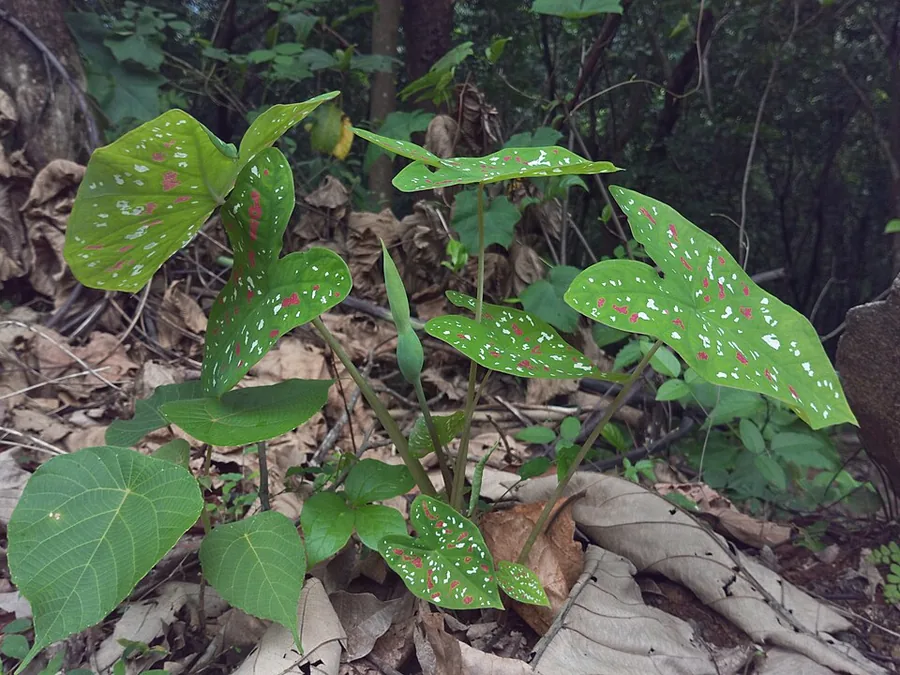
What makes a caladium such a friendly choice is that you grow it purely for its leaves. Every tuber pushes up big, paper-thin, heart-shaped foliage marbled in red, pink, white, and green, and one plant can light up a shady corner where little else holds any color. It sits within the arum family beside philodendrons and peace lilies, and like them it leans toward warmth and moist air.
Picture a tropical tuber that runs entirely on warmth. It wakes, grows in a hurry, hits full size within one season, and then quietly settles into rest as the weather cools, which is exactly what it should do and no cause for concern. Set it in a shaded bed, a patio container, or indoors as a houseplant, and in every case it only wants warm soil and air around 16°C or warmer before it stirs.
Color is the whole point of growing it, and shade is what protects that color. Strong sun bleaches the bright markings toward dull green and singes the tender leaves, while gentle dappled light keeps them glowing. Once the warmth has arrived a caladium is easygoing about nearly everything; it is firm on this single point only, and getting it right turns out to be very forgiving.
Care
The short version: offer partial to dappled shade, soil kept warm so the tubers never chill, and even moisture all through the growing season. Feed lightly, keep the air on the humid side, and gradually pull back the water once the leaves yellow toward their rest.
Light
Partial to dappled shade hits the sweet spot, with maybe 2 to 4 hours of mild sun and a rest from the fierce afternoon. Too much direct sun pales the bright markings to green and sears the thin leaves, while softer, deeper shade holds the color at its best, so when you are unsure, choose the shadier side.
Water
While it is in growth your caladium is thirsty, so keep the soil evenly moist to the touch and never waterlogged, since soggy ground is what rots the tubers. Watering every 2 to 4 days suits most plants well, and you simply taper off as the leaves start yellowing into dormancy.
Soil
Plant it into fertile, well-drained soil generous with organic matter, the kind that stays moist yet never turns to mud. A mildly acidic pH of 5.5 to 6.0 keeps it content, and that free drainage is your strongest protection against tuber rot.
Temperature
Warmth runs the whole show. Caladiums are happy between 61°F and 86°F (16°C to 30°C) and will only sulk or stall when it turns cool, so letting the soil warm before the tubers go outside sets you up nicely.
Humidity
As tropical plants, they thrive in humidity of 60% or more. Dry indoor air can leave the leaf edges crisp and brown, but that is an easy fix: group a few plants close, stand them on a pebble tray, or run a humidifier in a dry room.
Feeding
Feed every two weeks through the growing season using a balanced liquid fertilizer, or pick a slow-release low-phosphorus formula instead. Keep the dose modest, since overfeeding will wash those reds and whites back toward plain green.
Pruning
Pruning could hardly be lighter. Snip off any yellowing or damaged leaves at the base, and if you take out the central bud on a tuber before planting, it will reward you with more shoots and leaves.
Repotting
Instead of potting up, caladiums are just replanted each year from stored tubers. Leave settled clumps alone, lifting and dividing only when the tubers crowd and push up to the surface or the leaves shrink as the season runs on.
Size & spacing
A caladium grows 12 to 30 inches (30 to 76 cm) tall with a spread to match. Set the tubers 8 to 12 inches apart so the broad leaves have room to fill in without jostling each other.
When to plant
A caladium reads the warmth, not the calendar, so let the soil be your guide rather than the date. Start tubers indoors a few weeks before the last frost for an early lead, and shift them outside only once the ground has truly warmed in late spring. They fill out across summer and ease back gently as it cools.
Northern hemisphere
Southern hemisphere
Typical months for a temperate climate: start earlier in warm zones, later where spring frosts linger.
- Sow: Start tubers indoors 4-6 weeks before the last frost in a warm spot, keeping the medium about 70 degrees F, to get a head start in cold-winter regions
- Plant: After all danger of frost has passed and soil reaches at least 60-70 degrees F (late spring to early summer)
- Harvest: Grown for foliage, which reaches full size in one season; insignificant arum-type spathe flowers may appear in summer
Hardiness
USDA hardiness zones: 9–10
Temperature: down to -7°C
Troubleshooting
Caladium hiccups nearly always fall into one of two groups: tubers slow to wake in chilly soil, and leaves that lose their color or collect a few nibbles. The reassuring part is that the early clues are easy to spot and most of it is simple to prevent. Find your match below and you will have plenty of season left to put things right.
A tuber that softens underground instead of pushing up a shoot
Take a breath, because this rarely means you did anything wrong. Tubers that stall or go mushy are almost always sitting in soil that is both too cool and too wet. Give them ground that holds at 60°F to 70°F (16°C to 21°C), open up the drainage so it stays lightly damp without puddling, and quietly remove any tuber that feels soft to the squeeze. Choosing clean, healthy stock from the outset is your simplest defense against fungal tuber rot taking hold.
Fix:
- Wait to plant until soil is consistently 60-70 degrees F
- Improve drainage and reduce watering so soil is moist but not saturated
- Discard soft or rotted tubers and start with disease-free stock
Once-colorful leaves drifting back toward ordinary green
This is one of the kindest problems to fix, so set any worry aside. When the red, pink, and white markings begin to wash out, the plant is almost always taking in too much direct sun or a little too much fertilizer. Give it partial or dappled shade with shelter from the strong afternoon light, and feed only sparingly, perhaps once or twice all season. The deeper the shade, the richer the color stays, so erring toward a shadier spot is rarely a mistake.
Fix:
- Move to partial or dappled shade with protection from hot afternoon sun
- Reduce fertilizer to a light application once or twice in the season
Chewed gaps and frayed edges showing up across the foliage
Holes and ragged margins usually trace back to slugs and snails, quiet night feeders that give themselves away with shiny slime trails come morning. Go out after dark to lift them off by hand, or set a bit of bait, and clear away the cool damp corners where they shelter through the day. Should the leaves look torn instead of eaten, the brittle foliage has probably been knocked about by wind or hail, and moving it somewhere more sheltered will keep it safe.
Fix:
- Hand-pick slugs and snails or use baits per label
- Site out of strong wind to protect brittle leaves
Toxicity
Every part of a caladium is toxic, with no exception, so this is the one area to hold a firm line. Leaves, stems, and tubers are loaded with insoluble calcium oxalate crystals that act like tiny needles, and a single bite triggers sharp burning, drooling, and swelling of the mouth and throat. Nothing here can be eaten, so keep the plant and any stored tubers safely beyond the reach of pets, livestock, and children.
Toxic to
Cats · Dogs · Horses · Rabbits · Livestock · Birds · People
Cats Toxic
A cat that takes a bite feels the burn right away and starts pawing at its face and drooling freely. Soon the lips, tongue, and throat begin to swell, and vomiting or struggling to swallow tends to follow.
Dogs Toxic
Chewing any piece gives a dog a sudden bite of pain in the mouth, with lots of drool and a tongue that puffs up. Most quit fast, yet queasiness and a passed-over food bowl can stick around for a day.
Horses Toxic
The crystals set a horse's mouth and lips aching the moment they touch, with pain, drooling, and hard swallowing. A horse cannot be sick, so that soreness stays put wherever the plant was bitten.
Rabbits Toxic
Rabbits run into the same needle-like crystals, which sting the mouth and gut and turn them off eating. Place the plant and any stored tubers somewhere a rabbit simply has no way to reach.
Livestock Toxic
Goats, sheep, and cattle that taste the foliage are left with a sore mouth and gut. The sting arrives so quickly that most drop it at once, but keeping these plants well away from pasture is the safe call.
Birds Toxic
Those oxalate raphides irritate a bird's mouth and crop in just the same way they trouble mammals, so a pet bird should never be left near the leaves or sap.
People Caution
There is no edible part to this plant at all. One bite sets the lips and mouth burning, with drooling and swelling, and the sap may leave skin itchy, so wash your hands afterward and keep it out of children's reach.
Keep plants and stored tubers out of reach of pets and children; wash hands after handling sap.
Helpline numbers

United States
ASPCA Animal Poison Control: (888) 426-4435 (fee applies)
Poison Control: (800) 222-1222



Canada
Poison Centres: 1-844-764-7669
Varieties
There are hundreds of named caladiums, sorted mostly by leaf shape. Just a few are the ones really worth meeting first.
Candidum
A timeless fancy-leaved pick, loved for its almost-white leaves threaded through with strong green veins.
Pink Cloud
A fancy-leaved cultivar named in the NC State listing, soft and pretty with its pink-blushed foliage.
Lance-leaved (strap-leaved) types
Narrower plants that mostly stay below 12 inches tall, and they cope with a touch more sun than the fancy-leaved kinds.
How to propagate
Caladiums increase through their tubers, and you have two gentle routes: cut a single tuber into sections, or separate the offsets a clump produces on its own.
DivisionEasy
Late winter to early spring before planting, while tubers are dormant · 4-6 weeks to sprout in warm soil; full size in one season
There is nothing to be nervous about here. While the tubers are resting in late winter or early spring, take a large one and cut it into sections, leaving each section with at least one eye. Set the cut faces aside to dry and callus, then tuck each piece in eye-side up about 2 inches deep. Given warm soil they break ground in 4 to 6 weeks and grow to full size in that one season.
Offsets & pupsEasy
At lifting in autumn or replanting in spring · One growing season to reach mature size
Helpfully, caladiums raise their own daughter tubers clustered around the parent. Lift the clump in autumn, or when you replant in spring, gently break the offsets loose, and pot or plant each one separately, where a single growing season carries it to mature size.
Myths
Caladiums must sit in full sun before their bright leaf colors will show.
It is gladly the other way around. Color comes through deepest in partial or dappled light, whereas too much direct sun fades the reds, pinks, and whites toward green and burns the soft leaves.
Caladium tubers can go into the ground in early spring like any hardy bulb.
Being tropical, they only rot or sit and sulk in cool ground. Wait until the soil reaches at least 60°F to 70°F (16°C to 21°C) before they go in, and that usually means late spring rather than the first warm afternoon.