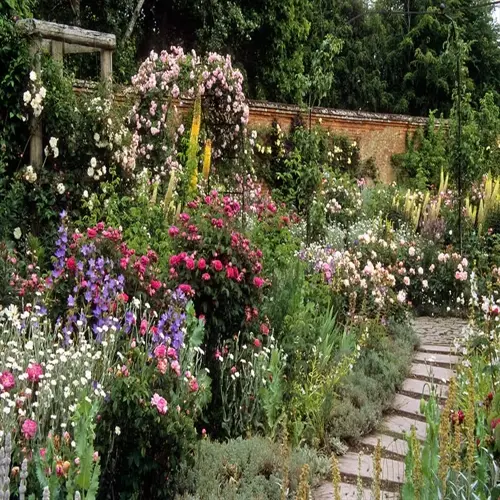
Witch-hazel, forsythia, flowering quince and Korean spice viburnum open first. Then come flowering almond, shadblow serviceberry, lilac, black chokeberry, mock orange and Siberian peashrub. Purdue Extension lists those ten spring flowering bushes in the order their flowers open, so the group works as a calendar as much as a plant list. The first one flowers while the ground is still cold and bare, and the last of them holds on into June.
Yellow fills the kitchen window over the sink every midspring. Wash a dish, look up, and the fence line is lit end to end. That is border forsythia, planted by whoever owned the house before me. I checked it against the calendar one year. Two weeks, near enough, from the first open bud to yellow petals on the grass.
Witch-hazel and forsythia are the early blooming shrubs of the ten. The Arnold Promise witch-hazel can flower from late winter right through spring, which is why you notice it while every other branch is still bare. Forsythia is the traditional first-flowering plant of spring and opens just behind it. Everything else falls into line through April, May and early June.
Here are the spring flowering shrubs from that list with the timing and the flower detail for each one. Read the middle column first, because bloom order tells you whether two plants will overlap or hand off to each other.
Three of the ten sit outside that table. Quince comes third in the order, right after forsythia, and flowering almond follows the Korean spice viburnum. Siberian peashrub sits last of the ten, at the tail of the run.
Size and habit matter as much as bloom date once you start placing these spring flowering bushes. Black chokeberry stays under 5 feet (1.5 m) tall, so it fits a front border where lilac and mock orange would swallow the space. Shadblow serviceberry suckers and chokeberry can colonize, and both will widen into a thicket if you let them. Give each one room, or plan on cutting runners back every year.
Most of these flower for about two weeks and then go green, which is the number people miss when they buy just one. Pick a pair that open at different points in the order, then add a shrub that flowers in July, and the same bed carries color from late winter to midsummer. Korean spice viburnum and mock orange make an easy match because both are fragrant and they miss each other by a month.
One caution on how this group gets described. You will see the whole list called native, and that is not accurate. Siberian peashrub comes from Central Asia. Forsythia and Korean spice viburnum are not native either, so read the label before you plant one where native status matters to you.
Plant forsythia, Korean spice viburnum and mock orange together. Those three cover the run from early spring into June, and mock orange is low maintenance once it settles in.
Of all the shrubs that bloom in spring on this list, those are the ones that ask the least and flower the longest. Add serviceberry if you want fruit, since its sweet black berries ripen in summer once the flowers are gone. Then watch the order play out in your own yard, because these spring flowering bushes shift by a week or two depending on how the winter ran.
Read the full article: 10 Flowering Bushes and How to Pick One